
What drives CCUS systems cost at large industrial facilities?




CCUS systems cost is rarely determined by the capture unit alone. At a large industrial facility, the largest budget surprises usually come from the work needed to make the existing plant compatible with capture, move the CO2 to a permitted destination, and operate the system without creating an unacceptable energy or production penalty.
A useful starting point is to treat CCUS as a connected infrastructure project rather than a single equipment purchase. The capture plant, flue-gas treatment, steam and power supply, CO2 compression, pipelines or shipping, injection access, monitoring, and contractual liabilities must work as one chain. A lower-priced capture package can become the more expensive choice when it needs extensive site modifications, depends on costly utilities, or lacks a practical storage route.
The most reliable cost comparison is therefore based on lifecycle cost per tonne of CO2 permanently managed, not on the quoted price of the capture equipment or its nameplate capture capacity.
Capture chemistry and flue-gas quality set the starting point
The source stream has a direct effect on both capital expenditure and operating expenditure. CO2 from a concentrated process stream is generally easier to separate than CO2 diluted in a large volume of exhaust gas. Concentration matters, but it is not the only variable. Pressure, temperature, flow consistency, oxygen content, moisture, particulates, sulfur compounds, nitrogen oxides, and trace contaminants all influence the required process design.
A facility with variable operations may need larger equipment, buffer capacity, more sophisticated controls, or a capture process that can tolerate changing gas composition. A plant that operates steadily can often make better use of fixed equipment and utility infrastructure. This difference is material when evaluating industrial sites that appear similar on paper but have different operating profiles.
Flue-gas conditioning is often underestimated during early budgeting. Particulate removal, cooling, contaminant control, and other upstream treatment may be required to protect solvent systems, membranes, compressors, and downstream equipment. If the existing emissions-control train is old, undersized, or difficult to modify, the integration package can become a major share of the project scope.
The energy penalty is often the decisive operating cost
Most capture technologies require substantial energy in one form or another. Solvent-based systems commonly need heat to regenerate the solvent; compression needs electricity; pumps, fans, drying systems, and cooling equipment add further demand. The question is not simply how much energy the system consumes, but where that energy will come from and what it displaces.
Using spare low-value heat may improve the project case, but only if that heat is genuinely available at the right temperature and during the periods when capture is required. Diverting steam from a turbine, process heater, or export service can create lost production or lost power revenue. Building new steam generation or electric heating may reduce operational conflicts, yet it adds capital cost and can alter the emissions profile of the facility.
Electricity exposure also deserves close attention. CO2 compression is not a minor utility load at large scale. The cost effect depends on the facility’s power arrangement, local grid constraints, operational hours, and whether the capture plant must run continuously. Projects that assume a stable low-cost energy supply without testing these conditions can produce a misleading operating-cost estimate.
Utility integration is more than connecting pipes and cables
Existing industrial sites were built around their original production process, not around carbon capture. Space may be limited. Pipe racks may be congested. Cooling-water systems may lack capacity. Electrical substations may need reinforcement. The capture island may require a new steam header, cooling tower, water-treatment equipment, or backup power arrangement.
These works are site-specific and cannot be reliably inferred from a generic cost benchmark. A quote that excludes battery limits, utility tie-ins, civil works, or shutdown execution is not necessarily incomplete, but it should not be compared directly with a more fully integrated offer.
Before selecting a technology provider, establish a clear scope boundary: what is supplied inside the capture package, what remains with the site owner, and what must be delivered by other contractors. Many cost overruns arise because these ownership boundaries are not defined early enough.
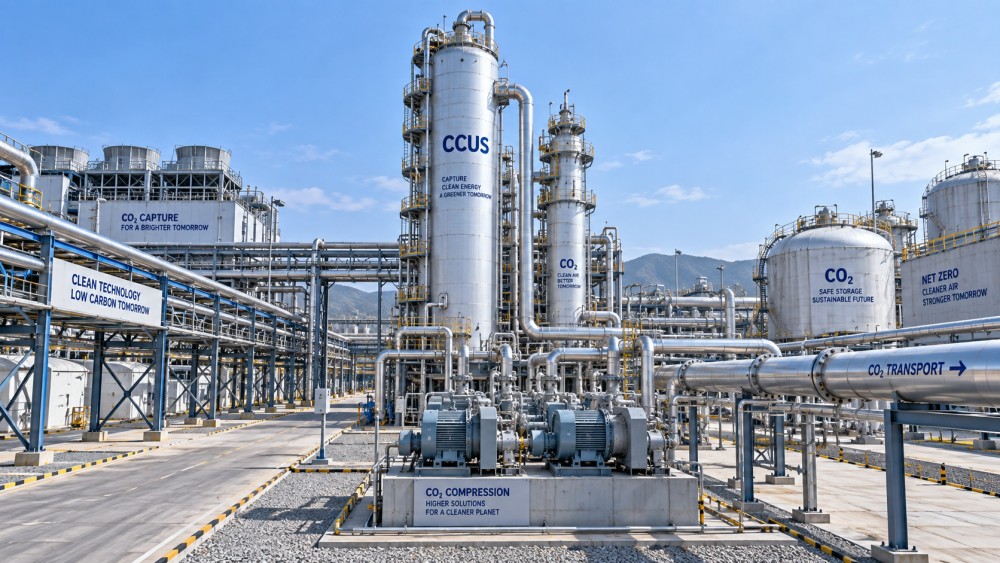
Compression, dehydration, and CO2 specification affect the whole chain
Captured CO2 must be conditioned for its transport and storage pathway. That normally means removing water and impurities, then compressing the stream to the pressure required by the chosen transport system. The required specification depends on whether the CO2 is sent by pipeline, ship, or another route, and on the requirements of the receiving storage operator or utilization facility.
This is where a seemingly local decision becomes a network decision. A capture plant designed for one transport specification may need changes if the storage route changes later. A project that expects to join a shared network should avoid designing solely around the current minimum requirement, especially where future blending of streams from multiple emitters is likely.
Compression trains also introduce reliability considerations. Large rotating equipment requires maintenance planning, suitable redundancy, vibration control, electrical integration, and safe depressurization arrangements. Selecting the lowest initial-cost compressor configuration can create availability problems if the production site cannot tolerate repeated capture outages or if CO2 delivery commitments include penalties.
Transport and storage access can outweigh the capture-plant price
There is no complete CCUS project without a credible destination for the CO2. Transport distance, route complexity, shared infrastructure availability, terminal access, injection capacity, and storage operator terms can change the economics more than modest differences between capture technologies.
A short pipeline route is not automatically low cost. Crossings, land access, permitting, terrain, third-party interfaces, material requirements, and the need for intermediate compression can materially alter the installed cost. Shipping can offer flexibility where pipeline access is unavailable, but it adds liquefaction, storage tanks, loading facilities, scheduling dependencies, and port interfaces. The right choice depends on throughput, distance, continuity requirements, and the maturity of the downstream network.
Storage arrangements require equally careful scrutiny. The commercial model may allocate responsibility for transport, injection, monitoring, remediation, and long-term stewardship among different parties. These obligations shape both the recurring cost and the risk retained by the project sponsor. A low transport tariff has limited value if access is interruptible, injection capacity is uncertain, or liability allocation is poorly defined.
Scale helps, but scale alone does not make a project economical
Larger systems can spread development, engineering, and shared infrastructure costs across more captured tonnes. However, scale can also expose bottlenecks that do not appear in a smaller project. A large installation may need grid reinforcement, new utility systems, a dedicated transport connection, expanded land use, or a more complex shutdown strategy.
Modular designs can reduce construction risk and shorten site work in some settings. They are less attractive when modules must be heavily customized for difficult site access, unusual flue gas, or constrained tie-in windows. The procurement question is not whether modular or bespoke design is universally cheaper. It is which approach reduces uncertainty at the specific facility.
Phased deployment can be sensible when storage access, utility capacity, or operating data remain uncertain. It can also cost more per tonne if each phase repeats engineering, construction mobilization, or connection work. A phased plan should preserve the physical space, utility corridors, and contractual rights needed for expansion; otherwise, the later phase may become a separate project with a separate cost base.
Construction risk is concentrated at the operating site
New-build projects allow greater control over layout and utility design. Retrofit projects must coexist with production, maintenance schedules, existing safety systems, and physical constraints. The capture plant may be technically proven while the installation remains difficult because work must be carried out near live process units.
Shutdown duration is a cost driver that is often handled too late. Tie-ins to flue-gas ducts, steam systems, electrical infrastructure, or process controls may require planned outages. If the required window is unavailable, temporary works or alternative connection methods may be needed. The resulting expense can be substantial, particularly when production interruption is more valuable than the construction activity itself.
Contracting strategy matters here. A single point of responsibility can simplify interfaces, but it may include a risk premium. Multiple packages can offer more pricing transparency, but the owner then carries more coordination risk among the capture technology provider, engineering contractor, utilities contractor, transport provider, and storage counterparty. The suitable approach depends on internal project-delivery capability and the maturity of each interface.
Do not treat operating reliability as a technical afterthought
CCUS economics depend on tonnes actually captured and delivered, not theoretical capacity. Solvent degradation, fouling, corrosion, rotating-equipment outages, utility interruptions, and downstream transport constraints can reduce effective capture performance. Maintenance access, spare-parts strategy, emissions-control integration, and process-control design all affect long-term cost.
A credible evaluation should separate three figures: installed capacity, expected availability, and expected annual captured volume. They are not interchangeable. A proposal with a lower capital cost may still be weaker if it requires frequent maintenance, has limited turndown capability, or cannot respond well to changes in plant throughput.
Service agreements should be assessed beyond their headline annual fee. Review what they cover, how performance is measured, whether critical equipment is included, and how responsibility is handled when the capture plant is available but transport or storage is not. The interfaces are often more consequential than the service scope for the capture unit itself.
Permitting, monitoring, and liability belong in the base case
Environmental approvals, safety studies, emissions accounting, pipeline or terminal permissions, storage monitoring, and reporting requirements consume time and capital. They should be included in the investment case from the first estimate rather than treated as a contingency category.
Long-term monitoring is especially important because permanent storage is not equivalent to a one-time disposal transaction. Project economics depend on how monitoring duties, corrective actions, financial security, and post-injection responsibilities are allocated. These terms vary by location and project structure, but the decision principle is consistent: retained liability should be valued as part of the asset, not described only in legal schedules.
A practical approval sequence
Approval is stronger when the project is tested in the order that risk becomes irreversible. Starting with a capture technology shortlist before confirming storage access can lead to expensive redesign.
- Confirm the CO2 source basis. Use representative data across normal operation, low-load periods, start-ups, and expected production changes.
- Secure the downstream pathway. Define transport mode, delivery specification, storage access, capacity rights, and interruption responsibilities.
- Map site utilities and physical constraints. Identify the real cost of steam, power, cooling, water, plot space, and tie-in windows.
- Compare lifecycle cases on a common boundary. Include capture, conditioning, compression, transport, storage, monitoring, maintenance, energy, and retained liabilities.
- Stress-test the commercial model. Test lower utilization, higher energy cost, construction delay, capture underperformance, and downstream unavailability.
This sequence does not eliminate uncertainty, but it prevents the most common mistake: approving an attractive capture-island estimate before the full CO2 chain has been priced and contracted.
Where benchmarking adds value
CCUS procurement requires comparison across process engineering, materials selection, pressure systems, transport infrastructure, and storage interfaces. A benchmark should distinguish between a technically compliant design and a design that is genuinely suitable for the facility’s gas stream, operating pattern, and downstream network.
Resources such as the Global Hydrogen-Economy & Zero-Carbon Infrastructure (G-HEI) can be useful when a project team needs to compare CCUS infrastructure choices alongside broader decarbonization assets, including hydrogen-ready power and industrial energy systems. The practical benefit is not a generic technology ranking. It is a clearer view of technical interfaces, material integrity, operating conditions, and infrastructure dependencies before they become procurement commitments.
The strongest CCUS investment cases are built from a complete chain of evidence: measured source conditions, a defensible utility plan, a deliverable construction scope, contracted CO2 handling, and explicit allocation of long-term obligations. When those elements are aligned, the cost discussion becomes less about finding the cheapest equipment and more about selecting the project structure that can continue operating as intended.
Related News
- What makes CCUS systems in the Middle East viable for cement plants?Oct 03, 2026CCUS systems Middle East are reshaping cement decarbonization. Discover how storage, energy, hubs, and policy can create a bankable low-carbon future.
- What drives CCUS systems cost at large industrial facilities?Sep 17, 2026CCUS systems cost depends on capture, energy, site integration, transport, storage, and reliability. Explore full-chain factors for smarter industrial investment decisions.
- What to compare when selecting CCUS systems suppliers for CO2 compressionSep 11, 2026CCUS systems suppliers: compare CO2 compression performance, efficiency, impurities, reliability, interfaces, and lifecycle value for a confident selection.
- Which factory carbon audit standards apply to CO2 compression projects?Sep 10, 2026Factory carbon audit standards for CO2 compression projects: compare ISO 14064, ISO 50001, verification rules, metering, and lifecycle reporting requirements.
Related News
- 00
0000-00
Hydrogen Energy Storage for Data Centers Gets Costly Fast - 00
0000-00
When 99.999% Hydrogen Purity Still Is Not Good Enough - 00
0000-00
When Does a Hydrogen-Ready Gas Turbine Pay Off? - 00
0000-00
Electricity Price Volatility Is Rewriting Hydrogen Cost Models - 00
0000-00
PSA Recovery Rate Drops for Reasons Operators Miss
Dr. Elena Carbon
Weekly Insights
Stay ahead with our curated technology reports delivered every Monday.