
Can modular carbon capture and storage scale with phased expansion?




For enterprise leaders balancing decarbonization targets, capital discipline, and operational resilience, modular carbon capture and storage can scale effectively through phased expansion.
The approach is not automatically lower risk, however. Its success depends on designing early modules, transport links, storage permits, and commercial contracts for the intended end-state.
When those foundations are aligned, modular carbon capture and storage lets companies invest against verified emissions volumes, regulatory milestones, customer demand, and infrastructure readiness.
When they are not aligned, organizations may create isolated capture units that cannot access transport capacity, qualify for incentives, or connect economically to permanent storage.
The executive question is therefore not whether modularity is technically possible. It is whether a phased program preserves asset economics, storage integrity, safety performance, and expansion options.
The Executive Answer: Yes, but Only With an End-State Plan
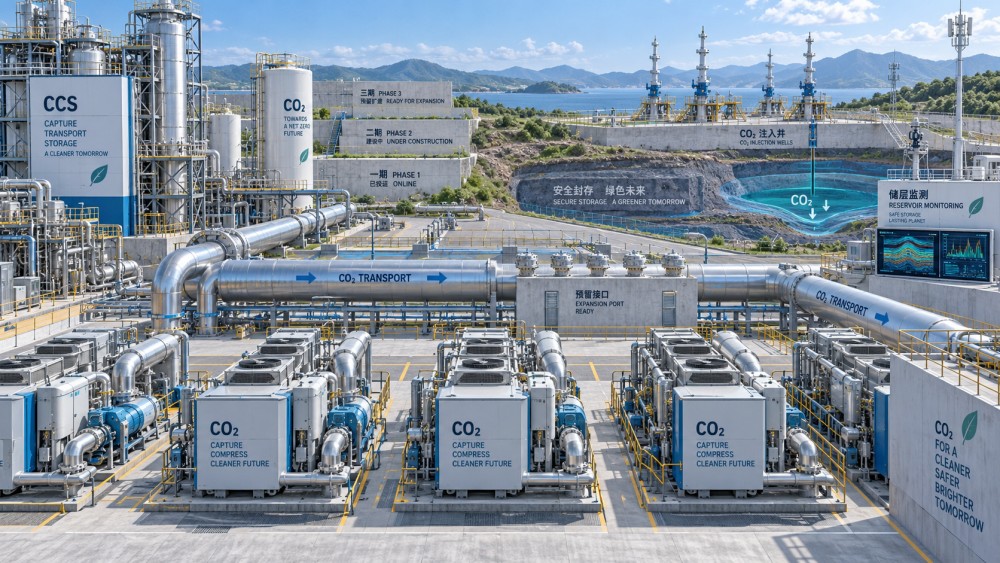
Modular carbon capture and storage can scale through phased expansion when each initial investment is treated as part of a defined network architecture.
A smaller first phase can reduce upfront capital exposure, generate operating data, establish permitting experience, and improve confidence before larger capacity commitments are authorized.
Yet capture modules alone do not create a scalable CCUS system. Transport, injection capacity, monitoring systems, liability arrangements, and regulatory approvals must scale alongside capture.
Executives should distinguish between modular equipment deployment and genuinely modular infrastructure development. The former concerns skid-mounted assets; the latter requires coordinated commercial and geological planning.
The strongest projects use a staged investment model while reserving corridors, pressure capacity, wells, land rights, utility connections, and data systems for future phases.
This approach makes phased expansion a strategic option rather than a temporary compromise, allowing management to expand only when emissions, policy support, and market economics justify it.
What “Modular” Means Across the Carbon Capture and Storage Value Chain
In capture operations, modularity usually means standardized trains that can be replicated across flue-gas sources, industrial units, power blocks, or hydrogen production facilities.
These trains may include pretreatment, solvent regeneration, compression, dehydration, utilities, controls, and measurement equipment configured around a repeatable capacity range.
Transport modularity is more constrained. A shared pipeline must be sized for throughput, pressure management, impurity specifications, and future connection points from the beginning.
For early volumes, truck, rail, or ship transport may bridge a gap. These options can support demonstration projects but rarely provide the economics required for major expansion.
Storage modularity means progressively developing injection wells, compression capacity, monitoring arrays, and reservoir models within a storage complex that has proven additional capacity.
Because storage permits and characterization take time, the reservoir should not be treated as a downstream detail. It is the capacity anchor for every capture phase.
Where Phased Expansion Creates the Most Business Value
Phased development is especially valuable where emissions volumes are uncertain, industrial facilities are being upgraded gradually, or several emitters may join a regional network over time.
Refineries, cement plants, steel facilities, waste-to-energy sites, chemical complexes, and blue hydrogen projects often fit this profile because their operating conditions change over decades.
It is also useful where carbon pricing, tax credits, contracts for difference, or clean-product premiums are developing but not yet fully bankable for a final investment decision.
A first phase can establish measurement practices, demonstrate capture performance, and secure customer or regulator confidence without committing capital to maximum theoretical capacity immediately.
For multi-site enterprises, modular deployment can prioritize the highest-emitting or lowest-cost locations first, then apply standardized lessons to later sites across the portfolio.
However, projects with stable large emissions and nearby proven storage may favor a larger initial build. Excessive fragmentation can sacrifice scale economies and delay emissions reductions.
Design the First Phase for the Capacity You Intend to Reach
The most consequential decision occurs before construction. Teams must define a credible end-state capacity, even if management approves only the first operating module initially.
This does not require forecasting every future emissions source precisely. It requires identifying reasonable growth scenarios, capacity boundaries, physical constraints, and investment trigger points.
Capture equipment should allow future trains to connect without extensive shutdowns. Shared utilities, electrical substations, cooling systems, control platforms, and plot space need expansion allowances.
Compression systems deserve particular scrutiny because later stages may require different pressure ratios, redundancy levels, dehydration specifications, or pipeline entry conditions than the first phase.
Pipeline routing should protect future tie-in locations and avoid designs that leave later emitters dependent on costly rerouting, additional boosters, or incompatible operating windows.
Storage development should include appraisal sufficient to support the ultimate injection strategy, including plume behavior, pressure management, monitoring design, containment confidence, and well integrity requirements.
Use Clear Gates to Decide When Each Expansion Phase Proceeds
Phased expansion works best when investment gates are agreed before the first module starts operation. Otherwise, promising pilot results can become an excuse for indefinite delay.
Each gate should combine technical, commercial, regulatory, and operational evidence. Capture availability alone is insufficient if storage permits, transport access, or liability terms remain unresolved.
A practical first gate tests whether the initial module meets capture-rate, energy-use, emissions-quality, reliability, and safety targets under representative operating conditions.
A second gate can assess whether contracted carbon revenues, incentives, avoided compliance costs, and customer premiums support the next capacity increment under conservative assumptions.
A third gate should verify that transport and storage capacity remain available, including injection-well performance, monitoring results, pressure forecasts, and planned third-party demand.
Management should also define stop criteria. These may include persistent solvent degradation, unfavorable energy costs, delayed permits, insufficient storage injectivity, or declining policy support.
Economics: Smaller Initial Capital Does Not Always Mean Lower Cost
Modular projects reduce initial capital commitment, but smaller capture trains can have higher unit costs because engineering, utilities, compression, and monitoring are not fully shared.
Decision-makers should evaluate lifecycle economics rather than comparing only the first-phase capital budget against a conventional full-scale project estimate.
The relevant comparison includes expected cost per tonne captured, transported, injected, monitored, and permanently stored over the complete phased development schedule.
Early modules can also incur temporary costs for rented transport, underused pipelines, duplicated controls, or utility systems built ahead of immediate throughput requirements.
Those costs may be justified if early deployment protects market position, unlocks incentives, satisfies customer procurement requirements, or reduces exposure to future carbon liabilities.
A robust investment case therefore models base, accelerated, delayed, and constrained expansion scenarios, with explicit assumptions for carbon value, energy prices, utilization, and storage access.
Protect Storage Integrity as Volumes Increase
Permanent storage integrity cannot be modularized away. Every phase must remain consistent with reservoir pressure limits, caprock performance, well integrity standards, and approved monitoring plans.
As injection volumes rise, reservoir pressure and plume migration may change materially. Updated simulation models should inform well placement, injection scheduling, and pressure-management requirements.
Monitoring systems should be designed to accumulate comparable data across phases, rather than being replaced with disconnected tools whenever another capture module is added.
Measurement, reporting, and verification programs require particular discipline because carbon-credit eligibility, tax incentives, regulatory compliance, and stakeholder trust depend on defensible data.
Operators should assign clear responsibility for long-term storage stewardship, including post-injection monitoring, closure obligations, financial assurance, and potential transfer of liability.
For enterprise boards, proven storage governance is often more valuable than an aggressive capture-capacity forecast, because storage failure would undermine the entire decarbonization strategy.
Manage Integration Risks Between Capture, Transport, and Storage
The major risk in modular carbon capture and storage is not usually the individual technology. It is the interface between independently timed assets and commercial parties.
Capture plants need predictable transport nominations, while pipeline operators require consistent quality and volume. Storage operators need injection schedules that protect reservoir management objectives.
Carbon dioxide specifications should be established early, including water content, oxygen, sulfur compounds, nitrogen, hydrogen, and other impurities affecting corrosion, phase behavior, or storage performance.
Contracts should address curtailment, take-or-pay commitments, force majeure, quality excursions, measurement disputes, expansion rights, and responsibility for nonconforming carbon dioxide streams.
Digital operating models can improve coordination by combining capture availability, transport constraints, storage injection rates, emissions measurements, and maintenance planning in a common decision environment.
Where multiple emitters share infrastructure, neutral governance and transparent capacity-allocation rules become essential. Without them, later expansion can trigger disputes that slow decarbonization progress.
Build Governance Around Decisions, Not Just Technology
Enterprise leaders should establish a cross-functional CCUS governance structure involving operations, finance, legal, commercial, environmental teams, engineering, and corporate strategy.
The steering group should own expansion criteria, not merely receive project updates. This prevents technical optimization from drifting away from capital priorities and market conditions.
Key performance indicators should include capture rate, energy penalty, availability, cost per stored tonne, transport reliability, storage injectivity, verified emissions reductions, and safety performance.
Risk reporting should separate controllable plant performance from external dependencies such as permitting, third-party pipelines, government incentives, power prices, and storage operator obligations.
Boards also need a clear view of optionality. Reserved land, pipeline capacity, permits, utility connections, and storage rights may hold strategic value before producing immediate revenues.
That value should be quantified where possible, because it explains why selected upfront enabling investments can strengthen future economics despite raising early-phase capital requirements.
When Modular Carbon Capture and Storage Is the Wrong Choice
Phased expansion is not universally superior. It may be unsuitable where emissions are already large, storage is proven, financing is available, and delay carries significant compliance costs.
A full-scale project may also be preferable where major shared infrastructure must be built regardless of initial capture volume, leaving limited savings from a smaller first module.
Modularity can become expensive when equipment vendors use incompatible proprietary designs, site space is constrained, or future shutdowns would disrupt critical industrial production.
It is also weak where policy incentives require rapid minimum volumes, where storage access is uncertain, or where the first phase cannot achieve commercially representative operating conditions.
Before proceeding, executives should test whether a phased design genuinely reduces irreversible commitments or simply defers unavoidable costs while adding schedule and interface complexity.
The right answer depends on the relationship between emissions certainty, storage confidence, infrastructure scale, regulatory timing, customer expectations, and the organization’s tolerance for staged risk.
Conclusion: Scale Capacity in Steps, but Commit to System Discipline
Modular carbon capture and storage can provide a credible path to scale, particularly for enterprises facing uncertain demand, evolving regulation, and uneven industrial transition schedules.
Its advantage is not that it makes CCUS simple. Its advantage is that it allows capital commitments to follow evidence while preserving access to future capacity.
Successful programs begin with a complete end-state architecture, then approve discrete phases against transparent technical, commercial, regulatory, and storage-performance gates.
Organizations should prioritize storage certainty, transport integration, expansion rights, and lifecycle economics before selecting capture modules, because those factors determine whether later phases remain viable.
For decision-makers, the practical conclusion is clear: build in increments when uncertainty warrants it, but design every increment as part of one durable decarbonization system.
Related News
- INPEX Starts Blue Hydrogen and Ammonia Demonstration at Japan’s Kashiwazaki Hydrogen ParkOct 23, 2026INPEX begins blue hydrogen and ammonia demonstration supply at Japan’s Kashiwazaki Hydrogen Park. Explore what this milestone means for buyers, CCUS evidence and supply-chain readiness.
- CNPC Injects Over 13 Million Tonnes of CO2 to Advance CCUS CommercializationOct 22, 2026CNPC has injected over 13 million tonnes of CO2 into CCUS and EOR projects. Explore how planned cluster expansion could shape commercialization and supplier opportunities.
- How to size gear reducers for subsurface injection gate actuatorsOct 19, 2026Size gear reducers for subsurface injection gate actuators with confidence. Learn how to verify breakaway loads, torque, stroke time, and overload protection for reliable valve operation.
- SLB CCS Permitting: What Operators Need for a Class VI Well ApplicationOct 13, 2026Explore slb ccs permitting requirements for Class VI wells, from site characterization to monitoring and financial assurance. Build a stronger application with this guide.
Related News
- 00
0000-00
Hydrogen Energy Storage for Data Centers Gets Costly Fast - 00
0000-00
When 99.999% Hydrogen Purity Still Is Not Good Enough - 00
0000-00
When Does a Hydrogen-Ready Gas Turbine Pay Off? - 00
0000-00
Electricity Price Volatility Is Rewriting Hydrogen Cost Models - 00
0000-00
PSA Recovery Rate Drops for Reasons Operators Miss
Dr. Elena Carbon
Weekly Insights
Stay ahead with our curated technology reports delivered every Monday.