
What should CO2 well monitoring detect before injection begins?




Before CO2 injection begins, monitoring has a different purpose from routine operational surveillance. It is not yet trying to prove that injected CO2 remains contained. It is establishing the evidence needed to recognize a future deviation quickly, explain its likely cause, and demonstrate that the storage complex was suitable for injection at the start of operations.
That distinction matters. Once injection starts, pressure, temperature, fluid chemistry, and seismic response will change. A reading that appears unusual in isolation may be entirely consistent with planned reservoir behavior. Without a defensible pre-injection baseline, operators may struggle to distinguish normal plume development from a developing loss-of-containment issue, a faulty instrument, or an unrelated change in the surrounding formation.
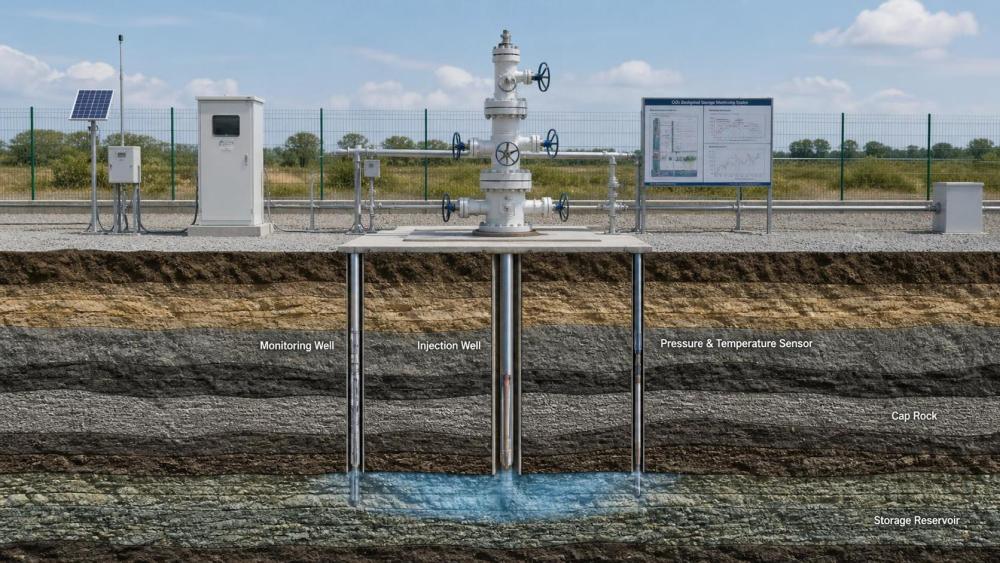
Effective CO2 well monitoring before injection therefore has to cover more than the injection well itself. It should examine the wellbore barriers, the target reservoir, the confining system, nearby groundwater zones, and every credible pathway through which pressure or CO2-affected fluids could migrate.
The baseline is the real starting point for containment assurance
A storage project is often described through its injection rate and total storage capacity. For operational integrity, however, the more important starting question is whether the site has a measurement baseline that can support later decisions.
A usable baseline must be representative rather than merely extensive. A large volume of pre-injection data is of limited value if it was collected over too short a period, without calibration records, or before seasonal groundwater and reservoir-pressure variation could be understood. Measurements should also be traceable to specific depths, perforated intervals, annular spaces, formations, and sampling locations.
The baseline should answer several practical questions:
- What are the natural pressure and temperature ranges in the storage reservoir and surrounding formations?
- What fluids are present before injection, and how variable are their chemical compositions?
- Are the casing, cement, tubing, packers, and wellhead capable of maintaining isolation at the intended operating envelope?
- Which old wells, faults, fractures, or shallow permeable intervals could provide migration pathways?
- What monitoring response would be expected if pressure communication or fluid migration occurred?
These questions should be resolved before the project defines its final alert thresholds. Setting thresholds without knowing the natural variability of the site is a common weakness. It can produce frequent false alarms, or worse, thresholds so broad that a meaningful early warning is missed.
Well integrity must be verified as a barrier system, not inferred from one test
For an injection well, the primary containment system is normally the combination of casing, cement, tubing, packer, wellhead equipment, and operational controls. Each component matters, but the system can fail even where an individual component appears acceptable.
Pre-injection integrity work should begin with a complete review of the well’s construction record: casing grades and connections, cementing reports, centralizer placement, pressure-test history, formation evaluation logs, workover records, and any evidence of lost circulation, poor returns, corrosion, sustained casing pressure, or remedial cementing. A documentation gap is itself a risk indicator; it should not be treated as a paperwork issue only.
Mechanical integrity testing should be selected according to well design and applicable regulation. In jurisdictions operating under the United States Underground Injection Control program, Class VI wells are subject to specific testing and monitoring requirements. Elsewhere, the regulatory pathway may differ, but the engineering objective remains similar: demonstrate that injected fluids cannot move through the tubing-casing annulus, casing defects, cement channels, or unintended formation pathways.
Typical pre-injection evidence can include pressure testing, annulus monitoring verification, casing inspection logs, cement evaluation logs, temperature or noise logs where appropriate, and wellhead valve testing. No single logging method can prove cement isolation under every geological and wellbore condition. Cement bond and ultrasonic tools, for example, provide different evidence and have different limitations in eccentric casing, lightweight cement systems, complex completion geometry, or poor borehole conditions.
The important decision is not whether a particular log has been run, but whether the combined evidence closes the integrity question for every critical interval. Particular attention is needed at the injection zone, above-zone monitoring interval, casing shoes, cement tops, known loss zones, and any formation containing protected groundwater.
Measure reservoir pressure before defining injection limits
Pressure is the central operating variable in geological CO2 storage. It determines injectivity, plume movement, stress changes, caprock loading, and the potential for pressure to communicate with other formations. A well can be mechanically sound while the storage complex is still unsuitable for the planned injection profile because pressure management has been inadequately characterized.
Before injection, the operator should establish static reservoir pressure and temperature at representative depths, preferably with sufficient observation time to separate transient drilling or completion effects from true formation conditions. Where the project design relies on pressure communication, pressure observations in monitoring wells may be as important as the injection-well reading itself.
Pressure data should be integrated with reservoir models, injectivity tests, formation permeability estimates, and fracture or fault assessments. The goal is to define an operating range that remains below conditions likely to compromise caprock integrity, reactivate critically stressed faults, or force brine into sensitive formations.
It is risky to treat fracture pressure as a single fixed number. The margin between planned injection pressure and damaging pressure depends on in-situ stress, rock properties, pore pressure, temperature, heterogeneity, well proximity, and uncertainty in the data. A robust pre-injection program states which uncertainties remain and how they will be managed operationally.
Characterize the CO2 stream and the fluids already in the system
“CO2” is not a complete fluid specification. The injected stream may contain water, oxygen, nitrogen, argon, hydrogen, carbon monoxide, sulfur compounds, or other constituents, depending on its capture source and conditioning process. Small concentrations can have a material effect on corrosion risk, phase behavior, transport conditions, and compatibility with elastomers and metals.
Before injection, monitoring plans should identify the expected CO2 stream specification, its permissible variability, sampling method, analytical method, and response to off-specification deliveries. This is especially important where CO2 is received through a shared transport network or from multiple industrial sources.
Baseline sampling should also characterize formation brine and any groundwater that could be affected by an unlikely migration event. Relevant parameters commonly include pH, alkalinity, conductivity, major ions, dissolved metals, dissolved gases, isotopic signatures where justified, and naturally occurring trace constituents. The exact analytical suite should be risk-based; sampling every possible analyte is not automatically better.
The practical purpose is attribution. If a shallow monitoring point later shows a chemical change, the project needs a basis for determining whether it is consistent with CO2-related mobilization, natural seasonal movement, agricultural influence, legacy industrial contamination, or sampling error.
Legacy wells are often the most difficult part of site assurance
In mature oil and gas regions, the highest uncertainty may not lie in the new injection well. It may lie in old production, exploration, disposal, or abandoned wells that penetrate the storage reservoir or cross the confining sequence.
A map of known wells is not enough. The pre-injection review should assess well location accuracy, total depth, completion history, plugging method, cement type where known, abandonment date, and the quality of available records. Older wells may have been constructed to standards that did not consider long-term exposure to dense-phase CO2, carbonic acid, elevated pressure, or decades of post-closure monitoring.
The correct response is not necessarily to test every historical well in the area. It is to rank them by migration consequence and probability. Wells close to the projected plume footprint, within the pressure-influence area, near faults, or with uncertain plugging records deserve a higher level of scrutiny. Some may require remediation, re-entry, pressure surveillance, or exclusion from the planned operating envelope.
Faults and fractures deserve the same disciplined approach. Their presence does not automatically disqualify a site. What matters is whether they are connected, transmissive under current conditions, likely to be affected by injection-induced pressure changes, and capable of linking the storage formation to shallower units.
Baseline monitoring must include the shallow environment
Subsurface containment monitoring is incomplete if it ends at the caprock. The monitoring area should reflect the site-specific risk assessment and include shallow groundwater, soil gas, atmospheric CO2 where relevant, and surface conditions around well pads and pipelines.
Shallow CO2 measurements require careful interpretation because CO2 is naturally variable. Soil respiration, weather, vegetation, microbial activity, and land use can change concentrations substantially. A single pre-injection soil-gas survey provides only a snapshot. Repeated measurements across different conditions provide a more defensible baseline.
Groundwater programs should consider seasonal water levels, pumping influences, sampling-point construction, purge procedures, sample preservation, and laboratory detection limits. A monitoring well with poor construction or inconsistent sampling practice can create misleading results that are difficult to distinguish from a genuine subsurface change.
Where the risk assessment identifies potential surface-release consequences, emergency detection and response arrangements should be tested before injection. This includes alarm logic, ventilation where enclosed spaces are present, access controls, communications, evacuation procedures, and coordination with local emergency services. CO2 is not flammable, but it can accumulate in low-lying or enclosed areas and displace oxygen.
Monitoring equipment needs its own quality assurance plan
Pre-injection monitoring often fails quietly through instrument and data-management weaknesses rather than obvious mechanical failures. A pressure gauge may drift. A downhole sensor may be installed at the wrong reference depth. A sampling chain may lose traceability. A time-series database may mix corrected and uncorrected values. These failures undermine later containment decisions.
Every critical measurement should have documented calibration status, accuracy, range, resolution, installation depth, time synchronization, maintenance interval, and data-validation rules. For continuous systems, the project should specify how missing data, communication loss, outliers, and sensor disagreement will be handled.
Independent verification is valuable for high-consequence parameters. For example, a permanent downhole pressure gauge can be checked against periodic wireline measurements or a calibrated surface reference. Chemical samples can include duplicates, blanks, and split samples. Where remote sensing or seismic methods are used, repeatability and acquisition geometry should be controlled so that apparent differences are not merely processing artifacts.
The resulting dataset should be auditable. ISO 27914 provides international guidance for geological storage of CO2, including monitoring-related considerations, while local permits and regulations may impose more specific requirements. A sound quality system links each monitoring point to its purpose, acceptance criteria, records, accountable owner, and corrective-action process.
Define abnormal conditions before the first tonne is injected
Monitoring only becomes useful when data trigger action. Before injection begins, the operator should define what constitutes an alert, what requires investigation, what justifies reducing the injection rate, and what requires suspension.
These triggers should not rely on a single universal number. A pressure increase may be expected in the injection interval but concerning in an overlying monitoring zone. A small annulus-pressure change may be operationally insignificant in one completion but a serious integrity signal in another. Chemical excursions must be assessed against baseline variation, analytical uncertainty, and hydrogeological context.
A practical escalation framework commonly distinguishes between: expected operational movement; a data-quality anomaly requiring validation; a developing condition requiring engineering review; and a potential loss-of-containment event requiring immediate control measures and regulatory notification where applicable. The value of this framework is speed. It prevents critical decisions from being delayed while teams debate whether a result is “abnormal enough.”
Pre-injection exercises should test the framework using realistic scenarios: unexpected pressure communication above the storage reservoir, sustained annulus pressure, declining injectivity, corrosion-related debris, a change in shallow-water chemistry, or a sensor outage during a pressure transient. The purpose is to expose unclear responsibilities and weak data pathways before actual injection creates time pressure.
A defensible readiness decision is broader than commissioning
Injection should begin only when the project can show that the well barriers are verified, baseline conditions are adequately characterized, monitoring systems are functioning, data quality controls are active, and response actions are understood by the operating organization.
The final readiness package should make clear what has been measured, what remains uncertain, which assumptions limit the operating envelope, and how those assumptions will be checked as injection proceeds. It should also preserve the evidence needed for future regulatory review, insurer scrutiny, stakeholder engagement, and post-closure planning.
The central lesson is simple: pre-injection CO2 well monitoring is not a checklist completed before operations. It is the reference system for the entire storage lifecycle. When the baseline is credible, later changes can be interpreted with confidence. When it is weak, even a technically sound storage site becomes harder to operate safely, harder to verify, and harder to defend.
Related News
- INPEX Starts Blue Hydrogen and Ammonia Demonstration at Japan’s Kashiwazaki Hydrogen ParkOct 23, 2026INPEX begins blue hydrogen and ammonia demonstration supply at Japan’s Kashiwazaki Hydrogen Park. Explore what this milestone means for buyers, CCUS evidence and supply-chain readiness.
- CNPC Injects Over 13 Million Tonnes of CO2 to Advance CCUS CommercializationOct 22, 2026CNPC has injected over 13 million tonnes of CO2 into CCUS and EOR projects. Explore how planned cluster expansion could shape commercialization and supplier opportunities.
- How to size gear reducers for subsurface injection gate actuatorsOct 19, 2026Size gear reducers for subsurface injection gate actuators with confidence. Learn how to verify breakaway loads, torque, stroke time, and overload protection for reliable valve operation.
- SLB CCS Permitting: What Operators Need for a Class VI Well ApplicationOct 13, 2026Explore slb ccs permitting requirements for Class VI wells, from site characterization to monitoring and financial assurance. Build a stronger application with this guide.
Related News
- 00
0000-00
Hydrogen Energy Storage for Data Centers Gets Costly Fast - 00
0000-00
When 99.999% Hydrogen Purity Still Is Not Good Enough - 00
0000-00
When Does a Hydrogen-Ready Gas Turbine Pay Off? - 00
0000-00
Electricity Price Volatility Is Rewriting Hydrogen Cost Models - 00
0000-00
PSA Recovery Rate Drops for Reasons Operators Miss
Dr. Elena Carbon
Weekly Insights
Stay ahead with our curated technology reports delivered every Monday.