
How to Compare Hydrogen Storage Solutions by Cost, Safety, and Footprint




How to Compare Hydrogen Storage Solutions by Cost, Safety, and Footprint
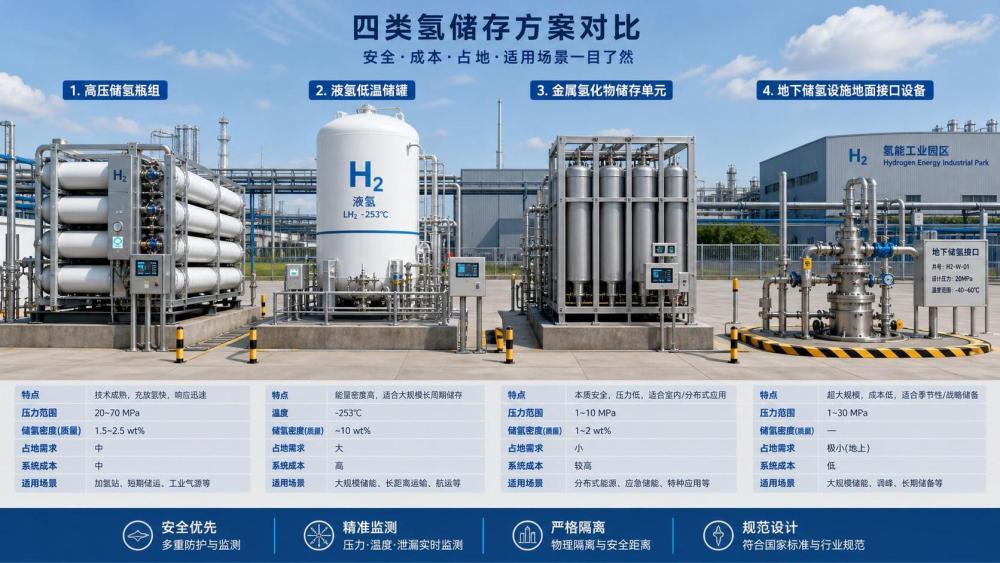
Choosing among hydrogen storage solutions is no longer a narrow engineering task. It now shapes project economics, permitting speed, and long-term expansion.
That shift is easy to understand. Storage decisions influence equipment count, land use, insurance exposure, and system uptime.
In practical terms, the right choice depends on three filters first: cost, safety, and physical footprint.
This framework helps compare compressed gas, liquid hydrogen, metal hydrides, and underground storage without getting lost in vendor claims.
For large programs, G-HEI treats hydrogen storage solutions as part of sovereign infrastructure, not stand-alone hardware.
That means every comparison should connect storage technology to codes, site risk, supply volatility, and future hydrogen throughput.
Start with the operating profile
Before comparing vendors, define how the storage system will actually work across the asset life.
A refueling station needs fast cycling and high dispensing pressure. A port terminal needs volume, transfer efficiency, and logistics resilience.
An industrial cluster may value buffer capacity between electrolyzers and turbines. A national reserve may prioritize seasonal scale.
Build the comparison around these questions:
- How many kilograms per day must be stored and delivered?
- Is the storage duty short-term, daily balancing, or seasonal backup?
- What inlet and outlet pressures are required?
- How constrained is the site by land, setbacks, or zoning?
- Which codes apply, including ISO 19880 and ASME B31.12?
Once that profile is clear, hydrogen storage solutions become much easier to rank on business value rather than generic technical promise.
Compare cost beyond the tank price
Many teams start with equipment quotes. That is useful, but it is rarely enough for a sound decision.
A better approach is total installed cost plus operating cost over the expected project horizon.
Compressed gas systems often look attractive at smaller scale. They are modular, proven, and easier to phase.
Yet costs can climb fast with cascading vessels, compression stages, cooling, and safety separation distances.
Liquid hydrogen can improve volumetric density, which helps constrained sites. Still, liquefaction energy and boil-off management are major economic variables.
Metal hydrides offer niche advantages where compactness and lower pressure matter. Their material cost and thermal management can limit broader adoption.
Underground caverns usually win at very large scale. However, development timelines, geology, and permitting can delay value realization.
When comparing hydrogen storage solutions, include these cost lines:
- Storage vessel or containment system
- Compression, liquefaction, or heat management equipment
- Civil works, blast walls, and hazardous area preparation
- Inspection, monitoring, and maintenance intervals
- Efficiency losses, including boil-off or parasitic power
- Expansion cost for future capacity additions
This is where many decision errors appear. A lower upfront quote can produce a higher delivered hydrogen cost later.
In real projects, the most competitive hydrogen storage solutions are often the ones with predictable lifecycle performance, not simply the cheapest hardware.
Assess safety as a system issue
Safety should never be reduced to pressure level alone. Hydrogen risk depends on containment, materials, ventilation, ignition control, and operating discipline.
Compressed storage brings risks from high pressure and repeated cycling. That raises concerns around fatigue, fittings integrity, and leak detection response.
Liquid hydrogen adds cryogenic hazards, embrittlement concerns, and vapor management complexity. These are manageable, but only with mature engineering controls.
Metal hydrides operate differently. Lower pressure can help, though thermal runaway and material handling need close review.
Underground storage changes the risk picture again. Surface equipment may be standard, but subsurface integrity and monitoring become central.
A practical safety screen for hydrogen storage solutions should cover:
- Compatibility with hydrogen service materials
- Leak detection speed and shutdown logic
- Vent stack design and gas dispersion behavior
- Emergency access, isolation, and fire protection
- Compliance with recognized standards and local permits
- Operator training burden and maintenance discipline
A useful rule is simple. The safest option on paper may not be the safest option on your site.
Site geometry, neighboring assets, and workforce capability can completely change which hydrogen storage solutions are operationally safer.
Measure footprint in three dimensions
Footprint is about more than square meters. It includes height, exclusion zones, truck access, maintenance clearance, and future tie-ins.
This matters more than ever because many hydrogen projects are being inserted into brownfield industrial sites.
Compressed gas storage can spread across a site because of vessel banks and separation rules. Liquid systems usually store more hydrogen in less area.
That said, liquid systems need supporting cryogenic infrastructure. The saved area may be partly offset by handling and safety needs.
Underground storage has a different advantage. Surface footprint can be relatively small compared with the stored energy volume.
When evaluating footprint, review these points together:
- Net storage capacity per square meter
- Required safety setbacks and traffic lanes
- Utility connections and process equipment adjacency
- Access for inspection, replacement, and crane lifts
- Expandability without major site rework
The strongest hydrogen storage solutions are those that preserve optionality. Space saved today should not block capacity growth tomorrow.
Use a simple comparison matrix
A decision matrix helps turn technical detail into a board-ready choice. Keep it simple enough to use, but detailed enough to avoid blind spots.
This kind of matrix keeps hydrogen storage solutions anchored to actual deployment logic, not abstract preference.
Match the storage option to the business case
From recent market shifts, one signal is clear. No single storage technology dominates every use case.
For fast deployment and modular growth, compressed systems still hold a strong position. For density and logistics reach, liquid hydrogen is increasingly relevant.
For strategic energy reserves, underground storage can reshape the economics of large-scale decarbonization.
A practical selection flow looks like this:
- Define throughput, storage duration, and pressure requirements.
- Map site constraints, utilities, and permitting barriers.
- Model total cost over expansion phases.
- Stress-test safety controls against realistic incidents.
- Score footprint with future capacity in mind.
- Shortlist hydrogen storage solutions that stay robust under all three tests.
That process sounds straightforward, but it avoids a common trap. Teams often buy for today’s pilot, then regret tomorrow’s scale-up path.
The better move is to choose hydrogen storage solutions that support both near-term execution and long-horizon infrastructure strategy.
Make the final decision with confidence
The best hydrogen storage solutions are not simply the most advanced. They are the ones that fit the operating profile, pass the safety case, and scale economically.
In most cases, cost, safety, and footprint will trade off against each other. The real job is deciding which compromise strengthens the whole asset system.
That is why disciplined benchmarking matters. G-HEI evaluates hydrogen storage solutions within the broader zero-carbon chain, from electrolysis output to transport, refueling, and power conversion.
When the choice is framed this way, storage becomes a strategic lever rather than a procurement line item.
Use a lifecycle view. Check standards early. Test site realities before approving a technology path.
If you are comparing hydrogen storage solutions now, start with a structured matrix and validate each option against your next expansion step, not just your first installation.
Related News
- Hydrogen Storage Choices Get Costly at Utility ScaleApr 27, 2026Hydrogen storage drives utility-scale power costs in the energy transition. Explore hydrogen economy trade-offs across PEM electrolysis, cryogenic liquid hydrogen, transport, and decarbonization technology.
- Cryogenic Liquid Hydrogen Storage Has a Boil-Off ProblemApr 27, 2026Cryogenic liquid hydrogen and hydrogen storage face a major boil-off challenge shaping the hydrogen economy, hydrogen transport, and zero-carbon infrastructure—see practical insights for safer, scalable decarbonization.
- How to evaluate a hydrogen transport systems supplier for liquid hydrogen tank capacityNov 08, 2026Choose a hydrogen transport systems supplier with confidence. Compare usable tank capacity, boil-off, safety, and lifecycle costs to make a smarter buying decision.
- Does ISO 19880 Apply to Liquid Hydrogen Storage Tanks?Oct 17, 2026Understand hydrogen storage ISO 19880 compliance for liquid hydrogen tanks. Learn when ISO 19880-1 applies and which vessel standards and approvals you need.
Related News
- 00
0000-00
Hydrogen Energy Storage for Data Centers Gets Costly Fast - 00
0000-00
When 99.999% Hydrogen Purity Still Is Not Good Enough - 00
0000-00
When Does a Hydrogen-Ready Gas Turbine Pay Off? - 00
0000-00
Electricity Price Volatility Is Rewriting Hydrogen Cost Models - 00
0000-00
PSA Recovery Rate Drops for Reasons Operators Miss
Marcus Valve
Weekly Insights
Stay ahead with our curated technology reports delivered every Monday.