
Liquid Hydrogen Tank Selection: Sizing Hold Time and Boil-Off for Daily Demand




A liquid hydrogen storage decision often becomes urgent after a supply plan has already been sketched: daily consumption is known, a delivery interval has been discussed, and a vessel capacity is being compared on a quotation sheet. The problem is that a tank large enough to hold the nominal demand may still be the wrong tank. It can create avoidable vent losses, arrive at an inconvenient fill level, fail to preserve enough usable inventory through a delivery delay, or impose a pressure-management burden that the site cannot support.
The practical starting point is this: size liquid hydrogen tanks from the required usable inventory during the worst credible replenishment interval, then add allowances for operating reserve, heel, delivery conditions, and expected boil-off. Hold time and boil-off rate are not secondary specifications. They determine how much of the nameplate capacity is genuinely available and whether stored product remains economically and operationally useful between deliveries.
Start with the demand profile, not the tank volume
“Daily demand” is rarely a single stable number. A refueling installation may have peak-hour draws but low overnight use. A power or industrial process may consume hydrogen continuously, while commissioning, maintenance, or seasonal operation changes the load materially. A tank selected from average daily demand alone can be undersized during a high-use period or oversized when demand falls, leaving liquid in storage long enough for boil-off to become a meaningful loss.
Build the sizing basis around four separate figures:
- Average daily withdrawal: expected use over a normal operating day.
- Maximum daily withdrawal: a realistic high-demand day, not an extreme theoretical maximum with no operating relevance.
- Replenishment interval: the usual time between deliveries or on-site liquefaction availability.
- Supply interruption allowance: additional days or hours of cover needed for delivery variation, weather exposure, access restrictions, production outages, or operational policy.
The first estimate of required usable liquid inventory is straightforward:
Usable inventory = daily demand × required days of cover
That estimate should then be adjusted for loss and inaccessible volume. A buyer who asks for “three days of storage” should define whether those are three days of gross liquid in the vessel or three days of hydrogen that can actually be delivered to the downstream process under normal pressure and transfer conditions. Only the latter is useful for equipment selection.
Turn usable inventory into gross vessel capacity
A cryogenic vessel is not normally operated from completely full to completely empty. A minimum heel is often retained to support stable pressure behavior, avoid undesirable operating conditions, and preserve readiness for the next receipt. The maximum fill level may also be restricted by the vessel design, receiving procedure, thermal condition, and operating rules. The usable fraction is therefore less than the geometric volume of the tank.
A working sizing calculation can be expressed as:
Gross capacity = (required usable inventory + expected storage loss during the cycle) ÷ usable operating fraction
The units must remain consistent. Demand may be tracked by mass, while supplier documentation can state volume, net mass, or water capacity. Hydrogen density changes with storage conditions, so conversions should be based on the stated liquid properties and the vessel’s approved operating range rather than a generic conversion factor copied from an unrelated system.
For example, a site that receives bulk deliveries cannot assume that every delivery restores the tank to its nominal maximum. A partially filled vessel, a warm transfer line, a constrained unloading window, or a supplier’s delivery practice may leave a lower received inventory than the nameplate calculation assumes. Conversely, designing only around full fills can force unnecessarily frequent partial deliveries when actual consumption is lower than forecast.
The useful question for a quotation comparison is not “Which tank is larger?” It is: What inventory band can this vessel safely and repeatedly operate within, and how much deliverable hydrogen does that band represent?
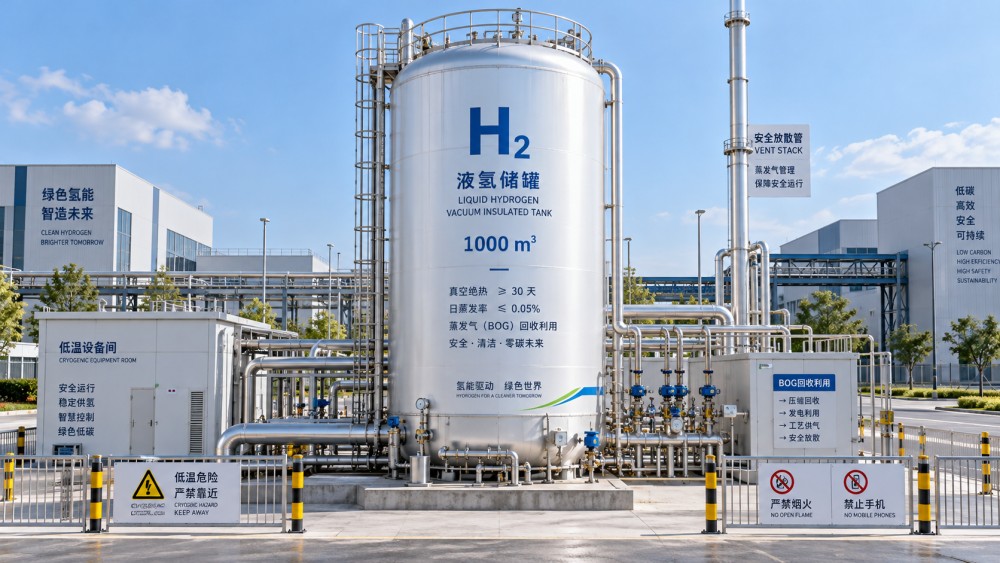
Hold time is a supply-resilience requirement
Hold time is often treated as a marketing shorthand for insulation quality. In a real operating plan, it should be interpreted more carefully. It describes how long stored liquid can remain within a defined pressure or loss condition when withdrawal is absent or limited. The stated result depends on assumptions such as initial fill level, ambient conditions, vessel configuration, allowed pressure rise, and whether vapor is vented, recovered, or consumed.
A long hold time matters most when hydrogen use is intermittent, delivery timing is uncertain, or the site may leave the tank lightly loaded for extended periods. It is less decisive at a facility with regular, continuous withdrawal because product withdrawal can remove heat and limit pressure rise. That does not eliminate boil-off; it changes the pressure and thermal balance that needs to be evaluated.
Ask suppliers to define the conditions behind any hold-time statement. A value without its test or calculation basis cannot be compared reliably. Clarify:
- the starting fill percentage and liquid condition;
- the ambient temperature and solar exposure assumptions;
- the initial and final pressure criteria;
- whether the result assumes zero withdrawal;
- the treatment of venting, vapor recovery, or pressure-building operations; and
- the insulation system, vacuum performance expectations, and field-installation factors included in the figure.
A vessel with a favorable static hold-time claim may not deliver the best result if it requires operating practices that do not match the site. The same applies to a tank with a lower capital cost but a less favorable thermal profile when inventory is expected to sit for long periods.
Evaluate boil-off as mass balance, not as an isolated percentage
Boil-off gas is generated when heat enters the stored liquid and causes vaporization. The pressure inside the vessel rises unless vapor is withdrawn, used, reliquefied where applicable, recovered into another system, or released through the designed pressure-control arrangement. The relevant impact is not merely the published daily boil-off percentage. It is the mass of hydrogen lost or handled over the expected operating cycle.
A simple planning expression is:
Daily boil-off mass = stored liquid mass × daily boil-off rate
Because the stored mass changes as the tank is used, a more realistic estimate evaluates the inventory over the delivery cycle rather than assuming the vessel remains full. This is especially important where the tank is large relative to demand. A low percentage applied to a large standing inventory can still represent a material daily quantity of hydrogen.
There are two distinct questions to separate during selection:
Do not assume that all boil-off is automatically wasted. Some facilities can use vapor in a compatible downstream demand, condition it for another hydrogen system, or manage it through a recovery path. Those options have limits: pressure, purity, flow variability, equipment availability, and periods of zero demand all matter. A nominal vapor-use path should not be credited as a complete solution unless it remains available during the operating situations that create the greatest pressure risk.
Recognize when a larger tank increases risk rather than resilience
Oversizing is attractive when delivery reliability is uncertain. It can reduce transport frequency and provide a comfortable inventory buffer. Yet a larger vessel also tends to spend more time at low turnover, particularly during commissioning, reduced production, maintenance shutdowns, or demand forecasts that do not materialize. The result can be greater boil-off exposure and more frequent pressure-management activity.
There is a practical turnover test: compare expected storage duration with the vessel’s thermal and pressure-management capability. When most of the inventory will cycle through quickly, capacity and delivery logistics may dominate the decision. When inventory may remain for extended periods, insulation performance, allowable hold time, vapor handling, and operating discipline carry more weight.
Intermittent users should model at least three operating states rather than one annual average:
- Normal consumption: planned demand and normal delivery cadence.
- Low-demand period: reduced withdrawal while the vessel remains partly filled.
- Supply disruption or shutdown: limited withdrawal combined with delayed delivery, site closure, or downstream equipment unavailability.
The third state reveals whether the selected configuration can remain within pressure limits without relying on improvised venting or emergency consumption. It also reveals whether a smaller, more frequently replenished tank could be more suitable than a larger storage asset for the actual demand pattern.
Delivery frequency changes the optimum size
Tank selection and delivery planning must be developed together. A vessel designed for infrequent deliveries needs enough usable inventory to cover the interval plus delay allowance, but it may create long residence times during ordinary operation. A smaller vessel with more frequent deliveries may reduce standing inventory, though it places greater dependence on logistics, unloading access, receiving hours, and supplier reliability.
Before setting a storage capacity, establish the practical delivery envelope:
- minimum and maximum delivery quantity that can be received without exceeding operating fill limits;
- the time required for a safe transfer, including connection, cooldown, and disconnection activities;
- vehicle access, turning, parking, and separation constraints;
- permitted delivery hours and the availability of trained receiving staff;
- how remaining inventory is measured and communicated for scheduling; and
- the response plan when a planned delivery cannot occur.
These details prevent a common mismatch: a tank has sufficient theoretical capacity, but the site cannot accept the quantity or timing needed to keep it in the intended inventory band. Level instrumentation, alarm thresholds, and ordering points should be aligned with the usable inventory calculation, not simply set as generic percentages.
Site conditions can change both performance and installed cost
Vacuum-insulated cryogenic vessels require more than a pad and a delivery connection. Available footprint, foundation loading, clearances, vehicle routes, hazardous-area considerations, vent discharge routing, electrical classification, and access for inspection or maintenance can constrain the tank configuration. A vessel that fits on a layout drawing may still be difficult to operate if the fill connection is poorly located or if vent outlets cannot be routed to an acceptable discharge location.
Ambient heat exposure deserves attention. Direct solar loading, confined equipment yards, nearby hot process equipment, inadequate airflow, and local temperature extremes can influence the thermal duty that the storage system experiences. The tank should be evaluated as an installed assembly: vessel, valves, piping, transfer hose connections, pressure-building equipment, vaporizer interfaces, and instrumentation all affect performance and operability.
Material and component compatibility must also match liquid-hydrogen service. Low temperatures create brittleness risks in unsuitable materials, and hydrogen service introduces additional integrity considerations. The specification should identify the required design code, pressure rating, inspection documentation, relief-device philosophy, and applicable local permitting requirements. These items should be confirmed early, because retrofitting pressure relief routing, instrumentation, or classified electrical equipment after delivery can alter both schedule and cost.
Use a quotation comparison that exposes hidden assumptions
Two offers with the same nominal capacity may not provide the same usable storage service. Request a side-by-side technical schedule that asks each supplier to answer the same operating questions. This reduces the risk of comparing a high-level capacity figure from one proposal with a more conservative operating figure from another.
Information to request before making a final selection
- nominal volume, maximum permitted fill, minimum recommended operating inventory, and calculated usable mass;
- design pressure, normal operating pressure range, and pressure-control method;
- boil-off or heat-leak performance with clear reference conditions;
- hold-time definition and the assumptions used to derive it;
- expected vapor generation during no-withdrawal and reduced-withdrawal conditions;
- relief, vent, and vapor-management interfaces required from the site;
- delivery connection type, transfer limits, and expected receiving procedure;
- instrumentation provided, including level, pressure, temperature where applicable, alarms, and remote signal requirements;
- foundation loads, footprint, maintenance clearance, and transport dimensions; and
- documentation demonstrating compliance with the project’s specified safety and mechanical requirements.
It is useful to ask for a mass-balance estimate over the intended delivery cycle. The calculation should show starting inventory, planned withdrawal, estimated boil-off, minimum operating inventory, and projected receipt quantity. A supplier may reasonably need site-specific operating assumptions to prepare this. The goal is not a guaranteed loss figure; it is a transparent basis for comparing alternatives under the same conditions.
A practical selection sequence
First, define demand in mass per day and identify the high-demand and low-demand operating states. Next, decide how many days of usable cover are actually required, separating routine delivery spacing from contingency reserve. Then calculate the operating inventory band after allowing for heel, maximum fill restriction, and estimated losses. Only after this should gross tank capacity be selected.
Review the resulting vessel against its static hold-time basis and projected pressure behavior during no-use periods. Confirm that the site has a deliberate path for boil-off gas and that this path remains workable when downstream consumption is unavailable. Finally, test the selected size against real delivery quantities, transfer timing, layout constraints, relief routing, and the required engineering and permitting review.
The strongest specification does not simply request the largest available vessel or the lowest stated boil-off rate. It defines the usable hydrogen required at the point of use, the time it must remain available, and the conditions under which the storage system must manage pressure safely. That approach makes capacity, hold time, and boil-off part of one operating decision rather than three disconnected line items.
Related News
- Hydrogen Storage Choices Get Costly at Utility ScaleApr 27, 2026Hydrogen storage drives utility-scale power costs in the energy transition. Explore hydrogen economy trade-offs across PEM electrolysis, cryogenic liquid hydrogen, transport, and decarbonization technology.
- Cryogenic Liquid Hydrogen Storage Has a Boil-Off ProblemApr 27, 2026Cryogenic liquid hydrogen and hydrogen storage face a major boil-off challenge shaping the hydrogen economy, hydrogen transport, and zero-carbon infrastructure—see practical insights for safer, scalable decarbonization.
- How to evaluate a hydrogen transport systems supplier for liquid hydrogen tank capacityNov 08, 2026Choose a hydrogen transport systems supplier with confidence. Compare usable tank capacity, boil-off, safety, and lifecycle costs to make a smarter buying decision.
- Does ISO 19880 Apply to Liquid Hydrogen Storage Tanks?Oct 17, 2026Understand hydrogen storage ISO 19880 compliance for liquid hydrogen tanks. Learn when ISO 19880-1 applies and which vessel standards and approvals you need.
Related News
- 00
0000-00
Hydrogen Energy Storage for Data Centers Gets Costly Fast - 00
0000-00
When 99.999% Hydrogen Purity Still Is Not Good Enough - 00
0000-00
When Does a Hydrogen-Ready Gas Turbine Pay Off? - 00
0000-00
Electricity Price Volatility Is Rewriting Hydrogen Cost Models - 00
0000-00
PSA Recovery Rate Drops for Reasons Operators Miss
Marcus Valve
Weekly Insights
Stay ahead with our curated technology reports delivered every Monday.