What ISO Standards Apply to Hydrogen Storage Tank Procurement?




What ISO standards apply to hydrogen storage tank procurement? The practical answer is that no single ISO document covers every hydrogen tank. The correct standard set depends first on whether the asset stores compressed gaseous hydrogen, liquid hydrogen, or hydrogen in a vehicle, transport module, or refueling station. Procurement failures usually start when a buyer asks for “an ISO-certified hydrogen tank” without defining that service duty.
A sound specification separates the pressure vessel itself from the wider storage system: materials, valves, pressure-relief devices, piping, controls, installation, inspection, and local legal approval. ISO standards are central to that work, but they often sit alongside mandatory pressure-equipment rules and construction codes such as the ASME Boiler and Pressure Vessel Code, ASME B31.12, the EU Pressure Equipment Directive where applicable, or national regulations.
For a quick answer: ISO 19881 is highly relevant for high-pressure gaseous hydrogen containers used in land vehicles; ISO 11119 and ISO 9809 may apply to transportable composite or steel cylinders; ISO 21009, ISO 21010, and ISO 21013 are important for cryogenic liquid-hydrogen vessels and their safety equipment. Stationary bulk storage normally requires a recognized pressure-vessel design code in addition to ISO-based hydrogen-specific requirements.
What ISO standards apply to hydrogen storage tank procurement in practice?
The first procurement decision is not the tank volume. It is the storage category. A 70 MPa composite vessel feeding a vehicle or mobile application cannot be specified in the same way as a stationary tube bundle, a liquid-hydrogen vacuum-insulated vessel, or a buffer vessel located beside an electrolyzer.
The standards most often reviewed are below. They should be treated as a starting map, not as a substitute for a project-specific compliance review.
The table is useful, but its limitation matters: an ISO standard may govern a component or application, while a local authority requires the stationary vessel to be designed, fabricated, examined, and registered under a separate pressure-equipment regime. Asking a supplier for ISO compliance alone can leave a major gap in the bid package.
Start with the storage duty, not the catalogue model
Many hydrogen projects use “tank” as a loose label. In procurement, that word needs to be replaced by a defined duty statement. Before requesting quotations, establish the following:
- Hydrogen state: compressed gas, cryogenic liquid, or solid-state storage.
- Maximum allowable working pressure, normal operating pressure, and expected pressure cycles.
- Minimum and maximum metal temperatures, including rapid filling, depressurization, and ambient exposure.
- Stationary, transportable, mobile, marine, or vehicle-mounted service.
- Required usable hydrogen capacity, flow rate, replenishment method, and allowable boil-off or vent losses.
- Expected design life, inspection interval, and replacement strategy.
- Installation jurisdiction and the authority having jurisdiction for pressure equipment and hazardous-area compliance.
That information determines which standards are truly relevant. For example, ISO 19881 is a strong reference for gaseous hydrogen containers on land vehicles, including the demanding cyclic and environmental conditions those containers can face. It should not automatically be used as the sole technical basis for a large stationary hydrogen buffer vessel. A stationary vessel may be better governed by ASME Section VIII, EN 13445, AD 2000, or another accepted pressure-vessel code, with hydrogen-specific material and system requirements added to the specification.
This distinction is more than paperwork. A vessel that is suitable for a vehicle application may have a different design philosophy, inspection route, mounting arrangement, fatigue profile, and certification pathway than a permanently installed asset.
Do not confuse ISO 19880 with a tank manufacturing standard
ISO 19880-1 is frequently cited in hydrogen procurement because it addresses gaseous hydrogen fueling stations. It is highly relevant when storage sits within a refueling facility, especially where cascade storage, compressors, priority panels, dispensers, emergency shutdown systems, and vent stacks are part of the same package.
However, ISO 19880-1 does not replace the construction standard for the pressure vessel. It helps define the safety and functional expectations of the station system. The vessel still needs an appropriate design and conformity route, while connected piping needs its own engineering basis. In many projects, ASME B31.12 is considered for hydrogen piping because it addresses the particular challenges of hydrogen service, including material behavior and design considerations that ordinary process piping specifications may not capture.
A supplier proposal that cites ISO 19880-1 but is silent on vessel code, nameplate data, relief-device sizing basis, material certificates, and third-party inspection should be treated as incomplete.
Material compatibility deserves its own review
Hydrogen can affect the mechanical behavior of certain metals, especially under high pressure, cyclic loading, low temperature, or unfavorable microstructural conditions. The risk is not reduced simply because the vessel has passed a general pressure test. Material selection must suit the actual hydrogen exposure, fabrication process, and duty cycle.
For cryogenic service, ISO 21010 is especially useful because it addresses material toughness and related requirements for cryogenic vessels. Procurement documentation should identify base materials, weld consumables, heat treatment requirements, non-destructive examination methods, and traceability. The exact acceptance criteria will depend on the governing vessel code and project jurisdiction.
For high-pressure gaseous storage, do not accept a vague statement such as “hydrogen-compatible steel.” Ask for the design standard, material designation, approved operating temperature range, fatigue basis, and evidence that the selected material is appropriate for the specified hydrogen pressure and cycling service. A legitimate manufacturer should be able to provide a clear technical file without relying on broad marketing language.
Build the standards into the purchase specification
The most useful procurement document is not a list of standards pasted into a request for quotation. It is a compliance matrix that shows exactly where each standard applies and what evidence the supplier must submit.
For the vessel package, require the supplier to state the governing design code and identify all applicable ISO standards, national laws, and customer specifications. Then require a line-by-line response. This avoids a common problem: a bidder marks “compliant” against a standard that is only partially relevant to the supplied scope.
A practical technical schedule normally asks for:
- Design pressure, design temperature, test pressure, allowable service conditions, and corrosion allowance where relevant.
- Hydrogen purity assumptions and contamination limits that could affect connected equipment.
- Detailed drawings, nozzle schedule, supports, lifting points, transport restraints, and foundation loads.
- Material certificates, weld procedures, welder qualifications, non-destructive examination records, and pressure-test reports.
- Pressure-relief valve data, sizing calculations, discharge routing requirements, and set-pressure tolerances.
- Leak-test method and acceptance criteria appropriate for hydrogen service.
- Factory acceptance testing, site acceptance testing, commissioning support, and required spare parts.
- Inspection plan, maintenance instructions, remaining-life approach, and end-of-life disposal or recertification requirements.
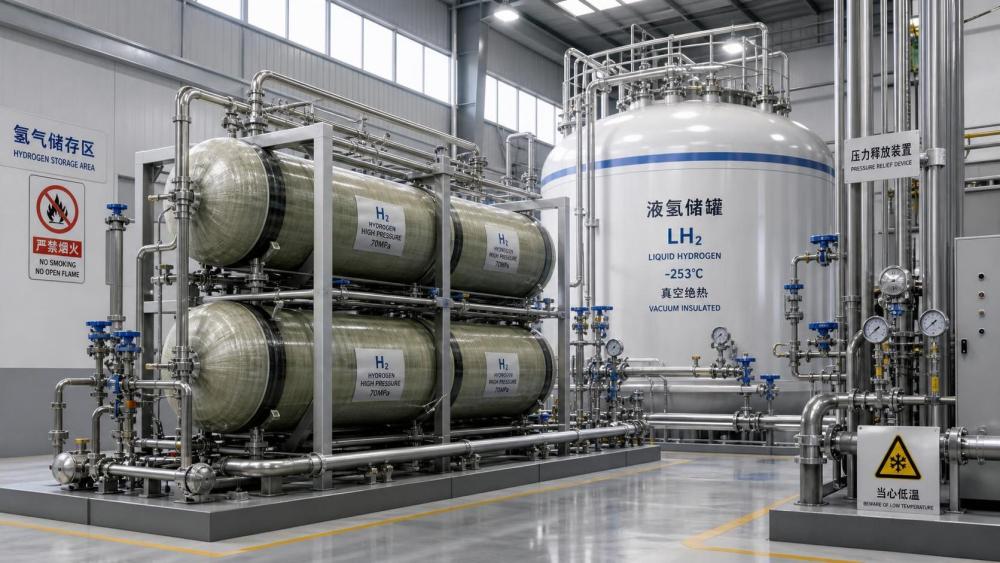
For liquid hydrogen, add requirements for vacuum insulation, vacuum monitoring where provided, boil-off expectations, thermal contraction allowances, cold-service valve arrangements, and safe handling of vented hydrogen. ISO 21009 is particularly relevant here because cryogenic vessels are not merely conventional pressure vessels with extra insulation. Their performance and hazards are shaped by very low temperatures, vacuum integrity, relief arrangements, and operational heat ingress.
Pressure-relief equipment is part of the tank scope
A tank cannot be procured safely as an isolated shell. Overpressure protection, vent piping, isolation valves, breakaway provisions where applicable, instrumentation, and emergency shutdown logic must be evaluated as a system. ISO 21013 is a useful reference for pressure-relief accessories for cryogenic service, while the final relief design also needs to follow the governing vessel code and the site hazard study.
One recurring mistake is to specify the relief valve set pressure without defining credible overpressure scenarios. For compressed hydrogen, those scenarios may include fire exposure, blocked-in warming, failed pressure control, or compressor malfunction. For liquid hydrogen, thermal expansion, loss of vacuum, and boil-off conditions become central. The relief-device supplier cannot resolve those questions alone; the package designer and site engineer need a shared design basis.
Vent discharge location is equally important. A compliant vessel can still become a problematic installation if hydrogen is discharged near air intakes, electrical equipment, occupied areas, or confined spaces. Local fire, building, and hazardous-area requirements must be checked before the equipment layout is frozen.
Verify certification, traceability, and the jurisdiction early
Standards are only useful when the supplied equipment can be accepted at the installation site. Before placing an order, confirm which approvals are mandatory in the country, state, province, port, or industrial zone where the tank will operate. Imported equipment can meet a respected international standard yet still require additional review, registration, marking, inspection, or documentation.
Ask who will conduct the independent inspection, whether that party is accepted by the local authority, and when inspections occur. Waiting until factory acceptance testing to discover that the required notified body or authorized inspector was not involved can create expensive delay.
For composite pressure vessels, review serial-number traceability, manufacturing batch records, damage inspection criteria, and service-life limits. Composite systems are not interchangeable by appearance. Their allowable use depends on the qualified design, liner type, protective layers, mounting method, and exposure history. A procurement team should also clarify whether field repair is permitted, restricted, or prohibited by the manufacturer and governing standard.
Where G-HEI benchmarking can help
Cross-border hydrogen projects often bring together electrolyzers, storage, transport, refueling, and power-generation assets that were designed under different engineering assumptions. In that situation, a technical benchmarking resource such as the Global Hydrogen-Economy & Zero-Carbon Infrastructure (G-HEI) can help compare standards coverage across the wider value chain, including ISO 19880, ASME B31.12, and related interfaces.
The useful role of that comparison is not to replace the engineer of record or the local authority. It is to expose gaps early: a storage tank may meet its vessel code, while its piping metallurgy, dispensing interface, hydrogen quality basis, or cryogenic relief arrangement has not yet been aligned with the rest of the project.
Common procurement mistakes that create avoidable risk
The first is buying by nominal pressure alone. “70 MPa” says little about cycle life, usable capacity, temperature limits, qualification conditions, or installation suitability. The second is treating an ISO reference as proof of legal compliance. It may support compliance, but it does not automatically satisfy every local requirement.
Another weak practice is accepting a generic certificate without checking its scope. A certificate may cover a component family, a manufacturing quality system, or a previous project configuration rather than the exact vessel being purchased. Read the certificate number, issue date, applicable model, pressure range, and exclusions.
Finally, do not leave the interface between tank vendor and site contractor undefined. The most consequential failures often occur at connections: improperly rated fittings, incompatible seals, poorly supported piping, relief lines that create backpressure, or controls that do not respond correctly during abnormal operation.
A practical release checklist before purchase order
Do not release the purchase order until the project has a defined storage duty, a confirmed governing vessel code, applicable ISO standards mapped to the scope, a local compliance path, reviewed drawings, verified material and relief-device documentation, and clear responsibility for installation interfaces. Where any of those items remains provisional, identify it as a formal hold point rather than assuming the supplier will resolve it later.
What ISO standards apply to hydrogen storage tank procurement? The best answer is a matched standard package: ISO 19881 for relevant vehicle containers, ISO 11119 or ISO 9809 for applicable transportable cylinders, ISO 21009 through ISO 21013 for cryogenic vessel work, and ISO 19880-1 where storage forms part of a fueling installation. Pair those standards with the legally required pressure-vessel code and a project-specific hydrogen safety review. That approach produces a tank specification that is not only technically credible, but also inspectable, installable, and far less likely to fail at commissioning.
Frequently asked questions
Is ISO 19881 required for every high-pressure hydrogen storage tank?
No. ISO 19881 is focused on gaseous hydrogen containers for land vehicles. It can inform design thinking, but a stationary vessel generally needs a stationary pressure-vessel code and local regulatory acceptance route.
Can a supplier’s ISO 9001 certificate prove that a hydrogen tank meets ISO requirements?
No. ISO 9001 addresses a quality-management system. It does not certify that a specific vessel design meets ISO 19881, ISO 21009, or another hydrogen storage standard.
Which ISO standards matter most for liquid hydrogen storage?
ISO 21009 addresses static vacuum-insulated vessels, ISO 21010 covers material toughness and related cryogenic requirements, and ISO 21013 addresses pressure-relief accessories for cryogenic service. The applicable vessel construction code remains essential.
Should a storage tank vendor provide relief-valve sizing calculations?
Yes, where the relief device is in the vendor’s scope. The calculations should be based on documented scenarios and coordinated with the site vent system, not supplied as an isolated component datasheet.
Is ASME B31.12 an ISO standard?
No. It is an ASME code for hydrogen piping and pipelines. It is often relevant because tank procurement includes piping connections and hydrogen-service interfaces that must be engineered with the vessel package.
Related News
- Hydrogen Storage Choices Get Costly at Utility ScaleApr 27, 2026Hydrogen storage drives utility-scale power costs in the energy transition. Explore hydrogen economy trade-offs across PEM electrolysis, cryogenic liquid hydrogen, transport, and decarbonization technology.
- Cryogenic Liquid Hydrogen Storage Has a Boil-Off ProblemApr 27, 2026Cryogenic liquid hydrogen and hydrogen storage face a major boil-off challenge shaping the hydrogen economy, hydrogen transport, and zero-carbon infrastructure—see practical insights for safer, scalable decarbonization.
- Liquid Hydrogen Tank Selection: Sizing Hold Time and Boil-Off for Daily DemandOct 12, 2026Liquid hydrogen tanks: learn how to size usable inventory, assess hold time and boil-off, and select a safer, cost-effective storage solution for daily demand.
- Which hydrogen liquefaction standards apply to new storage projects?Oct 10, 2026Hydrogen liquefaction standards for new storage projects: explore ISO, ASME, NFPA, CGA, and local compliance requirements for safer design, approval, and operation.
Related News
- 00
0000-00
Hydrogen Energy Storage for Data Centers Gets Costly Fast - 00
0000-00
When 99.999% Hydrogen Purity Still Is Not Good Enough - 00
0000-00
When Does a Hydrogen-Ready Gas Turbine Pay Off? - 00
0000-00
Electricity Price Volatility Is Rewriting Hydrogen Cost Models - 00
0000-00
PSA Recovery Rate Drops for Reasons Operators Miss
Marcus Valve
Weekly Insights
Stay ahead with our curated technology reports delivered every Monday.