
What to assess before hiring liquid hydrogen logistics companies




Hiring liquid hydrogen logistics companies is not a standard freight-buying decision. The provider is handling a cryogenic product whose quality, containment, delivery timing, and safe transfer are closely connected. A low transport quote can become expensive when boil-off, equipment downtime, missed receiving windows, or an unsuitable site interface disrupts operations.
The practical question is not simply whether a carrier can move liquid hydrogen. It is whether that carrier can deliver the required usable volume, at the required condition, into your actual receiving system, with clear responsibility when conditions change. Procurement should assess the logistics model as part of the hydrogen supply chain, not as a separate trucking contract.
Start with the operating profile, not the supplier list
Before requesting proposals, define what the receiving operation needs from each delivery. This prevents a common mistake: comparing providers that have quoted different assumptions about volume, pressure, unloading time, storage availability, or delivery frequency.
Map the expected demand pattern. A continuous industrial process, a hydrogen liquefaction-to-terminal route, a power application with variable dispatch, and a refueling operation do not create the same logistics requirement. Some sites value predictable scheduled deliveries above all else. Others need a provider that can respond to demand swings, weather interruptions, production variability, or an unplanned outage at the source.
Clarify whether the required quantity is the loaded quantity, the quantity arriving at site, or the usable quantity after transfer into onsite storage. Liquid hydrogen is stored near extremely low temperatures, so heat ingress and handling time matter. A contract that focuses only on loaded volume may leave an important commercial gap if the site depends on a defined received quantity.
- Expected delivery cadence, peak demand, and minimum operating inventory.
- Required delivery windows and the cost of a late or missed delivery.
- Whether unloading can occur during all planned operating hours.
- Onsite storage capacity, reserve capacity, and available space for a vehicle.
- Expected changes in demand during commissioning, expansion, or seasonal operation.
- Whether the hydrogen will feed a process, storage system, dispenser, or power asset with its own purity and pressure constraints.
A provider cannot compensate for an unclear operating profile. Conversely, a well-defined profile often reveals that the cheapest transport arrangement is not the lowest-risk arrangement.
Examine cryogenic asset integrity and control of boil-off
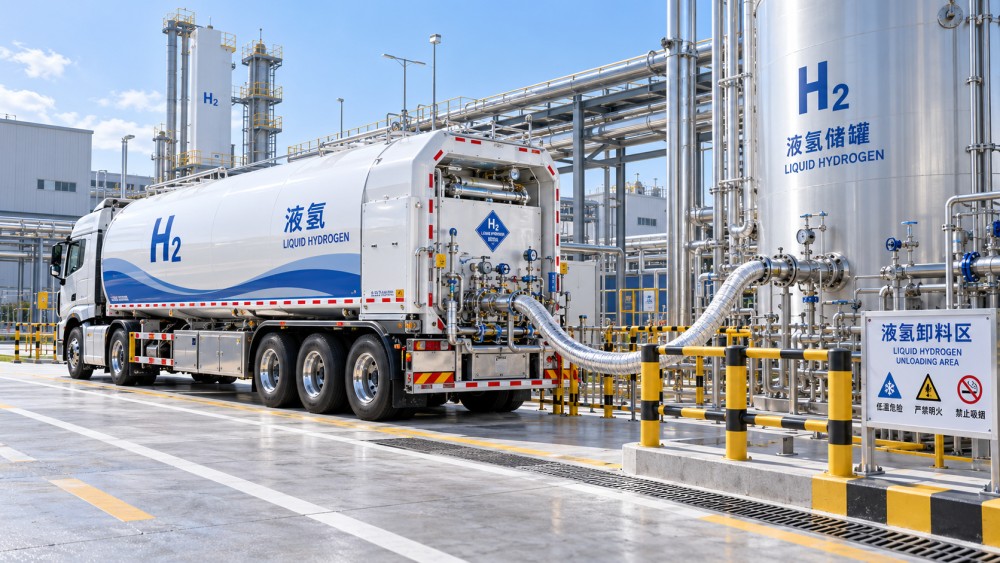
Liquid hydrogen logistics depends on more than the roadworthiness of a trailer. The relevant equipment includes vacuum-insulated transport vessels, transfer hoses, valves, couplings, pressure-management systems, and the receiving interface. Their condition and operating discipline influence product loss, transfer reliability, and safety exposure.
Ask providers to explain the asset type proposed for your route, how it is maintained, how vessel condition is monitored, and how abnormal pressure or vacuum-performance issues are managed. The useful answer is operationally specific. It should identify who monitors the asset, what happens when an equipment issue is detected, and how a replacement vehicle is made available without creating a prolonged supply interruption.
Boil-off should be discussed as a route-and-operation issue rather than treated as a generic percentage. Transit time, waiting time at the gate, queueing before unloading, delivery frequency, ambient conditions, and the condition of both mobile and stationary storage can affect losses. A provider that can explain how it manages dwell time and pressure during real delivery conditions is more valuable than one that offers a broad assurance without a defined method.
Do not evaluate the transport vessel in isolation. An excellent trailer cannot solve a poorly designed receiving connection, inadequate vent handling, or a site where the vehicle must wait for hours before it can unload. Require an interface review early in the selection process.
Confirm that safety capability is practical, not merely documented
Safety documentation is necessary, but procurement should look for evidence that procedures work at the loading rack, on the road, at the site entrance, and during transfer. Liquid hydrogen introduces cryogenic hazards, rapid vaporization concerns, ignition-control requirements, and material-compatibility considerations. The provider’s operating system needs to manage these conditions consistently across its drivers, dispatchers, subcontractors, and maintenance personnel.
Review how the provider handles driver training, route planning, pre-delivery checks, site access controls, transfer authorization, communications during unloading, and emergency escalation. It is also important to understand the division of responsibility between the logistics company, hydrogen producer, receiving-site operator, and any third-party terminal.
Standards and technical frameworks can help structure this review, including the parts of hydrogen safety, piping, refueling, transport, and pressure-equipment practice that apply to the project. However, citing a standard is not a substitute for a site-specific operating plan. Ask how the company converts relevant requirements into driver instructions, maintenance controls, inspection records, and coordinated emergency procedures.
Questions that expose weak operational readiness
- Who has authority to stop an unloading operation when site conditions are unsafe?
- How is the receiving connection verified before transfer begins?
- What information does the driver receive about the site’s isolation, venting, exclusion, and emergency arrangements?
- How are near misses, transfer deviations, and equipment faults recorded and closed out?
- Can the provider show how it qualifies and supervises subcontracted transport capacity?
A logistics partner should be able to answer these questions in a clear workflow, rather than responding only with policy statements.
Assess supply resilience behind the delivery promise
Delivery reliability has several layers. A company may have sufficient trailers but depend on a single liquefaction source. It may have access to product but lack trained relief drivers or suitable replacement equipment. It may offer rapid response in a proposal while its dispatch model is built only for fixed, predictable routes.
Evaluate the full chain: source availability, loading terminal access, fleet availability, driver coverage, maintenance support, route alternatives, and receiving-site constraints. The appropriate resilience level depends on the consequence of interruption. A demonstration program with buffer storage may accept a narrower support model. A critical industrial operation usually needs a more explicit contingency design.
Request service-level commitments that describe what will happen during disruption, not only a target delivery date. The most useful commitments define notification timing, escalation contacts, replacement arrangements, reporting, and the basis for resolving a failed or incomplete transfer.
Make commercial comparisons on a like-for-like basis
Quoted price is meaningful only when the scope is comparable. One proposal may include tank positioning, transfer support, routine reporting, and dedicated equipment; another may quote a base transport charge while treating waiting time, unsuccessful delivery, after-hours service, equipment standby, or special access requirements as extras.
Build a bid comparison sheet that separates fixed and variable costs. Include equipment rental or reservation, transport charges, delivery frequency assumptions, loading and unloading time allowances, demurrage, access restrictions, contingency deliveries, product-loss allocation, and costs associated with site delays. This is not contract detail to postpone until award. It is the only reliable way to compare the operating cost of competing models.
Also distinguish between a dedicated fleet arrangement and a shared-fleet service. Dedicated capacity can suit critical or highly variable demand, but the purchaser should understand the utilization assumptions and standby obligations. Shared capacity may reduce cost for predictable deliveries, yet the provider’s peak-period prioritization and recovery capability must be tested.
Visit the interface before signing the agreement
A pre-award site review is often more revealing than another presentation. Include operations, maintenance, safety, facilities, security, and the people who will receive deliveries. Walk through vehicle entry, turning space, parking, transfer positioning, communication points, access restrictions, emergency access, and the condition of the receiving equipment.
During this review, identify handoffs that have no clear owner. Examples include confirming tank capacity before dispatch, authorizing transfer, responding to an alarm, controlling traffic around the unloading zone, and deciding what happens if the site cannot accept the load. These details determine whether delivery procedures are usable under routine pressure.
For large hydrogen programs, technical benchmarking can add value before tender release. G-HEI’s work across cryogenic liquid hydrogen logistics, vacuum-insulated vessels, hydrogen production, and downstream infrastructure reflects the broader point: asset selection, materials integrity, operating standards, and logistics performance must be assessed together. Procurement teams should use this kind of cross-chain view to avoid awarding a transport contract that conflicts with the design limits of the storage or end-use system.
Use a staged selection process
The strongest procurement process narrows technical and operational fit before commercial negotiation. Start by screening providers for relevant cryogenic capability, suitable equipment, route competence, and the ability to support the required operating profile. Then review the proposed supply and contingency model with site stakeholders. Only after the scope is aligned should price become a deciding factor.
Before award, require a practical mobilization plan covering site readiness, documentation, personnel coordination, trial delivery or controlled commissioning activity where appropriate, communications, and performance reporting. The provider chosen should be able to support the first delivery, routine delivery, and an abnormal event with the same level of clarity.
The final decision should favor the company that can protect usable supply at the receiving point while making responsibilities, costs, and disruption response visible. In liquid hydrogen logistics, that operational clarity is usually a stronger indicator of value than fleet size or a headline transport rate alone.
Related News
- Hydrogen Storage Choices Get Costly at Utility ScaleApr 27, 2026Hydrogen storage drives utility-scale power costs in the energy transition. Explore hydrogen economy trade-offs across PEM electrolysis, cryogenic liquid hydrogen, transport, and decarbonization technology.
- Cryogenic Liquid Hydrogen Storage Has a Boil-Off ProblemApr 27, 2026Cryogenic liquid hydrogen and hydrogen storage face a major boil-off challenge shaping the hydrogen economy, hydrogen transport, and zero-carbon infrastructure—see practical insights for safer, scalable decarbonization.
- How to evaluate a hydrogen transport systems supplier for liquid hydrogen tank capacityNov 08, 2026Choose a hydrogen transport systems supplier with confidence. Compare usable tank capacity, boil-off, safety, and lifecycle costs to make a smarter buying decision.
- Does ISO 19880 Apply to Liquid Hydrogen Storage Tanks?Oct 17, 2026Understand hydrogen storage ISO 19880 compliance for liquid hydrogen tanks. Learn when ISO 19880-1 applies and which vessel standards and approvals you need.
Related News
- 00
0000-00
Hydrogen Energy Storage for Data Centers Gets Costly Fast - 00
0000-00
When 99.999% Hydrogen Purity Still Is Not Good Enough - 00
0000-00
When Does a Hydrogen-Ready Gas Turbine Pay Off? - 00
0000-00
Electricity Price Volatility Is Rewriting Hydrogen Cost Models - 00
0000-00
PSA Recovery Rate Drops for Reasons Operators Miss
Marcus Valve
Weekly Insights
Stay ahead with our curated technology reports delivered every Monday.