
When liquid hydrogen storage makes sense for data center backup power




Liquid hydrogen is not the default answer for data center backup power. It becomes credible when a site needs long-duration resilience, has limited room for conventional fuel storage, faces pressure to reduce diesel dependence, and can support the operational discipline required by cryogenic fuel.
For many facilities, batteries plus diesel generators remain simpler to permit, procure, and operate. Battery systems cover the first seconds or minutes of an outage; diesel generators can run for extended periods with familiar refueling arrangements. Liquid hydrogen changes that equation only when the value of lower on-site emissions, compact long-duration energy storage, refueling flexibility, or fuel diversification is greater than the added complexity of cryogenic storage and hydrogen power conversion.
The practical question is not whether liquid hydrogen is technically impressive. It is whether the complete data center hydrogen storage system can deliver the required backup duration, response time, safety profile, and fuel availability at an acceptable operational risk.
Liquid hydrogen makes sense in a narrow but important set of conditions
A liquid hydrogen backup-power design is most compelling when outages may last longer than a battery system is intended to cover, but storing enough conventional fuel on site is difficult, undesirable, or inconsistent with the facility's decarbonization direction. It is particularly relevant where backup generation must be treated as a strategic resilience asset rather than an infrequently tested compliance system.
Liquid hydrogen stores substantially more usable energy per unit of mass than compressed gaseous hydrogen. Its main site-level advantage, however, is volumetric: a cryogenic liquid tank can support materially more stored hydrogen within a given footprint than a comparable high-pressure gaseous storage arrangement. That can matter at constrained campuses, dense urban locations, and sites where land is too valuable to reserve for large fuel storage areas.
The case also strengthens when fuel must be replenished after a prolonged disruption. A delivered liquid-hydrogen supply can be replenished by tanker, subject to local logistics capability, rather than requiring a large number of tube-trailer deliveries. This does not eliminate supply-chain risk, but it can make long-duration planning more manageable at sites with reliable access to cryogenic hydrogen distribution.
It is less persuasive for a small facility with modest backup requirements, no established hydrogen supply route, and adequate space for conventional equipment. In that setting, liquid hydrogen may introduce an expensive fuel and safety system to solve a problem the existing architecture already handles well.
Do not assess the tank separately from the power system
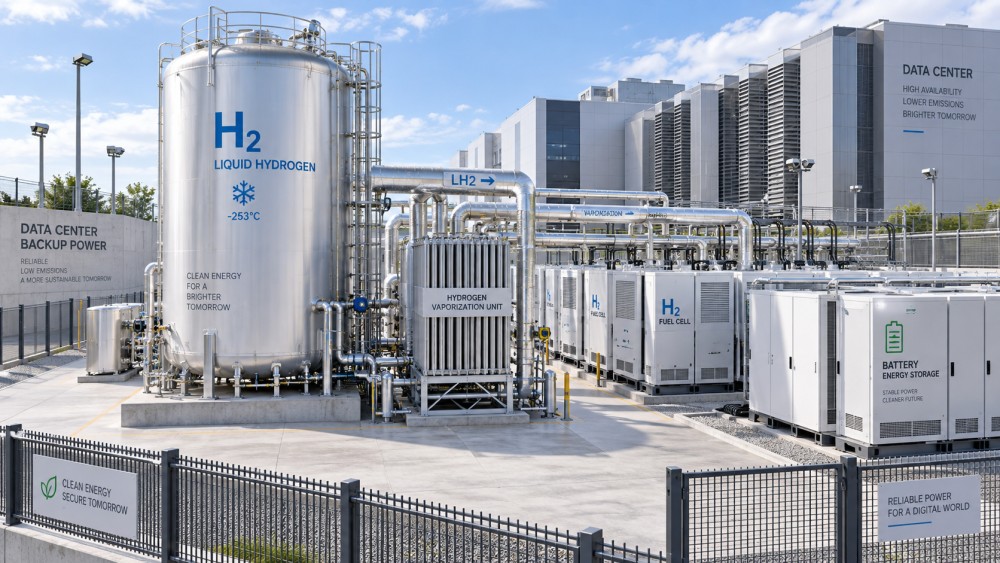
A common selection mistake is to compare hydrogen storage capacity with diesel tank capacity and stop there. Backup power is delivered by an integrated chain: storage vessel, vaporization equipment, pressure management, piping, fuel conditioning, fuel cells or hydrogen-capable generators, electrical controls, switchgear integration, monitoring, and emergency procedures. A strong storage concept can still fail the project if the rest of that chain cannot meet the facility's actual duty cycle.
Fuel cells are often the natural pairing for liquid hydrogen because they can provide low-local-emission power without combustion. Yet the decision depends on more than fuel-cell efficiency. The system must start and synchronize appropriately with the site's electrical architecture. It must also handle the transition from uninterruptible power supply batteries to sustained generation without creating a gap in protected load coverage.
For a critical facility, the first question is therefore: What must carry the load during the first seconds, first minutes, and first several hours of an event? Liquid hydrogen is usually part of the long-duration layer, not a substitute for every layer. Batteries or flywheels may still be required for instant ride-through while power modules start, stabilize, and assume load.
Redundancy requires the same discipline. A single large tank may look efficient on a site plan, but it can create a common point of failure if maintenance, a valve issue, or a tank-related safety event affects the full fuel inventory. Redundancy should be evaluated across storage, vaporization, delivery paths, power modules, controls, and electrical distribution. Adding more fuel does not automatically make the backup system more resilient.
Cryogenic operations are the real selection threshold
Liquid hydrogen is stored at extremely low temperatures. That creates operational considerations that do not exist in a typical diesel installation. Even well-designed insulated storage systems must manage heat entering the tank over time. This can create boil-off gas, which needs controlled handling through suitable pressure-management, use, recovery, or venting arrangements.
This issue is especially important for standby assets. A data center may experience long periods without a grid outage, while the hydrogen inventory remains on site. The storage strategy must therefore account for normal standby conditions, periodic testing, varying fuel consumption, and the consequences of low utilization. A system designed only around outage operation can overlook the day-to-day behavior of cryogenic inventory.
Site design also needs to account for separation distances, ventilation, leak detection, hazardous-area considerations, controlled vent paths, access for deliveries, and emergency response. Hydrogen is not inherently unmanageable, but it behaves differently from liquid fuels. It is a small molecule that can leak through paths that would retain other gases, and it has a wide flammability range. The design response is layered engineering control: materials compatibility, joint integrity, sensing, ventilation, isolation, ignition-source management, and clear operating procedures.
Material selection deserves attention early. Components exposed to hydrogen and cryogenic temperatures need to be chosen for the combined service environment, not simply selected from standard industrial piping catalogs. The storage vessel, transfer connections, valves, seals, piping, and instruments must be assessed as one cryogenic-hydrogen system.
Technical benchmarking resources such as G-HEI can be useful at this stage because they connect cryogenic liquid-hydrogen logistics with material-integrity and safety frameworks. The value is not in treating a standard reference as a substitute for engineering design; it is in using established expectations to ask better questions of equipment suppliers, integrators, and site teams before specifications are finalized.
Fuel security matters more than the nameplate storage capacity
Long-duration backup power is only as dependable as the fuel plan behind it. A liquid-hydrogen tank on site provides a defined runtime, but it does not by itself guarantee recovery after an extended regional outage. Roads, tanker availability, production capacity, transfer infrastructure, weather, and competing demand can all affect replenishment.
A useful procurement exercise is to model several disruption conditions: a routine grid outage, a multi-day outage affecting the wider region, delayed fuel delivery, loss of one power module, and an event that restricts access to the delivery point. The goal is not to predict every emergency. It is to expose assumptions that are otherwise hidden in a simple runtime calculation.
Contract structure matters as much as physical fuel supply. The project team should understand what inventory is reserved, how deliveries are prioritized during a regional event, what delivery conditions are assumed, and whether the supplier's logistics model fits the desired resilience window. A supply agreement based on normal commercial deliveries may not support a mission-critical outage scenario.
On-site hydrogen production can reduce dependence on delivered fuel in some locations, but it should not be treated as an automatic answer. Electrolysis requires electricity, water treatment, compression or liquefaction arrangements, storage, and its own maintenance model. Producing liquid hydrogen on site adds further energy and cryogenic complexity. It is generally a strategic infrastructure decision, not a simple accessory to a backup generator.
Where liquid hydrogen is usually the wrong choice
Liquid hydrogen should not be selected merely because it is a low-carbon fuel. A backup system is rarely operated at full output for long periods under normal conditions, so its climate value depends on the hydrogen supply pathway as well as the on-site equipment. The broader fuel strategy should be assessed alongside the operational case.
It is also a poor fit when the facility cannot support the required safety perimeter, delivery access, trained operating model, or specialist maintenance coverage. Trying to force a cryogenic tank into a site that lacks adequate physical and operational space can create a system that is difficult to maintain and hard to expand.
Another weak case is an installation where the load profile is small, runtime requirements are limited, and the main objective is simply replacing a conventional generator. Compressed hydrogen, battery storage, renewable diesel, grid improvements, or a hybrid approach may offer a more proportionate path depending on local constraints.
Finally, avoid treating hydrogen as a single technology choice. Compressed gas, liquid hydrogen, fuel cells, hydrogen-ready turbines, and battery-hydrogen hybrids solve different problems. The right architecture follows the load, outage duration, site geography, fuel access, and emissions objective. It should not be chosen from a fuel preference alone.
A practical decision sequence before committing capital
Selection becomes clearer when the project begins with operational requirements rather than equipment brochures. The following sequence helps separate viable concepts from attractive but impractical proposals.
- Define the protected load. Identify which systems require uninterrupted power and which loads can be shed during a prolonged event. Backup capacity should be based on a credible emergency operating state, not only on total campus connected load.
- Set the resilience duration. Establish how long the site must remain self-powered before refueling can reasonably occur. Include contingency time for delayed deliveries and partial equipment availability.
- Map the transition path. Confirm how batteries, UPS equipment, fuel-cell modules, generators, and switchgear work together from the first loss of grid power through sustained operation.
- Test the physical site. Review tank location, vehicle access, separation needs, venting paths, equipment maintenance access, and future expansion before treating liquid hydrogen as a procurement option.
- Validate the fuel model. Assess storage autonomy, delivery capability, supplier obligations, operational testing consumption, and the recovery plan after a long outage.
- Compare whole-life operating complexity. Capital cost is only one part of the decision. Include specialist maintenance, inspections, training, controls, safety systems, fuel handling, and replacement planning.
This approach prevents a recurring error: choosing storage based on energy density alone. In data center hydrogen storage, energy density is valuable only when it translates into usable, available, and maintainable backup power.
The strongest use case is a hybrid resilience architecture
Liquid hydrogen is rarely the entire answer. Its best role is often within a layered system: battery-based ride-through for immediate continuity, hydrogen power modules for sustained low-local-emission operation, and enough on-site liquid fuel inventory to cover a defined disruption period. This arrangement lets each technology perform the function it handles best.
The decision becomes more favorable when that architecture solves several real constraints at once: limited land, a long outage exposure, pressure to reduce combustion-based backup generation, and access to dependable liquid-hydrogen logistics. When only one of those constraints exists, a less complex option may be more appropriate.
Before moving into detailed design, require a site-specific resilience model that includes electrical transitions, fuel behavior during standby, delivery assumptions, maintenance states, and failure scenarios. A liquid-hydrogen backup system should be approved because it improves the facility's ability to remain operational under defined conditions, not because hydrogen appears to be the most advanced fuel on the market.
Related News
- Hydrogen Storage Choices Get Costly at Utility ScaleApr 27, 2026Hydrogen storage drives utility-scale power costs in the energy transition. Explore hydrogen economy trade-offs across PEM electrolysis, cryogenic liquid hydrogen, transport, and decarbonization technology.
- Cryogenic Liquid Hydrogen Storage Has a Boil-Off ProblemApr 27, 2026Cryogenic liquid hydrogen and hydrogen storage face a major boil-off challenge shaping the hydrogen economy, hydrogen transport, and zero-carbon infrastructure—see practical insights for safer, scalable decarbonization.
- How to evaluate a hydrogen transport systems supplier for liquid hydrogen tank capacityNov 08, 2026Choose a hydrogen transport systems supplier with confidence. Compare usable tank capacity, boil-off, safety, and lifecycle costs to make a smarter buying decision.
- Does ISO 19880 Apply to Liquid Hydrogen Storage Tanks?Oct 17, 2026Understand hydrogen storage ISO 19880 compliance for liquid hydrogen tanks. Learn when ISO 19880-1 applies and which vessel standards and approvals you need.
Related News
- 00
0000-00
Hydrogen Energy Storage for Data Centers Gets Costly Fast - 00
0000-00
When 99.999% Hydrogen Purity Still Is Not Good Enough - 00
0000-00
When Does a Hydrogen-Ready Gas Turbine Pay Off? - 00
0000-00
Electricity Price Volatility Is Rewriting Hydrogen Cost Models - 00
0000-00
PSA Recovery Rate Drops for Reasons Operators Miss
Marcus Valve
Weekly Insights
Stay ahead with our curated technology reports delivered every Monday.