
How cryogenic testing exposes leaks in hydrogen infrastructure




How Cryogenic Testing Exposes Leaks in Hydrogen Infrastructure
Hydrogen infrastructure operates under extreme pressure, low temperatures, and demanding safety expectations, so a leak that appears minor at ambient conditions can become a serious operational failure in service.
Cryogenic testing for hydrogen infrastructure helps quality-control and safety teams reveal seal failures, material weaknesses, weld discontinuities, and insulation defects before they threaten personnel, availability, or asset integrity.
Why ambient leak tests are not enough for hydrogen assets
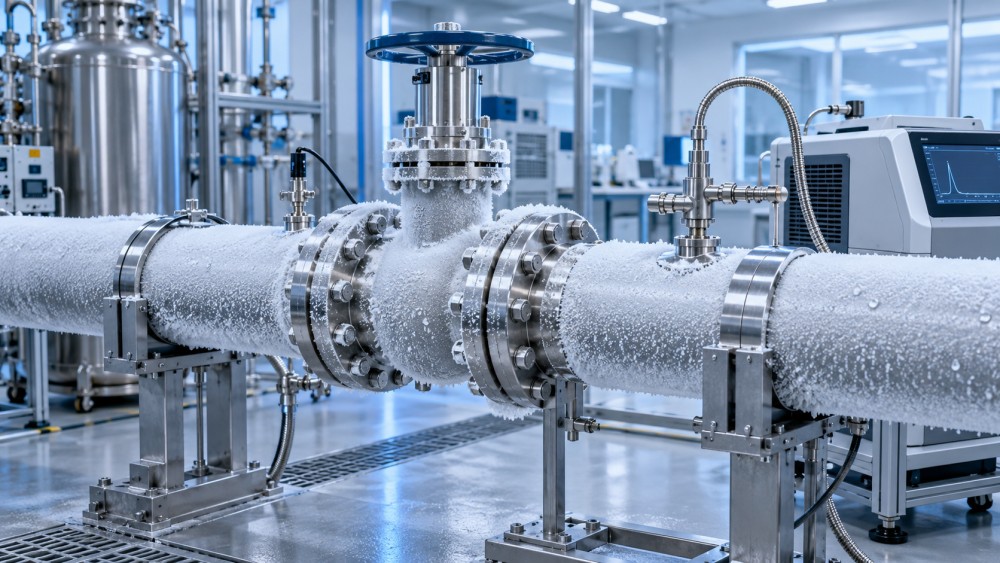
Standard pressure testing remains essential, but it cannot fully represent the stresses created when equipment approaches liquid-hydrogen temperatures, thermal cycling, vacuum conditions, or rapid cooldown during real operations.
At cryogenic temperatures, materials contract at different rates, elastomers lose flexibility, bolted joints redistribute load, and microscopic manufacturing imperfections can become active leak paths.
For quality teams, the central question is not simply whether an assembly holds pressure today. It is whether it remains leak-tight after cooling, cycling, vibration, and repeated operational loading.
This distinction matters most in liquid hydrogen storage, transfer systems, vacuum-insulated piping, cryogenic valves, loading connections, and interfaces linking cold equipment to higher-temperature process sections.
A component may pass a room-temperature helium test while still failing during cooldown. The test pressure can be correct, yet the mechanical state of the joint remains unrepresentative.
Cryogenic testing recreates the conditions that change geometry, material behavior, sealing force, and permeability. It therefore provides a stronger basis for release decisions and corrective-action priorities.
The process is especially valuable where hydrogen losses affect more than product economics. Escaped hydrogen can create flammability concerns, accelerate embrittlement risks, and undermine emissions reporting credibility.
For safety managers, cryogenic verification also supports defensible assurance. It demonstrates that leakage controls were evaluated under credible operating conditions rather than only under convenient laboratory conditions.
Which defects become visible only during cooldown
Thermal contraction is one of the main reasons cryogenic testing exposes hidden defects. Different metals, polymers, coatings, and insulation materials shrink differently as temperatures fall.
A flange assembly can lose gasket compression when bolts, flanges, and seals contract at unequal rates. Conversely, localized contraction can overload a brittle gasket or distorted sealing surface.
Valve stems and bonnet seals are frequent concern areas. Packing that performs adequately at ambient temperature may stiffen, shrink, crack, or lose contact pressure in cryogenic service.
Weld imperfections can also become more significant. Small lack-of-fusion zones, porosity clusters, undercut areas, and residual-stress concentrations may open as the surrounding material contracts.
In vacuum-insulated systems, damaged jackets, poorly sealed penetrations, or defective multilayer insulation can compromise thermal performance before a direct process-fluid leak is evident.
That degradation increases boil-off, raises operating costs, and may create frost patterns that obscure the actual failure mechanism. Cryogenic testing helps separate insulation failures from containment leaks.
Cold-induced movement can also expose inadequate pipe supports, expansion allowances, and flexible connections. A leak sometimes originates from mechanical restraint rather than from the pipe wall itself.
Quality investigations should therefore examine the complete assembly: piping, supports, welds, valves, instruments, transition joints, vacuum spaces, and interfaces with adjacent equipment.
How a practical cryogenic leak-test program works
An effective program starts with a defined test objective. Teams should specify whether they are verifying pressure containment, external leakage, vacuum integrity, insulation performance, or cycling durability.
The test boundary must be documented before cooldown begins. This includes isolation points, vent routes, pressure-relief provisions, measurement locations, and acceptable leak-rate criteria.
Helium is commonly used as a tracer because its small atomic size makes it highly effective for identifying fine leak paths. Hydrogen itself requires additional control measures.
Before cryogenic exposure, teams normally complete baseline visual inspections, dimensional checks, weld documentation reviews, and ambient leak tests. These results establish a useful comparison point.
Cooldown should be controlled rather than abrupt. Excessive thermal gradients can create test-induced damage that does not reflect intended operating conditions or valid equipment capability.
Temperature sensors should be placed where gradients are expected: valve bodies, flanges, branch connections, pipe supports, vessel nozzles, and transitions between dissimilar materials.
As the system cools, technicians monitor pressure, temperature, vacuum level, tracer-gas response, and visible indicators such as unusual frost formation or insulation surface temperature changes.
The test should include a stable hold period at the intended low temperature. Some leakage mechanisms emerge only after contraction stabilizes and the assembly reaches thermal equilibrium.
Choosing the right leak-detection method
No single method is sufficient for every hydrogen asset. The right approach depends on expected leak size, accessibility, system geometry, operating pressure, and the consequence of failure.
Helium mass-spectrometer testing offers high sensitivity and is widely used for critical welded assemblies, vacuum jackets, valve bodies, cryogenic vessels, and instrument penetrations.
In vacuum-mode testing, the component is evacuated and helium is applied externally. The detector identifies helium entering through defects, enabling precise localization of very small leaks.
Sniffer-mode testing is useful when the system can be pressurized with helium or a safe tracer mixture. A probe is moved around joints, welds, fittings, and suspected leak locations.
Pressure-decay testing can identify larger containment losses, but it is less sensitive and can be distorted by temperature changes. It should not be treated as proof of fine leak-tightness.
Bubble testing has value for accessible joints and gross leaks, although conventional fluids may not suit cryogenic surfaces. It is generally a supplementary method, not a final acceptance tool.
Infrared gas imaging and fixed hydrogen detectors can support operational monitoring. However, they typically complement rather than replace controlled cryogenic tracer-gas testing during qualification.
For vacuum-insulated equipment, vacuum-rise measurements and thermal-performance data may reveal jacket integrity problems even when external visual inspection shows no obvious defect.
Where quality teams should focus inspection effort
Prioritize locations where geometric change, assembly complexity, or repeated human intervention increases leakage probability. These points usually offer greater risk reduction than broad, uniform testing.
Flanged connections deserve close attention because their sealing performance depends on surface finish, bolt loading, gasket selection, alignment, and contraction behavior during cooldown.
Welded joints should be evaluated according to fabrication history, nondestructive examination results, repair records, material thickness changes, and proximity to supports or nozzles.
Valve assemblies require particular scrutiny at bonnet seals, stem packing, seat interfaces, body-to-bonnet joints, drain ports, and instrument connections that experience frequent thermal cycling.
Transfer hoses and flexible connectors are high-risk items because they experience bending, connection cycles, handling damage, and repeated cooldown. Their service life must be actively managed.
Instrumentation penetrations can create overlooked leak paths. Pressure transmitters, level sensors, thermowells, cable entries, and impulse lines often combine small seals with difficult access.
For liquid hydrogen tanks, inspect vacuum ports, safety-relief interfaces, fill and withdrawal lines, nozzle welds, support structures, and annular-space monitoring arrangements.
High-pressure hydrogen systems connected to cryogenic processes also need attention. Temperature transitions can affect fittings, compression joints, regulators, and materials selected for warmer service.
Interpreting results without creating false confidence
A detected leak rate is useful only when interpreted against defined acceptance criteria. Teams should establish limits based on safety, product loss, equipment purpose, and relevant standards.
Acceptance criteria should distinguish between process containment leakage, vacuum-jacket leakage, and external fugitive emissions. These conditions have different consequences and require different corrective actions.
Testing records should capture the actual thermal state when measurements were taken. A passing result at partial cooldown does not necessarily demonstrate performance at the minimum design temperature.
It is equally important to document test pressure, tracer concentration, detector sensitivity, background readings, calibration status, hold time, and the specific locations examined.
False positives can arise from residual tracer gas, poor ventilation, contaminated test areas, or incorrect probe technique. A clear retest protocol prevents unnecessary repairs and schedule disruption.
False negatives are often more dangerous. They can result from inaccessible areas, inadequate stabilization time, insufficient tracer-gas concentration, sensor positioning errors, or incomplete test boundaries.
When a leak is found, teams should avoid treating sealing repair as the only solution. The underlying cause may involve alignment, support restraint, material incompatibility, weld quality, or assembly practice.
A corrective-action report should link the defect to a root cause, repair method, retest result, and preventive control. This turns individual findings into stronger future procurement and fabrication requirements.
Managing safety during cryogenic testing
Cryogenic testing introduces hazards beyond normal pressure testing. These include hydrogen flammability, oxygen condensation, cold burns, brittle fracture, pressure release, and reduced visibility around frosting equipment.
A test plan should define exclusion zones, ignition-source control, ventilation requirements, emergency isolation, gas detection, communications, and clear authority for stopping the test.
Personnel need training on cryogenic behavior as well as leak-detection equipment. A technician who recognizes abnormal frosting or vacuum changes can prevent a developing incident.
Vent discharge points must be reviewed carefully. Hydrogen or helium releases can displace oxygen in enclosed areas, while hydrogen accumulation can create an ignition hazard in poorly ventilated spaces.
Personal protective equipment should address both cryogenic contact and task-specific hazards. Gloves, face protection, insulated clothing, and appropriate footwear are necessary but do not replace procedural controls.
Testing should also account for oxygen-enriched conditions. Air can condense on extremely cold surfaces, creating local environments that increase combustion severity if hydrocarbons or ignition sources are present.
Safety managers should require pre-job reviews whenever test configurations change. Temporary hoses, altered vent paths, revised isolation boundaries, and new instruments can change the risk profile.
Good testing discipline protects people while preserving data quality. Uncontrolled interruptions, rushed cooldowns, and undocumented deviations can invalidate results even when no immediate incident occurs.
Using cryogenic test data to improve asset decisions
Cryogenic testing for hydrogen infrastructure is most valuable when its findings influence design, supplier qualification, maintenance planning, and operational readiness instead of remaining isolated test reports.
Repeated leaks at similar locations may indicate a specification problem. For example, a gasket material, valve design, weld procedure, or support arrangement may be unsuitable for the duty cycle.
Supplier scorecards can include cryogenic test performance, repair frequency, traceability quality, and retest outcomes. This provides stronger procurement insight than relying only on certificates of conformity.
For existing assets, test data supports risk-based maintenance. Components with recurring thermal-cycle leakage can receive targeted inspection intervals, planned replacement, or engineering redesign before failure escalates.
Investment and operations leaders can also use the information to evaluate lifecycle cost. Lower boil-off, fewer outages, reduced repair exposure, and improved availability may justify more rigorous qualification testing.
The strongest programs combine design review, material verification, fabrication controls, ambient testing, cryogenic testing, commissioning checks, and continuous operational monitoring across the asset lifecycle.
Standards such as ASME B31.12, ISO 19880, and relevant project specifications provide important reference points, but acceptance decisions should still reflect the actual operating envelope and failure consequences.
Teams should define measurable lessons learned after every major campaign. The objective is not merely to pass a test, but to reduce uncertainty about long-term hydrogen containment.
Conclusion: test the condition where failure is most likely
Hydrogen systems should not be judged solely by room-temperature performance when their intended service includes extreme cold, high pressure, thermal cycling, or vacuum-insulated liquid-hydrogen operations.
Cryogenic testing exposes leaks because it reveals the real interaction between material contraction, seal behavior, weld integrity, mechanical restraint, and insulation performance under demanding conditions.
For quality-control personnel, the priority is a disciplined method: establish a representative test condition, apply suitable detection technology, inspect high-risk interfaces, and record meaningful acceptance evidence.
For safety managers, the priority is equally clear: treat cryogenic leak testing as a critical assurance activity that protects people, maintains containment, and strengthens confidence in hydrogen infrastructure readiness.
Related News
- Choosing K9 Ductile Iron Pipe for Buried Water MainsNov 06, 2026K9 ductile iron pipe selection starts beyond the label. Explore pressure, soil, corrosion and joint checks to make a confident procurement decision.
- How to detect leaks in vacuum-insulated hydrogen transport linesOct 24, 2026Improve hydrogen transport systems leak detection: discover how vacuum monitoring, hydrogen sensing, and helium testing help identify leaks in vacuum-insulated lines safely.
- How cryogenic testing exposes leaks in hydrogen infrastructureOct 13, 2026Cryogenic testing for hydrogen infrastructure reveals hidden leaks, seal failures, and insulation defects under real cold conditions—improving safety, uptime, and asset confidence.
- How vacuum insulated piping reduces hydrogen transport lossesOct 02, 2026Hydrogen transport infrastructure benefits from vacuum insulated piping by reducing heat leak, boil-off, pressure instability, and costly transfer losses.
Related News
- 00
0000-00
Hydrogen Energy Storage for Data Centers Gets Costly Fast - 00
0000-00
When 99.999% Hydrogen Purity Still Is Not Good Enough - 00
0000-00
When Does a Hydrogen-Ready Gas Turbine Pay Off? - 00
0000-00
Electricity Price Volatility Is Rewriting Hydrogen Cost Models - 00
0000-00
PSA Recovery Rate Drops for Reasons Operators Miss
Marcus Valve
Weekly Insights
Stay ahead with our curated technology reports delivered every Monday.