How to Align Hydrogen Storage Contracts with ASME B31.12




How to Align Hydrogen Storage Contracts with ASME B31.12
How to align hydrogen storage contracts with ASME B31.12? The practical answer is not “add the standard to the technical specification.” That approach looks tidy in a bid package but leaves too much unresolved once design temperatures, material certificates, welding qualifications, pressure tests, and commissioning records start moving between the owner, EPC contractor, fabricator, and site team.
For hydrogen projects, contract language has to turn a code requirement into a chain of auditable obligations. ASME B31.12 addresses hydrogen piping and pipelines, not every component inside a storage package. A high-pressure vessel, for example, may be governed principally by the ASME Boiler and Pressure Vessel Code or another applicable vessel code, while the piping connecting storage banks, compressors, dispensers, electrolyzers, vaporizers, or export headers may fall within ASME B31.12. Confusing those boundaries is one of the fastest ways to create a compliance gap.
That distinction matters particularly in large-scale hydrogen infrastructure. A facility may combine megawatt-scale PEM or alkaline electrolysis, gaseous storage, liquid-hydrogen transfer systems, refueling equipment above 70 MPa, and hydrogen-ready power generation. Each interface has different design assumptions. The contract should make those interfaces visible before procurement begins, not after a supplier has already selected materials and issued fabrication drawings.
Start by defining the code boundary, not just the asset name
“Hydrogen storage system” is commercially convenient language, but it is too broad for code allocation. A storage package can include pressure vessels, tube trailers, manifolds, isolation valves, pressure-relief devices, vent piping, instruments, supports, compressor tie-ins, and control logic. Not all of these items are designed, fabricated, or inspected under the same rules.
A well-written contract therefore includes a battery-limits definition and a code applicability matrix. The matrix does not need to reproduce the standard. It should identify each system segment, its design owner, the governing code or standard, and the party responsible for demonstrating compliance. This is especially useful at the line between packaged equipment and field-installed piping, where responsibilities often become blurred.
The contract should also state the exact edition of ASME B31.12 being invoked. “Latest edition” can sound sensible, but it creates ambiguity when the project design basis, local approval process, and fabrication schedule span different publication dates. If the project intends to adopt later revisions, establish a formal change-control mechanism: identify who reviews the impact, who absorbs cost, and whether previously approved documents need revision.
Convert hydrogen service conditions into contractual design inputs
Hydrogen service is not simply natural-gas service with a different gas composition entered on a data sheet. Material behavior, leakage sensitivity, cyclic loading, pressure ramping, and the consequences of a small defect need attention. Contract schedules should require the contractor to document the design basis used for every defined piping class or piping segment.
At a minimum, that basis should address design pressure, design temperature range, hydrogen purity or expected contaminants, flow direction, operating cycles, transient conditions, intended service life, external environment, and the consequences of depressurization. For a facility connected directly to an electrolyzer, the operating profile may differ sharply from a buffer-storage system serving a refueling station or a turbine fuel train. A system that cycles frequently may need a different engineering focus than a line held at relatively stable pressure.
Avoid a generic clause stating that equipment must be “suitable for hydrogen.” It is hard to inspect and even harder to enforce. Require the supplier or EPC contractor to submit a material-selection report that links base materials, weld consumables, seals where relevant, pressure-containing components, and corrosion or environmental assumptions to the stated hydrogen duty. The owner does not need to prescribe every alloy or component selection in the commercial contract. What matters is that the selection is traceable, reviewed, and cannot quietly change through a substitution request.
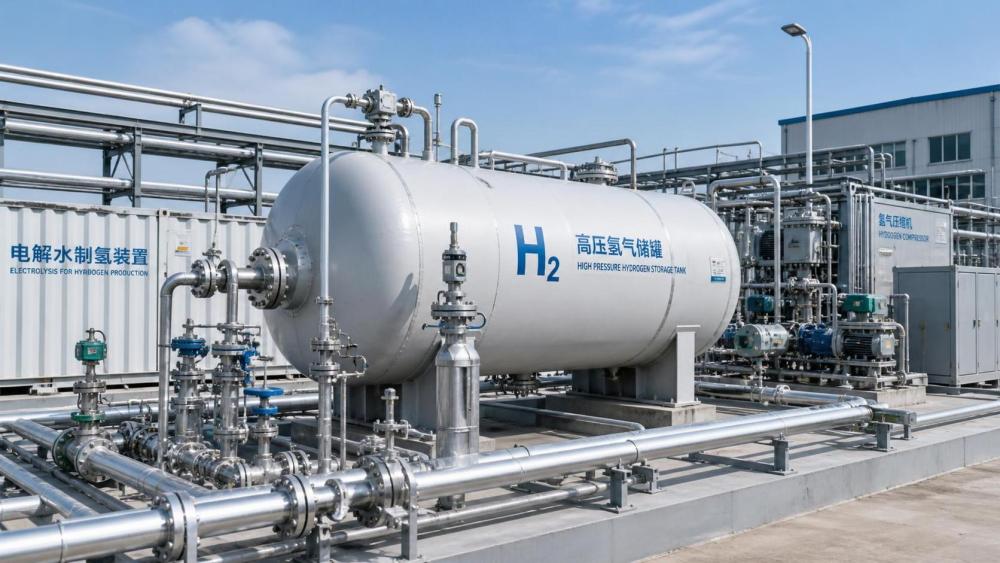
This is where technical benchmarking can add discipline. In the G-HEI approach to zero-carbon infrastructure, high-performance assets are assessed across the full chain: electrolyzer output, compression or liquefaction, storage, transport, and final use. That is useful because a piping decision made around a storage manifold can be affected by upstream gas quality, downstream pressure cycling, or a future expansion to refueling or power-generation service. The contract should require interface data to be maintained, rather than treating each package as an isolated purchase.
Make fabrication, welding, and traceability deliverables explicit
Many disputes do not arise because a contractor ignored ASME B31.12 outright. They arise because the owner expected a deeper evidence trail than the contractor priced. If material traceability, weld mapping, examination records, or repair controls are important, they must appear in the contract deliverables register and inspection-and-test plan.
For pressure-containing piping in hydrogen service, contract requirements commonly need to cover approved material specifications, material test reports, positive material identification where specified by the project, heat-number traceability, welding procedure specifications, procedure qualification records, welder performance qualifications, and weld maps. The precise level of examination should follow the applicable code, project class, and risk assessment; it should not be invented through a blanket commercial phrase such as “100% tested.” More testing is not automatically better if it is poorly specified, badly sequenced, or disconnected from acceptance criteria.
The same applies to nonconformities. A contract should distinguish between a concession, a repair, and a design change. It should state who can accept each one. A field team should not be able to approve a material substitution or weld repair affecting hydrogen-service integrity simply because the schedule is tight. Reserve final technical authority for a named owner representative or independent engineer, with a clear review route.
A practical point on subcontractors
Packaged-skid suppliers often outsource bends, fittings, specialty valves, fabrication, coatings, or nondestructive examination. The prime contractor should remain accountable for code compliance and document completeness, even when the physical work is performed elsewhere. Require disclosure of critical subcontractors and retain audit rights for high-risk fabrication activities. Without that provision, the owner may receive a completed skid but lack access to the records needed for commissioning, insurer review, regulator engagement, or future modification.
Tie inspection and testing to acceptance, not to a vague promise of compliance
A hydrogen storage contract should specify hold points and witness points early enough to matter. The owner or its appointed inspector may need the right to review material receipt, fit-up, weld documentation, pressure-test preparation, test execution, reinstatement, and final dossier completion. If these rights appear only in a general quality clause, they are often interpreted as optional site visits rather than acceptance gates.
Testing clauses need particular care. State the required test basis, medium where applicable, test boundaries, calibrated instrument requirements, duration or stabilization expectations if defined by project procedures, safety controls, leak-test requirements, and criteria for retest after repair. The detailed requirements must remain consistent with the applicable code and local rules. Where site conditions make a conventional test difficult, the alternative method should be proposed, technically justified, and approved before installation—not introduced as a late workaround.
Completion should not mean “mechanically complete” alone. A better acceptance structure separates mechanical completion, test completion, dossier completion, commissioning support, and final handover. This protects both sides: the contractor knows what evidence is needed for payment, while the owner is not forced to accept an asset whose records arrive months after it is energized.
Do not overlook relief, venting, and operational interfaces
ASME B31.12 alignment is only one layer of hydrogen risk management. The piping code does not replace site safety design, hazardous-area classification, emergency shutdown philosophy, detection systems, fire protection review, or local permitting obligations. Contracts should identify these interfaces and assign ownership. A storage package vendor may size or supply a relief device, for example, while the EPC contractor remains responsible for integrating the discharge piping and safe release location into the site layout.
This is particularly relevant where gaseous storage interfaces with cryogenic liquid-hydrogen logistics, high-pressure refueling, or a hydrogen-ready turbine. Standards such as ISO 19880 and SAE J2601 may become relevant in specific applications, but they should be referenced only where their scope actually fits the facility. Listing every familiar hydrogen standard in a contract can create contradictory obligations. A controlled standards register is more useful: each reference should have a defined purpose, precedence order, and responsible party.
Use change control to protect the asset over its operating life
Hydrogen projects evolve. An initial storage installation may later connect to more electrolyzer capacity, a blending network, a trailer-loading bay, or a refueling island. Contracts should therefore preserve the records needed for future modifications: line lists, piping and instrumentation diagrams, isometrics, stress-analysis outputs where required, valve data, material records, weld maps, test packs, relief-device documentation, and as-built drawings.
The better contract also requires a formal review when operating conditions move beyond the original design basis. A pressure increase, a change in cycling pattern, altered gas quality, replacement component, or rerouting of a vent line can affect more than one discipline. It should trigger an engineering assessment, not merely a maintenance note.
Ultimately, aligning a hydrogen storage contract with ASME B31.12 means making compliance inspectable from design through handover. Define the boundary, name the applicable edition, document hydrogen service conditions, require traceable fabrication evidence, set meaningful test gates, and control changes after award. For investors, utilities, and public-sector decision makers building strategic hydrogen capacity, that level of contract discipline is not administrative overhead. It is how technical intent survives procurement pressure, schedule pressure, and the long operating life of zero-carbon infrastructure.
Related News
- How cryogenic testing exposes leaks in hydrogen infrastructureOct 13, 2026Cryogenic testing for hydrogen infrastructure reveals hidden leaks, seal failures, and insulation defects under real cold conditions—improving safety, uptime, and asset confidence.
- How vacuum insulated piping reduces hydrogen transport lossesOct 02, 2026Hydrogen transport infrastructure benefits from vacuum insulated piping by reducing heat leak, boil-off, pressure instability, and costly transfer losses.
- How to load following hydrogen systems without exceeding pipe pressure limitsSep 30, 2026Load following hydrogen systems safely with staged pressure control, trapped-volume protection, and proven steps to prevent pipe overpressure.
- Which logistics packaging best protects vacuum insulated piping in transit?Sep 03, 2026Logistics packaging for vacuum insulated piping: discover engineered transport frames, moisture barriers, and monitoring controls that reduce transit damage and protect cryogenic project schedules.
Related News
- 00
0000-00
Hydrogen Energy Storage for Data Centers Gets Costly Fast - 00
0000-00
When 99.999% Hydrogen Purity Still Is Not Good Enough - 00
0000-00
When Does a Hydrogen-Ready Gas Turbine Pay Off? - 00
0000-00
Electricity Price Volatility Is Rewriting Hydrogen Cost Models - 00
0000-00
PSA Recovery Rate Drops for Reasons Operators Miss
Marcus Valve
Weekly Insights
Stay ahead with our curated technology reports delivered every Monday.