
Which logistics packaging best protects vacuum insulated piping in transit?




Which logistics packaging best protects vacuum insulated piping in transit?
Selecting the right logistics packaging is critical to protecting vacuum insulated piping from shock, vibration, moisture, and costly vacuum-loss risks during transit.
For hydrogen and cryogenic infrastructure projects, project leaders need more than standard crates: they need engineered protection that preserves integrity, dimensional accuracy, and compliance readiness.
The short answer is that the best logistics packaging is usually a purpose-designed, transport-frame system with restrained supports, multilayer environmental barriers, monitored handling controls, and route-specific protection.
A conventional wooden crate may protect exterior surfaces, but it rarely manages the forces that threaten vacuum-jacketed pipe assemblies, sensitive valves, supports, and instrument connections.
For project managers, the decision should be based on total installation risk rather than packaging purchase price alone. A damaged vacuum section can delay commissioning, trigger retesting, and affect safety documentation.
This article addresses the practical evaluation questions behind the search for logistics packaging: what must be protected, which packaging features matter, and how requirements should be specified.
It is particularly relevant for liquid hydrogen, liquid nitrogen, liquefied natural gas, industrial gas, and other cryogenic projects where piping performance depends on insulation continuity and vacuum integrity.
Start With the Failure Modes That Packaging Must Prevent
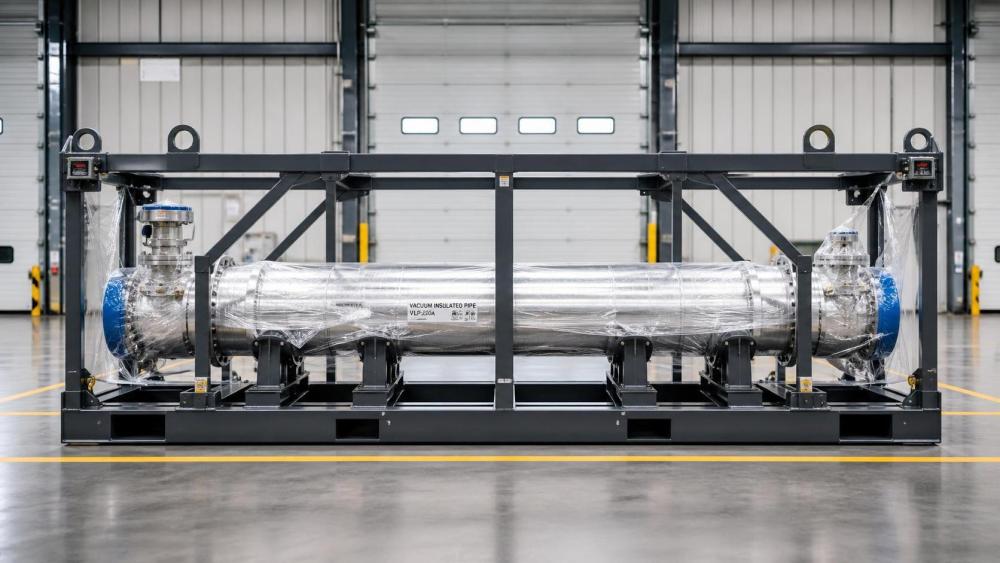
Vacuum insulated piping contains an inner process line, an evacuated annular space, an outer jacket, insulation materials, and often engineered supports between concentric pipe walls.
Transit damage is not limited to visible dents. Excessive acceleration can shift internal supports, damage expansion elements, stress welds, or create microscopic leaks that compromise thermal performance.
The most serious consequence is vacuum degradation. If the annular space loses vacuum, heat ingress increases, cryogenic fluid boil-off rises, and the installed system may fail performance acceptance tests.
Project teams should therefore assess packaging against four primary threats: impact, vibration, moisture exposure, uncontrolled lifting, and dimensional distortion during storage or transport.
Impact commonly occurs during forklift handling, crane transfers, truck loading, container stuffing, and last-mile delivery at constrained industrial construction sites.
Vibration is more gradual but equally important. Long-distance road transport, rail movement, marine shipment, and poor road surfaces can transmit repeated loads into unsupported pipe sections.
Moisture can corrode exposed carbon-steel structures, contaminate connection faces, degrade labeling, and weaken packaging materials before the equipment reaches the project site.
Dimensional distortion is particularly concerning for prefabricated spools. A slightly bent assembly may appear usable yet create alignment problems at field joints, supports, valves, or equipment nozzles.
The correct logistics packaging strategy begins with a transport risk assessment, not a standard crate selection. The packaging must reflect pipe diameter, length, mass, fragility, route, and installation sequence.
Why Engineered Transport Frames Usually Offer the Best Protection
For most vacuum insulated piping assemblies, the strongest option is an engineered steel or timber transport frame designed specifically around approved lifting points and support locations.
Unlike a loose crate, a transport frame prevents the piping from moving independently inside the package. Controlled restraint is essential because free movement converts routine handling into damaging impact.
The frame should support the outer jacket only at manufacturer-approved points. Supports must avoid concentrated loading near bellows, valves, bayonet connections, instrumentation, and sensitive transition sections.
Where long pipe runs are shipped, multiple saddles or cradles should distribute weight across the assembly. Spacing should be validated against the supplier's transport support calculations.
Cradles should use non-abrasive, load-rated contact materials. High-density elastomer pads, engineered polymer liners, or protected timber interfaces can prevent coating damage and localized jacket deformation.
Rigid metal-to-metal contact should generally be avoided unless the equipment manufacturer explicitly approves it. Unprotected contact can create stress concentrations and surface damage during vibration.
Restraints should stop lateral, vertical, and longitudinal movement without compressing the vacuum jacket. Over-tightened straps are a common mistake because they appear secure while creating hidden damage risks.
Bolted clamps, padded hold-downs, and engineered cross-bracing are usually more reliable than generic ratchet straps. Each restraint should have a defined load path and inspection point.
For large-diameter vacuum-jacketed pipe, the frame should include lifting pockets or certified lifting lugs. This reduces improvised rigging decisions during loading and receiving.
A well-designed frame also creates a stable footprint for temporary storage. It allows pipe assemblies to remain supported correctly while installation sequencing, civil works, or weather conditions change.
Use Layered Environmental Packaging Around the Structural Frame
Structural restraint protects against movement, but it does not provide sufficient environmental protection. The frame should be combined with layered barriers appropriate to the transport route and storage duration.
An inner protective wrap can shield polished surfaces, identification labels, flanges, and exposed connections from abrasion. Materials should not leave adhesive residues or trap moisture against metal surfaces.
Vapor barrier film is useful for marine shipments, humid climates, and extended storage. It should be sealed carefully while allowing approved desiccant placement where necessary.
Desiccants should be sized for the enclosed packaging volume, expected transit period, and anticipated humidity exposure. Randomly adding small packets provides little assurance for large industrial packages.
For overseas transport, corrosion protection should consider the outer jacket material, support steel, fasteners, exposed flange faces, and temporary protective caps.
Volatile corrosion inhibitor materials may be appropriate for certain metallic surfaces, provided they are compatible with project cleaning procedures and supplier material requirements.
Connection ends require special attention. Flanges, bayonets, valves, instrument ports, and pressure-relief interfaces should use purpose-made caps that resist impact and prevent contamination.
Simple plastic caps can be adequate for light contamination control, but they should not be assumed to provide mechanical protection during forklift contact or cargo shifting.
Where equipment is transported in open-deck conditions, a weatherproof outer cover should be secured without becoming a wind-loaded sail. Drainage and inspection access must remain possible.
The packaging design should identify whether outdoor storage is permitted. A package built for three days of truck transport is not automatically suitable for six months in an exposed laydown yard.
Match Packaging to the Actual Logistics Route and Handling Plan
The most effective logistics packaging changes with the journey. A pipe spool transported directly by dedicated truck faces different hazards than one moving through ports, containers, warehouses, and multiple carriers.
Project managers should map every transfer point before approving packaging. Damage often occurs at interfaces where responsibility changes and handling instructions are not communicated effectively.
Dedicated road transport may require reinforced saddles, anti-slip base details, and trailer tie-down points. The package should be secured through its transport frame, never directly through the pipe assembly.
Containerized shipments need attention to internal width, door clearance, floor loading, lashing positions, and potential condensation. A package that fits nominal dimensions may still be difficult to unload safely.
Breakbulk or flat-rack shipments require stronger weather protection and marine lashing design. Dynamic vessel motion can impose loads far beyond those experienced during ordinary road transport.
For air freight, packaging mass and dimensions may become commercial constraints. However, reducing frame strength simply to lower shipping cost can create a disproportionate technical risk.
Remote construction sites create another category of exposure. Rough roads, repeated loading, limited lifting equipment, dust, and untrained handlers may justify additional frame protection and clearer visual controls.
Handling instructions should be physically visible on all accessible package sides. They should identify lifting points, center of gravity, stacking restrictions, orientation, and prohibited contact areas.
Labels alone are insufficient unless they are reinforced through carrier briefings, lifting plans, and receiving inspections. Packaging succeeds when operational controls support the engineering design.
Specify Shock and Tilt Monitoring for High-Value Cryogenic Equipment
For critical vacuum insulated piping, shock and tilt indicators provide useful evidence when shipment damage is suspected. They also encourage more disciplined handling by logistics providers.
Basic mechanical indicators can show whether a package exceeded a selected impact or tilt threshold. They are inexpensive, but they do not record timing, duration, or the exact transport location.
Electronic data loggers offer stronger traceability. They can record acceleration, tilt events, temperature, humidity, location, and time data throughout a complex multimodal shipment.
The threshold values should not be chosen arbitrarily. Equipment manufacturers should define allowable transport acceleration limits based on pipe geometry, support design, and vulnerable components.
Monitoring data is most valuable when the project has a defined response procedure. A triggered indicator should lead to quarantine, inspection, and documented technical disposition.
Without that procedure, monitoring becomes a compliance accessory rather than a useful risk-control tool. Teams need clarity on who reviews data and who authorizes release.
For strategic hydrogen infrastructure, chain-of-custody records can also support warranty discussions, insurance claims, quality audits, and root-cause investigations after installation issues.
Digital monitoring is especially valuable when equipment crosses national borders or changes logistics providers. It creates a factual record independent of informal handover reports.
Define Packaging Requirements in the Procurement Specification
Packaging should be treated as a technical procurement requirement, not an administrative shipping note issued after fabrication is complete. Early specification prevents expensive redesign and schedule disruption.
The purchase order should identify each assembly's dimensions, mass, center of gravity, approved support points, lifting points, maximum stacking load, and allowable transport orientation.
It should also state environmental requirements, including maximum storage duration, indoor or outdoor storage conditions, corrosion prevention measures, and required protection for connection interfaces.
For vacuum insulated piping, the specification should require that transportation supports are reviewed or approved by the piping manufacturer. Generic packaging assumptions should not override product-specific handling rules.
Include requirements for packaging drawings before shipment. Drawings should show frame dimensions, support locations, restraint methods, lifting provisions, protective layers, and tie-down interfaces.
Project teams should request a packing list linked to package numbers and component serial numbers. This helps receiving teams verify that critical spools and accessories arrive together.
Photographic records before closure are also valuable. They document internal restraint condition and can reveal whether packaging was changed after final inspection.
For international projects, specifications should address wood treatment requirements, export markings, customs documentation, dangerous-goods separation, and local import restrictions.
Relevant standards may include project-specific transport rules, ISO packaging practices, contractual quality plans, and the engineering requirements supporting ASME B31.12 or other applicable piping systems.
Standards do not replace detailed packaging design. They establish a framework, while the supplier must still demonstrate that the proposed logistics packaging protects the actual product configuration.
Inspect the Package at Factory Release and Site Receipt
A packaging inspection should occur before dispatch, ideally alongside final product inspection. Waiting until the shipment reaches site removes the opportunity to correct preventable packaging deficiencies.
The factory inspection should confirm that all supports match the approved drawing, restraints are secure, protective caps are fitted, labels are visible, and monitoring devices are activated.
Inspectors should verify that no sharp edges, protruding fasteners, or loose materials can contact the pipe during transit. Small omissions can become serious under repeated vibration.
At site receipt, the team should inspect the external package before unloading. Damage to the frame, wraps, indicators, or weather barrier should be recorded immediately.
Do not remove damaged packaging until photographs, carrier notifications, and technical review requirements are understood. Early uncontrolled unpacking can weaken evidence for a claim.
After unpacking, inspect outer jackets, weld regions, supports, valves, flanges, caps, labels, and dimensional alignment. Compare findings against factory photographs and release records.
Where a significant shock event occurred, the owner should consult the manufacturer before installation. Additional leak testing, vacuum verification, alignment checks, or non-destructive examination may be justified.
Receiving inspections should be planned around installation needs. A package may need to remain protected until the area is ready, rather than being unpacked immediately into an exposed laydown zone.
Evaluate Cost Through Schedule Protection and Asset Risk
Engineered logistics packaging costs more than basic crating, but the comparison should include the avoided cost of replacement, rework, delayed commissioning, and specialist inspection.
A single damaged vacuum-jacketed spool can affect multiple downstream work packages. Installation crews, lifting teams, insulation specialists, quality personnel, and commissioning schedules may all be disrupted.
For hydrogen projects, schedule consequences can be especially severe because equipment interfaces are tightly coordinated across storage, transfer, fueling, vaporization, and safety systems.
The financial value of packaging increases with pipe complexity, delivery lead time, geographic remoteness, and the difficulty of obtaining replacement components.
Project managers should prioritize stronger packaging for long-lead assemblies, proprietary connections, prefabricated valve stations, transition spools, and items needed on the critical path.
Commodity pipe sections may justify simpler protection when technical risk is low. The packaging level should be proportional to consequence, not identical for every shipment.
A useful commercial measure is the cost of packaging as a percentage of the installed asset value and likely delay exposure. This usually makes engineered protection easier to justify.
Build a Practical Decision Matrix Before Releasing Shipment
Before approving logistics packaging, project leaders can use a structured decision matrix covering product vulnerability, route complexity, environmental exposure, handling frequency, and replacement consequences.
High-vulnerability assemblies should receive rigid transport frames, validated support points, controlled restraints, moisture barriers, shock monitoring, detailed drawings, and mandatory pre-shipment inspection.
Medium-risk assemblies may use simplified frames and protective wrapping, provided transport is direct, lifting is controlled, and the manufacturer confirms adequate support spacing.
Low-risk components can use standard crates or bundled packaging when they are mechanically robust, easily replaceable, protected from corrosion, and unlikely to affect the project critical path.
The decision matrix should include site storage conditions. A package that survives transport may still fail its purpose if it cannot protect equipment during delayed installation.
It should also assign ownership. Engineering defines acceptable loads, procurement includes requirements, suppliers design packages, logistics providers follow handling controls, and site teams verify receipt condition.
Clear ownership closes the gap between technical design and physical delivery. Vacuum insulated piping should arrive as an installation-ready asset, not as a shipment requiring emergency assessment.
Conclusion: Treat Logistics Packaging as Part of Asset Protection
The best logistics packaging for vacuum insulated piping is an engineered system, not simply a stronger box. It combines approved structural support, controlled restraint, environmental barriers, traceable monitoring, and disciplined handling.
For project managers, the key question is not whether packaging prevents cosmetic damage. It is whether it preserves vacuum performance, dimensional fit, safety assurance, and installation schedule certainty.
Prioritize transport frames designed around manufacturer-approved support points, then add route-specific weather protection, monitoring, documentation, and receipt inspections proportionate to asset criticality.
When logistics packaging is specified early and verified rigorously, hydrogen and cryogenic projects reduce avoidable damage, protect high-value infrastructure, and arrive at commissioning with fewer technical uncertainties.
Related News
- How cryogenic testing exposes leaks in hydrogen infrastructureOct 13, 2026Cryogenic testing for hydrogen infrastructure reveals hidden leaks, seal failures, and insulation defects under real cold conditions—improving safety, uptime, and asset confidence.
- How vacuum insulated piping reduces hydrogen transport lossesOct 02, 2026Hydrogen transport infrastructure benefits from vacuum insulated piping by reducing heat leak, boil-off, pressure instability, and costly transfer losses.
- How to load following hydrogen systems without exceeding pipe pressure limitsSep 30, 2026Load following hydrogen systems safely with staged pressure control, trapped-volume protection, and proven steps to prevent pipe overpressure.
- Which logistics packaging best protects vacuum insulated piping in transit?Sep 03, 2026Logistics packaging for vacuum insulated piping: discover engineered transport frames, moisture barriers, and monitoring controls that reduce transit damage and protect cryogenic project schedules.
Related News
- 00
0000-00
Hydrogen Energy Storage for Data Centers Gets Costly Fast - 00
0000-00
When 99.999% Hydrogen Purity Still Is Not Good Enough - 00
0000-00
When Does a Hydrogen-Ready Gas Turbine Pay Off? - 00
0000-00
Electricity Price Volatility Is Rewriting Hydrogen Cost Models - 00
0000-00
PSA Recovery Rate Drops for Reasons Operators Miss
Marcus Valve
Weekly Insights
Stay ahead with our curated technology reports delivered every Monday.