
How current density affects efficiency in alkaline water electrolysis




For technical evaluators of utility-scale hydrogen assets, alkaline water electrolysis current density is far more than a stack nameplate parameter. It is the operating lever that connects hydrogen throughput with electrical consumption, heat rejection, gas quality, component loading, and replacement economics. A higher current density can make a plant more compact and increase hydrogen output from the same electrode area. Yet the same decision may raise cell voltage, deepen thermal gradients, accelerate degradation mechanisms, and narrow the margin for stable operation.
This creates a familiar challenge during technology selection: the lowest capital cost per unit of installed hydrogen capacity is not automatically the lowest cost of hydrogen over the asset life. In alkaline electrolysis, the most credible design point is usually not the maximum current density demonstrated under controlled conditions. It is the point at which stack efficiency, balance-of-plant capability, renewable-power profile, safety controls, and expected stack life remain aligned.
Current density: the throughput variable with system-wide consequences
Current density is the electrical current passing through a defined active electrode area, typically expressed in A/cm² or kA/m². At a basic level, hydrogen production follows Faraday’s law: increasing current increases the rate at which water is split, provided that Faradaic efficiency remains high and gas crossover is controlled. For a given stack active area, doubling current density approximately doubles theoretical hydrogen output.
That relationship is appealing because electrolyzer stacks are capital-intensive assemblies. If more hydrogen can be produced from fewer cells, the plant may require less stack hardware, less building space, fewer electrical interfaces, and potentially less duplicated auxiliary equipment. For installations constrained by footprint—industrial retrofits, ports, refueling hubs, or co-located renewable sites—this is a material advantage.
However, hydrogen output is only one side of the engineering equation. The voltage required to sustain electrolysis rises as current density rises. Since electrical energy consumption is determined by voltage and current, the incremental hydrogen produced at a higher loading may require disproportionately more electricity. In markets where power cost dominates lifecycle economics, this penalty can quickly outweigh a reduction in installed stack area.
Why cell voltage rises at higher loading
An alkaline electrolyzer cell must overcome the reversible thermodynamic voltage for water splitting, along with several real-world losses. At operating temperature, the actual cell voltage can be viewed as the reversible voltage plus activation, ohmic, and mass-transport overpotentials. The thermoneutral voltage, commonly referenced near 1.48 V under standard conditions, is also important because it indicates the boundary between net heat absorption and net heat generation. Actual plant behavior depends on temperature, pressure, electrolyte concentration, and operating configuration.
- Activation overpotential reflects the kinetic energy needed to drive the hydrogen evolution reaction at the cathode and the oxygen evolution reaction at the anode. The oxygen side is generally the more demanding reaction in alkaline systems.
- Ohmic loss arises from ionic resistance in the electrolyte and separator or diaphragm, as well as electronic resistance in electrodes, current collectors, connections, and busbars. It tends to increase strongly with current density.
- Mass-transport loss becomes more relevant when gas bubbles, electrolyte circulation limits, concentration gradients, or restricted flow paths impede access to active catalytic surfaces.
At modest loading, voltage may rise in a relatively manageable manner. As the stack approaches more aggressive operating conditions, the slope can steepen. Bubble coverage blocks electrochemically active area, local current distribution becomes less uniform, and gas evacuation becomes increasingly important. The result is not merely a higher average voltage on a performance curve; it can be uneven electrochemical stress across large-format electrodes and across the stack.
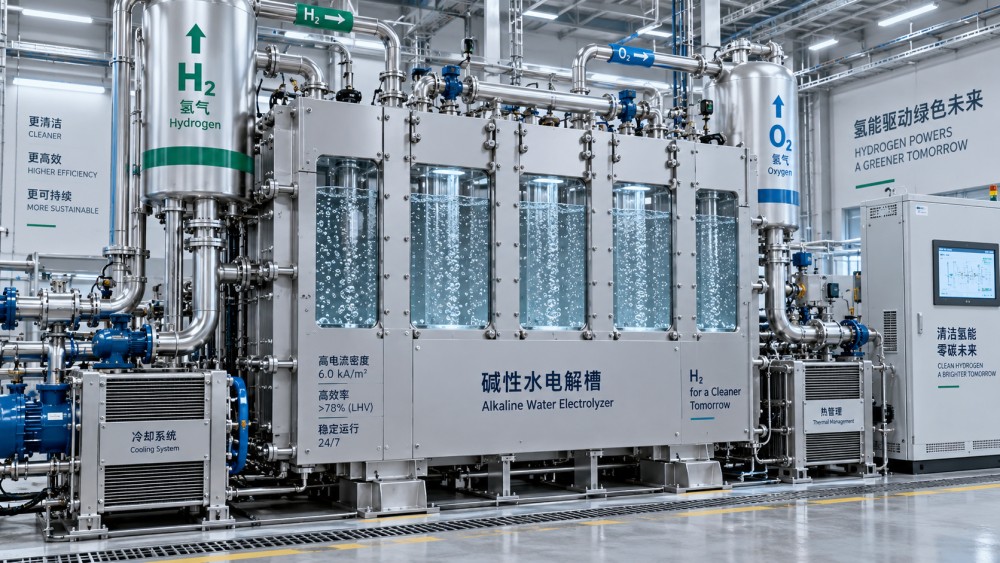
The efficiency trade-off is not captured by a single kWh figure
When comparing alkaline water electrolysis current density options, evaluators should distinguish between stack efficiency and plant-level efficiency. Stack data may be reported on a direct-current basis, often using lower heating value (LHV) or higher heating value (HHV) conventions. Neither basis is inherently wrong, but comparisons become misleading if the convention is unstated. The electrical demand of rectifiers, pumps, cooling equipment, electrolyte circulation, water treatment, hydrogen drying, compression, and control systems must then be added to understand delivered-hydrogen energy use.
Higher current density generally increases stack-specific electricity consumption because of the associated voltage increase. At the same time, some fixed auxiliary loads are spread across greater hydrogen production. A pump or control system does not necessarily consume twice as much power just because stack current doubles. Consequently, plant-level efficiency may not deteriorate at exactly the same rate as cell efficiency. The true result depends on system architecture and the load profile.
There is also a thermal dimension. Operation above the thermoneutral voltage generates heat that must be removed or usefully integrated. Some heat generation is beneficial, particularly during warm-up or when maintaining electrolyte temperature. Excess heat, by contrast, imposes cooling-duty requirements and can create temperature non-uniformity. An assessment that treats thermal management as a secondary balance-of-plant detail may underestimate the practical cost of sustained high-current operation.
In alkaline systems, bubbles and separation matter as much as catalysts
Alkaline technology benefits from mature materials, aqueous potassium hydroxide electrolyte, and an established supply chain. Its performance envelope, however, is closely tied to two-phase fluid behavior. Hydrogen and oxygen bubbles are continuously formed on opposite electrodes. They must disengage efficiently, travel through the electrolyte and separator arrangement as intended, and be removed without excessive pressure drop or entrainment.
As current density increases, gas evolution intensifies. Bubble accumulation can reduce effective electrode area and increase local resistance. Inadequate circulation may allow pockets of elevated gas fraction, causing apparent voltage instability or localized hot spots. Electrode geometry, surface wettability, gap design, separator properties, electrolyte velocity, and the orientation of the cell all influence this behavior.
Gas purity requires equal attention. Differential pressure management and separator integrity are central to preventing unacceptable hydrogen-in-oxygen or oxygen-in-hydrogen crossover. Higher production rates can increase the severity of these controls, especially under dynamic operation or during turndown. The relevant concern is not simply whether a stack can reach a given current density briefly, but whether it can remain within defined gas-quality and safety limits throughout starts, stops, ramps, pressure changes, and periods of low load.
What high current density does to durability
A stack operating point should be evaluated over thousands of hours, not only during a short performance acceptance test. Elevated current density can impose greater electrochemical, mechanical, and thermal stress on electrodes, coatings, diaphragms, seals, frames, current collectors, and intercell contacts.
Higher overpotentials may contribute to catalyst or coating degradation, particularly at the oxygen-evolving electrode. More intense gas evolution can change local flow patterns and mechanical loading. Temperature excursions affect gasket compression and chemical stability, while repeated cycling can worsen contact resistance or create leakage pathways. Even a small increase in voltage degradation rate becomes financially significant when multiplied across a large stack fleet and a multi-decade project horizon.
For this reason, a vendor’s rated current density should never be read as a universal efficiency point. It may represent a nominal design condition, a maximum continuous point, or a value attainable only under tightly controlled temperature and pressure conditions. Technical diligence should request polarization curves, degradation data, thermal maps where available, operating envelopes, and a clear statement of all test conditions. Results should identify electrolyte concentration, temperature, outlet pressure, gas purity, DC or AC power basis, and the definition of hydrogen production used in the calculation.
Finding the practical operating window
There is no single optimum current density for every alkaline electrolyzer project. The suitable window is shaped by electricity price, annual operating hours, land constraints, hydrogen delivery pressure, cooling availability, and the expected behavior of the power source. A baseload industrial hydrogen plant may prioritize low specific energy consumption and stable thermal operation. A renewable-linked project with constrained space may value higher production intensity, provided that cycling capability and degradation risk are acceptable.
In practice, the most robust procurement approach evaluates several operating points rather than selecting one headline value. Consider a low-load point, a normal operating point, and a high-output point. For each, examine hydrogen flow, cell and system voltage, DC and AC specific energy consumption, cooling requirement, gas purity, pressure differential, and projected degradation. This makes it possible to see whether high current density is a useful dispatch option or an economically unsound continuous-duty condition.
Dynamic renewable operation changes the decision
Current density is especially consequential when alkaline electrolyzers are coupled to variable wind and solar generation. Conventional alkaline systems have often been associated with steady operation, but modern designs are increasingly expected to ramp, turndown, and restart more frequently. A stack may tolerate a high current density at stable conditions yet face different stresses when repeatedly moving between low and high load.
During rapid changes, electrolyte temperature, gas-liquid distribution, and pressure control may lag electrical input. The stack control strategy therefore matters as much as the electrochemical rating. A credible design should coordinate rectifier response, electrolyte circulation, cooling, hydrogen handling, oxygen handling, and safety interlocks. Evaluators should ask for transient performance evidence rather than assuming that a nominal ramp rate translates into equally reliable operation across the full current-density range.
Grid-connected projects may use dispatch optimization to avoid extended operation in an inefficient high-current regime during expensive-power periods. Conversely, surplus renewable electricity can justify temporary operation nearer the upper boundary if the marginal hydrogen value exceeds the marginal energy and wear cost. This is a commercial calculation grounded in electrochemistry, not a simple preference for “higher output.”
Standards and verification: separate compliance from performance claims
International codes and standards provide essential discipline for large hydrogen projects, but they do not replace operating-point validation. Hydrogen handling and downstream infrastructure may need to align with frameworks such as ISO 19880, ASME B31.12, and SAE J2601 where their scopes apply. Pressure systems, piping, electrical installations, hazardous-area classification, functional safety, and gas-quality requirements each require project-specific review.
For the electrolyzer itself, technical teams should maintain a traceable boundary between certified equipment compliance and claimed electrochemical efficiency. A stack may meet applicable safety and manufacturing requirements while still requiring independent confirmation of energy consumption, degradation, and gas crossover at the project’s intended alkaline water electrolysis current density. Factory acceptance testing, site acceptance testing, calibrated instrumentation, and clearly defined calculation methods are indispensable.
A decision rule for technical evaluators
The best current density is rarely the highest figure on a datasheet. It is the level that produces the required hydrogen volume with acceptable electrical intensity, manageable heat rejection, verified gas separation, and a degradation profile consistent with the project’s financial model. This is particularly important for sovereign-scale hydrogen infrastructure, where a small deviation in stack voltage or availability can become a large operating exposure across megawatt-scale capacity.
When benchmarking alkaline electrolyzer proposals, treat current density as a system-design variable rather than a marketing shorthand. Compare like-for-like conditions, model annual dispatch instead of relying on a single rated point, and test the margins around safety, thermal control, and durability. That discipline turns a promising stack specification into a defensible long-term hydrogen production decision.
Related News
- How to calculate KOH concentration in an alkaline electrolyzerNov 09, 2026Master KOH concentration calculation for alkaline electrolyzers with practical formulas, worked examples, density conversions, and essential safety checks.
- Hongqiao Forum Hydrogen Session Held in Shanghai, Industry Reports ReleasedNov 06, 2026Hongqiao Forum hydrogen session highlights China’s latest hydrogen and green fuel reports. Explore the findings and their global energy transition implications.
- Everfuel Secures €245 Million for Danish 200 MW Green Hydrogen ProjectNov 05, 2026Everfuel secures €245 million for a planned 200 MW green hydrogen project in Denmark. Explore its pipeline plans and proposed deliveries to Germany.
- How much electricity does an alkaline water electrolysis system use?Nov 04, 2026An alkaline water electrolysis system typically uses 50–60 kWh per kg of hydrogen. Explore the factors behind demand and compare supplier figures with confidence.
Related News
- 00
0000-00
Hydrogen Energy Storage for Data Centers Gets Costly Fast - 00
0000-00
When 99.999% Hydrogen Purity Still Is Not Good Enough - 00
0000-00
When Does a Hydrogen-Ready Gas Turbine Pay Off? - 00
0000-00
Electricity Price Volatility Is Rewriting Hydrogen Cost Models - 00
0000-00
PSA Recovery Rate Drops for Reasons Operators Miss
Dr. Aris Aero
Weekly Insights
Stay ahead with our curated technology reports delivered every Monday.