
How operating pressure affects energy use in ALK electrolysis




Operating pressure in alkaline (ALK) electrolysis is not a simple “higher pressure is better” variable. Raising stack pressure can reduce or eliminate part of the downstream hydrogen-compression duty, but it also increases reversible cell voltage, raises the mechanical and safety burden on the stack and balance of plant, and can narrow the operating margin for gas crossover control. The energy outcome depends on the required delivery pressure, the compression architecture, and whether hydrogen and oxygen are produced at similar pressure or separated by a controlled differential pressure.
For a utility-scale system, the relevant comparison is not stack specific energy consumption alone. It is the combined electricity demand and risk profile of the electrolyser, gas treatment train, compression system, storage interface, and final hydrogen consumer. A low-pressure ALK unit paired with efficient staged compression can outperform a higher-pressure unit in some duty cycles; in other cases, pressurised electrolysis reduces equipment count and improves the overall plant arrangement.
Pressure changes the electrochemical energy requirement before any compressor is considered
Water splitting requires more electrical potential when the product gases are generated at elevated partial pressures. The reversible voltage follows the Nernst relationship:
E = E0 + (RT / 2F) ln(pH2 × pO21/2)
Where hydrogen and oxygen are both produced at a higher pressure, the thermodynamic voltage rises logarithmically. The increase is modest in voltage terms but meaningful at plant scale. At typical ALK operating temperatures, taking both product gases from approximately 1 bar to 30 bar raises reversible voltage by several tens of millivolts. That increment becomes additional stack electricity consumption per kilogram of hydrogen, before considering changes in overpotentials, pump power, cooling duty, or gas purification.
This point is frequently misunderstood when pressure is discussed only as a means of “saving compression energy.” The stack does not create pressurised gas without an energy penalty. It performs part of the compression work electrochemically, while also pressurising the oxygen stream. Whether that is beneficial depends on what value the project obtains from both pressurised streams and how efficient the alternative mechanical compression route would be.
Cell voltage under pressure is not determined by thermodynamics alone. Bubble coverage, electrolyte circulation, separator wetting, electrode structure, gas disengagement, and current density all influence the practical voltage response. A supplier’s quoted stack efficiency at nominal pressure should therefore not be extrapolated across a broad pressure range without polarisation data taken at the intended temperature, electrolyte concentration, current density, and pressure-control mode.
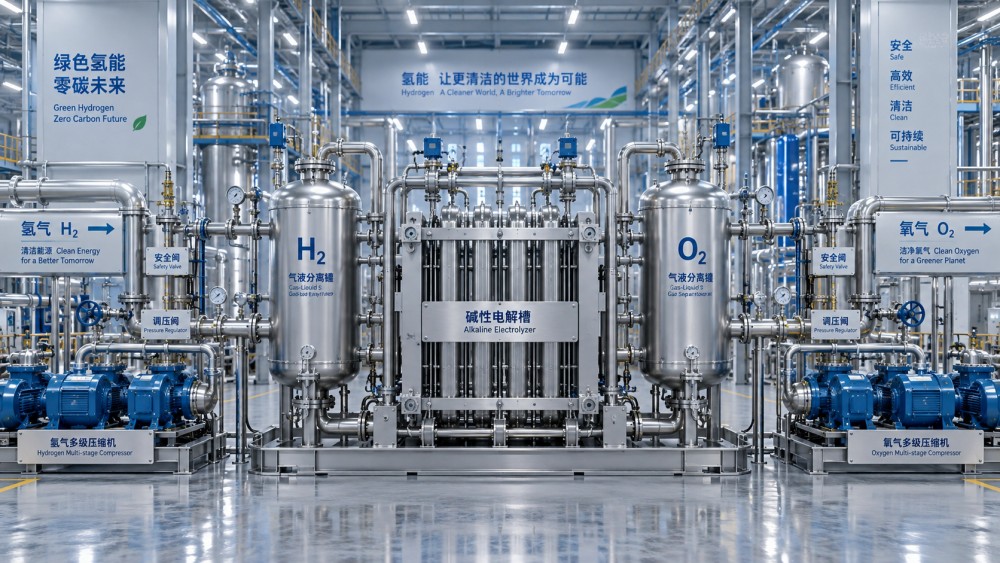
The real comparison is delivered hydrogen energy, not electrolyser energy alone
Hydrogen leaving a near-atmospheric ALK electrolyser must be compressed if it is destined for pipeline injection, buffer storage, mobility refuelling, synthesis loops, or high-pressure transport. Mechanical compressors introduce their own electricity use, cooling demand, maintenance exposure, and availability constraints. Pressurised electrolysis can reduce the compression ratio handled by downstream equipment and may allow smaller intermediate buffer vessels or fewer compression stages.
That benefit is strongest when the required downstream pressure is moderate and reasonably stable. A system delivering hydrogen into a process header at several tens of bar is different from one supplying tube trailers, 350-bar storage, or 700-bar vehicle refuelling. In the latter cases, a substantial compression train remains necessary even if the electrolyser produces at elevated pressure. The upstream stack pressure may still be useful, but it should not be represented as a substitute for high-pressure compression infrastructure.
A robust assessment uses a common battery limit. Electricity consumption should include the stack, rectifier losses, electrolyte pumps, cooling, water treatment, gas drying, purification, and every compression stage required to reach the contractual delivery condition. Comparing one supplier’s stack-level kWh/kg figure with another supplier’s outlet-pressure figure does not reveal project-level efficiency.
Absolute pressure and differential pressure are different design questions
An ALK electrolyser has hydrogen and oxygen compartments separated by a diaphragm or separator saturated with alkaline electrolyte. The critical integrity issue is not only absolute operating pressure; it is also the pressure differential across that separator.
Many pressurised ALK designs operate both gas sides at broadly similar pressure and control the differential tightly. This arrangement limits mechanical loading across the separator while retaining the advantage of pressurised product gas. A large sustained differential pressure can deform separator materials, alter liquid levels, promote gas migration, and increase the probability of an unacceptable combustible mixture on the oxygen side or oxygen contamination on the hydrogen side.
Hydrogen crossover is particularly consequential because hydrogen mixed with oxygen becomes flammable over a broad concentration range. The hazard is governed by composition, temperature, pressure, flow, ignition sources, enclosure ventilation, and the ability of instrumentation to detect an abnormal condition early. It cannot be assessed by stack pressure as an isolated number.
Pressure control must therefore be considered together with the full gas-liquid separation system: separator vessels, demisters, condensate management, recirculation loops, pressure-control valves, back-pressure regulators, vent routing, and analyser locations. At variable electrical load, gas generation rates change rapidly relative to the response of some liquid-level and pressure-control elements. A pressure strategy that appears stable at rated output may behave differently during low-load operation, warm-up, shutdown, or rapid ramping.
Higher pressure does not automatically improve hydrogen purity
It is tempting to assume that a pressurised system produces cleaner hydrogen because gas handling is more contained. Purity is instead determined by several interacting mechanisms: diaphragm performance, pressure differential, gas crossover, electrolyte entrainment, separator efficiency, drying, purification equipment, and the operating envelope.
Elevated absolute pressure can change gas solubility in the electrolyte and alter the transport conditions within the separator system. A pressure imbalance can increase convective transport across the separator. Low-load operation can also be challenging because gas production is lower while crossover-related effects do not necessarily decline in the same proportion. This is one reason why allowable turndown is not merely a power-electronics specification; it is linked to gas-quality and safety limits.
The correct technical question is not whether a system is “high-purity” at one nominal point. It is whether the supplier can define and demonstrate product-gas composition across the intended operating envelope, including minimum load, load transients, pressure excursions, start-up, standby, and restart. This should include analyser range, response time, alarm thresholds, shutdown logic, calibration practice, and the location at which purity is guaranteed.
Where hydrogen is intended for fuel-cell applications, semiconductor processes, or other purity-sensitive uses, the final required specification may be materially stricter than the raw electrolyser outlet condition. ISO 14687 is commonly referenced for hydrogen fuel quality, but it should not be treated as a general electrolyser performance standard. The project must identify the applicable delivery specification and verify whether downstream drying and purification are included within the supplier’s scope.
Thermal and hydraulic effects are often hidden in pressure discussions
ALK electrolysers operate with circulating alkaline electrolyte, commonly potassium hydroxide solution, and require stable heat removal. Operating pressure influences flashing margins, gas disengagement, circulation design, separator-vessel configuration, and the rating of valves, piping, instrumentation, and heat-exchange equipment. These effects are usually more visible in the balance of plant than in the stack datasheet.
Higher pressure suppresses boiling and can provide a wider margin against vapour formation in hot electrolyte circuits. That may simplify some aspects of thermal stability. At the same time, the system requires pressure-rated separators and piping, robust relief arrangements, and tighter control of liquid inventory. Heat removal remains essential because practical cell voltage exceeds the thermoneutral voltage; the difference is rejected as heat. Pressure does not eliminate this thermal duty.
Pressure also affects maintainability. Components exposed to caustic electrolyte and pressurised hydrogen or oxygen require materials, seals, flange arrangements, and inspection provisions appropriate to both chemical service and pressure cycling. A design rated for a stated maximum pressure is not necessarily equally suitable for frequent cycling between low load and full load. The anticipated ramp profile, number of pressure cycles, and shutdown philosophy should be considered alongside the nominal pressure rating.
Pressure selection should begin with the hydrogen destination
The most defensible operating-pressure choice starts at the delivery point rather than at the electrolyser stack. A process plant requiring hydrogen at a relatively steady medium pressure may justify pressurised production if the reduction in compressor duty and equipment complexity offsets the higher stack energy and pressure-rated balance-of-plant cost. A project with highly variable storage pressure or very high final delivery pressure may place greater value on a dedicated compressor train with broad control range and well-defined maintenance access.
Oxygen disposition also matters. If oxygen is vented after controlled handling, the electrochemical work used to produce it at elevated pressure has limited direct value. If there is a nearby oxygen consumer able to use a pressurised stream, the system-level calculation changes. The answer should be based on an explicit mass and energy balance, not on an assumed credit for pressurised oxygen.
For comparative technical evaluation, pressure-related guarantees should be requested at defined boundary conditions:
- Hydrogen and oxygen outlet pressures, including normal range, maximum allowable working pressure, and permissible differential pressure across the separator.
- Specific energy consumption at the proposed operating pressure and guaranteed current-density range, with auxiliary loads clearly separated from stack consumption.
- Hydrogen purity and oxygen-side hydrogen concentration across minimum, nominal, and maximum load conditions.
- Pressure-control philosophy during ramping, loss of power, emergency shutdown, and restart.
- Required downstream compression duty to meet the actual delivery pressure, temperature, and flow profile.
- Design pressure, relief-valve basis, vent destination, hazardous-area classification, and materials compatibility for caustic electrolyte service.
Standards define obligations, but they do not select the optimum pressure
ISO 22734 provides safety requirements for hydrogen generators using water electrolysis and is an important reference for packaged electrolyser safety. It does not determine the economically optimal operating pressure for a specific project. Pressure vessels, piping, and associated protective devices must also comply with the legal regime of the installation location. Depending on jurisdiction and equipment scope, this may involve the ASME Boiler and Pressure Vessel Code, ASME B31.12 for hydrogen piping and pipelines, the European Pressure Equipment Directive (PED), and local pressure-system regulations.
Hazardous-area design requires equal attention. Electrical equipment and installation practices may need to comply with IEC 60079-series requirements or the applicable national framework. Vent systems, hydrogen detection, oxygen-enrichment considerations, ventilation, emergency isolation, and separation distances must be engineered as an integrated safety case. A pressure rating on a vessel nameplate is only one element of that case.
The practical conclusion is straightforward: operating pressure should be treated as a system architecture decision. Moderate pressurisation can be valuable where it matches a stable downstream pressure requirement and can be controlled without sacrificing gas-separation margin. It becomes a poor choice when evaluated only through the headline claim of reduced compression. The decisive metric is safe, specification-compliant hydrogen delivered at the required pressure, over the full operating envelope and over the equipment’s intended service life.
Related News
- How to calculate KOH concentration in an alkaline electrolyzerNov 09, 2026Master KOH concentration calculation for alkaline electrolyzers with practical formulas, worked examples, density conversions, and essential safety checks.
- Hongqiao Forum Hydrogen Session Held in Shanghai, Industry Reports ReleasedNov 06, 2026Hongqiao Forum hydrogen session highlights China’s latest hydrogen and green fuel reports. Explore the findings and their global energy transition implications.
- Everfuel Secures €245 Million for Danish 200 MW Green Hydrogen ProjectNov 05, 2026Everfuel secures €245 million for a planned 200 MW green hydrogen project in Denmark. Explore its pipeline plans and proposed deliveries to Germany.
- How much electricity does an alkaline water electrolysis system use?Nov 04, 2026An alkaline water electrolysis system typically uses 50–60 kWh per kg of hydrogen. Explore the factors behind demand and compare supplier figures with confidence.
Related News
- 00
0000-00
Hydrogen Energy Storage for Data Centers Gets Costly Fast - 00
0000-00
When 99.999% Hydrogen Purity Still Is Not Good Enough - 00
0000-00
When Does a Hydrogen-Ready Gas Turbine Pay Off? - 00
0000-00
Electricity Price Volatility Is Rewriting Hydrogen Cost Models - 00
0000-00
PSA Recovery Rate Drops for Reasons Operators Miss
Dr. Aris Aero
Weekly Insights
Stay ahead with our curated technology reports delivered every Monday.