
How to size an alkaline electrolyzer for hydrogen-based steelmaking




Size an alkaline electrolyzer for steelmaking from the DRI plant’s net fresh hydrogen demand at the agreed delivery boundary, then convert that demand into electrical capacity using guaranteed system consumption and a realistic operating schedule. Annual steel output alone is insufficient: the DRI share of the furnace charge, reduction conditions, hydrogen recycling, and production hours all change the required supply.
A steelworks may need steady hydrogen while its renewable electricity supply fluctuates. Sizing only for average demand can leave the reduction plant short during power interruptions; sizing for every possible peak can create expensive idle capacity. The practical design task is to match electrolyzer modules, electricity availability, and usable hydrogen storage against the same hourly production profile.
Establish the hydrogen demand before specifying megawatts
Begin with annual DRI production rather than finished steel tonnage. An electric arc furnace using scrap and DRI does not require the same hydrogen supply as one relying predominantly on DRI. Obtain the charge mix, metallic yield assumptions, and DRI production schedule from the steelmaking process design.
The next input is specific fresh hydrogen consumption, expressed in kilograms per tonne of DRI. Use a value supplied or validated by the reduction-process licensor. It must reflect ore characteristics, metallization target, gas composition, purge losses, and the proposed operating conditions.
Do not confuse fresh hydrogen consumption with the total reducing-gas flow through the shaft furnace. Recycled gas can make the circulation rate much larger than the electrolyzer’s makeup requirement. Counting that circulation as new hydrogen would substantially overstate capacity.
- Production basis: annual DRI tonnage, normal hourly throughput, maximum sustained throughput, and planned outages.
- Consumption basis: net makeup hydrogen, with a clear statement of whether purge and downstream losses are included.
- Delivery conditions: hydrogen pressure, temperature, purity, moisture limit, and allowable supply fluctuations.
- Additional users: hydrogen heating or other plant consumers, included separately when applicable.
Keep upstream losses outside the DRI consumption figure visible. Dryer regeneration, off-spec gas diversion, storage losses, and distribution losses may increase production requirements. Their treatment should be explicit so that neither the process designer nor the electrolyzer supplier counts them twice.
Convert the production schedule into a capacity requirement
The initial calculation is straightforward:
Annual hydrogen demand (kg/year) = annual DRI production (t/year) × specific fresh hydrogen consumption (kg/t).
Normal hydrogen demand (kg/h) = annual hydrogen demand ÷ DRI operating hours.
For a transparent worked calculation, assume a hypothetical plant produces 1,000,000 tonnes of DRI annually, consumes 60 kg of fresh hydrogen per tonne, and operates for 8,000 hours. These are illustrative inputs, not a benchmark or a process guarantee. Annual demand would be 60,000,000 kg, and average demand during production would be 7,500 kg/h.
That hourly result is valid only for the assumed operating schedule. If the plant concentrates output into fewer hours, its operating demand increases. Check maximum sustained DRI throughput separately; annual averages can conceal the supply requirement during high-production periods.
Apply electricity consumption at the correct boundary
Electrolyzer electrical demand (MW) = hydrogen production (kg/h) × specific electricity consumption (kWh/kg) ÷ 1,000.
Continuing the illustrative calculation, an assumed consumption of 52 kWh/kg gives 390 MW for 7,500 kg/h. This is a preliminary operating-duty result, not a complete installed-capacity recommendation. It excludes any equipment outside the assumed electricity-consumption boundary and does not yet cover outage recovery or redundancy.
A stack DC figure cannot be compared directly with an AC package figure. Request consumption at the contracted hydrogen outlet, identifying rectifier losses, pumps, cooling, purification, drying, and other auxiliaries. Compression to the steelworks delivery pressure may be included or excluded; resolve this before comparing offers.
Also establish whether guarantees apply at beginning of life or at a specified later condition. Stack degradation can increase electricity demand at a fixed hydrogen output. The electrical connection, rectifiers, cooling system, and commercial evaluation should accommodate the agreed end-of-period duty, not just initial performance.
Resolve the mismatch between renewable power and continuous DRI production
When an alkaline electrolyzer for steelmaking receives firm electricity, the capacity calculation starts close to the required continuous hydrogen flow. With variable renewable supply, annual energy sufficiency and hourly hydrogen availability become separate tests. Passing the annual test does not establish that the furnace will remain supplied.
A useful screening relationship is:
Required hydrogen nameplate rate (kg/h) = annual production requirement (kg) ÷ equivalent full-load production hours.
Equivalent full-load production hours represent actual hydrogen production expressed at nameplate rate. They are not simply the hours in which wind or solar generation is present, nor the renewable generator’s capacity factor. Partial-load efficiency, electrical limits, curtailment, outages, and storage constraints affect the result.
In the same hypothetical example, 5,000 equivalent full-load production hours would require 12,000 kg/h of hydrogen nameplate capacity. At the assumed 52 kWh/kg, the corresponding electrical capacity would be 624 MW. This illustrates why an intermittently powered installation may need greater capacity than the 390 MW continuous-duty calculation. It does not prove that 624 MW can maintain supply through a renewable drought.
Test candidate capacities using time-series simulation. Use electricity availability and DRI demand at matching intervals, with finer resolution where short interruptions or ramp limits matter. The model should track:
- Hydrogen output at each operating point, including minimum stable load and startup delays.
- Storage inventory, charging limits, withdrawal limits, and minimum usable pressure.
- Planned maintenance, credible equipment outages, and off-spec production periods.
- Unserved hydrogen demand and the time needed to restore reserve inventory.
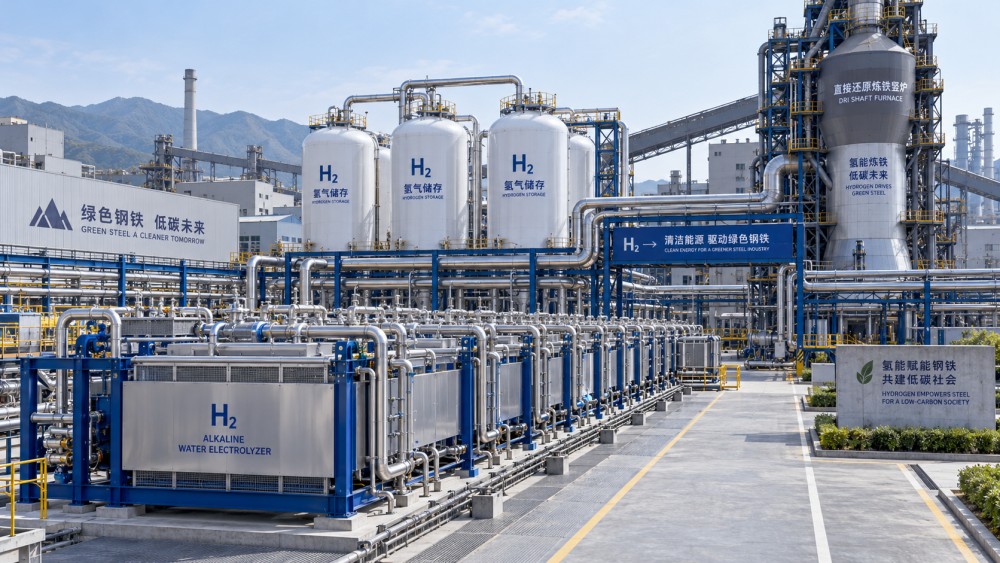
A larger electrolyzer only helps when sufficient electricity is available to operate it and storage has room to accept its output. Where long low-generation periods dominate, firm electricity or another qualified hydrogen source may address reliability more effectively than additional electrolyzer capacity.
Size storage for both interruption coverage and replenishment
For a simple interruption with no hydrogen production, the starting calculation is:
Usable hydrogen inventory (kg) = demand (kg/h) × required coverage duration (h).
At the illustrative 7,500 kg/h demand, eight hours of coverage requires 60,000 kg of usable hydrogen. That is withdrawal inventory, not the total mass physically contained in storage. Minimum delivery pressure, cushion inventory where applicable, temperature effects, and compressor arrangements determine how much stored gas is actually available.
The more revealing question is how quickly the reserve can be rebuilt. A unit producing exactly the ongoing DRI demand cannot replenish storage while the furnace continues operating. Additional hydrogen capacity, temporary demand reduction, or backup supply is necessary.
For example, restoring the hypothetical 60,000 kg reserve over 24 hours requires 2,500 kg/h above continuing demand, before additional losses. The electrolyzer would need to produce 10,000 kg/h during that recovery window, and the electricity supply and storage charging equipment would need to support it.
Separate short-duration buffering from protection against extended supply loss. A small buffer may smooth load changes or cover switching between modules without offering meaningful protection against prolonged power shortages. Define each storage duty and its required recovery time rather than assigning one arbitrary autonomy period.
Evaluate alkaline operating limits at module level
Plant-wide turndown depends on module arrangement as well as stack capability. Several independently controlled trains may follow demand by taking complete trains offline while keeping operating trains within their permitted range. However, shared auxiliaries can restrict that flexibility.
Ask suppliers for operating envelopes that connect hydrogen output, electricity consumption, pressure, gas purity, temperature, and ramp rate. A single minimum-load percentage is not enough. Gas crossover and purity constraints can limit low-load operation, particularly during transitions, and protective controls may divert gas rather than send it to the process.
Distinguish rapid electrical response from delivery of qualified hydrogen. A rectifier may change load before temperatures, separator levels, pressure control, and downstream purification stabilize. The supply model must use the response at the steelworks delivery boundary.
Check redundancy across the complete supply chain
Adding one spare electrolyzer train does not automatically create an N+1 hydrogen system. Shared transformers, cooling circuits, water treatment, purification, compression, or control infrastructure may still stop all production. Evaluate credible failure cases against the amount of hydrogen that remains deliverable.
For each critical outage, identify surviving production capacity, storage withdrawal capability, repair duration assumptions, and the permitted DRI response. The design basis may allow reduced throughput rather than full production during maintenance. That decision materially changes installed capacity and should be agreed before tendering.
Hydrogen quality deserves the same attention as quantity. Specify oxygen, moisture, electrolyte carryover, and other relevant contaminants at the delivery point. Do not assume a generic hydrogen purity percentage establishes suitability for the DRI process. Purification equipment must support maximum production and remain effective during the operating transitions the supply model relies on.
Compression also needs separate checks for continuous furnace delivery and storage filling. Depending on the arrangement, replenishing high-pressure storage while supplying the reduction plant can impose a different flow and power requirement from steady operation alone.
Turn the calculation into a comparable equipment specification
A useful procurement basis states both hydrogen and electrical requirements. Specify normal and maximum deliverable kg/h, required pressure and quality, available electricity profiles, usable storage inventory, reserve recovery duty, and production required with designated equipment unavailable.
Require bidders to declare exclusions and guarantee boundaries. Water treatment, cooling rejection, gas drying, compression, electrical conversion, and standby consumption should be identifiable rather than hidden inside an undefined “system efficiency.” Check utilities at site conditions, including ambient-temperature extremes and feedwater quality.
Compare configurations by whether they satisfy the same delivery obligations, not merely by their advertised megawatt rating. A lower-rated package may be adequate with firm power; a larger installation may still fail if its restart behavior or storage charging rate was omitted from the model.
Before freezing capacity, obtain process-licensor confirmation of hydrogen consumption and delivery limits, supplier guarantees for the proposed operating envelope, and site-specific engineering review of storage, pressure equipment, hydrogen piping, and safety functions. Increase nameplate capacity only where the calculations identify a concrete duty: peak demand, reserve replenishment, reduced production hours, or operation with equipment unavailable.
Related News
- How to calculate KOH concentration in an alkaline electrolyzerNov 09, 2026Master KOH concentration calculation for alkaline electrolyzers with practical formulas, worked examples, density conversions, and essential safety checks.
- Hongqiao Forum Hydrogen Session Held in Shanghai, Industry Reports ReleasedNov 06, 2026Hongqiao Forum hydrogen session highlights China’s latest hydrogen and green fuel reports. Explore the findings and their global energy transition implications.
- Everfuel Secures €245 Million for Danish 200 MW Green Hydrogen ProjectNov 05, 2026Everfuel secures €245 million for a planned 200 MW green hydrogen project in Denmark. Explore its pipeline plans and proposed deliveries to Germany.
- How much electricity does an alkaline water electrolysis system use?Nov 04, 2026An alkaline water electrolysis system typically uses 50–60 kWh per kg of hydrogen. Explore the factors behind demand and compare supplier figures with confidence.
Related News
- 00
0000-00
Hydrogen Energy Storage for Data Centers Gets Costly Fast - 00
0000-00
When 99.999% Hydrogen Purity Still Is Not Good Enough - 00
0000-00
When Does a Hydrogen-Ready Gas Turbine Pay Off? - 00
0000-00
Electricity Price Volatility Is Rewriting Hydrogen Cost Models - 00
0000-00
PSA Recovery Rate Drops for Reasons Operators Miss
Dr. Aris Aero
Weekly Insights
Stay ahead with our curated technology reports delivered every Monday.