
Industrial Hydrogen Infrastructure Trends Shaping Plant Investments in 2026




As 2026 budgets move from concept to allocation, industrial hydrogen infrastructure has become a capital question rather than a research topic. Plants that once treated hydrogen as a future option are now assessing where production, storage, transport, power integration, and compliance must be upgraded together.
That shift matters because hydrogen assets do not perform well as isolated investments. Electrolyzers, pipelines, tanks, turbines, refueling systems, and carbon management links all depend on material integrity, regional energy prices, permitting timelines, and safety standards that can reshape returns over decades.
In practical terms, industrial hydrogen infrastructure now sits at the intersection of resilience, sovereign energy strategy, and industrial decarbonization. The strongest investment cases in 2026 are being built around integrated systems, benchmarked performance, and infrastructure choices that can survive both regulation and scale.
Why 2026 is a turning point for plant investment
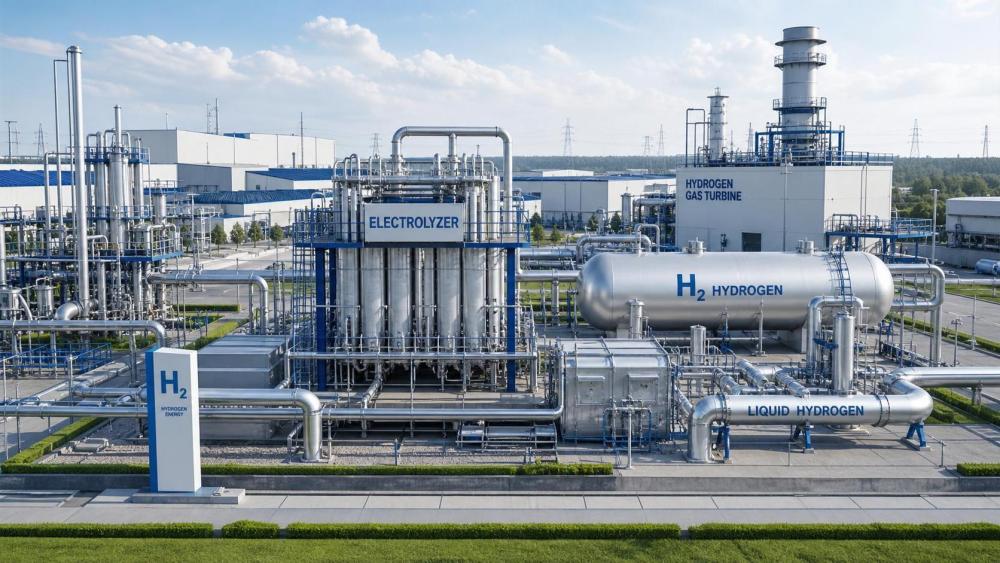
Several forces are converging at once. Power markets are rewarding flexible low-carbon assets, heavy industry is under tighter emissions pressure, and energy security has become a strategic procurement issue rather than a policy slogan.
At the same time, the cost debate has matured. The question is no longer limited to hydrogen price per kilogram. Investors are comparing delivered hydrogen cost, uptime risk, compression energy, boil-off losses, blending compatibility, and long-cycle maintenance exposure.
This is where industrial hydrogen infrastructure becomes decisive. A plant may secure low-cost electrolytic production, yet still fail commercially if storage losses, materials degradation, or transport bottlenecks erase the margin.
Another reason 2026 stands out is the growing preference for benchmarked assets. Organizations are moving toward reference frameworks such as ISO 19880, ASME B31.12, and SAE J2601 earlier in project design, not only during final commissioning.
What industrial hydrogen infrastructure now includes
The term covers more than hydrogen production units. In current capital planning, it refers to the full physical and operational chain required to produce, condition, store, move, use, and secure hydrogen at industrial scale.
Core asset layers
- Megawatt-scale electrolysis systems, especially PEM and alkaline platforms.
- Compression, purification, drying, and balance-of-plant equipment.
- High-pressure and cryogenic storage, including vacuum-insulated vessels.
- Pipeline, trailer, port, and terminal logistics for regional distribution.
- Hydrogen-ready gas turbines and power integration interfaces.
- High-pressure refueling systems above 70MPa for mobility corridors.
- CCUS links where blue hydrogen or transitional carbon management remains part of the business case.
A platform such as G-HEI is relevant in this context because it treats these assets as part of one strategic system. Its value is less about promotion and more about technical benchmarking across performance, standards compliance, and asset security.
The trends changing capital allocation decisions
Integrated design is replacing single-asset procurement
Projects are moving away from buying an electrolyzer first and solving the rest later. Investment committees increasingly require line-of-sight from renewable power input to final offtake, including storage duration and transport constraints.
Materials performance is under closer scrutiny
Hydrogen embrittlement, seal reliability, compressor fatigue, and cryogenic thermal cycling are no longer niche engineering concerns. They are major financial variables because failure in one component can interrupt entire plant economics.
Regional supply chains now shape project viability
Local access to titanium components, pressure vessels, certified valves, renewable power, and port infrastructure is influencing project sequencing. In some regions, logistics readiness is becoming more important than nameplate production capacity.
Power conversion is back in focus
Hydrogen-ready turbines and blending strategies are attracting fresh investment because they connect industrial hydrogen infrastructure to dispatchable electricity. That link matters where grids need flexible backup for variable renewable generation.
Safety compliance is entering the early financial model
Permitting delays, additional containment, monitoring systems, and inspection intervals affect cash flow. Plants that price these requirements early tend to avoid the expensive redesign cycles that slow deployment.
Where the strongest business value is emerging
The value of industrial hydrogen infrastructure differs by use case, but a few patterns are becoming clear. The best projects create optionality, not just emissions reduction.
In each case, returns improve when infrastructure serves multiple end uses. A storage asset that supports process heat, fleet fueling, and backup generation is usually more defensible than one built for a single demand profile.
How to read plant opportunities more accurately
Many hydrogen projects still look attractive in slide decks because they assume smooth scale-up. In practice, the better filter is operational coherence.
Questions that deserve early attention
- Is production matched to realistic offtake timing, or only to ideal demand forecasts?
- Can the selected materials handle pressure, purity, and thermal cycling over the intended operating life?
- Which standard governs each node of the system, and where are compliance gaps likely to appear?
- Does local infrastructure support hydrogen transport, or will the plant carry hidden logistics costs?
- How sensitive are returns to electricity pricing, water availability, and downtime?
- Can the asset evolve from blending or transitional use toward higher-purity hydrogen service later?
These questions are why benchmarking repositories matter. G-HEI’s focus on electrolysis, cryogenic logistics, turbine power, CCUS, and refueling systems reflects the areas where technical detail most often determines commercial success.
A practical framework for the next round of decisions
The next step is not to approve every hydrogen project that appears strategic. It is to sort opportunities by infrastructure readiness, standards maturity, and regional fit.
Start with asset mapping. Identify where industrial hydrogen infrastructure already exists, where it can be retrofitted, and where greenfield development would trigger long permitting cycles.
Then compare investment options against a common scorecard. Include delivered hydrogen cost, uptime profile, certification pathway, materials risk, grid linkage, and expansion flexibility.
Finally, test the project against a broader industrial logic. The strongest 2026 plant investments will not be the ones with the boldest hydrogen narrative. They will be the ones where industrial hydrogen infrastructure, safety compliance, and market demand reinforce each other from day one.
That makes this a useful moment to review benchmark data, pressure-test assumptions, and narrow the field to assets that can operate securely at scale. In 2026, disciplined selection is becoming more valuable than early enthusiasm.
Related News
- How to calculate KOH concentration in an alkaline electrolyzerNov 09, 2026Master KOH concentration calculation for alkaline electrolyzers with practical formulas, worked examples, density conversions, and essential safety checks.
- Hongqiao Forum Hydrogen Session Held in Shanghai, Industry Reports ReleasedNov 06, 2026Hongqiao Forum hydrogen session highlights China’s latest hydrogen and green fuel reports. Explore the findings and their global energy transition implications.
- Everfuel Secures €245 Million for Danish 200 MW Green Hydrogen ProjectNov 05, 2026Everfuel secures €245 million for a planned 200 MW green hydrogen project in Denmark. Explore its pipeline plans and proposed deliveries to Germany.
- How much electricity does an alkaline water electrolysis system use?Nov 04, 2026An alkaline water electrolysis system typically uses 50–60 kWh per kg of hydrogen. Explore the factors behind demand and compare supplier figures with confidence.
Related News
- 00
0000-00
Hydrogen Energy Storage for Data Centers Gets Costly Fast - 00
0000-00
When 99.999% Hydrogen Purity Still Is Not Good Enough - 00
0000-00
When Does a Hydrogen-Ready Gas Turbine Pay Off? - 00
0000-00
Electricity Price Volatility Is Rewriting Hydrogen Cost Models - 00
0000-00
PSA Recovery Rate Drops for Reasons Operators Miss
Dr. Aris Aero
Weekly Insights
Stay ahead with our curated technology reports delivered every Monday.