
KOH Electrolysis Explained: Electrolyte Function, Concentration, and Safety Risks




KOH electrolysis is not simply “water splitting with an added chemical.” In an alkaline electrolyzer, potassium hydroxide is the ionic transport medium that makes practical current densities possible, but it also creates a coupled quality and safety control problem. Electrolyte concentration, temperature, purity, circulation, liquid level, and gas-side pressure must remain within a defined operating envelope. A deviation in one variable can alter electrical resistance, gas purity, corrosion behavior, separator performance, and the severity of any personnel exposure.
The central operational point is easy to state but often underappreciated: KOH is not consumed by the ideal overall electrolysis reaction, yet its concentration and condition do not remain constant automatically. Water transfer with product gases, evaporation, make-up water quality, carbon dioxide ingress, entrained electrolyte, and maintenance practices can all shift the electrolyte away from its qualified condition. Stable hydrogen output is therefore not, by itself, proof of a healthy electrolyte system.
What KOH does inside an alkaline electrolyzer
Alkaline water electrolysis uses two electrodes separated by a diaphragm or separator. The electrolyte carries hydroxide ions between the electrode compartments while preventing bulk mixing of hydrogen and oxygen.
At the cathode, water is reduced:
2H2O + 2e− → H2 + 2OH−
At the anode, hydroxide ions are oxidized:
2OH− → ½O2 + H2O + 2e−
The net reaction is the familiar splitting of water into hydrogen and oxygen. KOH supplies a high concentration of mobile ions, reducing electrolyte resistance relative to untreated water. It also supports alkaline electrode chemistry and helps maintain a stable ionic environment across the separator.
That role has a direct implication for quality control: electrolyte health is not a secondary balance-of-plant issue. It affects stack voltage, energy consumption, thermal loading, circulation performance, gas-liquid separation, and the conditions under which hydrogen and oxygen crossover can become hazardous.
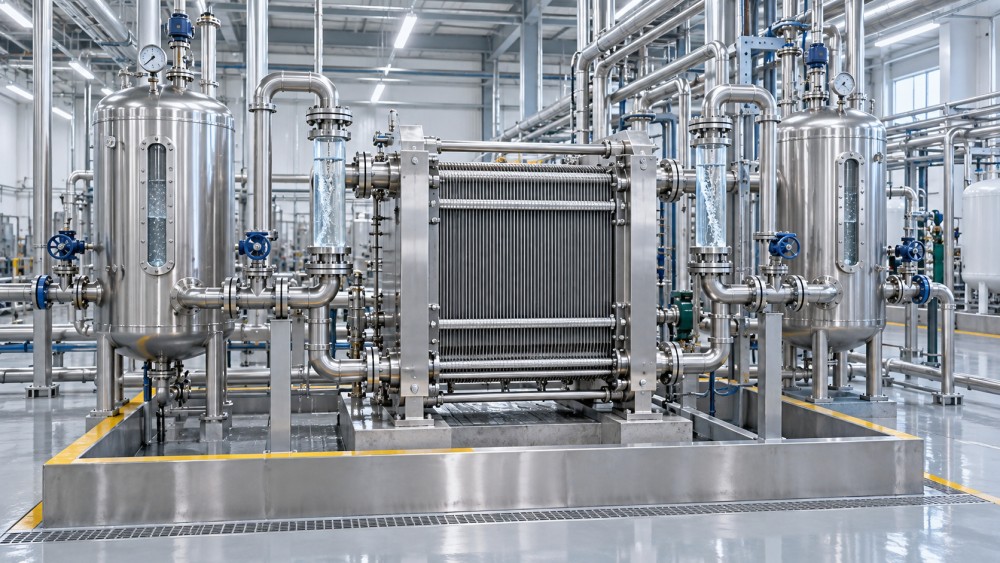
Why concentration is a controlled operating variable, not a single “best” number
Commercial alkaline systems commonly operate with KOH solutions in an approximate range of 20–40% by mass, with many designs using a mid-range concentration. The approved concentration, however, is an equipment-specific value. It depends on cell design, diaphragm type, catalyst system, pressure regime, operating temperature, circulation arrangement, and the manufacturer’s performance and safety limits.
Increasing KOH concentration initially improves ionic conductivity and can reduce ohmic losses. This does not mean that the highest practical concentration gives the best electrolyzer performance. As concentration rises, viscosity also rises. Higher viscosity increases pumping demand, can worsen mass-transfer conditions, affects bubble release from electrode surfaces, and may reduce the effectiveness of gas-liquid disengagement. Concentrated hot caustic also narrows material-compatibility margins.
Temperature changes the picture further. Conductivity generally improves as temperature rises, which is one reason alkaline electrolyzers are often operated at elevated temperatures. Yet a concentration that performs acceptably at one temperature can produce a different conductivity, density, viscosity, vapor behavior, and corrosion environment at another. A concentration value without its corresponding temperature is incomplete process information.
The practical control question is not “Is the KOH concentration high enough?” It is whether the measured concentration, temperature, density, circulation rate, and cell voltage are mutually consistent with the qualified operating window. A density reading taken from a sample or an online instrument must be temperature-compensated or interpreted against the correct temperature-specific reference. Using ambient-temperature density tables for a hot circulating electrolyte can lead to an incorrect concentration adjustment.
Electrolyte concentration can drift even when KOH is not consumed
In a correctly balanced electrolysis reaction, potassium hydroxide acts as an electrolyte rather than a reactant. In operation, however, water is continually redistributed. Hydrogen and oxygen leaving the stack can carry water vapor and, if gas-liquid separation is inadequate, liquid droplets or caustic aerosol. Make-up water changes the inventory. Maintenance drains, sampling losses, leaks, and incomplete return of recovered liquid also change the system balance.
Carbon dioxide is another important source of electrolyte degradation. CO2 entering through air exposure, unsuitable water, purge arrangements, or maintenance practices reacts with KOH to form potassium carbonate. The consequence is not merely a lower “free KOH” value. Carbonate changes the chemistry and physical behavior of the electrolyte, may affect conductivity and electrode behavior, and can create crystallization or deposit concerns depending on concentration and temperature conditions. The relevant laboratory program should therefore distinguish total alkalinity from free hydroxide where carbonate formation is credible.
Feedwater quality also matters. Electrolyzer suppliers commonly define water-quality requirements because dissolved salts and trace contaminants can accumulate in recirculating loops or interfere with components. Chloride deserves particular attention: it is not a harmless conductivity contributor in an alkaline system. Its presence can aggravate corrosion mechanisms, contaminate process streams, and introduce undesirable electrochemical side reactions under certain conditions. The allowable impurity limits should come from the equipment design basis rather than generic water-treatment assumptions.
The safety issue is two hazards at once: caustic liquid and mixed gases
KOH is strongly corrosive to skin and eyes. Contact with concentrated solution can cause severe chemical burns, while mist or aerosol can irritate or damage respiratory tissue. The hazard becomes more difficult to manage when electrolyte is hot, circulated under pressure, or entrained in product gas. A small flange leak in a warm caustic loop is not equivalent to a water leak: spray direction, flash behavior, containment, drainage, eyewash access, and resistant personal protective equipment all require deliberate consideration.
Preparing or replenishing KOH solution carries a separate thermal risk. Dissolving solid potassium hydroxide in water is strongly exothermic. Adding water directly onto a substantial quantity of dry KOH can generate rapid localized heating and splashing. Controlled addition of KOH to the specified volume of water, with agitation and temperature management, is the standard safer principle, subject to the site’s written procedure and chemical supplier guidance. Make-up preparation should also address dust control because dry KOH can damage eyes and respiratory passages.
The hydrogen hazard is governed by more than a leak from a pipe. Gas crossover through the separator, a pressure imbalance between hydrogen and oxygen compartments, degraded diaphragms, low liquid level, unstable circulation, and ineffective downstream separation can raise impurity levels. Hydrogen in oxygen, or oxygen in hydrogen, is particularly serious because the mixture can enter a flammable or explosive range when combined with an ignition source.
Gas purity analyzers, differential-pressure monitoring, high-high alarm settings, interlocks, purge logic, ventilation, hazardous-area electrical classification, and emergency shutdown functions should be treated as layers of protection rather than isolated instruments. A single analyzer is not a substitute for maintaining the process conditions that limit crossover in the first place. Any change to electrolyte concentration, operating pressure, separator type, or control philosophy should trigger a review of the gas-separation and functional-safety basis.
Material compatibility is more nuanced than “alkali-resistant”
Potassium hydroxide compatibility depends on concentration, temperature, stress, oxygen availability, impurities, weld condition, and exposure time. A material acceptable for a cool storage tank may not be appropriate for a hot, aerated, stressed, or cyclically loaded electrolyzer component.
Aluminum, zinc, galvanized steel, and many alloys containing susceptible metals are generally unsuitable for KOH service because strong alkali can attack them and, in some cases, generate hydrogen. This is especially relevant to temporary maintenance equipment, gratings, fasteners, sample containers, drain accessories, and improvised transfer tools. Compatibility failures often occur in these peripheral items rather than in the primary process vessels.
Nickel-based materials and nickel-containing components are widely associated with alkaline electrolysis service, but they are not a universal answer. Carbon steel and stainless steels may be used in selected service conditions, yet hot caustic environments can create corrosion or caustic stress-corrosion-cracking concerns depending on the exact metallurgy and process envelope. The correct basis for acceptance is the equipment manufacturer’s material specification, supported where needed by recognized corrosion data and a documented assessment of temperature, concentration, pressure, and mechanical stress.
Elastomers, gaskets, hose linings, sealants, coatings, and instrument wetted parts need the same discipline. A compatibility chart for room-temperature KOH may not cover the actual combination of elevated temperature, pressure cycling, oxygen exposure, and long-term compression set. Material substitution during maintenance should be controlled through formal change management, not selected solely on the basis of chemical name or apparent similarity.
What a defensible electrolyte-control program measures
A robust program links laboratory checks, online instruments, and process trends. The exact schedule and limits belong to the equipment operating manual and site hazard analysis, but the measurement logic is consistent.
- KOH concentration: determined by validated titration, density measurement with temperature correction, or another qualified analytical method. Trend results rather than relying on a single nominal value.
- Carbonate and free hydroxide: monitored where CO2 exposure, long electrolyte life, or unexplained electrical drift makes carbonate accumulation plausible.
- Temperature and circulation: assessed alongside concentration because conductivity and viscosity cannot be interpreted independently of temperature.
- Cell or stack voltage trends: reviewed at comparable load and temperature conditions. Rising voltage may indicate electrolyte, separator, electrode, electrical-contact, or flow issues; it should not automatically be attributed to KOH strength.
- Gas purity and crossover indicators: treated as safety-critical evidence, with defined response actions for abnormal readings, analyzer faults, and calibration failures.
- Electrolyte level and separator performance: checked to prevent gas carryover, pump cavitation, inadequate wetting, and instability during load changes.
- Contamination indicators: investigated after maintenance, water-treatment excursions, component failures, or abnormal corrosion findings.
Sampling itself needs control. Samples from hot caustic loops should be obtained through designed sample points that minimize splash, flashing, and exposure. Containers must be compatible, clearly labeled, and protected from atmospheric CO2 uptake where analytical accuracy matters. An unrepresentative sample can produce an apparently precise result that drives an incorrect correction to the whole inventory.
Standards establish the framework, but they do not replace the design basis
For hydrogen generators using water electrolysis, ISO 22734 provides an important international safety reference. It addresses safety requirements for hydrogen generators that use electrochemical reactions to produce hydrogen from water. Its application should be considered alongside the equipment’s certified configuration, local regulations, installation rules, and the specific operating mode of the facility.
Hydrogen installations may also fall within local requirements for flammable gas handling, pressure systems, electrical equipment in explosive atmospheres, ventilation, fire protection, and occupational chemical safety. Depending on jurisdiction and project scope, relevant frameworks can include IEC 60079 for explosive atmospheres, IEC 61511 for safety instrumented systems, and nationally adopted fire and electrical codes. These references do not establish a universal KOH concentration or a universal trip setpoint. Those must be derived from the electrolyzer design, hazard studies, validated operating procedures, and the supplier’s documented limits.
The most dangerous shortcut is treating an alkaline electrolyzer as a stable chemical system that only needs periodic caustic replenishment. It is an integrated electrochemical, thermal, mechanical, and gas-safety system. KOH concentration is a key control variable because it sits at the intersection of all four. Maintaining it within specification, verifying electrolyte purity, preventing CO2 ingress, preserving pressure balance, and controlling hot-caustic exposure are not separate housekeeping tasks; together, they protect stack performance, personnel, and hydrogen-system integrity.
Related News
- How to calculate KOH concentration in an alkaline electrolyzerNov 09, 2026Master KOH concentration calculation for alkaline electrolyzers with practical formulas, worked examples, density conversions, and essential safety checks.
- Hongqiao Forum Hydrogen Session Held in Shanghai, Industry Reports ReleasedNov 06, 2026Hongqiao Forum hydrogen session highlights China’s latest hydrogen and green fuel reports. Explore the findings and their global energy transition implications.
- Everfuel Secures €245 Million for Danish 200 MW Green Hydrogen ProjectNov 05, 2026Everfuel secures €245 million for a planned 200 MW green hydrogen project in Denmark. Explore its pipeline plans and proposed deliveries to Germany.
- How much electricity does an alkaline water electrolysis system use?Nov 04, 2026An alkaline water electrolysis system typically uses 50–60 kWh per kg of hydrogen. Explore the factors behind demand and compare supplier figures with confidence.
Related News
- 00
0000-00
Hydrogen Energy Storage for Data Centers Gets Costly Fast - 00
0000-00
When 99.999% Hydrogen Purity Still Is Not Good Enough - 00
0000-00
When Does a Hydrogen-Ready Gas Turbine Pay Off? - 00
0000-00
Electricity Price Volatility Is Rewriting Hydrogen Cost Models - 00
0000-00
PSA Recovery Rate Drops for Reasons Operators Miss
Dr. Aris Aero
Weekly Insights
Stay ahead with our curated technology reports delivered every Monday.