
Scaling Electrolysis Beyond 100 MW: Grid, Water, and Balance-of-Plant Priorities




Scaling Electrolysis Beyond 100 MW: Grid, Water, and Balance-of-Plant Priorities
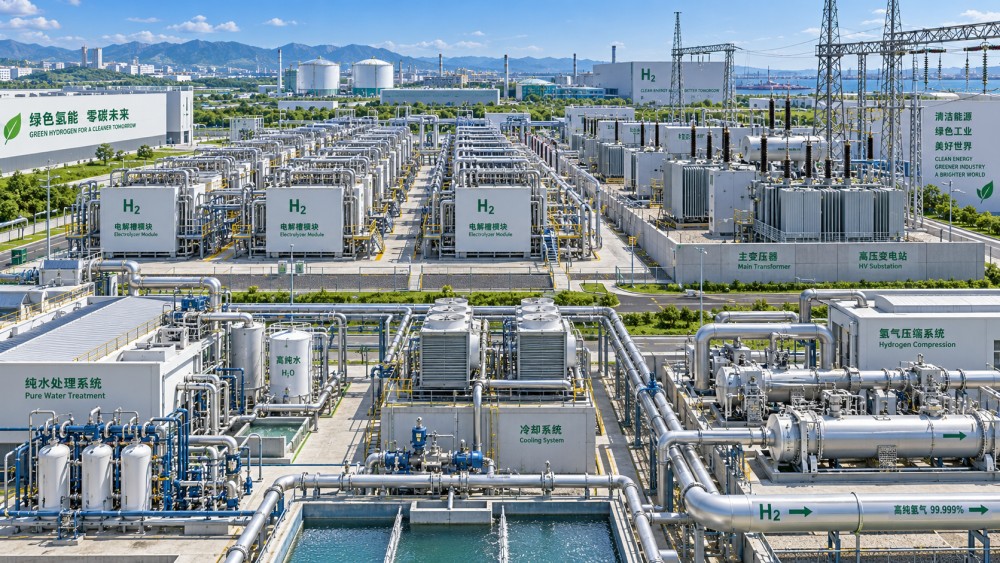
Scaling electrolysis beyond 100 MW changes the nature of the project. The electrolyzer stacks remain central, but they are no longer the dominant integration challenge. At this scale, a hydrogen plant behaves more like a power-intensive industrial utility, with its own electrical substation, water-treatment train, cooling duties, gas handling network, process safety architecture, and operational constraints.
This is where many large scale electrolysis projects encounter avoidable delays. A stack package may be technically sound, yet the project can still lose availability because the grid connection cannot support operating profiles, feedwater quality drifts outside supplier limits, compressors become a throughput bottleneck, or control systems cannot coordinate rapid changes in renewable generation. A credible design therefore starts with the whole system boundary, not with the nameplate rating of the electrolysis modules.
For utility-scale developers, industrial hydrogen users, and infrastructure owners, the practical question is not simply “How many megawatts can be installed?” It is whether the facility can produce hydrogen at the required pressure, purity, reliability, and delivery profile while remaining safe, maintainable, grid-compliant, and financeable over its intended operating life.
Start with the electrical system, not the stack count
At 100 MW and above, electrical infrastructure deserves early design authority. The electrolyzer itself consumes direct current, but the project must first receive alternating current at a suitable voltage, manage power quality, transform and rectify that power, and coordinate with the transmission or distribution network. These interfaces can shape the project schedule more than the procurement lead time for the stacks.
A grid interconnection study should examine more than available capacity. Fault level, harmonic limits, reactive-power requirements, voltage ride-through obligations, curtailment exposure, and planned network reinforcement all matter. A plant that follows intermittent renewable output may impose a very different duty cycle on rectifiers, transformers, cooling circuits, and balance-of-plant equipment than one supplied through a firm power purchase arrangement.
PEM and alkaline electrolysis have different operating characteristics, but neither removes the need for disciplined electrical integration. PEM systems are often selected where dynamic operation is important. Alkaline systems may be attractive for certain steady or moderately variable duty profiles. The correct choice depends on more than ramp capability: expected annual operating hours, hydrogen offtake commitments, maintenance philosophy, water availability, ambient conditions, and the cost of power conditioning all affect the decision.
It is also risky to assume that a project connected to renewable generation is electrically isolated from the wider grid. Even behind-the-meter configurations may need import capability during low-generation periods, export arrangements during outages, black-start planning, and protection coordination across multiple owners. The design basis should define what happens when power drops abruptly, when a transformer trips, or when one electrolyzer train is unavailable but downstream compression remains in service.
A useful early-stage deliverable is an electrical operating envelope rather than a single annual consumption figure. It should state minimum stable load, normal ramp rates, expected cycling frequency, permitted power interruptions, reactive-power obligations, and the consequences of operating outside those conditions. That document gives equipment suppliers, grid specialists, and process engineers a shared reference before the design becomes difficult to change.
Water is a process utility, not a secondary procurement item
Electrolysis consumes water, but the engineering challenge is not limited to water volume. The plant needs a reliable source, a treatment train capable of meeting the electrolyzer supplier’s feedwater specification, storage for operational continuity, and a plan for concentrate, wastewater, and chemical handling. Seawater, municipal supplies, reclaimed water, river abstraction, and industrial water each create different treatment and permitting questions.
Water demand must be assessed across the full facility. In addition to process water converted into hydrogen and oxygen, projects may require water for polishing, flushing, cooling systems, fire protection, maintenance activities, and treatment losses. The exact balance depends on the electrolyzer technology, cooling concept, site climate, water source quality, and operating regime. Treating this as a late utility connection often leads to undersized treatment equipment or an unrealistic view of the site’s environmental constraints.
For raw water with variable seasonal quality, the design should account for more than average laboratory results. Turbidity, dissolved solids, organic content, biological growth, chlorides, silica, and trace contaminants can influence pretreatment requirements and membrane performance. If reverse osmosis, electrodeionization, ion exchange, or other polishing steps are proposed, the operating team needs a practical plan for cleaning, replacement, chemical inventory, sampling, and waste streams.
The same applies to oxygen. At smaller scale, oxygen may be safely vented under an appropriate design. At large scale, the oxygen stream can affect plot layout, hazardous-area assessment, ventilation, materials selection, and any potential recovery or export concept. It should not be treated as an afterthought merely because hydrogen is the commercial product.
Balance of plant determines whether capacity becomes usable production
The balance of plant, often shortened to BoP, includes the systems that allow stacks to operate as an industrial facility: power conversion, water treatment, cooling, gas-liquid separation, drying, purification, compression, storage interfaces, piping, instrumentation, control, ventilation, drainage, and safety systems. At utility scale, these systems frequently create the most consequential interfaces between suppliers.
A common design error is to procure the electrolyzer package around one definition of capacity while downstream equipment is designed around another. Is the stated hydrogen output measured at stack outlet, after purification, after compression, or at the custody-transfer point? Is it based on nominal conditions or a defined ambient range? Does it include planned degradation, standby consumption, and availability assumptions? A project cannot reconcile its production model without clear answers.
Compression deserves particular scrutiny. Hydrogen may leave the electrolyzer at a pressure that is useful for internal processing but insufficient for pipeline injection, tube-trailer loading, underground storage, ammonia synthesis, refinery use, or high-pressure fueling. Every additional compression stage adds power demand, heat rejection, maintenance needs, vibration considerations, controls complexity, and safety interfaces. The downstream demand profile should be fixed as early as possible; otherwise, the compression train becomes a costly hedge against uncertainty.
Cooling is another area where nameplate thinking can mislead. Heat rejection varies with electrical loading, ambient temperature, water chemistry, equipment arrangement, and the degree of turndown expected. An air-cooled approach may reduce site water dependence but can be sensitive to high ambient temperatures and plot-space constraints. Wet cooling may offer different thermal behavior while adding water treatment and plume considerations. Neither is universally preferable.
Interfaces, controls, and maintainability need an owner
At 100 MW scale, multi-vendor integration is normal. One supplier may provide electrolyzer skids, another the transformers and rectifiers, another compression, and another the distributed control system. The technical risk is not that these packages are individually inadequate. It is that no party has clearly accepted responsibility for the operating behavior at their boundaries.
The owner’s requirements should define battery limits, design conditions, data ownership, communication protocols, alarm philosophy, startup sequences, trip hierarchy, performance-test conditions, and responsibility for transient events. A cause-and-effect matrix cannot wait until construction. It should be developed while equipment choices can still be influenced, especially where a process trip must coordinate grid protection, electrolyzer shutdown, compressor sequencing, vent systems, and emergency isolation.
Maintainability is equally strategic. Large hydrogen projects are not operated in laboratory conditions. Filters foul, instruments require calibration, valves need inspection, water-treatment consumables are replaced, and rotating equipment requires planned intervention. Layout must provide lifting routes, safe access, isolation points, drain paths, purging connections, and enough separation to allow work without unnecessarily shutting down the entire facility. Redundancy should be applied where loss of a component has a disproportionate effect on availability, rather than copied indiscriminately across every package.
Standards should guide the boundary, not become a checklist exercise
Hydrogen projects sit across several standards domains: electrical installation, pressure equipment, process safety, hazardous areas, piping, storage, transportation, and end-use applications. The relevant framework depends on jurisdiction and facility scope. ASME B31.12, for example, is frequently considered for hydrogen piping and pipelines, while ISO 19880 addresses hydrogen fueling-station requirements. SAE J2601 is associated with fueling protocols, not with the core design of an electrolyzer plant. These distinctions matter when a production facility includes a 70 MPa refueling interface or a separate hydrogen logistics terminal.
A standards register should therefore identify which requirements apply to each battery limit, who interprets them, and how compliance will be evidenced. It is not enough to list familiar standards in a specification. Material compatibility, weld procedures, pressure relief design, gas detection, ventilation, electrical classification, emergency response, and inspection access must be translated into design decisions and commissioning records.
This systems view is central to the work of the Global Hydrogen-Economy & Zero-Carbon Infrastructure (G-HEI). Its benchmarking perspective spans megawatt-scale PEM and alkaline systems, cryogenic liquid hydrogen logistics, hydrogen-ready turbine infrastructure, CCUS assets, and high-pressure fueling systems. The useful contribution is not a generic claim that every technology belongs in one project. It is the ability to examine where equipment, material-integrity requirements, and international frameworks intersect across the hydrogen value chain.
A better path to bankable scale
The most reliable large scale electrolysis projects treat uncertainty as an engineering item to be closed, not an assumption to be carried into procurement. Before issuing major equipment packages, confirm the grid operating envelope, raw-water characterization, product specification at delivery, compression duty, heat-rejection strategy, plot-plan constraints, and applicable safety obligations. Then test the interfaces against realistic events: loss of power, low water quality, compressor trip, high ambient temperature, communication failure, and partial-train operation.
Beyond 100 MW, the stacks may be modular, but the project is not. Its performance will be defined by the quality of the connections around them. A design that makes grid behavior, water resilience, BoP capacity, and operating responsibility visible early is far more likely to translate installed megawatts into dependable hydrogen output.
Related News
- How to calculate KOH concentration in an alkaline electrolyzerNov 09, 2026Master KOH concentration calculation for alkaline electrolyzers with practical formulas, worked examples, density conversions, and essential safety checks.
- Hongqiao Forum Hydrogen Session Held in Shanghai, Industry Reports ReleasedNov 06, 2026Hongqiao Forum hydrogen session highlights China’s latest hydrogen and green fuel reports. Explore the findings and their global energy transition implications.
- Everfuel Secures €245 Million for Danish 200 MW Green Hydrogen ProjectNov 05, 2026Everfuel secures €245 million for a planned 200 MW green hydrogen project in Denmark. Explore its pipeline plans and proposed deliveries to Germany.
- How much electricity does an alkaline water electrolysis system use?Nov 04, 2026An alkaline water electrolysis system typically uses 50–60 kWh per kg of hydrogen. Explore the factors behind demand and compare supplier figures with confidence.
Related News
- 00
0000-00
Hydrogen Energy Storage for Data Centers Gets Costly Fast - 00
0000-00
When 99.999% Hydrogen Purity Still Is Not Good Enough - 00
0000-00
When Does a Hydrogen-Ready Gas Turbine Pay Off? - 00
0000-00
Electricity Price Volatility Is Rewriting Hydrogen Cost Models - 00
0000-00
PSA Recovery Rate Drops for Reasons Operators Miss
Dr. Aris Aero
Weekly Insights
Stay ahead with our curated technology reports delivered every Monday.