
When does ALK electrolysis offer lower hydrogen costs at scale?




A hydrogen project can look inexpensive in the investment model and still produce costly hydrogen once it enters operation. The usual trigger is a large electrolyzer procurement tied to low-cost renewable power: alkaline equipment appears attractive because initial stack and system costs are often lower than competing technologies. Yet the expected advantage can disappear when the plant runs too few hours, electricity is not truly low-cost, compression and water systems are undersized, or stack replacement assumptions are overly optimistic.
ALK electrolysis offers lower hydrogen costs at scale when the project can combine low-cost electricity, high annual operating hours, steady or intelligently managed loading, long stack life, and a balance-of-plant sized for the delivered hydrogen specification rather than only the electrolyzer nameplate. It is generally strongest where hydrogen demand is large and relatively predictable, land and water treatment can be developed centrally, and power procurement supports sustained production. Low purchase price alone is not the deciding factor; levelized hydrogen cost is dominated by electricity use, utilization, and lifecycle availability.
The cost question starts with the operating profile
Alkaline electrolyzers use liquid electrolyte and have long industrial operating experience. Their appeal in large installations is straightforward: mature supply chains, modular scale-up potential, and less reliance on certain scarce materials than some alternative electrolyzer configurations. Those characteristics can reduce installed capital cost per unit of capacity, especially when the project moves from small packages to large standardized trains.
But a procurement team should first ask a more practical question: How will this asset actually run? A facility supplying hydrogen continuously to ammonia production, refinery processes, steel operations, pipeline injection, or a centralized storage system faces a different economic case from a plant that only consumes surplus renewable generation during short, irregular intervals.
High utilization spreads capital recovery, site infrastructure, engineering, controls, water treatment, rectification, gas handling, and safety systems over more kilograms of hydrogen. A lower-cost alkaline system therefore becomes particularly compelling when it can operate for a substantial portion of the year. Conversely, a very low utilization rate can leave even a low-CAPEX system carrying too much fixed cost per kilogram.
Steady demand favors the alkaline cost case
Where the off-taker requires a stable hydrogen flow, the project can design storage, compression, purification, and electrical infrastructure around a more predictable production base. The electrolyzer does not need to be oversized excessively to capture occasional renewable peaks, and operators can avoid repeatedly cycling auxiliary systems. This operating environment tends to support efficient maintenance planning and more credible availability assumptions.
Variable renewable supply does not automatically rule out alkaline technology. The relevant issue is whether the system design, controls, stack operating envelope, and power strategy are suited to the expected ramping pattern. A project using renewable generation, grid power, batteries, or contracted firm clean electricity may create a smoother electrical profile than the generation asset alone would suggest. The correct comparison is not “renewables versus alkaline”; it is the expected load profile at the electrolyzer terminals over the life of the plant.
Electricity price matters more than a marginal equipment discount
For most green hydrogen projects, power consumption is the largest operating-cost driver. This changes the order in which a purchasing decision should be made. Before comparing vendor quotations, define the electricity supply: contracted price structure, curtailment exposure, transmission charges, grid-use restrictions, delivery losses, and the hours at which power is genuinely available.
A lower electrolyzer purchase price cannot compensate for persistently expensive electricity or avoidable conversion losses. Decision-makers should assess specific energy consumption at the operating points the plant will spend most of its time at, not only at a favorable rated condition. The useful boundary should include more than the stack. Rectifiers, cooling, pumps, gas-liquid separation, water purification, hydrogen drying, oxygen handling, controls, and any required compression all consume energy or influence availability.
The distinction is important in procurement documents. One proposal may state stack-level performance, while another provides a broader system boundary. Comparing these figures directly can produce a misleading cost ranking. Require each bidder to define:
- the electrical measurement point and whether transformer and rectifier losses are included;
- hydrogen pressure, temperature, purity, and moisture condition at the stated output point;
- water quality requirements and the energy included for treatment;
- performance at part load, nominal load, and anticipated overload conditions where applicable;
- expected degradation treatment in lifecycle calculations;
- the auxiliary consumption assumed during standby, startup, shutdown, and low-load operation.
ALK electrolysis is cost-competitive when these full-system figures remain favorable under the project’s real tariff and dispatch assumptions. It is less attractive to base a decision on a single efficiency value without asking how the unit behaves during daily power fluctuations, planned maintenance, or periods of reduced hydrogen demand.
Scale lowers cost only when the site is designed to absorb it
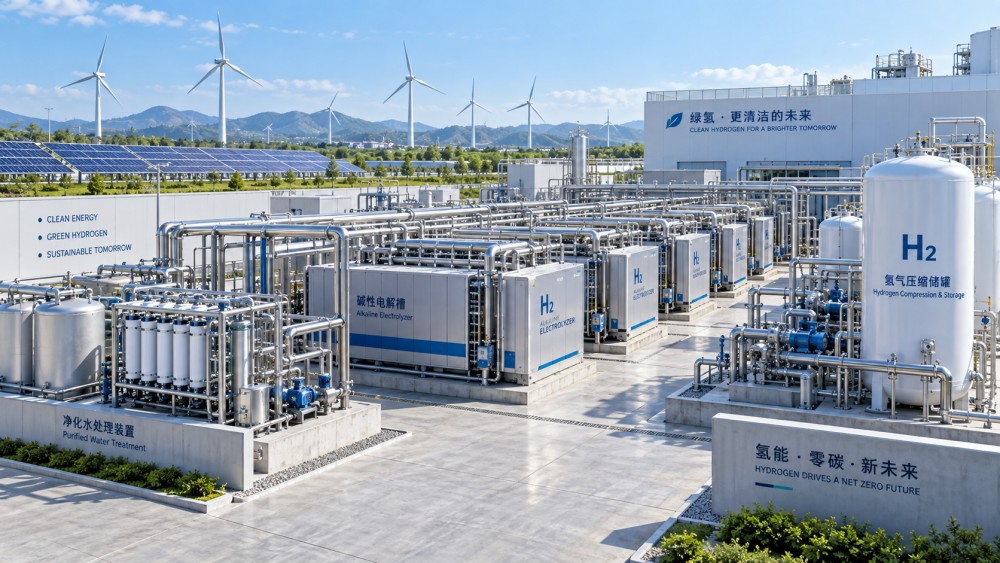
Large electrolyzer blocks can reduce unit costs through standardized engineering, shared utilities, common controls, larger electrical connections, centralized water treatment, and consolidated gas processing. The savings are real only if the surrounding infrastructure can serve the expanded production volume without creating bottlenecks.
Hydrogen leaving the electrolyzer is not necessarily ready for use or transport. The required delivery pressure and purity may drive significant downstream equipment. A nearby industrial consumer accepting moderate-pressure hydrogen has a different cost structure from a project requiring high-pressure storage, tube trailer filling, pipeline injection, liquefaction feed, or synthesis-loop integration. Compressing every kilogram to a high pressure because one portion of demand requires it can damage the economics of the entire plant.
Segregating hydrogen delivery paths may be more economical: direct lower-pressure supply for an adjacent process, buffered supply for variable demand, and a dedicated compression train for the portion requiring higher pressure. The same principle applies to oxygen. Oxygen may be safely vented or managed as a by-product, but where it has a legitimate local use, recovery requirements must be assessed without assuming a revenue credit that the project cannot reliably realize.
Water and thermal systems should not be treated as minor utilities
At large scale, water availability, intake quality, treatment chemistry, wastewater handling, and cooling design can affect both project schedule and operating reliability. Feedwater requirements are governed by the equipment design and must be maintained throughout operation, not merely demonstrated during commissioning. A water source that varies seasonally or contains difficult contaminants can impose more than an operating expense; it can create maintenance and uptime risk.
Thermal management deserves equal attention. Electrolyzer performance, stack health, and auxiliary loads depend on maintaining suitable operating temperatures. In hot climates, cooling capacity and water use can become material design constraints. In cold conditions, freeze protection, startup procedures, and heat losses may influence availability. These are not reasons to reject alkaline technology. They are reasons to make the cost model site-specific rather than treating the electrolyzer as an isolated electrical load.
Durability and availability determine whether low CAPEX survives the lifecycle model
An alkaline plant with a competitive initial price can lose its advantage if stack refurbishment, component replacement, unplanned outages, or electrolyte-management issues are inadequately budgeted. Lifecycle evaluation should therefore separate routine maintenance from major stack-related interventions and define who bears the performance risk.
Do not accept a generic availability number without clarifying its basis. It should distinguish planned outages, forced outages, grid-related interruptions, time needed for restart, and periods when the system is technically available but cannot produce saleable hydrogen because downstream compression or purification is unavailable. A plant-wide availability model is more useful than an electrolyzer-only figure.
For a multi-train facility, modularity can reduce the impact of maintenance because one train may be serviced while others continue producing. That benefit depends on headers, electrical distribution, controls, and downstream gas systems being designed for partial operation. A centralized compressor or purification package without adequate redundancy can nullify the availability benefit of multiple electrolyzer trains.
Intermittent power requires a more careful comparison
One common mistake is to assume that the technology with the lowest installed cost always fits the lowest-cost renewable electricity. In reality, deeply intermittent generation can lead to frequent starts, stops, low-load periods, or rapid changes in power. The economic effect depends on how often these conditions occur, how the specific alkaline design is qualified to operate, and what supporting assets are available.
A sound assessment uses time-series data rather than annual average renewable output. Hourly or finer dispatch modeling should test at least three cases: expected resource conditions, lower-than-expected generation, and periods of high renewable output coinciding with curtailed hydrogen demand. The model should include minimum operating thresholds, ramp limitations, standby consumption, restart requirements, storage capacity, and any grid import rules.
Alkaline systems can remain a strong choice in renewable-led projects when a hybrid power strategy raises utilization and avoids unnecessarily harsh cycling. That may include renewable overbuild, battery buffering, grid-connected operation under defined clean-power rules, or hydrogen storage that allows production and delivery schedules to differ. Each measure carries cost, so the objective is not perfect smoothing. It is finding the least-cost combination that delivers the required hydrogen volume and carbon-intensity outcome.
Compare alternatives by the duty, not by reputation
Technology selection often becomes distorted by simplified claims: alkaline is “best for baseload,” while other designs are “best for renewables.” Those labels may help start a discussion but cannot complete a procurement decision. The right comparison uses the same project boundary, delivery conditions, financial assumptions, site constraints, and operating schedule for every candidate.
ALK electrolysis usually has an advantage when the project values large standardized capacity, a relatively stable operating regime, cost-conscious deployment, and a supply chain compatible with long-duration industrial service. Another technology may justify a higher capital cost where footprint is severely constrained, very dynamic operation is central to the business model, or specific pressure and response characteristics reduce broader system costs. The better choice is the one with the lower delivered-hydrogen cost and acceptable operational risk, not the one that wins a single equipment metric.
Turn the decision into a bankable procurement scope
Before issuing a final request for proposal, establish a design basis that prevents vendors from optimizing around different assumptions. Define annual hydrogen quantity, hourly delivery requirements, minimum purity, pressure at the custody-transfer point, anticipated load profile, water source, ambient design conditions, electrical interconnection, planned maintenance windows, and the treatment of oxygen. State which party provides compression, storage, backup power, civil works, and controls integration.
Then request a lifecycle submission rather than a headline quotation. It should show installed scope, guaranteed consumption, degradation assumptions, stack-service intervals, consumables, maintenance labor assumptions, critical spares, availability exclusions, and performance-test methods. Require sensitivity cases for electricity price and annual operating hours. A supplier whose cost advantage remains visible under realistic sensitivities is more relevant than one with the lowest base quotation.
The final decision should also examine interface risk. In large projects, delays and cost overruns frequently occur between packages: electrical engineering and rectification, water treatment and electrolyzer feed requirements, hydrogen processing and compression, control systems and site safety functions. Clear battery limits, responsibility matrices, and acceptance criteria are as important as the selected stack technology.
Alkaline electrolysis becomes the lower-cost route at scale when the project is built around its economic strengths: sustained production, disciplined utility integration, credible lifecycle maintenance, and delivery infrastructure matched to the actual hydrogen use. Where those conditions are absent, the apparent CAPEX benefit should be tested against reduced utilization, added buffering, more demanding operational requirements, and the cost of producing hydrogen that cannot be delivered in the form the off-taker needs.
Related News
- How to calculate KOH concentration in an alkaline electrolyzerNov 09, 2026Master KOH concentration calculation for alkaline electrolyzers with practical formulas, worked examples, density conversions, and essential safety checks.
- Hongqiao Forum Hydrogen Session Held in Shanghai, Industry Reports ReleasedNov 06, 2026Hongqiao Forum hydrogen session highlights China’s latest hydrogen and green fuel reports. Explore the findings and their global energy transition implications.
- Everfuel Secures €245 Million for Danish 200 MW Green Hydrogen ProjectNov 05, 2026Everfuel secures €245 million for a planned 200 MW green hydrogen project in Denmark. Explore its pipeline plans and proposed deliveries to Germany.
- How much electricity does an alkaline water electrolysis system use?Nov 04, 2026An alkaline water electrolysis system typically uses 50–60 kWh per kg of hydrogen. Explore the factors behind demand and compare supplier figures with confidence.
Related News
- 00
0000-00
Hydrogen Energy Storage for Data Centers Gets Costly Fast - 00
0000-00
When 99.999% Hydrogen Purity Still Is Not Good Enough - 00
0000-00
When Does a Hydrogen-Ready Gas Turbine Pay Off? - 00
0000-00
Electricity Price Volatility Is Rewriting Hydrogen Cost Models - 00
0000-00
PSA Recovery Rate Drops for Reasons Operators Miss
Dr. Aris Aero
Weekly Insights
Stay ahead with our curated technology reports delivered every Monday.