
AEM Electrolysis Stacks: Performance Limits and Fit for Distributed H2 Projects




A credible option for a narrow but important project profile
AEM electrolysis stacks deserve attention in distributed hydrogen projects when the project needs flexible operation, aims to reduce dependence on precious-metal catalysts, and can tolerate a technology qualification process that is more demanding than for mature alkaline equipment. They are not yet a default replacement for PEM or conventional alkaline systems. Their practical fit depends on whether the expected operating profile stays within the stack's demonstrated durability window, whether water treatment and gas handling are designed for alkaline conditions, and whether the supplier can substantiate performance beyond a short factory test.
For a technical evaluator, the central question is not whether an anion exchange membrane electrolyzer can achieve an attractive cell-voltage figure at a selected current density. The relevant question is whether that performance can be retained through starts, stops, load changes, impurity exposure, pressure differentials, and the maintenance intervals expected at a remote or distributed site. AEM technology can combine useful characteristics from alkaline electrolysis and PEM systems, but it also inherits a difficult materials challenge: the membrane, ionomer, electrodes, porous transport layers, seals, and operating chemistry must remain stable together.
That distinction matters most in smaller projects, where a stack failure can remove a large share of available hydrogen production and where the owner may not have a specialist electrochemistry team on site. Distributed deployment rewards compact equipment and good renewable-following behavior, but it penalizes uncertain lifetime, complex service requirements, and replacement parts that are not yet standardized across suppliers.
Where AEM can fit better than the usual alternatives
The strongest use case is a hydrogen asset with variable electricity input and a moderate production scale: renewable-powered industrial sites, distributed refueling support, microgrids, constrained grid connections, and behind-the-meter generation where hydrogen is consumed locally. In these settings, fast response can have direct value. The electrolyzer may need to absorb curtailed renewable output, reduce demand during high-price periods, or follow an intermittent power profile without operating continuously at its nominal point.
Traditional alkaline systems remain compelling where utilization is high, footprint is less constrained, and the plant can operate steadily. Their long industrial record, established supply chain, and conventional materials are substantial advantages. PEM systems are usually easier to justify when very high current density, compact layout, high differential pressure capability, and rapid cycling are decisive. Their cost and supply exposure are tied in part to scarce catalyst and component materials.
AEM electrolysis stacks sit between those positions. Their attraction is the possibility of alkaline chemistry with lower precious-metal loading than PEM, combined with a stack architecture that can be more compact and responsive than classical alkaline systems. This is a design objective, not a universal outcome. An AEM package should only be compared with PEM or alkaline equipment at the same delivered hydrogen conditions: production rate, outlet pressure, purity specification, turndown range, site electrical interface, cooling requirement, and expected annual operating hours.
The comparison should also separate stack-level efficiency from system-level electricity consumption. Pumps, cooling equipment, water purification, gas drying, compression, power conversion, and controls can materially affect the result at distributed scale. A low cell voltage in a controlled test does not automatically translate into low energy use per kilogram of usable hydrogen at the site boundary.
The performance limits are primarily durability limits
AEM cells conduct hydroxide ions through an alkaline polymer membrane. This creates the opportunity to use catalysts and hardware that differ from the platinum-group-metal-intensive approach associated with many PEM designs. It also creates a durability challenge. Hydroxide is chemically aggressive, and the membrane and ionomer must preserve ionic conductivity, mechanical integrity, and electrode adhesion over a long service period. Small losses in one layer can amplify losses elsewhere: rising resistance increases heat generation, uneven current distribution accelerates local degradation, and gas crossover can become more difficult to control.
Published or supplier-reported performance should therefore be read with care. A current-density result is meaningful only alongside operating temperature, electrolyte concentration where applicable, electrode area, pressure, gas purity, test duration, and degradation behavior. Short runs can demonstrate electrochemical potential. They do not demonstrate a field-ready lifetime. The same caution applies to claims of low catalyst loading. Lower loading can reduce material exposure, but the catalyst layer still needs to maintain activity, electrical contact, wetting behavior, and adhesion as the stack cycles.
Membrane stability is not a single property. Chemical resistance, dimensional swelling, mechanical strength, reinforcement, interfacial compatibility, and tolerance to operating excursions all matter. A membrane that performs well under stable laboratory conditions can face different stresses in a modular plant that sees repeated shutdowns, cold starts, temperature gradients, water interruptions, or variable differential pressure between hydrogen and oxygen sides.
For distributed projects, evaluators should ask for degradation evidence under the anticipated duty cycle rather than accepting steady-state endurance data alone. A solar-coupled system may require daily ramping and frequent low-load operation. A grid-services asset may experience more rapid setpoint changes. A refueling-linked asset may operate in bursts based on storage inventory. These profiles affect gas management, heat balance, membrane hydration, electrode potentials, and control logic in different ways.
Water quality is a system design issue, not an ancillary utility
The perception that alkaline chemistry is inherently forgiving can lead to an underdesigned water system. Water impurities can contaminate electrodes, alter electrolyte composition, promote deposits, and affect membrane behavior. The actual tolerance will depend on the supplier's architecture, whether the system uses a circulating electrolyte, and the materials selected for wetted components. Technical teams should define feedwater quality, sampling points, purification redundancy, conductivity monitoring, and response actions before finalizing the stack selection.
Water treatment also has implications for remote operations. Cartridge replacement frequency, resin regeneration arrangements, storage tank hygiene, sensor calibration, and freeze protection may be more consequential than a small difference in quoted stack efficiency. A well-designed package makes these conditions observable and manageable; it does not assume that the stack will absorb persistent utility-side failures.
Balance-of-plant choices can decide the project outcome
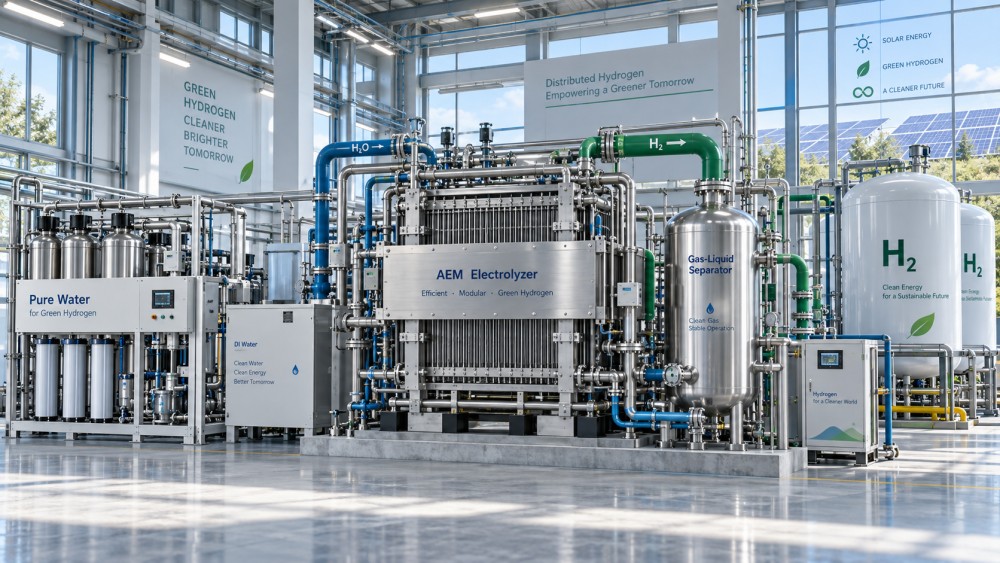
An AEM stack is only one part of the hydrogen production system. Its suitability should be assessed with the rectifier, power electronics, thermal management, electrolyte handling where relevant, gas-liquid separation, drying, purification, ventilation, controls, and downstream compression or storage. A distributed project can fail its availability target even when the electrochemical stack itself is sound, simply because interfaces are poorly matched.
Dynamic operation is a useful example. A stack may be capable of fast electrical response, while the supporting equipment imposes a slower practical response due to temperature control, circulation flow, gas separation, or downstream pressure management. At low load, hydrogen purity and crossover behavior may become more sensitive. At high load, cooling capacity and uniform flow distribution may set the limit. The project specification should define acceptable operation across the full intended load range, rather than treating nominal-load performance as the sole acceptance condition.
Pressure architecture needs the same discipline. Producing hydrogen at pressure may reduce downstream compression work, but it raises demands on seals, pressure control, crossover monitoring, and safety design. The value of higher stack outlet pressure should be calculated against the entire compression and storage train, including the required delivery pressure, buffer storage strategy, compression ratio, and duty cycle. A higher-pressure stack is not automatically the lowest-risk configuration for an unattended location.
- Specify the expected load profile, including start-stop frequency, ramp rate, minimum stable load, and outage recovery behavior.
- Require stack and system data separately: cell voltage, auxiliary consumption, hydrogen purity, water consumption, heat rejection, and operating limits.
- Evaluate degradation through representative cycling, not only continuous nominal-load endurance.
- Define the water-quality envelope and identify which contaminants trigger a controlled shutdown or corrective maintenance action.
- Review gas crossover monitoring, ventilation, purge sequences, pressure-relief design, and hydrogen detection as part of the package design.
- Establish a replacement and service plan that includes lead times, field labor requirements, recommissioning tests, and disposal or refurbishment arrangements.
How to qualify a supplier without turning the process into a laboratory program
Technical due diligence should focus on evidence that reduces the project's uncertainty. A supplier does not need to disclose every proprietary material detail, but it should be able to define the operating envelope clearly and explain the conditions behind its performance claims. Ambiguous statements such as “PEM-like efficiency” or “alkaline-level durability” are insufficient without a stated test protocol and an identified system boundary.
Start with a duty-cycle matrix derived from the intended project. It should cover normal operating points, low-load operation, ramps, planned shutdowns, unplanned power loss, restart conditions, ambient-temperature limits, water excursions, and pressure transients. Ask the supplier to state which conditions have been demonstrated and which remain outside the warranted operating range. This approach is more useful than comparing a single headline efficiency value.
Then examine the stack replacement model. In an emerging technology category, replacement economics are closely tied to design maturity. Is the stack field-replaceable without extensive pipework changes? Are manifolds, seals, sensors, and power connections standardized? Does replacement require a full system requalification? Can the operator identify degradation before hydrogen purity, production rate, or safety margins deteriorate? These questions matter more for a 24-hour industrial consumer than for a pilot asset with frequent engineering supervision.
Acceptance testing should include more than nameplate hydrogen production. It should verify stable operation across agreed load points, electrical consumption at the defined boundary, gas-quality performance, control-system alarms, purge and shutdown sequences, leak testing, and behavior after a loss of power. For projects serving refueling or high-pressure storage, the electrolyzer acceptance plan should connect explicitly to the safety logic and operating limits of the downstream equipment.
A practical decision rule for distributed hydrogen
AEM is a credible candidate when the project values flexible operation and reduced reliance on scarce catalyst materials, while the owner can accept a structured validation effort and has a realistic service model. It is less compelling when the site needs the longest possible proven operating record, has little tolerance for stack replacement uncertainty, or requires operating conditions beyond the supplier's demonstrated envelope.
The technology should be treated as a system-level choice rather than a material-substitution exercise. A project that pairs an AEM stack with disciplined water management, realistic thermal and pressure design, clear cycling requirements, and measurable acceptance criteria may obtain a useful balance of responsiveness and material efficiency. A project that selects it solely on headline efficiency or catalyst claims risks discovering its limits after the equipment has become a critical production asset.
For technical evaluators, the useful next step is to convert the intended hydrogen demand and power profile into a qualification specification, then test every stack proposal against that specification. That keeps the decision anchored to availability, safety, maintainability, and delivered hydrogen performance, which are the measures that determine whether distributed production works beyond commissioning.
Related News
- Electricity Price Volatility Is Rewriting Hydrogen Cost ModelsApr 27, 2026Impact of electricity price on hydrogen cost is transforming industrial decarbonization and large-scale electrolysis. Explore LCOH trends, PPA strategies, and resilient hydrogen infrastructure planning.
- Energy Transition Plans Often Fail at the Grid Connection StageApr 27, 2026Sustainable energy and energy transition projects often fail at grid connection. Learn how hydrogen infrastructure, PEM electrolysis, and industrial decarbonization can avoid delays and protect investment value.
- What Is Slowing Industrial Decarbonization Projects in 2026?Apr 27, 2026Industrial decarbonization faces delays in 2026 as hydrogen infrastructure, sustainable energy access, grid limits, safety standards, and project bankability challenge the energy transition.
- How PEM electrolyzers support the energy transition in EuropeNov 10, 2026Discover how PEM electrolyzers support the energy transition in Europe, from renewable hydrogen and industrial applications to project costs and infrastructure.
Related News
- 00
0000-00
Hydrogen Energy Storage for Data Centers Gets Costly Fast - 00
0000-00
When 99.999% Hydrogen Purity Still Is Not Good Enough - 00
0000-00
When Does a Hydrogen-Ready Gas Turbine Pay Off? - 00
0000-00
Electricity Price Volatility Is Rewriting Hydrogen Cost Models - 00
0000-00
PSA Recovery Rate Drops for Reasons Operators Miss
Dr. Aris Aero
Weekly Insights
Stay ahead with our curated technology reports delivered every Monday.