
CIF price vs FOB price comparison for electrolyzer import cost control




CIF Price vs FOB Price Comparison for Electrolyzer Import Cost Control
For an electrolyzer procurement team, comparing CIF and FOB prices is not a simple freight-cost exercise. It is a decision about who controls the shipment, where risk changes hands, how transparent the landed-cost model will be, and how much room remains to recover when a port, carrier, or documentation issue disrupts the delivery schedule.
This matters more for utility-scale hydrogen projects than for routine industrial imports. An electrolyzer package may include containerized skids, stacks, rectifiers, water-treatment equipment, cooling systems, control cabinets, spare parts, and sensitive components requiring moisture protection or controlled handling. A late transformer, a damaged PEM stack crate, or a missing customs document can hold up civil works, electrical integration, commissioning teams, and downstream hydrogen infrastructure at the same time.
A disciplined CIF price vs FOB price comparison therefore starts with the full delivery chain, not with the number printed next to the equipment quotation. The lowest CIF offer is not automatically the lowest landed cost, and an attractive FOB price may become expensive once the buyer takes responsibility for freight, insurance, port handling, customs coordination, and inland transport.
The practical difference between CIF and FOB
Under Incoterms® 2020, CIF means Cost, Insurance and Freight. The seller delivers the goods when they are placed on board the vessel at the port of shipment, but the seller also contracts and pays for carriage to the named destination port. The seller must arrange cargo insurance at the minimum level required by CIF unless the contract calls for broader cover.
That split often causes confusion: the seller pays freight to the destination port, yet the risk of loss or damage generally transfers to the buyer when the cargo is loaded on board at origin. If an electrolyzer skid is damaged during the ocean voyage, the buyer may need to pursue the marine insurer even though the seller arranged and paid for the policy.
FOB, or Free On Board, places more transport responsibility on the buyer. The seller delivers the cargo on board the vessel nominated by the buyer at the agreed port of shipment. From that point, the buyer controls the main carriage, marine insurance, destination-port arrangements, and typically the onward route to site.
Neither term should be treated as a complete delivery-to-project-site solution. Under both CIF and FOB, the buyer normally handles import clearance, duties, taxes, destination terminal charges not included in the shipping arrangement, and inland movement after discharge. Contract language should also state whether sellers are responsible for export packaging, lashing, surveys, lifting plans, and loading of oversized cargo. Incoterms rules allocate delivery obligations; they do not settle every commercial detail.
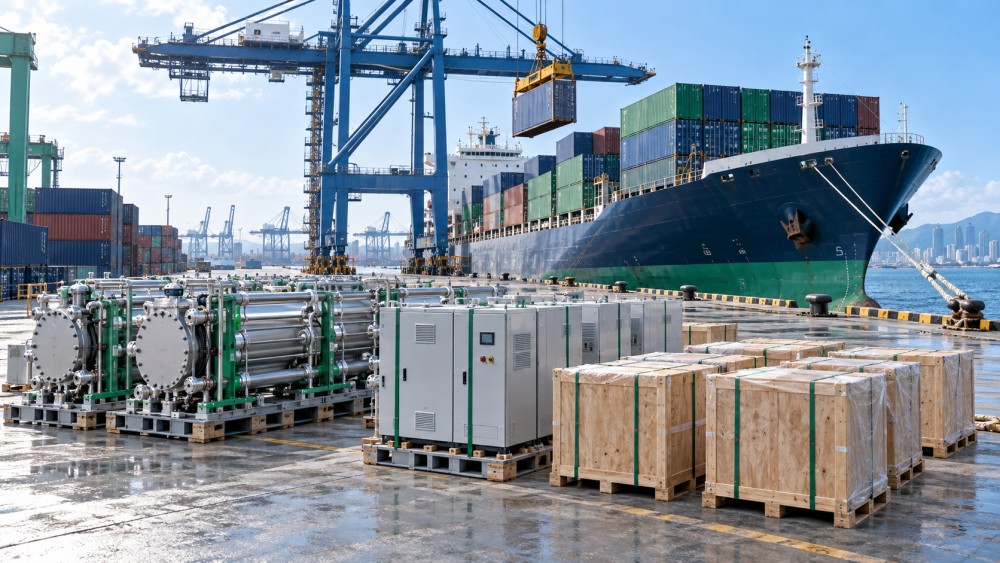
Why the CIF price can look safer than it really is
CIF is attractive when a buyer has limited freight-buying capability, is importing a relatively standard package, or needs a quick budget figure to compare several suppliers. It can reduce the number of immediate logistics decisions. Procurement also receives one consolidated equipment-and-freight price, which may simplify an early investment committee submission.
The weakness is visibility. A CIF quotation may include a freight allowance that is difficult to isolate, and the selected carrier or routing may not match the project’s actual schedule needs. A supplier can understandably optimize for its shipping cost rather than for the buyer’s site-delivery sequence. Transshipment risk, sailing frequency, free-time arrangements, and special handling capability may receive less attention than they would under a buyer-managed shipment.
Insurance deserves particular scrutiny. CIF requires the seller to procure insurance, but the minimum cover required by the rule may not be enough for a high-value electrolyzer shipment with sensitive instrumentation, electronics, coated components, and large fabricated skids. Procurement should not assume that “insured” means all-risk protection, coverage for delay, or straightforward claims handling. The policy wording, insured party, claim procedure, deductible, exclusions, and coverage period should be reviewed before shipment—not after a crate arrives with visible impact damage.
There is also a budget trap around destination charges. A CIF price ends at the named destination port. It does not necessarily include discharge costs, terminal handling, storage, demurrage, detention, customs brokerage, inspections, import duties, local tax, crane hire, permits, or the final heavy-haul route to the hydrogen plant. These are often the items that make a CIF quote appear cheaper than it is.
Where FOB gives the buyer better cost control
FOB becomes more compelling when the purchaser has a capable logistics team, a nominated freight forwarder, a framework agreement with carriers, or a portfolio of projects that can create shipping volume. The buyer can compare freight options independently, choose a carrier with appropriate project-cargo experience, purchase broader insurance, and align vessel timing with site readiness.
For large alkaline or PEM electrolyzer systems, shipment planning is rarely just about booking container space. Packages can contain out-of-gauge components, heavy power-electronics cabinets, corrosion-sensitive materials, and crates that need clear lifting points and inspection access. If the project also includes compression, storage, hydrogen refueling, CCUS interfaces, or hydrogen-ready power assets, inbound deliveries may compete for the same port capacity and site laydown area. Direct logistics control can be worth more than a modest difference in quoted freight.
FOB does not eliminate risk; it shifts management responsibility to the buyer. The procurement team must nominate a vessel in time, issue correct shipping instructions, verify cargo readiness, and ensure that the forwarder understands packing dimensions, hazardous-material declarations where applicable, and delivery priorities. Missing a vessel cut-off can turn a supposedly controlled shipment into a schedule problem that the seller will reasonably argue is outside its responsibility.
One technical caution: FOB and CIF are designed for sea or inland waterway transport where delivery occurs on board the vessel. For containerized cargo handed over at a terminal before loading, FCA may be operationally cleaner than FOB because the seller can deliver to the carrier at the terminal. This is not a semantic point. It affects the moment of risk transfer and whether a supplier is being asked to control a loading event it cannot realistically manage.
Build the comparison around landed cost, not Incoterms labels
A useful procurement comparison puts CIF and FOB offers into the same cost structure. Start with the ex-works equipment value, then separately list export packing, origin inland transport, origin terminal charges, export clearance, ocean freight, insurance, destination-port charges, customs clearance, duty and tax exposure, inland transport, site unloading, and contingency for delay-related costs.
Some charges will not be known precisely during an early tender stage. That is normal. The goal is not false precision; it is to expose where assumptions differ. If one supplier quotes CIF to a named port while another quotes FOB, ask for an itemized freight and insurance breakdown from the CIF supplier and obtain an indicative logistics quote against the same packing list for the FOB option. The comparison is only credible when weight, dimensions, number of packages, readiness date, port pair, and cargo-handling assumptions are aligned.
Do not compare freight alone. A cheaper rate with a slow or unreliable routing can be a poor choice if the equipment is on the project’s critical path. The practical question is: what does one week of late delivery mean for installation crews, crane bookings, electrical works, commissioning, and financing milestones? The answer varies sharply by project, but it should influence the selected Incoterm and not sit outside the commercial evaluation.
Questions that should be settled before purchase order release
- What is the exact named port, including the terminal where relevant, and who pays charges after arrival?
- Are the electrolyzer skids shipped as containers, breakbulk, RoRo, or project cargo, and is the selected Incoterm suitable for that mode?
- Does the marine insurance cover the cargo value, packing method, handling risks, and claims process expected by the buyer?
- Who bears costs if cargo is held because technical files, certificates, invoices, packing lists, or origin documents are incomplete?
- Are port free-time assumptions realistic for customs inspection, heavy-lift mobilization, and inland transport permits?
- Which shipment date is contractually binding: factory-ready date, port-delivery date, vessel departure, or arrival at destination?
Documentation is part of import-cost control
Electrolyzer imports often create documentation pressure because the equipment package combines mechanical, electrical, process, and safety-critical elements. Customs authorities may require a clear description of each package and consistent values across commercial invoices, packing lists, bills of lading, and origin documentation. Technical teams may simultaneously need drawings, preservation instructions, inspection records, operating manuals, and material traceability records for installation acceptance.
This is where a narrow freight decision connects to broader asset integrity. In benchmarking work across megawatt-scale electrolysis, cryogenic hydrogen logistics, hydrogen-ready turbines, CCUS infrastructure, and high-pressure refueling systems, technical standards such as ISO 19880, ASME B31.12, and SAE J2601 may shape the project’s engineering and safety documentation requirements. They do not determine CIF or FOB responsibilities, but poorly coordinated technical documentation can still create import holds, storage exposure, or site acceptance delays.
A sensible contract attaches a document register to the supply agreement, assigns submission dates, identifies which documents must travel with the cargo, and defines the consequences of late or inaccurate paperwork. For high-value hydrogen assets, the shipping file should be treated as a project deliverable, not as an administrative afterthought.
Choosing the better term for the project in front of you
CIF can be reasonable when the shipment is straightforward, the seller has demonstrably reliable export logistics, the destination port is familiar, and the buyer wants a simplified initial commercial structure. It is most defensible when the contract makes freight, insurance, destination charges, document obligations, and claims support transparent.
FOB is usually stronger when the buyer needs control over carrier selection, schedule sequencing, insurance quality, and multimodal coordination. It is especially useful when several equipment packages must arrive in a defined installation order or when the buyer already has a project-logistics partner managing the wider hydrogen plant.
The most reliable answer rarely comes from a generic rule that “CIF is easier” or “FOB is cheaper.” Request both price structures where possible, normalize every downstream cost, and test the result against the actual shipment profile. For electrolyzer procurement, the commercial winner is the option that protects the critical delivery date, provides a workable claims path, and leaves no expensive responsibility hidden between the discharge port and the project gate.
Related News
- Electricity Price Volatility Is Rewriting Hydrogen Cost ModelsApr 27, 2026Impact of electricity price on hydrogen cost is transforming industrial decarbonization and large-scale electrolysis. Explore LCOH trends, PPA strategies, and resilient hydrogen infrastructure planning.
- Energy Transition Plans Often Fail at the Grid Connection StageApr 27, 2026Sustainable energy and energy transition projects often fail at grid connection. Learn how hydrogen infrastructure, PEM electrolysis, and industrial decarbonization can avoid delays and protect investment value.
- What Is Slowing Industrial Decarbonization Projects in 2026?Apr 27, 2026Industrial decarbonization faces delays in 2026 as hydrogen infrastructure, sustainable energy access, grid limits, safety standards, and project bankability challenge the energy transition.
- How PEM electrolyzers support the energy transition in EuropeNov 10, 2026Discover how PEM electrolyzers support the energy transition in Europe, from renewable hydrogen and industrial applications to project costs and infrastructure.
Related News
- 00
0000-00
Hydrogen Energy Storage for Data Centers Gets Costly Fast - 00
0000-00
When 99.999% Hydrogen Purity Still Is Not Good Enough - 00
0000-00
When Does a Hydrogen-Ready Gas Turbine Pay Off? - 00
0000-00
Electricity Price Volatility Is Rewriting Hydrogen Cost Models - 00
0000-00
PSA Recovery Rate Drops for Reasons Operators Miss
Dr. Aris Aero
Weekly Insights
Stay ahead with our curated technology reports delivered every Monday.