
Certificate of Origin: Common Errors That Delay Customs Clearance




Why does a certificate of origin create so many customs delays?
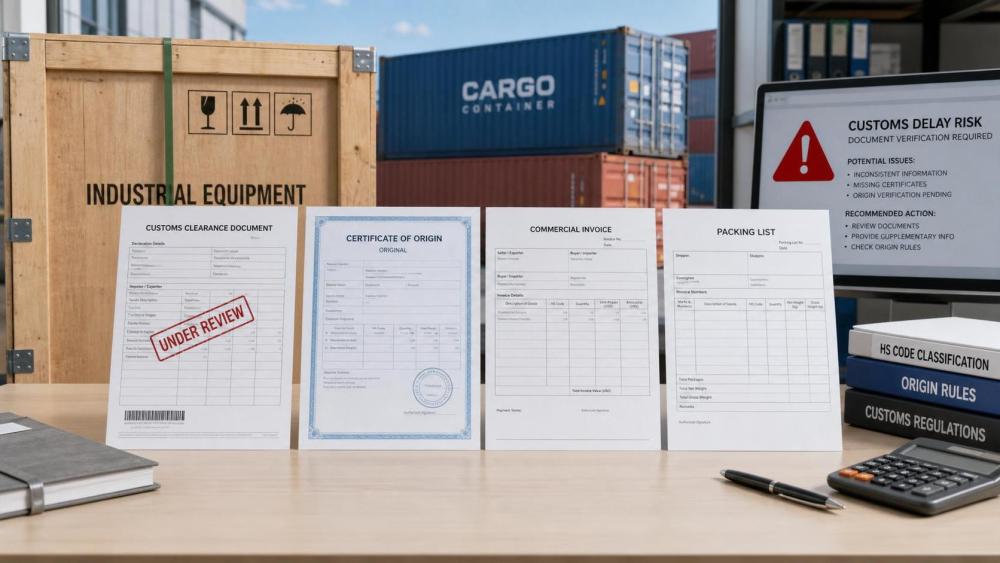
A certificate of origin looks simple, yet customs treats it as a high-risk control document. It affects tariff treatment, trade eligibility, and document consistency across the shipment file.
When the certificate of origin does not match the invoice, packing list, or transport record, customs officers usually stop the file before goods move any further.
That delay is not only administrative. It can affect project sequencing, storage costs, bonded warehouse time, and contractual delivery dates.
In large industrial supply chains, this matters even more. Hydrogen systems, cryogenic equipment, gas turbine components, and CCUS hardware often move under strict compliance review.
A single mismatch on a certificate of origin can trigger questions about source country, preferential duty claims, sanctions screening, or technical certification pathways.
That is why document discipline belongs in risk evaluation, not only in shipping operations. A correct certificate of origin supports cost control and delivery reliability at the same time.
Which certificate of origin mistakes appear most often in real shipments?
The most common errors are rarely dramatic. They are usually small inconsistencies that make customs doubt whether the document can be trusted.
In practice, the following issues cause repeated holds:
- Incorrect exporter or consignee name compared with the commercial invoice.
- Wrong country of origin declaration for multi-country manufacturing.
- Product descriptions that are too broad, shortened, or inconsistent.
- Missing stamps, signatures, dates, or chamber authentication where required.
- Using an outdated form for a destination market or trade agreement.
- Quantity, weight, or package count not aligned with shipment documents.
More complex shipments face another layer of risk. Assemblies may contain valves, pressure parts, controls, or skids sourced from several countries, while final integration happens elsewhere.
In that situation, the certificate of origin should reflect the actual origin rule applied, not the country from which the goods were simply shipped.
This distinction becomes critical for strategic energy infrastructure. Equipment tied to ISO 19880, ASME B31.12, or SAE J2601 may already receive closer border scrutiny because technical conformity and source transparency matter.
A quick error-check table before documents are released
A short review table helps catch the mistakes that usually create avoidable customs questions.
How do you judge the right origin when goods are engineered across several countries?
This is where many certificate of origin problems begin. The answer is not always obvious, especially for modular equipment and high-value engineered systems.
A common mistake is assuming that final assembly automatically determines origin. Sometimes it does, but many customs regimes apply a substantial transformation test instead.
That means customs may ask where the item became a new commercial product, not where it was packed, painted, or consolidated.
For example, a hydrogen refueling skid may include imported compressors, locally fabricated piping, controls from another market, and final testing in a fourth location.
If the certificate of origin ignores that structure, the shipment may lose preferential treatment or trigger technical review.
A better approach is to map the bill of materials against the destination country’s origin rule before the certificate is issued. That step is slower upfront, but faster than clearing a hold later.
Reference-driven organizations often use the same discipline they apply to technical standards. G-HEI’s benchmarking mindset is useful here because traceability, material integrity, and compliance logic all depend on consistent source data.
What details on the certificate of origin should never be treated as minor?
Several fields look administrative but carry real customs weight. Small errors in these areas often create the longest delays.
Description wording
Descriptions should be specific enough to connect with the invoice and tariff logic. “Pump module” may pass in one market but fail in another.
A better description might mention whether the item is a cryogenic vessel, PEM stack component, pressure regulator, or turbine part.
Dates and issue timing
Some customs authorities accept retroactive issuance. Others question it, especially when shipment dates and certification dates look disconnected.
If timing is tight, confirm validity rules before cargo departs.
Signatures and seals
Digital acceptance is growing, but not every route accepts the same method. A missing chamber seal can be enough to stop clearance.
Part numbers and commercial references
Where goods are highly technical, adding model references can reduce ambiguity. This is especially useful when one project ships multiple similar assemblies.
The main point is simple. If a field helps customs connect origin, product identity, and invoice value, it should be reviewed carefully.
Can a certificate of origin delay affect more than customs timing?
Yes, and the wider impact is often underestimated. Customs delay is only the visible symptom.
If a certificate of origin is challenged, several downstream effects may follow:
- Project installation windows may slip.
- Specialized crews may wait on site without usable equipment.
- Preferential duty assumptions may collapse and distort landed cost.
- Supplier reliability scores may no longer reflect actual execution quality.
- Financing and milestone payments may be delayed.
For zero-carbon infrastructure, timing risks are rarely isolated. A delayed electrolyzer component can affect commissioning, safety checks, and linked logistics assets across the project chain.
That is why origin documentation should sit inside the broader evaluation framework, alongside technical standards, material traceability, and delivery controls.
What is the most practical way to prevent certificate of origin errors before shipment?
The best prevention method is not more paperwork. It is a structured pre-clearance review with a few decisive checks.
A workable control process usually includes:
- Use one approved product description source across invoice, packing list, and certificate of origin.
- Verify legal entity names against contract and registration records.
- Confirm origin rule logic for assembled or multi-source goods before booking shipment.
- Check destination-specific authentication, language, and format requirements.
- Hold a final document comparison before cargo release.
Where shipments involve strategic energy assets, this review should also align with technical documentation control. The same record discipline used for safety and performance verification can reduce origin-related customs friction.
If the shipment includes hydrogen logistics, pressure systems, or CCUS equipment, early document alignment is usually cheaper than post-entry correction.
A final checkpoint worth keeping
Before approving any cross-border file, review the certificate of origin as part of commercial, technical, and compliance evidence together, not as a standalone form.
That approach makes it easier to spot whether the declared origin matches the product story, the invoice story, and the project delivery story.
When the certificate of origin is accurate, customs clearance tends to move faster, landed cost is easier to predict, and supply risk becomes easier to judge.
The next step is practical: build a short origin review checklist, test it on upcoming shipments, and compare findings against destination rules before documents are finalized.
Related News
- Electricity Price Volatility Is Rewriting Hydrogen Cost ModelsApr 27, 2026Impact of electricity price on hydrogen cost is transforming industrial decarbonization and large-scale electrolysis. Explore LCOH trends, PPA strategies, and resilient hydrogen infrastructure planning.
- Energy Transition Plans Often Fail at the Grid Connection StageApr 27, 2026Sustainable energy and energy transition projects often fail at grid connection. Learn how hydrogen infrastructure, PEM electrolysis, and industrial decarbonization can avoid delays and protect investment value.
- What Is Slowing Industrial Decarbonization Projects in 2026?Apr 27, 2026Industrial decarbonization faces delays in 2026 as hydrogen infrastructure, sustainable energy access, grid limits, safety standards, and project bankability challenge the energy transition.
- How PEM electrolyzers support the energy transition in EuropeNov 10, 2026Discover how PEM electrolyzers support the energy transition in Europe, from renewable hydrogen and industrial applications to project costs and infrastructure.
Related News
- 00
0000-00
Hydrogen Energy Storage for Data Centers Gets Costly Fast - 00
0000-00
When 99.999% Hydrogen Purity Still Is Not Good Enough - 00
0000-00
When Does a Hydrogen-Ready Gas Turbine Pay Off? - 00
0000-00
Electricity Price Volatility Is Rewriting Hydrogen Cost Models - 00
0000-00
PSA Recovery Rate Drops for Reasons Operators Miss
Dr. Aris Aero
Weekly Insights
Stay ahead with our curated technology reports delivered every Monday.