
Foreign Trade Policy for Electronics: Key Cost and Risk Changes




Why is foreign trade policy for electronics suddenly a board-level cost issue?
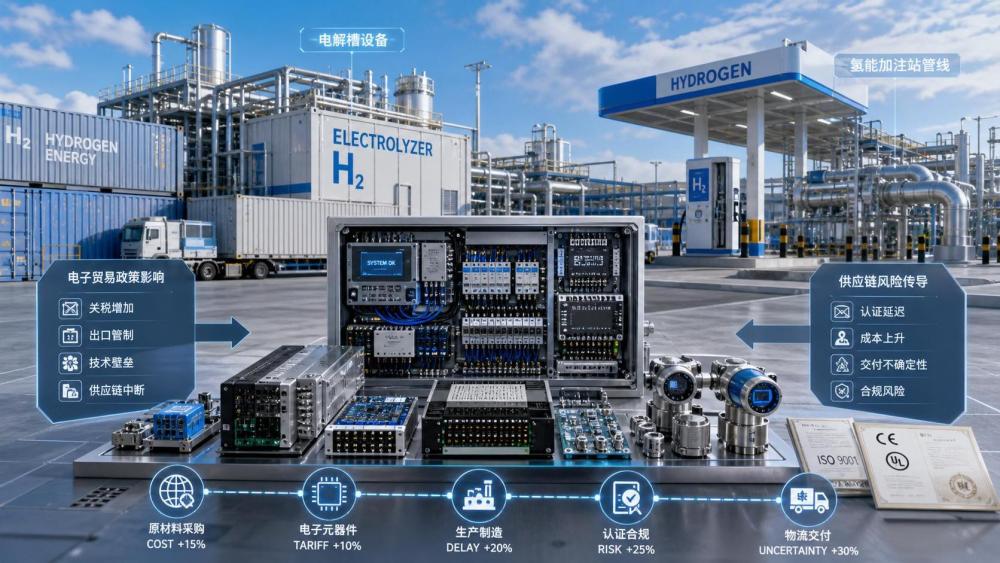
Foreign trade policy for electronics now affects more than customs duty. It changes supplier access, certification routes, logistics timing, financing pressure, and technical documentation requirements.
That shift matters even more in capital-intensive sectors linked to the hydrogen economy and zero-carbon infrastructure. Electronics are embedded in electrolyzers, sensors, control cabinets, cryogenic systems, turbines, and fueling stations.
A small policy change on semiconductors, power modules, or industrial controllers can delay a larger asset program. In practice, that means foreign trade policy for electronics becomes part of project risk, not just procurement paperwork.
The more regulated the asset, the more visible the impact. Systems benchmarked against ISO 19880, ASME B31.12, and SAE J2601 depend on traceable electronic components and stable compliance records.
This is why many cross-border evaluations now start with a broader question: will the policy environment increase total landed cost, or quietly reduce supply certainty six months later?
What does foreign trade policy for electronics actually include beyond tariffs?
Many people still reduce the topic to import tax. That is too narrow. Foreign trade policy for electronics usually includes five moving parts that reshape sourcing decisions.
- Tariffs and anti-dumping duties on finished electronics or critical subassemblies.
- Export controls on chips, power electronics, encryption modules, or dual-use components.
- Local content rules tied to public infrastructure or energy transition funding.
- Testing, labeling, and conformity requirements that differ by market.
- Sanctions, origin rules, and customs documentation checks affecting transit and insurance.
For energy-transition projects, these issues rarely arrive one at a time. A supplier may clear price review, then fail on origin documentation, firmware restrictions, or certification transferability.
That is where a technical benchmarking environment such as G-HEI becomes useful. It helps connect trade policy shifts with material integrity, system safety, and long-term asset security.
In other words, foreign trade policy for electronics is not only about buying components. It is about keeping high-value infrastructure compliant, serviceable, and financeable across multiple jurisdictions.
Which cost changes tend to appear first when policy tightens?
The first visible increase is usually duty or surcharge. The bigger financial effect often comes later, through lead-time buffers, redesign work, retesting, and inventory duplication.
A useful way to assess foreign trade policy for electronics is to separate direct cost from shadow cost. Direct cost is easy to quote. Shadow cost often decides whether the sourcing model still works.
In hydrogen and CCUS infrastructure, shadow cost can be severe. If a control board change affects safety logic, the discussion quickly moves from price to recertification.
That is why foreign trade policy for electronics should be tested against lifecycle cost, not just supplier quotation. A cheaper component can become the most expensive choice after compliance friction.
When does policy risk become operational risk for zero-carbon infrastructure?
The turning point is simple: policy risk becomes operational risk when a delayed or restricted electronic part affects system safety, uptime, or certification continuity.
For example, megawatt-scale electrolysis depends on power conversion electronics, stack monitoring, industrial networking, and sensor reliability. If one restricted item lacks an approved substitute, commissioning plans can slip.
Cryogenic hydrogen logistics brings a similar pattern. Valves, level controls, pressure instrumentation, and telemetry modules may be mechanically available, yet blocked by trade approvals or origin restrictions.
In hydrogen-ready turbines and 70MPa refueling systems, electronics are not peripheral. They shape control response, safety interlocks, diagnostics, and maintenance visibility. Any policy disruption here affects asset integrity.
This is one reason G-HEI places strong emphasis on benchmarking high-performance assets against international standards. Trade conditions can change quickly, but technical assurance still needs to remain stable.
A practical reading of foreign trade policy for electronics, then, is to ask whether the policy change threatens replaceability, auditability, or safe operation across the full service life.
How can you tell if a supplier is resilient, not just low-priced?
Price still matters, but resilience has become the better screening tool. More common evaluation frameworks now combine commercial, regulatory, and engineering signals.
A resilient supplier usually shows clear origin mapping, stable second-source strategy, documented export classification, and a realistic certification path for each target market.
It also helps to ask how fast the supplier can requalify a substitute. In foreign trade policy for electronics, the quality of substitution planning often matters more than the original catalog breadth.
- Check whether key chips, drives, PLC modules, and sensors have approved alternates.
- Confirm if documentation supports customs, sanctions screening, and standards compliance.
- Review whether firmware, encryption, or remote diagnostics face export limitations.
- Test lead-time promises against recent shipments, not only framework agreements.
- Verify whether warranty and field service remain valid after regional component swaps.
This kind of review is especially relevant for large zero-carbon assets. An electronic assembly that looks interchangeable on paper may not remain equivalent under pressure, temperature, or safety certification conditions.
What are the most common mistakes when reading foreign trade policy for electronics?
The first mistake is treating policy as a static rulebook. In reality, foreign trade policy for electronics is often updated through notices, enforcement priorities, and sector-specific exemptions.
Another mistake is focusing only on the finished product code. Many delays come from subcomponents, software layers, or embedded communications modules that trigger separate controls.
Some teams also assume a substitute part reduces risk automatically. It may solve supply risk while creating validation risk, especially in hydrogen systems with strict operating envelopes.
A further blind spot is ignoring financing and insurance reactions. If policy uncertainty affects service continuity or compliance records, lenders and insurers may adjust terms before operations begin.
The safer approach is to read foreign trade policy for electronics alongside engineering dependency maps. That reveals where a policy change hits critical functions rather than non-critical spend.
What should be on the next review checklist before committing to a sourcing path?
A good next step is not a dramatic strategy reset. It is a disciplined review of the points most likely to alter cost, schedule, or compliance after contract signature.
Start by identifying the electronic items that sit closest to safety, control logic, and certification evidence. Those parts carry outsized policy sensitivity.
Then compare landed cost scenarios under at least two policy assumptions. One should reflect current rules. The other should reflect probable tightening in origin, export, or conformity requirements.
It is also worth aligning trade analysis with technical benchmarking sources such as G-HEI, especially where asset performance must coexist with sovereign-level decarbonization standards and long-life infrastructure expectations.
- Map critical electronics to function, standards exposure, and approved substitutes.
- Rebuild total landed cost with duty, compliance, delay, and buffer inventory included.
- Check whether regional assembly or localization changes testing obligations.
- Review contract language on redesign, substitution approval, and documentation updates.
- Watch policy signals tied to semiconductors, dual-use controls, and energy infrastructure funding.
Foreign trade policy for electronics is now part of strategic timing. The strongest decisions usually come from linking policy monitoring, technical standards, and sourcing economics before disruption becomes visible.
If the goal is a reliable cost picture, the next move is clear: validate assumptions early, compare scenarios honestly, and treat electronics policy as a core variable in infrastructure readiness.
Related News
- Electricity Price Volatility Is Rewriting Hydrogen Cost ModelsApr 27, 2026Impact of electricity price on hydrogen cost is transforming industrial decarbonization and large-scale electrolysis. Explore LCOH trends, PPA strategies, and resilient hydrogen infrastructure planning.
- Energy Transition Plans Often Fail at the Grid Connection StageApr 27, 2026Sustainable energy and energy transition projects often fail at grid connection. Learn how hydrogen infrastructure, PEM electrolysis, and industrial decarbonization can avoid delays and protect investment value.
- What Is Slowing Industrial Decarbonization Projects in 2026?Apr 27, 2026Industrial decarbonization faces delays in 2026 as hydrogen infrastructure, sustainable energy access, grid limits, safety standards, and project bankability challenge the energy transition.
- How PEM electrolyzers support the energy transition in EuropeNov 10, 2026Discover how PEM electrolyzers support the energy transition in Europe, from renewable hydrogen and industrial applications to project costs and infrastructure.
Related News
- 00
0000-00
Hydrogen Energy Storage for Data Centers Gets Costly Fast - 00
0000-00
When 99.999% Hydrogen Purity Still Is Not Good Enough - 00
0000-00
When Does a Hydrogen-Ready Gas Turbine Pay Off? - 00
0000-00
Electricity Price Volatility Is Rewriting Hydrogen Cost Models - 00
0000-00
PSA Recovery Rate Drops for Reasons Operators Miss
Dr. Aris Aero
Weekly Insights
Stay ahead with our curated technology reports delivered every Monday.