Green Hydrogen Production Technology: PEM vs ALK Efficiency and Scale




Green Hydrogen Production Technology: PEM vs ALK Efficiency and Scale
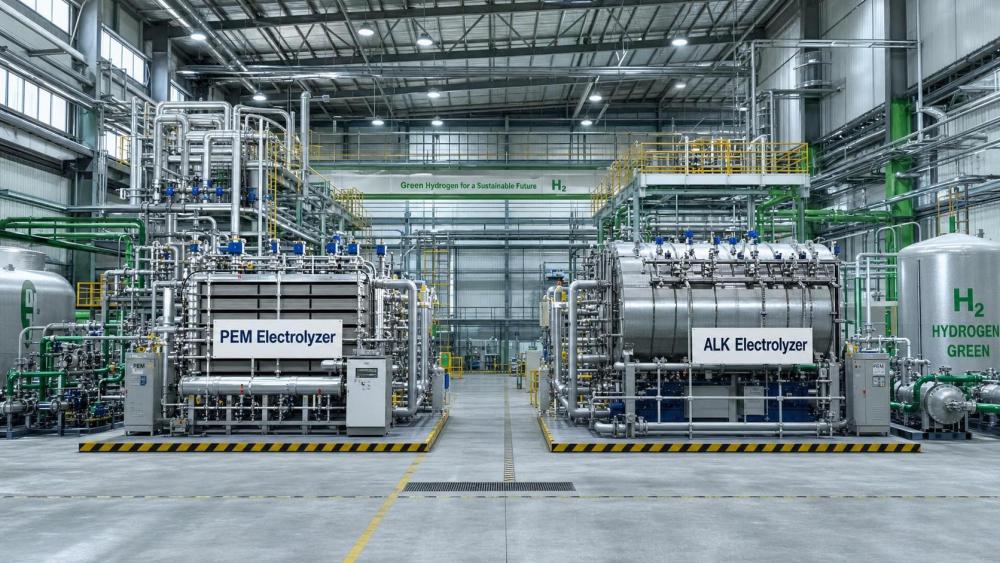
As utility-scale decarbonization accelerates, green hydrogen production technology is moving into core infrastructure planning.
The real decision is no longer a simple PEM versus ALK comparison.
It is now a system-level question about efficiency, scale, flexibility, safety, and lifecycle economics.
That shift matters because large hydrogen programs are being designed as sovereign assets, not pilot demonstrations.
In practice, technical teams must judge which green hydrogen production technology fits power volatility, water quality, site conditions, and expansion plans.
PEM and ALK both produce green hydrogen through electrolysis, yet they behave very differently under real operating loads.
The best choice depends on what must be optimized first: response speed, capex, output purity, stack life, or multi-gigawatt rollout readiness.
Why PEM vs ALK matters now
Recent market signals show a clear transition from standalone plants to integrated hydrogen corridors.
That means green hydrogen production technology must be evaluated with storage, compression, export, and safety interfaces in mind.
ALK remains attractive for mature supply chains and lower upfront equipment cost.
PEM draws attention for compact design, higher current density, and stronger performance under dynamic renewable power.
This is why the PEM versus ALK question sits at the center of many investment reviews.
A poor selection can lock a project into efficiency losses, material stress, or expensive balance-of-plant redesign later.
How PEM and ALK differ at the process level
ALK electrolysis uses a liquid alkaline electrolyte, usually potassium hydroxide, between two electrodes.
It is a proven architecture with decades of industrial operating history.
PEM electrolysis uses a solid polymer membrane and typically depends on precious metal catalysts.
That configuration supports higher current density and simpler differential-pressure operation.
From a green hydrogen production technology perspective, this difference shapes almost every downstream decision.
It affects footprint, startup behavior, purity management, maintenance routines, and material selection across the plant.
Core comparison points
- ALK offers lower stack cost and broad industrial familiarity.
- PEM offers faster ramping and better pairing with intermittent renewables.
- ALK usually needs more space and more complex gas crossover management at low load.
- PEM often delivers higher output purity and compact modular layouts.
- Both require strict safety engineering, but the material and operating risks differ.
Efficiency in real operating conditions
Efficiency claims often look similar in vendor summaries, yet real performance tells a more nuanced story.
A true green hydrogen production technology assessment should examine system efficiency, not stack efficiency alone.
That includes rectifiers, pumps, cooling, gas drying, compression interface, and part-load behavior.
ALK can perform very competitively at steady baseload operation.
PEM often gains an advantage where renewable inputs fluctuate through the day.
The reason is simple: rapid ramping reduces lost production during power swings.
So the most efficient option on paper may not be the most efficient option on site.
Questions that improve efficiency analysis
- What is the expected annual load profile from wind, solar, or grid power?
- How much time will the plant spend below nominal load?
- Does the project value fast response more than lowest capex?
- Will product hydrogen need additional purification before storage or mobility use?
Scale readiness and modular expansion
Scale is where the discussion becomes more strategic.
Many projects start with tens of megawatts but are expected to expand toward hydrogen hubs.
ALK has an advantage in established industrial references and mature fabrication pathways.
PEM, however, fits modular deployment strategies where phased expansion and compact land use are priorities.
For green hydrogen production technology selection, scale is not only about megawatts installed.
It is also about how easily additional trains connect to utilities, water treatment, compression, and control systems.
This is where early engineering discipline prevents expensive bottlenecks during later expansion phases.
Useful scale-readiness indicators
- Module standardization across future capacity blocks.
- Stack replacement planning and spare parts localization.
- Balance-of-plant compatibility with later compression upgrades.
- Site footprint efficiency and civil design flexibility.
Materials, durability, and safety frameworks
A serious green hydrogen production technology review must go beyond nameplate output.
Material integrity drives uptime, inspection frequency, and long-term risk exposure.
PEM systems often rely on titanium components and noble metal catalysts, raising supply-chain sensitivity.
ALK systems avoid some of those materials, but introduce electrolyte handling and corrosion management challenges.
Both pathways must align with strict hydrogen safety and piping frameworks.
Standards such as ISO 19880, ASME B31.12, and SAE J2601 become more relevant once hydrogen leaves the stack boundary.
This also means technology selection should be coordinated with storage pressure, transport mode, and end-use quality requirements.
Decision matrix for practical selection
A good decision process compares PEM and ALK against the operating mission, not against generic market claims.
This kind of matrix helps translate green hydrogen production technology into a procurement decision.
It also makes trade-offs visible before contract terms lock in long-term operational consequences.
Where each technology usually wins
PEM often wins where fast load following, compact design, and high-purity output create direct project value.
Examples include renewable-heavy grids, constrained industrial sites, and high-pressure downstream integration.
ALK often wins where steady operation, lower capex, and established industrial familiarity matter most.
Examples include large chemical complexes, stable power environments, and phased projects with cost sensitivity.
Neither option is universally superior.
The stronger choice is the one that aligns technology behavior with the asset’s operational mission.
A practical way to conclude the assessment
When reviewing green hydrogen production technology, start with the power profile and end-use pathway.
Then test PEM and ALK against efficiency at load, material resilience, safety obligations, and expansion logic.
In many cases, the right answer emerges only after stack data is connected to full infrastructure requirements.
That is especially true for sovereign-scale programs where reliability and compliance outweigh headline performance claims.
A disciplined selection process reduces redesign risk and protects long-term hydrogen asset value.
For projects moving from concept to procurement, that is the most useful lens for choosing between PEM and ALK.
Related News
- Electricity Price Volatility Is Rewriting Hydrogen Cost ModelsApr 27, 2026Impact of electricity price on hydrogen cost is transforming industrial decarbonization and large-scale electrolysis. Explore LCOH trends, PPA strategies, and resilient hydrogen infrastructure planning.
- Energy Transition Plans Often Fail at the Grid Connection StageApr 27, 2026Sustainable energy and energy transition projects often fail at grid connection. Learn how hydrogen infrastructure, PEM electrolysis, and industrial decarbonization can avoid delays and protect investment value.
- What Is Slowing Industrial Decarbonization Projects in 2026?Apr 27, 2026Industrial decarbonization faces delays in 2026 as hydrogen infrastructure, sustainable energy access, grid limits, safety standards, and project bankability challenge the energy transition.
- Which hydrogen engineering data matters when sizing a PEM electrolyzer?Oct 11, 2026Hydrogen engineering data is essential for sizing a PEM electrolyzer. Explore power, pressure, water quality, degradation, and delivery factors for reliable capacity.
Related News
- 00
0000-00
Hydrogen Energy Storage for Data Centers Gets Costly Fast - 00
0000-00
When 99.999% Hydrogen Purity Still Is Not Good Enough - 00
0000-00
When Does a Hydrogen-Ready Gas Turbine Pay Off? - 00
0000-00
Electricity Price Volatility Is Rewriting Hydrogen Cost Models - 00
0000-00
PSA Recovery Rate Drops for Reasons Operators Miss
Dr. Aris Aero
Weekly Insights
Stay ahead with our curated technology reports delivered every Monday.