How Long Does Green Hydrogen Equipment Export Certification Take?




A shipment date can look secure on a project schedule until the equipment reaches the point where it must prove it is allowed to enter, be installed, and operate in the destination market. This happens often with green hydrogen projects: an electrolyzer package is technically complete, a liquid-hydrogen vessel is ready for transport, or a 70 MPa refueling skid has passed factory testing—yet certification documents, inspection records, or local approval requirements are still moving through review.
The immediate question is usually, “How long does green hydrogen system export certification take?” The practical answer is that it takes as long as the slowest compliance path: product conformity, pressure-equipment assessment, hazardous-area documentation, transport requirements, destination-country registration, and site-specific acceptance can overlap, but they do not always finish at the same time. If one item is missing, the export date may remain technically possible while commissioning becomes uncertain.
This is frustrating because hydrogen equipment rarely travels as a single, simple product. A project package may combine electrical cabinets, pressure-bearing components, piping, control software, gas detection, safety valves, compressors, storage assemblies, and operating documentation. Each component can have a different regulatory route. The way to reduce surprises is not to ask for one universal certification duration, but to map the approval sequence before procurement, fabrication, and shipment decisions become difficult to change.
The timeline starts earlier than most shipping plans assume
Export certification is often treated as a final paperwork task. In reality, it begins when the equipment configuration is defined. Certification bodies and local authorities review what has actually been designed and built, not what a commercial proposal generally describes. A late change to pressure rating, material grade, electrical enclosure, safety-instrument logic, hose assembly, valve supplier, or installation country can reopen part of the review.
For green hydrogen equipment, the first distinction is important: export documentation is not always the same as permission to operate. Customs clearance, certificate of origin, packing compliance, and transport documentation may allow equipment to move across a border. They do not automatically confirm that the asset meets the destination’s safety, pressure, electrical, environmental, or installation rules. The operating approval may also depend on site layout, foundations, ventilation, emergency isolation, separation distances, and the qualifications of the installation contractor.
That distinction changes the schedule conversation. Instead of asking, “Is the certificate ready?” ask these questions:
- Which documents are needed to export the equipment physically?
- Which conformity evidence is needed before the buyer can import or install it?
- Which approvals require a completed site rather than a finished factory unit?
- Which inspections must be witnessed, repeated, or accepted by a destination-market authority?
When these paths are separated, the actual critical path becomes visible. A package may be ready for dispatch while its final operating authorization remains dependent on site work. That can be manageable if planned openly; it becomes costly when the two milestones have been treated as the same thing.
Begin with the equipment boundary, not the certificate name
A common source of delay is using a broad label such as “hydrogen plant certification” without defining the boundary of the supplied equipment. The certification route can differ substantially between a megawatt-scale PEM or alkaline electrolyzer, a cryogenic liquid hydrogen storage and transfer package, a hydrogen-ready gas-turbine modification, a carbon-capture interface, and a high-pressure refueling system.
Start by preparing an equipment boundary statement. It should identify what is included in the export scope and what is excluded. Include the process modules, electrical supply scope, control panels, gas treatment equipment, compression stages, storage vessels, dispensers, piping spools, skids, instruments, software interfaces, and loose items. If the supplier delivers only a skid while another party connects the interconnecting pipework, the line of responsibility must be clear.
This exercise is not administrative housekeeping. Standards and regulations apply to functions and hazards. A vessel may be assessed as pressure equipment; a control enclosure may require evidence for its intended environment; pipework may need design and material traceability; a refueling interface may need protocol and safety evidence linked to relevant frameworks such as ISO 19880 or SAE J2601. For hydrogen piping and associated integrity issues, ASME B31.12 may be relevant depending on the project basis and jurisdiction. The applicable requirements must be confirmed for the destination rather than copied from a prior project.
Build a compliance matrix before fabrication is locked
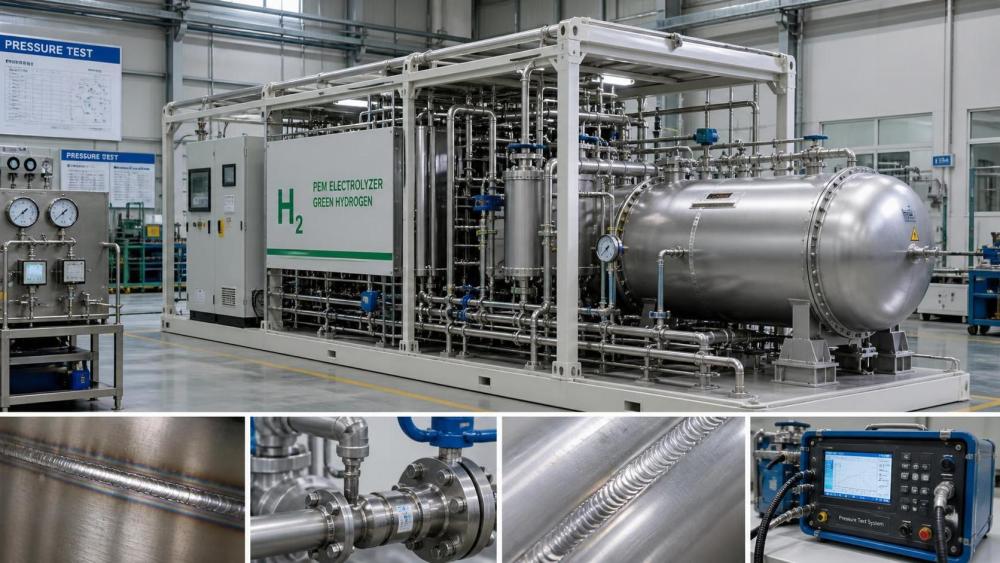
The most useful working tool is a compliance matrix, not a folder full of certificates gathered near shipment. Create one row for each major equipment group and one column for the evidence it needs. The matrix should connect the intended destination, applicable legal requirements, contractual standards, responsible party, document status, reviewer, and dependency.
For example, a pressure-containing hydrogen package may require design calculations, drawings, material certificates, welding procedures, welder qualifications, non-destructive examination records, pressure-test documentation, relief-device information, operating limits, nameplate data, and a technical file. An electrical or automation package may require schematics, component lists, cable specifications, functional safety evidence where relevant, enclosure details, and test records. A cryogenic system introduces another set of concerns, including insulation performance assumptions, vacuum-system records where applicable, relief arrangements, cold-service materials, and transport handling instructions.
Do not assume that a supplier declaration resolves every issue. A declaration can be an important document, but its value depends on whether it is supported by traceable evidence, whether the correct regulatory route was used, and whether the receiving authority accepts it. Ask early whether an independent inspection, notified assessment route, third-party test report, or local representative is required. The answer may change according to equipment category and destination.
Many teams also forget language and document-control requirements. If manuals, warnings, control-screen labels, emergency instructions, or technical records must be supplied in a particular language, translation should be treated as engineering-controlled work. A translated warning that contradicts the original operating manual can create a serious acceptance issue. Version numbers, revision history, and document ownership matter just as much as the translation itself.
Where certification time is usually lost
The longest delay is not always caused by the external reviewer. Internal uncertainty often consumes more time. A reviewer cannot complete an assessment if the manufacturer cannot establish which revision of a drawing matches the as-built skid, which material certificate belongs to a specific pressure part, or whether a late component substitution changes the original compliance argument.
Late design changes
Hydrogen projects evolve. A client may ask for a different compressor, a larger buffer volume, an altered electrical interface, or a revised vent-stack location. These can be reasonable changes, but each should trigger a controlled impact review. The key question is not merely whether the replacement part is equivalent in performance. It is whether it alters pressure boundaries, hazardous-area assumptions, heat load, venting, control logic, emergency shutdown behavior, or documentation already submitted for review.
Incomplete material and fabrication traceability
Material integrity is especially sensitive in hydrogen service. If documentation for metallic materials, welds, heat treatment, examination, or pressure testing is incomplete, recreating the evidence later can be far harder than obtaining it during fabrication. Retain records in a structured manufacturing record book from the beginning. Do not leave traceability to individual emails, supplier portals, or scanned attachments without a clear index.
Confusion between factory testing and final acceptance
Factory acceptance testing can verify that the supplied equipment performs against an agreed procedure. It does not necessarily demonstrate that the installed system is safe and compliant in its final environment. Site acceptance may require verification of field pipework, electrical connections, gas detection, ventilation, earthing, emergency stops, communications, and integrated controls. Treat factory testing as evidence within the approval package, not as the end of the regulatory journey.
A practical sequence for keeping the approval path moving
First, confirm the destination-market route in writing. Identify the country or region, intended use, pressure and electrical characteristics, hazardous-area conditions, transport mode, and whether the equipment is a complete system, a component, or a modification to an existing installation. If the final country is not known, state that clearly and avoid claiming final-market compliance prematurely.
Next, appoint one document owner for the package. This does not mean one person creates every record. It means one accountable coordinator maintains the document register, tracks open technical questions, controls revisions, and knows which evidence has been accepted, rejected, or is still under review. Without this role, separate suppliers may each assume that another party is handling the interface documents.
Then schedule review gates around actual engineering maturity. A useful early gate checks design basis, standards, and certification strategy before purchasing critical components. A second gate checks detailed drawings, calculations, supplier data, and inspection plans before fabrication advances too far. A later gate checks as-built records, test results, labels, manuals, spare-parts information, and shipment documents. These gates should allow comments to be resolved before the equipment is packed.
It is also worth holding a focused interface review. Hydrogen systems do not fail approval only because an individual skid is poorly documented. They can fail because the interface between skids is undefined: a pressure rating changes across a flange, an emergency signal is not hardwired as assumed, a vent line ends outside the responsible party’s scope, or the receiving system has different gas-quality expectations. Put interface assumptions into drawings and test procedures rather than leaving them in meeting notes.
Use the shipment date as a control point, not a deadline
Before release for shipment, carry out a document-to-equipment comparison. Verify that nameplates match drawings and certificates; serial numbers match packing lists; manuals describe the delivered configuration; inspection records identify the correct component; and software versions, if controlled, are recorded. Check that preservation, lifting, packaging, and handling instructions are suitable for the route. Cryogenic and high-pressure equipment can have transport sensitivities that are easy to overlook when documentation is prepared separately from logistics.
At this point, distinguish between open items that are genuinely harmless and open items that block safe installation. A formatting correction in a non-critical manual may be manageable under document control. A missing relief-valve setting record, unresolved hazardous-area classification issue, or absent pressure-test evidence should not be treated as a post-shipment administrative task. The right action is to escalate it, determine the compliance impact, and revise the project sequence if necessary.
When outside expertise is necessary
Bring in qualified regulatory, inspection, or legal support when the destination requirements are unclear, when the system combines several regulated categories, when an existing asset is being modified, or when pressure and hazardous-area responsibilities overlap across suppliers. Independent support is also valuable when contractual language promises compliance but does not identify the jurisdiction, standard edition, acceptance authority, or documentation format.
The goal is not to add another layer of paperwork. It is to obtain an answer that can be acted on: what must be demonstrated, who accepts the evidence, what can be done at the factory, what must wait for site installation, and what changes require reassessment.
For anyone planning a cross-border hydrogen project, the most reliable answer to the timeline question is therefore a project-specific one. Export certification moves fastest when it is treated as a controlled engineering workstream from the design stage onward. Define the equipment boundary, verify destination requirements, maintain traceable records, manage changes carefully, and separate shipment readiness from final operating approval. That approach does not eliminate review time, but it prevents avoidable uncertainty from becoming the real reason a hydrogen asset waits at the end of the project.
Related News
- Electricity Price Volatility Is Rewriting Hydrogen Cost ModelsApr 27, 2026Impact of electricity price on hydrogen cost is transforming industrial decarbonization and large-scale electrolysis. Explore LCOH trends, PPA strategies, and resilient hydrogen infrastructure planning.
- Energy Transition Plans Often Fail at the Grid Connection StageApr 27, 2026Sustainable energy and energy transition projects often fail at grid connection. Learn how hydrogen infrastructure, PEM electrolysis, and industrial decarbonization can avoid delays and protect investment value.
- What Is Slowing Industrial Decarbonization Projects in 2026?Apr 27, 2026Industrial decarbonization faces delays in 2026 as hydrogen infrastructure, sustainable energy access, grid limits, safety standards, and project bankability challenge the energy transition.
- Which hydrogen engineering data matters when sizing a PEM electrolyzer?Oct 11, 2026Hydrogen engineering data is essential for sizing a PEM electrolyzer. Explore power, pressure, water quality, degradation, and delivery factors for reliable capacity.
Related News
- 00
0000-00
Hydrogen Energy Storage for Data Centers Gets Costly Fast - 00
0000-00
When 99.999% Hydrogen Purity Still Is Not Good Enough - 00
0000-00
When Does a Hydrogen-Ready Gas Turbine Pay Off? - 00
0000-00
Electricity Price Volatility Is Rewriting Hydrogen Cost Models - 00
0000-00
PSA Recovery Rate Drops for Reasons Operators Miss
Dr. Aris Aero
Weekly Insights
Stay ahead with our curated technology reports delivered every Monday.