How to Identify the Lowest-Power Electrolyser for Small Hydrogen Demand




A lowest-power electrolyser is the unit that supplies the required hydrogen at the lowest system-level electrical input over its real operating schedule. A small stack with the lowest connected load is not automatically the lowest-energy choice. If it must run near its limit, cycle frequently, feed an oversized compressor, or rely on stored hydrogen to cover short peaks, its apparent advantage can disappear.
Start with hydrogen demand before comparing electrolyser brochures. Define the required quantity by hour, day, and week; the delivery pressure and purity; the maximum interruption the process can tolerate; and the amount of buffer storage already available. These inputs determine whether a compact, continuously operating unit or a larger unit operating for fewer hours will consume less electricity overall.
For small decentralized demand, the best result often comes from matching the production rate to the base hydrogen load and using storage only to absorb peaks. Sizing directly to the largest short-duration withdrawal usually creates a lightly loaded plant for most of the year. Low-load operation can increase specific energy consumption, complicate thermal control, and add starts and stops that shorten stack life.
Translate Demand into an Operating Duty
A useful sizing exercise separates demand into three layers: the minimum recurring load, the normal variable load, and infrequent peak events. A laboratory instrument, annealing line, backup generator, small refueling point, or process gas system can show the same daily total demand while imposing completely different production duties. The daily total alone is therefore an incomplete basis for selection.
Build an hourly demand profile from actual withdrawals or from the process schedule. Where measurements are unavailable, use production records, expected cycle times, and credible downtime assumptions. Then decide whether hydrogen is supplied directly from the electrolyser, from storage, or through a combination of both. The profile should include planned maintenance windows and the recovery period afterward. A plant sized only for average demand may take too long to restore storage after an outage.
Convert demand and production capacity to the same basis before comparing them. Hydrogen may be stated by mass, normal volume, standard volume, or energy content. These bases are not interchangeable unless the reference conditions are clear. Similarly, electrical consumption may refer to stack direct current, rectifier alternating current input, or the full package including water treatment, cooling, controls, dryers, and gas conditioning. For a power-sensitive selection, compare the latter.
Read Power Figures on a Consistent Boundary
Suppliers can legitimately report different energy figures because their battery limits differ. A stack figure excludes some of the equipment that makes usable hydrogen. A packaged electrolyser figure may include the rectifier and internal auxiliaries but exclude feedwater treatment, external cooling, product compression, or storage. Neither number is wrong, yet they answer different questions.
Request a power balance that identifies every electrical load: stack or cell voltage, transformer and rectifier losses, circulation pumps, cooling equipment, water purification, gas-liquid separation, drying, controls, enclosure ventilation, trace heating where relevant, and hydrogen compression. Ask for values at rated output and at the operating points expected from the demand profile. An average calculated from those points is more useful than a single best-case specific-energy figure.
Compression deserves separate treatment. A low-pressure electrolyser may look attractive until hydrogen must be raised to the storage or process pressure. The compression duty changes with inlet pressure, discharge pressure, temperature, flow rate, compressor technology, control method, and the degree of storage pressure swing allowed. High-pressure storage has less usable capacity than its vessel volume suggests because delivery requires a minimum residual pressure. That residual pressure must be included when calculating how much peak demand the buffer actually covers.
Do not assume that higher electrolyser outlet pressure always lowers total electricity use. It can reduce downstream compression work, but higher-pressure operation changes mechanical design and can alter stack operating conditions. The comparison needs a complete gas path from electrolyser outlet to the final point of use.
Part-Load Behavior Changes the Ranking
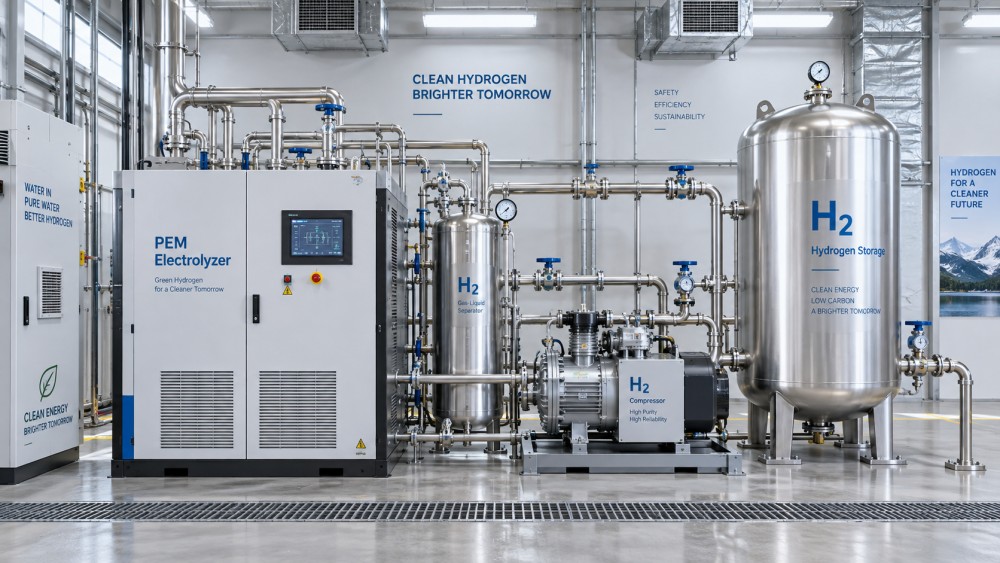
Small hydrogen systems rarely operate at a single fixed point. The lowest power electrolyser must be evaluated across its permitted load range. At reduced output, fixed auxiliary loads become a larger share of each unit of hydrogen produced. Thermal management can become less stable, and a control system may periodically cycle equipment that is almost constant at full load. A unit with an attractive rated figure can consequently use more energy per kilogram over a low-utilization schedule than a unit whose rated figure is slightly higher.
Ask for the minimum sustained production rate, the minimum load after which the unit enters standby or cycles, and the electrical draw in each state. Distinguish cold standby, warm standby, idle circulation, and shutdown. These conditions matter when demand comes in short batches. A package that consumes substantial power while waiting for the next production window should be included in the annual energy model even when it produces no hydrogen.
Dynamic operation is also a durability question. Frequent starts, pressure changes, and rapid load transitions place a different burden on stacks, seals, valves, dryers, and compressors than steady operation. The correct solution may be a smaller continuously running unit with storage, even when the alternative has a lower connected load. Conversely, where operation is only occasional and storage losses or permitting constraints limit buffer capacity, a unit designed for cycling can be the better fit.
Choose PEM or Alkaline from the Duty, Not the Label
PEM and alkaline electrolysers have distinct operating characteristics, but neither technology is inherently the lowest-power answer for every small-demand application. The relevant question is how each package behaves under the specified duty, pressure, water quality, ambient conditions, and maintenance regime.
PEM systems are often considered where compact footprint, responsive output changes, and close integration with variable electricity are important. Their stacks use specialized materials, and the package must maintain suitable water purity and thermal conditions. Alkaline systems can be well suited to steadier operation and may have a different balance of auxiliaries, circulation requirements, and gas management. A technology comparison should therefore use warranted system performance at the required output and delivery condition, rather than a generalized claim about stack efficiency.
Purity requirements can alter the decision. Hydrogen intended for a sensitive process, fuel-cell application, or high-pressure dispensing chain may require drying, purification, monitoring, and tightly controlled crossover behavior. If downstream conditioning is needed, include its pressure loss, electrical demand, maintenance consumables, and response to turndown. A lower-energy stack does not compensate for an unsuitable gas-quality configuration.
Water, Heat, and Site Interfaces Are Part of the Power Decision
Feedwater is often treated as a minor utility, yet its quality and availability influence both energy use and reliability. Verify the incoming water analysis, seasonal variation, pretreatment arrangement, reject-water routing, and deionized-water storage. A specification that assumes better incoming water than the site supplies can lead to additional treatment equipment after procurement. It can also increase maintenance frequency and disrupt hydrogen production.
Cooling must be reviewed with equal care. Ambient temperature, dust, salt exposure, room ventilation, available cooling water, and noise restrictions affect whether the quoted cooling arrangement works at site. Air-cooled equipment may draw more power during hot conditions; water-cooled equipment introduces water quality, pumping, freeze-protection, and heat-rejection interfaces. Place the electrolyser where its intake and exhaust conditions match the supplier's stated operating envelope, rather than treating the enclosure as a passive cabinet.
Electrical connection capacity also needs a realistic allowance. The relevant figure is not only the electrolyser's nominal kW rating. Starting currents, compressor operation, cooling loads, water-treatment regeneration, harmonic limits, power factor, and future storage expansion can affect transformer and switchgear sizing. Underestimating these interfaces can force redesign after equipment arrives, while excessive electrical infrastructure can undermine the purpose of selecting a low-power package.
Assess the Hydrogen System Beyond the Stack
The electrolyser should be selected as one part of a controlled hydrogen installation. Gas detection, ventilation, classified-area considerations, pressure relief routing, emergency shutdown logic, separation distances, bonding, vent stack location, and access for maintenance must be resolved alongside power consumption. A compact footprint is not useful if the site layout later requires long pipe runs, remote storage, or a larger ventilated enclosure.
Pipework material and joining method should suit pressure, purity, and the expected cycling duty. Dead legs and poorly placed low points can complicate purging and moisture control. Connections should allow isolation and leak testing without exposing the whole system to unnecessary depressurization. For small systems, these details have an outsized effect because purge losses and restart time represent a larger share of total production.
Installation sequencing should preserve the performance basis used during selection. Confirm foundation loads, delivery route, lifting points, electrical terminations, water drains, cooling connections, vent routing, instrument air where required, and communications before the unit is shipped. Site acceptance testing should verify hydrogen rate, electrical input at agreed operating points, gas quality, alarm responses, and compressor performance at actual delivery pressure. A test limited to “hydrogen produced” cannot confirm that the selected package meets its energy target.
A Practical Comparison Model
Use a simple operating model for each candidate configuration. For every representative hour, calculate hydrogen produced, hydrogen withdrawn, storage inventory, electrolyser load, auxiliary energy, compression energy, standby energy, and any purchased backup hydrogen. The model does not need false precision. Its purpose is to expose whether the chosen production rate restores storage after peaks, whether the compressor becomes the limiting component, and how often the system falls into inefficient low-load states.
Apply the same assumptions to every proposal: water temperature, ambient conditions, electricity supply limits, delivery pressure, required purity, storage working range, and planned availability. Record exclusions explicitly. A proposal that excludes an external dryer or cooling skid should be normalized by adding an equivalent realistic load, not compared directly with an integrated package.
Then test a few disruptive conditions rather than relying only on annual averages: a missed production day, an unusually high withdrawal period, reduced cooling performance, lower available electrical capacity, and maintenance of a critical auxiliary item. These tests reveal whether a nominally smaller electrolyser creates hidden dependence on backup supply or whether a slightly larger unit avoids repeated operating constraints.
The final choice should state one clear design duty: required delivery flow, storage recovery period, operating load range, full-system electrical boundary, water and cooling assumptions, and the conditions under which the stated energy performance applies. That definition turns “lowest power” from a brochure comparison into a verifiable requirement for the installed hydrogen system.
Related News
- Electricity Price Volatility Is Rewriting Hydrogen Cost ModelsApr 27, 2026Impact of electricity price on hydrogen cost is transforming industrial decarbonization and large-scale electrolysis. Explore LCOH trends, PPA strategies, and resilient hydrogen infrastructure planning.
- Energy Transition Plans Often Fail at the Grid Connection StageApr 27, 2026Sustainable energy and energy transition projects often fail at grid connection. Learn how hydrogen infrastructure, PEM electrolysis, and industrial decarbonization can avoid delays and protect investment value.
- What Is Slowing Industrial Decarbonization Projects in 2026?Apr 27, 2026Industrial decarbonization faces delays in 2026 as hydrogen infrastructure, sustainable energy access, grid limits, safety standards, and project bankability challenge the energy transition.
- Are G-HEI’s PEM Electrolyzer Benchmarks Reliable?Oct 13, 2026Assess G-HEI PEM electrolyzer benchmarking reliability through test boundaries, hydrogen measurement, and durability evidence. Discover what makes a benchmark worth trusting.
Related News
- 00
0000-00
Hydrogen Energy Storage for Data Centers Gets Costly Fast - 00
0000-00
When 99.999% Hydrogen Purity Still Is Not Good Enough - 00
0000-00
When Does a Hydrogen-Ready Gas Turbine Pay Off? - 00
0000-00
Electricity Price Volatility Is Rewriting Hydrogen Cost Models - 00
0000-00
PSA Recovery Rate Drops for Reasons Operators Miss
Dr. Aris Aero
Weekly Insights
Stay ahead with our curated technology reports delivered every Monday.