
How to Use a Hydrogen Technology Supplier Database for Shortlisting




Shortlisting in hydrogen is no longer a simple vendor exercise. A hydrogen technology supplier database now sits at the center of early project qualification, especially where safety, scale, and infrastructure compatibility shape the outcome as much as price.
In practice, the value of a database is not the list itself. It is the ability to compare suppliers against engineering standards, production maturity, logistics fit, and compliance evidence before formal engagement begins.
That matters more in 2026 than it did even a few years ago. Hydrogen investment has moved from pilot enthusiasm to asset-level scrutiny, where gaps in material integrity, fueling performance, or transport design can delay entire decarbonization programs.
For projects tied to electrolysis, CCUS, cryogenic transport, hydrogen-ready turbines, or 70MPa refueling, disciplined shortlisting reduces commercial noise and focuses attention on suppliers that can support sovereign-scale infrastructure.
What a Hydrogen Supplier Database Should Actually Contain
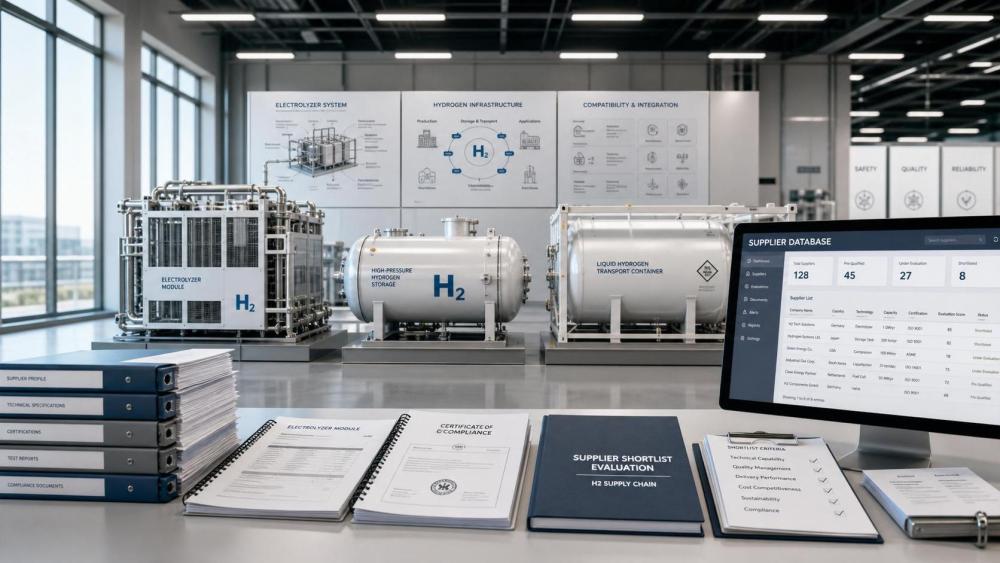
A useful hydrogen technology supplier database is more than a directory of company names. It should function as a screening tool built around technical comparability and documented evidence.
At minimum, each supplier profile should show product scope, engineering capabilities, manufacturing scale, certifications, market references, and delivery geography.
The stronger databases go further. They connect suppliers to asset categories such as PEM and alkaline electrolysis systems, cryogenic vessels, compression units, dispensers, turbines, and CO2 handling infrastructure.
This is where benchmark-led platforms such as G-HEI become relevant. By framing suppliers within standards like ISO 19880, ASME B31.12, and SAE J2601, the database becomes a decision instrument rather than a contact list.
Core data fields that improve shortlisting
- Technology type and operating range
- Pressure, temperature, or throughput specifications
- Standards compliance and test documentation
- Installed base and reference projects
- Lead time, localization, and after-sales support
- Material selection and safety-critical design details
Why Shortlisting Has Become More Demanding
Hydrogen projects now face a different level of scrutiny. Investors, utilities, and public-sector sponsors expect a clear link between technical performance and asset security.
A supplier may appear qualified on paper, yet still be unsuitable for a specific deployment. A cryogenic logistics package for export terminals is not assessed the same way as a refueling skid for mobility corridors.
The same issue applies across G-HEI’s five pillars. Electrolyzer stacks, hydrogen-ready turbines, CCUS systems, and high-pressure fueling assets each bring distinct failure points, inspection requirements, and integration constraints.
A hydrogen technology supplier database helps separate broad market visibility from operational fit. That distinction saves time before detailed engineering, legal review, and tender preparation begin.
Common reasons early shortlists fail
- Standards cited without current certification evidence
- Performance claims based on pilot conditions only
- Insufficient manufacturing depth for utility-scale rollout
- Weak service coverage in the intended project region
- Poor compatibility with existing transport or storage design
How to Use the Database as a Shortlisting Framework
The most effective approach starts with the project envelope, not the supplier list. Define the operating context first, then filter the hydrogen technology supplier database against that context.
Begin with system boundaries. Clarify whether the requirement sits in production, transport, storage, power conversion, refueling, or carbon management.
Then narrow the search using hard qualifiers. These usually include pressure class, flow rate, purity, thermal conditions, materials, certification path, and delivery region.
Only after those filters are applied should commercial comparisons begin. Pricing without technical relevance creates a false sense of competition.
A practical screening sequence
What to Compare Across Different Hydrogen Segments
Not all records inside a hydrogen technology supplier database should be judged with the same lens. Segment-specific evaluation is where many shortlist processes become more credible.
Electrolysis systems
Focus on stack durability, balance-of-plant integration, water purity requirements, turndown ratio, and efficiency at the intended operating load.
Cryogenic liquid hydrogen logistics
Pay close attention to boil-off management, insulation design, transfer equipment, vessel certification, and experience in long-duration transport environments.
Hydrogen-ready gas turbine power
The key issues are blending capability, combustion stability, emissions profile, retrofit complexity, and the evidence behind fuel-flex claims.
CCUS infrastructure
Shortlisting should account for capture efficiency, compression performance, transport interfaces, storage pathway compatibility, and monitoring obligations.
High-pressure refueling systems
Look at filling protocol compliance, dispenser reliability, cooling performance, storage cascade design, and field service response.
Reading Supplier Data Without Being Misled
A hydrogen technology supplier database is only as useful as the quality of interpretation behind it. Many supplier profiles contain strong marketing language but limited qualification depth.
Installed capacity figures should be separated from operational performance. A supplier may report a large order book while having relatively few assets in stable long-term operation.
Standards references also need context. Listing ISO 19880 or ASME B31.12 is not the same as demonstrating equipment design, testing, and documentation aligned with those frameworks.
This is one reason benchmark repositories matter. G-HEI’s value lies in connecting supplier claims to material integrity, efficiency thresholds, and technical security expectations across the zero-carbon value chain.
Signals that deserve closer review
- Reference projects without operating duration data
- Certification statements without certificate numbers
- Broad efficiency claims without stated test conditions
- Localized support promises without named service capacity
- Technology roadmaps presented as current capability
From Longlist to Decision-Ready Shortlist
A strong shortlist is usually small, evidence-based, and clearly ranked. The goal is not to find the most visible suppliers, but to identify the few that match project reality.
That means translating the hydrogen technology supplier database into a weighted comparison model. Some projects will prioritize safety and code compliance. Others will place more weight on delivery certainty or integration support.
The scoring method should stay transparent. When trade-offs emerge, the basis for including or excluding a supplier should already be documented.
At this stage, a shortlist often benefits from a final evidence request. Technical clarifications, reference validation, and manufacturing checks can resolve gaps before formal tendering.
Useful final filters before engagement
- Confirm current compliance status, not historic approval
- Check spare parts and service coverage for the asset life
- Review supply-chain dependence on critical materials
- Test whether the design suits local codes and climate conditions
- Compare reference sites that resemble the intended deployment
Used well, a hydrogen technology supplier database brings order to a market where technical variation is wide and claims can outpace operational proof. It helps narrow attention to suppliers that meet both project demands and infrastructure strategy.
The next step is usually straightforward: define the project envelope, align shortlist criteria with applicable standards, and evaluate each supplier against evidence rather than visibility. That is how a market scan becomes a decision process.
Related News
- Electricity Price Volatility Is Rewriting Hydrogen Cost ModelsApr 27, 2026Impact of electricity price on hydrogen cost is transforming industrial decarbonization and large-scale electrolysis. Explore LCOH trends, PPA strategies, and resilient hydrogen infrastructure planning.
- Energy Transition Plans Often Fail at the Grid Connection StageApr 27, 2026Sustainable energy and energy transition projects often fail at grid connection. Learn how hydrogen infrastructure, PEM electrolysis, and industrial decarbonization can avoid delays and protect investment value.
- What Is Slowing Industrial Decarbonization Projects in 2026?Apr 27, 2026Industrial decarbonization faces delays in 2026 as hydrogen infrastructure, sustainable energy access, grid limits, safety standards, and project bankability challenge the energy transition.
- How PEM electrolyzers support the energy transition in EuropeNov 10, 2026Discover how PEM electrolyzers support the energy transition in Europe, from renewable hydrogen and industrial applications to project costs and infrastructure.
Related News
- 00
0000-00
Hydrogen Energy Storage for Data Centers Gets Costly Fast - 00
0000-00
When 99.999% Hydrogen Purity Still Is Not Good Enough - 00
0000-00
When Does a Hydrogen-Ready Gas Turbine Pay Off? - 00
0000-00
Electricity Price Volatility Is Rewriting Hydrogen Cost Models - 00
0000-00
PSA Recovery Rate Drops for Reasons Operators Miss
Dr. Aris Aero
Weekly Insights
Stay ahead with our curated technology reports delivered every Monday.