
How to evaluate contract manufacturing partners for PEM electrolyzers




The strongest contract manufacturing partner for a PEM electrolyzer is not necessarily the supplier with the lowest quoted unit price. Favor a manufacturer that can demonstrate control of the exact work being outsourced, trace critical materials and process steps, test against agreed acceptance criteria, and support the required production volume. A competitive quotation has limited value if the supplier cannot show how it will prevent leaks, manage contamination, or maintain consistent stack assembly.
The decision becomes especially consequential when a prototype supplier must support a production ramp. A partner that assembles a few units successfully may still depend on manual adjustments, single-source components, or test equipment that cannot support the delivery schedule. Start by defining the manufacturing scope and project requirements, then compare suppliers using evidence from their processes, records, and capacity plans—not sales claims alone.
Define the work before comparing quotations
PEM electrolyzer manufacturing can mean component fabrication, membrane electrode assembly integration, stack assembly, balance-of-plant construction, or complete system integration. A supplier experienced in one of these activities should not automatically be assumed capable of the others. Identify which party owns the design, specifies components, approves changes, performs testing, and releases the finished equipment.
Issue the same scope package to each candidate. It should describe the design maturity, expected volumes and delivery profile, operating envelope, material specifications, quality documentation, and required test results. State whether the manufacturer may select sub-suppliers or must use nominated sources. Also distinguish firm requirements from targets that remain subject to engineering validation.
Interfaces deserve particular attention. For example, a stack manufacturer may deliver a pressure-tested stack, while another integrator supplies water treatment, power electronics, controls, and gas handling. Specify connection details, cleanliness requirements, handling limits, and responsibility for defects discovered after integration. Without clear boundaries, a lower initial price can leave the buyer paying to resolve disputes between suppliers.
Examine manufacturing capability at the process level
Ask suppliers to walk through the production route for the proposed scope, from incoming inspection to packing. The aim is to identify where product quality depends on controlled conditions, specialized equipment, or operator judgment. A factory tour is useful, but a process flow, control plan, and sample records are more revealing than equipment alone.
Materials and critical components
PEM stacks can contain titanium components, membranes, catalysts, porous transport layers, gaskets, and other parts whose properties affect performance and durability. Require traceability appropriate to the design: material identity, supplier, lot or heat number where relevant, inspection status, and the finished units in which the material was used. Ask how records connect a stack serial number to its critical component lots.
Review how the supplier verifies material specifications and handles substitutions. A certificate of conformity is useful only if it corresponds to the correct purchase specification and can be linked to the delivered material. For critical components, establish whether additional inspection, testing, or customer approval is required. A proposed alternative may be commercially attractive but must be evaluated for compatibility and performance before it enters production.
Assembly controls and cleanliness
Stack assembly can be sensitive to contamination, surface damage, alignment, compression, and fastening sequence. Ask which parameters are controlled, how limits were established, and what happens when a measurement falls outside them. Look for work instructions, calibrated tools, training records, and evidence that deviations are documented rather than corrected informally.
Cleanliness controls should match the design’s sensitivity. Discuss component storage, handling, protective packaging, cleaning methods, and segregation of nonconforming parts. The relevant question is not whether a supplier claims to have a clean facility, but whether it can explain and demonstrate controls for the specific components and process steps being outsourced.
Repeatability and equipment readiness
A successful demonstration unit does not establish that a process will remain stable across production lots. Request evidence of repeatability from comparable work where disclosure is permitted, including inspection trends, rework records, and examples of corrective action. Where the design is new, agree on a qualification build and the data needed to release the process for routine production.
Check whether key equipment is available, maintained, and suitable for the required part size and throughput. For bottleneck operations, ask about maintenance support, spare tooling, and recovery plans. An additional machine is not a substitute for qualified operators, validated instructions, and sufficient inspection capacity.
Make quality evidence comparable
Ask every candidate for a sample manufacturing record package with sensitive information removed. This reveals whether the promised documentation can be produced in a usable form. Depending on the scope, the package might include incoming inspection records, material certificates, assembly measurements, calibration references, test results, nonconformance reports, and release authorization.
Review the supplier’s quality management system, including any certifications it actually holds and their scope. Certification can indicate a structured management system, but it does not prove that a particular electrolyzer design or manufacturing process is qualified. Verify the certificate, covered site, and relevant activities rather than accepting a logo in a presentation.
Agree on hold points before production begins. These may cover first-article inspection, approval of critical material, review of a manufacturing deviation, or witnessing of a final test. Define who can release each hold point and how delays will be handled. Excessive inspection can slow delivery; too little visibility can allow defects to pass into expensive downstream assembly.
Separate test capability from product acceptance
A supplier may have a test stand without having the right test procedure, instrumentation, or capacity for the intended product. Request the proposed test plan and identify the conditions, measurements, tolerances, calibration requirements, safety controls, and data format. Confirm which tests are performed on every unit, which are performed on a sample, and which are reserved for qualification.
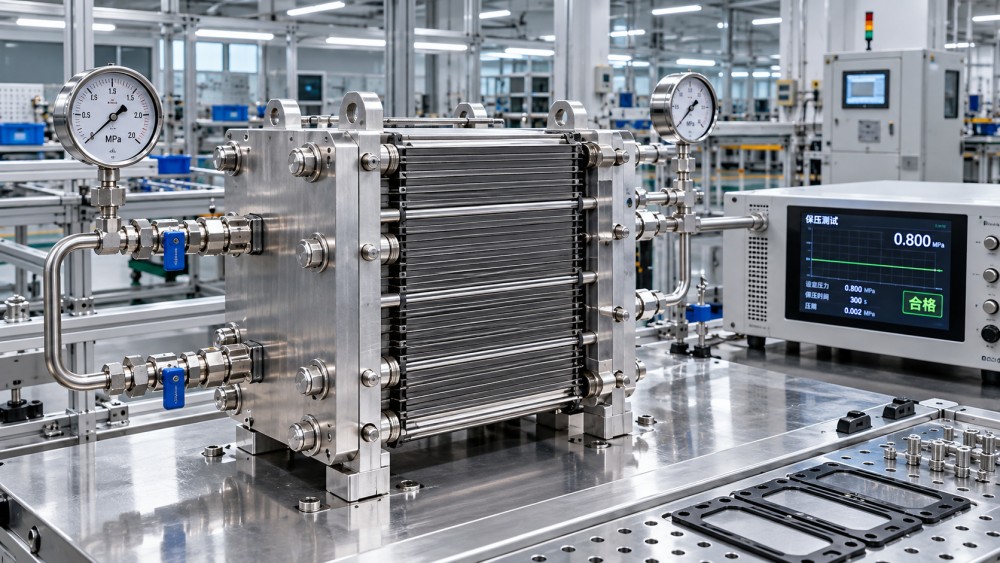
As applicable to the purchased scope, the plan may include dimensional checks, electrical insulation checks, leak or pressure testing, and operational performance measurements. Define the test medium and conditions, permissible limits, stabilization requirements, and treatment of a failed result. A leak test alone does not establish electrochemical performance or long-term durability; an operational test at one condition does not demonstrate performance across the full operating envelope.
For factory acceptance testing, determine who provides utilities and fixtures, who witnesses the test, and what evidence is required for shipment. If a performance claim depends on operating conditions outside the factory’s capabilities, agree on an alternative verification method or a site acceptance procedure. Do not leave the distinction between factory release and final project acceptance unresolved in the purchase order.
Test the capacity plan against the delivery schedule
Ask for a capacity model tied to the actual routing, not just an annual output figure. It should identify constrained operations, shift assumptions, yields, inspection and test time, and planned maintenance. Compare the model with the delivery profile: a supplier may have enough nominal annual capacity yet lack the ability to deliver the required units in the months they are needed.
Long-lead components can also determine the schedule. Request lead times, supplier commitments where available, inventory assumptions, and alternatives for critical materials and components. Understand which items are under the manufacturer’s control and which depend on customer approvals or nominated suppliers. A schedule based on unconfirmed lead times should be treated as a risk, not a commitment.
Where ramp-up is part of the award, link capacity milestones to evidence: equipment installation, operator qualification, successful build records, and available test slots. Consider a staged release of volume after the first production units meet agreed requirements. Also clarify whether capacity is reserved for the project or shared with other customers and how allocation will be handled during shortages.
Compare bids on total exposure, not unit price alone
Normalize each quotation to the same scope before ranking it. One supplier may include tooling, documentation, packaging, and testing while another lists them as options. Ask for assumptions and exclusions in writing, then price the differences using the information available. Avoid treating an uncertain estimate as a guaranteed cost.
Use a weighted scorecard only after setting non-negotiable thresholds. For example, a low price should not compensate for an inability to meet an essential leak-test requirement or provide required material traceability. For other criteria, score the strength of the evidence and record open assumptions. Procurement, engineering, quality, and operations can then challenge the same documented trade-offs rather than applying different interpretations of each bid.
Put change control and ownership into the agreement
Manufacturing changes can alter cost or availability, but they may also affect stack performance and safety. Define which changes require prior customer approval: examples include a critical material source, component specification, assembly method, test procedure, production site, or sub-supplier. Require the manufacturer to identify affected inventory and units, provide supporting qualification evidence, and retain records of the decision.
Address intellectual property and practical access separately. The contract should identify ownership and permitted use of drawings, process information, tooling, test data, and improvements, as applicable. If continuity of supply matters, establish what information and physical assets would be available for a transition, subject to confidentiality and the parties’ rights. Ownership of tooling is less useful if access, maintenance responsibility, and transfer conditions are undefined.
Finally, align warranty remedies with the acceptance process. Specify notification periods, investigation responsibilities, access to records, repair or replacement arrangements, and treatment of defects found after integration. Applicable safety, pressure-equipment, electrical, and project requirements should be identified for the equipment and destination; their applicability depends on the actual scope and jurisdiction. Resolve those requirements with the responsible engineering and compliance teams before committing to a manufacturing route or final acceptance criteria.
Related News
- Electricity Price Volatility Is Rewriting Hydrogen Cost ModelsApr 27, 2026Impact of electricity price on hydrogen cost is transforming industrial decarbonization and large-scale electrolysis. Explore LCOH trends, PPA strategies, and resilient hydrogen infrastructure planning.
- Energy Transition Plans Often Fail at the Grid Connection StageApr 27, 2026Sustainable energy and energy transition projects often fail at grid connection. Learn how hydrogen infrastructure, PEM electrolysis, and industrial decarbonization can avoid delays and protect investment value.
- What Is Slowing Industrial Decarbonization Projects in 2026?Apr 27, 2026Industrial decarbonization faces delays in 2026 as hydrogen infrastructure, sustainable energy access, grid limits, safety standards, and project bankability challenge the energy transition.
- How PEM electrolyzers support the energy transition in EuropeNov 10, 2026Discover how PEM electrolyzers support the energy transition in Europe, from renewable hydrogen and industrial applications to project costs and infrastructure.
Related News
- 00
0000-00
Hydrogen Energy Storage for Data Centers Gets Costly Fast - 00
0000-00
When 99.999% Hydrogen Purity Still Is Not Good Enough - 00
0000-00
When Does a Hydrogen-Ready Gas Turbine Pay Off? - 00
0000-00
Electricity Price Volatility Is Rewriting Hydrogen Cost Models - 00
0000-00
PSA Recovery Rate Drops for Reasons Operators Miss
Dr. Aris Aero
Weekly Insights
Stay ahead with our curated technology reports delivered every Monday.