ISO 22734 Water Electrolyzers: Key Compliance Checks Before Project Approval




Why does ISO 22734 matter before a hydrogen project is approved?
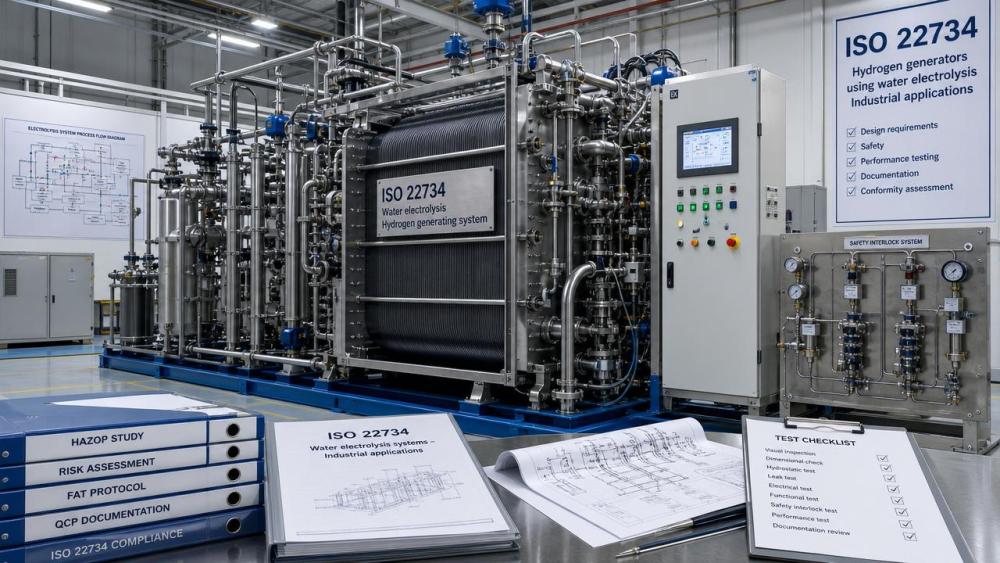
Hydrogen projects rarely fail because of one dramatic error. More often, they slip through small compliance gaps discovered too late.
That is why ISO 22734 water electrolyzers for energy has become an early decision checkpoint, not just a procurement detail.
At project approval stage, the standard helps test whether an electrolyzer package is ready for real industrial duty.
The focus is not limited to stack performance. It also covers electrical safety, hydrogen handling, protective systems, testing discipline, and documentation quality.
In practical terms, ISO 22734 water electrolyzers for energy gives decision makers a structured way to separate promising designs from bankable systems.
This matters even more in 2026, when large-scale electrolysis is tied to national infrastructure planning, grid integration, export corridors, and sovereign decarbonization goals.
Within the G-HEI benchmarking approach, ISO 22734 sits alongside other critical references such as ISO 19880 and ASME B31.12.
Simple compliance claims are not enough. What matters is whether the design evidence is complete, traceable, and suitable for project risk review.
What does ISO 22734 actually check in a water electrolyzer system?
A common misunderstanding is that the standard only checks hydrogen production efficiency. In reality, the scope is much broader.
ISO 22734 water electrolyzers for energy looks at how the whole package is designed, protected, tested, and documented for safe operation.
The strongest project reviews usually examine five areas together.
- System design boundaries, including operating pressure, gas purity interfaces, and shutdown logic.
- Electrical and control safety, especially interlocks, alarms, and emergency responses.
- Hydrogen and oxygen separation integrity, including cross-contamination prevention.
- Factory testing and acceptance criteria, with records that can withstand independent review.
- Technical documentation, including manuals, drawings, hazard information, and maintenance limits.
In actual project development, these checks shape more than safety approval. They influence insurance discussions, EPC alignment, and commissioning readiness.
If one of these areas is weak, the issue often reappears later as design revision, permit delay, or operational restriction.
Which compliance checks deserve the closest attention during approval review?
Not every checklist item carries the same project weight. Some points deserve deeper attention because they affect safety, schedule, and lifetime performance at once.
A useful review table can help separate routine paperwork from approval-critical evidence.
The best approval reviews do not ask only whether ISO 22734 water electrolyzers for energy was mentioned in the bid package.
They ask whether each claim is backed by design evidence and whether interfaces with the wider hydrogen chain are already resolved.
That wider chain may include compression, cryogenic logistics, turbine blending, refueling, or CCUS-linked industrial integration.
Where do teams most often misjudge ISO 22734 water electrolyzers for energy?
The most frequent mistake is treating certification language as proof of full project readiness.
A supplier may reference ISO 22734 water electrolyzers for energy, yet the approval file can still be incomplete.
In real projects, problems usually appear in the interfaces rather than in the headline performance numbers.
- Operating envelopes do not match the compressor or storage package.
- Ventilation and hazardous area assumptions are not aligned with site design.
- Water quality requirements are noted, but pretreatment responsibility is unclear.
- Test reports exist, yet they cover a similar model, not the final supplied configuration.
- Maintenance limits are stated generally, without stack-life assumptions tied to duty cycle.
Another misjudgment is focusing on capex speed over compliance maturity. That can look efficient during tendering, but costly during integration.
G-HEI’s technical perspective is useful here because it links electrolyzer review with adjacent infrastructure standards and long-term asset security.
That broader view helps identify whether a compliant unit on paper is also a resilient unit in the field.
How should approval teams compare vendors when every proposal says it meets the standard?
When several proposals appear compliant, the deciding factor is usually not the claim itself, but the depth of proof behind it.
A practical comparison starts with a simple question: how much interpretation risk remains after reading the technical file?
More mature submissions tend to show the following traits.
- Clear design basis tied to actual site conditions, not generic brochure values.
- Traceable test evidence linked to equipment tags, revisions, and acceptance limits.
- Defined interface responsibilities for water treatment, power quality, venting, and control integration.
- Material and safety assumptions aligned with hydrogen service expectations across the plant.
- Commissioning and maintenance documents prepared early, not deferred until delivery.
This is also where ISO 22734 water electrolyzers for energy becomes a strategic filter rather than a narrow compliance box.
The question is not only who meets the standard today. It is who can support reliable operation through expansion, inspection, and performance verification later.
In large zero-carbon programs, that difference affects financing confidence as much as engineering confidence.
What is the smartest next step before giving project approval?
A disciplined pre-approval review should turn ISO 22734 water electrolyzers for energy into a working decision framework.
That means moving beyond declarations and checking whether the supplied evidence is complete enough for design freeze, permitting, and commissioning.
A strong next step is to build a short approval file around four items.
- A compliance matrix against ISO 22734 clauses and project-specific operating conditions.
- An interface register covering storage, compression, utilities, controls, and hazardous area design.
- A test evidence pack with revision control and configuration traceability.
- A residual risk list showing what remains open before notice to proceed.
That approach keeps approval grounded in engineering reality, not sales language.
It also reflects the wider logic behind G-HEI: sovereign-scale hydrogen infrastructure only works when electrolysis assets are benchmarked against safety, integrity, and operational certainty together.
If approval is close, the sensible move is to review the evidence package line by line, confirm unresolved interfaces, and document any assumptions before commitment.
That small discipline often prevents large delays later, especially when the project must prove both technical credibility and long-term asset security.
Related News
- Electricity Price Volatility Is Rewriting Hydrogen Cost ModelsApr 27, 2026Impact of electricity price on hydrogen cost is transforming industrial decarbonization and large-scale electrolysis. Explore LCOH trends, PPA strategies, and resilient hydrogen infrastructure planning.
- Energy Transition Plans Often Fail at the Grid Connection StageApr 27, 2026Sustainable energy and energy transition projects often fail at grid connection. Learn how hydrogen infrastructure, PEM electrolysis, and industrial decarbonization can avoid delays and protect investment value.
- What Is Slowing Industrial Decarbonization Projects in 2026?Apr 27, 2026Industrial decarbonization faces delays in 2026 as hydrogen infrastructure, sustainable energy access, grid limits, safety standards, and project bankability challenge the energy transition.
- Are G-HEI’s PEM Electrolyzer Benchmarks Reliable?Oct 13, 2026Assess G-HEI PEM electrolyzer benchmarking reliability through test boundaries, hydrogen measurement, and durability evidence. Discover what makes a benchmark worth trusting.
Related News
- 00
0000-00
Hydrogen Energy Storage for Data Centers Gets Costly Fast - 00
0000-00
When 99.999% Hydrogen Purity Still Is Not Good Enough - 00
0000-00
When Does a Hydrogen-Ready Gas Turbine Pay Off? - 00
0000-00
Electricity Price Volatility Is Rewriting Hydrogen Cost Models - 00
0000-00
PSA Recovery Rate Drops for Reasons Operators Miss
Dr. Aris Aero
Weekly Insights
Stay ahead with our curated technology reports delivered every Monday.