ISO 22734 Water Electrolyzers: Key Specifications That Affect Compliance




ISO 22734 Water Electrolyzers: Key Specifications That Affect Compliance has moved from a niche engineering topic to a board-level concern across hydrogen projects. For facilities planning large-scale production, ISO 22734 water electrolyzers for energy specifications shape how safety, performance, and certification are judged long before commissioning begins.
That matters even more in 2026, when hydrogen infrastructure is being assessed as critical energy infrastructure rather than a pilot technology. In this setting, specification choices are no longer isolated technical details. They influence asset bankability, operating discipline, and the credibility of a national or industrial decarbonization program.
Across the G-HEI benchmarking landscape, electrolysis systems sit at the front end of a wider chain that includes storage, transport, turbines, and refueling. If the electrolyzer package is specified poorly, downstream risks multiply. If it is specified well, the rest of the hydrogen value chain becomes easier to govern.
Why ISO 22734 specifications matter beyond certification
The first checkpoint is not simply whether an electrolyzer can produce hydrogen. The real question is whether the system can do so under controlled, repeatable, and auditable conditions.
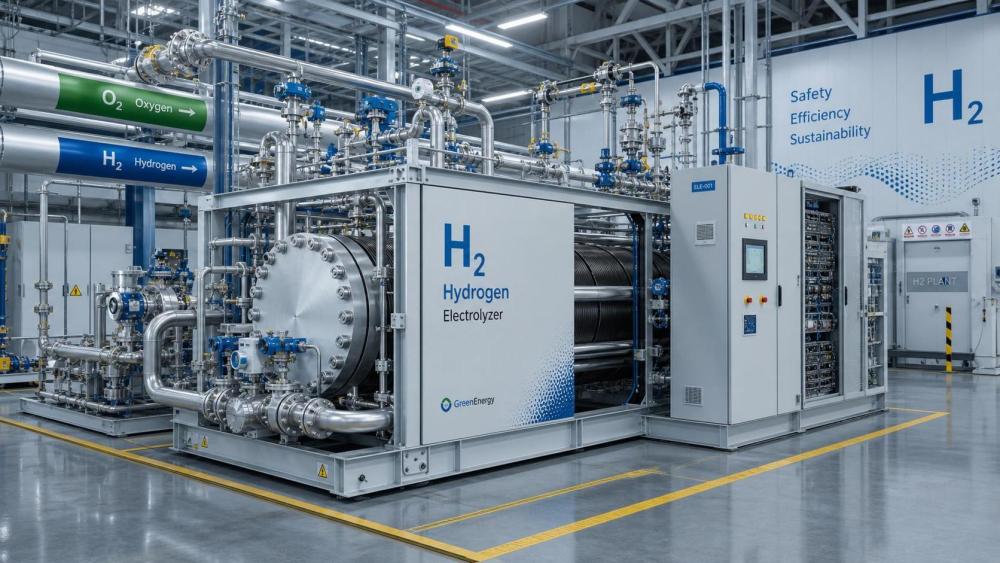
This is where ISO 22734 water electrolyzers for energy specifications become decisive. The standard provides a framework for design, construction, operation, and testing of hydrogen generators using water electrolysis. In practice, it connects engineering intent with safety evidence.
For project teams, compliance is rarely a single-pass exercise. Authorities, insurers, EPC firms, and internal governance groups usually want consistent answers on pressure boundaries, gas purity, alarm logic, shutdown behavior, and documentation quality.
A system may deliver nameplate output and still create compliance friction if its material traceability is weak or its protective functions are underdefined. That is why specification review should begin early, before procurement locks in avoidable gaps.
The specifications that most often affect compliance outcomes
Not every parameter carries the same weight. Some values are operational preferences. Others sit at the center of conformity assessment and incident prevention.
Materials and hydrogen compatibility
Material selection is one of the first areas reviewers examine. Wetted parts, pressure-retaining components, seals, and piping must tolerate chemical exposure, temperature variation, and hydrogen service conditions.
For PEM and alkaline systems, the risk profile differs, but the question is similar: can the chosen materials maintain integrity throughout the design life? Corrosion, embrittlement, contamination, and seal degradation all affect compliance positioning.
Pressure design and relief philosophy
Pressure ratings need to be coherent across stacks, separators, piping, valves, and downstream interfaces. Mismatched ratings create obvious concerns during review and can compromise protective design logic.
Relief devices, vent routing, and pressure monitoring must also be documented clearly. In hydrogen systems, a vague overpressure philosophy is not a minor omission. It is often treated as a serious safety deficiency.
Electrical protection and hazardous area considerations
Electrolyzers combine water handling, gas generation, power electronics, and control systems in one package. That makes electrical protection design central to ISO 22734 water electrolyzers for energy specifications.
Isolation, grounding, short-circuit protection, emergency shutdown integration, and hazardous area classification need to align with the installation context. A compliant skid in one jurisdiction may still need adaptation for another site’s electrical regime.
Gas purity and cross-contamination control
Hydrogen quality is not only a commercial issue. It is also a safety issue, especially when oxygen crossover or process instability is possible.
Specification sheets should define purity targets, monitoring methods, trip points, and response logic. When those values are missing or unrealistic, the compliance review often expands into a broader examination of process control maturity.
Control systems, alarms, and shutdown states
A compliant electrolyzer is not judged only by normal operation. It is judged by how it behaves in abnormal conditions.
Alarm hierarchy, interlocks, permissives, sensor redundancy, and fail-safe positions should be explicit. Reviewers usually look for a clear path from deviation detection to controlled shutdown without ambiguity.
Where compliance issues usually appear in real projects
In practice, compliance problems often emerge at interfaces rather than inside the electrolyzer stack itself. The package may be technically sound, yet still create risk when connected to compression, storage, utility power, or export systems.
This pattern is visible across integrated hydrogen programs tracked by G-HEI. Large projects rarely fail because teams ignore standards entirely. More often, they underestimate how specifications interact across different packages and standards.
A table like this looks simple, but it reflects a broader point. ISO 22734 water electrolyzers for energy specifications are only useful when they are translated into records, limits, and acceptance criteria that survive project handover.
How to read specifications with a risk-based lens
A specification review should not stop at checking whether values are present. It should test whether the values are defensible for the intended duty cycle, environment, and downstream integration.
Several questions are usually worth asking early:
- Are design pressures aligned with all connected systems, including upset conditions?
- Do material records prove suitability for hydrogen and process chemicals?
- Are purity limits linked to actual monitoring and automatic response logic?
- Can the shutdown sequence be validated through test evidence, not only narrative text?
- Does the documentation pack support inspection, training, and future modification control?
These questions help separate nominal compliance from durable compliance. The difference becomes critical when the electrolyzer is part of sovereign-scale or utility-scale infrastructure, where downtime and safety events carry strategic consequences.
Why benchmarking matters in a multi-standard hydrogen environment
ISO 22734 does not operate in isolation. Electrolyzer projects frequently intersect with pressure equipment rules, hydrogen piping codes, refueling standards, electrical codes, and local permitting frameworks.
That is one reason G-HEI’s cross-domain benchmarking model is useful. It places ISO 22734 water electrolyzers for energy specifications within a wider hydrogen system, alongside standards such as ISO 19880, ASME B31.12, and other safety-critical references.
This broader view prevents a common mistake: treating the electrolyzer as compliant in isolation while ignoring export pressure compatibility, vent dispersion constraints, or downstream purity obligations. Strong governance depends on alignment across the whole chain.
Practical next steps for stronger specification control
A useful starting point is to map every critical specification to one of three categories: safety-critical, performance-critical, or evidence-critical. Some parameters sit in more than one category, and those deserve tighter review.
It also helps to compare vendor submittals against a structured checklist rather than marketing literature. ISO 22734 water electrolyzers for energy specifications should be supported by test data, design assumptions, alarm matrices, and material documentation.
Where project scope includes future expansion, the review should also cover operating flexibility. Turndown range, transient response, water quality limits, and maintenance access can all affect future compliance and operating resilience.
For any program moving from pilot scale to strategic deployment, the next sensible step is to build a specification baseline that can be reused across sites. That creates consistency in procurement, inspection, and risk review, while making later comparisons far more reliable.
In hydrogen infrastructure, compliance is rarely secured by one document or one test. It is built through disciplined specification choices that remain coherent from design review to live operation. That is the practical value of understanding ISO 22734 water electrolyzers for energy specifications in context, not just in theory.
Related News
- Electricity Price Volatility Is Rewriting Hydrogen Cost ModelsApr 27, 2026Impact of electricity price on hydrogen cost is transforming industrial decarbonization and large-scale electrolysis. Explore LCOH trends, PPA strategies, and resilient hydrogen infrastructure planning.
- Energy Transition Plans Often Fail at the Grid Connection StageApr 27, 2026Sustainable energy and energy transition projects often fail at grid connection. Learn how hydrogen infrastructure, PEM electrolysis, and industrial decarbonization can avoid delays and protect investment value.
- What Is Slowing Industrial Decarbonization Projects in 2026?Apr 27, 2026Industrial decarbonization faces delays in 2026 as hydrogen infrastructure, sustainable energy access, grid limits, safety standards, and project bankability challenge the energy transition.
- Which hydrogen engineering data matters when sizing a PEM electrolyzer?Oct 11, 2026Hydrogen engineering data is essential for sizing a PEM electrolyzer. Explore power, pressure, water quality, degradation, and delivery factors for reliable capacity.
Related News
- 00
0000-00
Hydrogen Energy Storage for Data Centers Gets Costly Fast - 00
0000-00
When 99.999% Hydrogen Purity Still Is Not Good Enough - 00
0000-00
When Does a Hydrogen-Ready Gas Turbine Pay Off? - 00
0000-00
Electricity Price Volatility Is Rewriting Hydrogen Cost Models - 00
0000-00
PSA Recovery Rate Drops for Reasons Operators Miss
Dr. Aris Aero
Weekly Insights
Stay ahead with our curated technology reports delivered every Monday.