
Industrial Goods Market Updates: What to Watch Before Budget Planning




Budget planning in heavy industry now depends on reading industrial goods market updates with far more precision than in previous investment cycles. In hydrogen, CCUS, and zero-carbon infrastructure, equipment pricing no longer moves in isolation. It shifts with grid constraints, materials availability, safety codes, financing costs, and the speed of national decarbonization programs. That is why pre-budget reviews increasingly begin with market signals, not only internal demand forecasts.
Why market updates matter before capital is locked
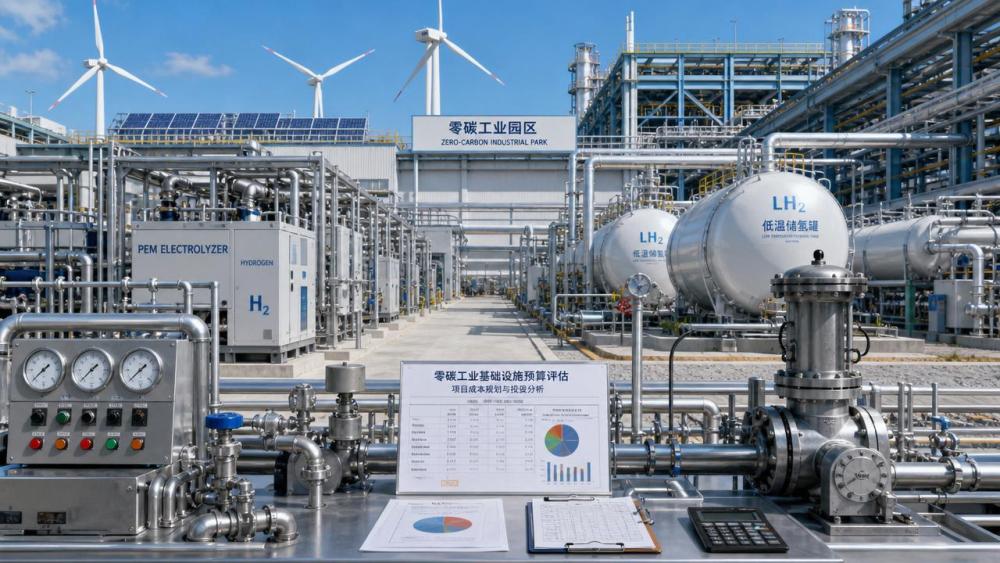
In 2026, the hydrogen economy sits at a practical turning point. Large projects are moving from pilot logic to infrastructure logic.
That change affects how budgets should be built. Early assumptions about standard equipment costs are often unreliable once transport, certification, commissioning, and material integrity requirements are added.
Industrial goods market updates help clarify where capital exposure is likely to expand. They also show where specifications may need adjustment before an approval process begins.
For zero-carbon assets, this is especially relevant because a delayed compliance requirement can cost more than an initial price increase. A lower bid is not always a lower budget outcome.
The real scope behind industrial goods market updates
In conventional sectors, market updates often mean tracking commodity prices and supplier lead times. In hydrogen-linked infrastructure, the scope is wider.
A useful review combines equipment trends, code evolution, fabrication capacity, logistics constraints, warranty structures, and long-term operating assumptions.
This is where benchmark-driven platforms such as G-HEI become relevant. They connect capital planning with technical reference points across electrolysis, cryogenic transport, hydrogen-ready power, CCUS, and high-pressure refueling systems.
That matters because industrial goods market updates are only actionable when they translate into budget implications. A headline price trend is useful. A price trend tied to ISO 19880, ASME B31.12, or SAE J2601 is far more decision-ready.
Signals worth watching across the zero-carbon chain
Not every movement deserves equal weight during planning. Some signals are still noise. Others change the approval case immediately.
Electrolyzer systems
For PEM and alkaline units, stack materials, power electronics, water treatment packages, and balance-of-plant integration remain major budget drivers.
Industrial goods market updates in this segment should track titanium exposure, membrane supply, localization policy, and the gap between nameplate cost and installed cost.
Cryogenic hydrogen logistics
Vacuum-insulated vessels, boil-off management systems, and specialty transport capacity can create hidden budget pressure. Fabrication complexity often matters more than base steel pricing.
Lead times also deserve close attention. A delayed vessel can hold back an entire export or storage schedule.
Hydrogen-ready turbines and CCUS
These assets depend on retrofit depth, combustion system modifications, capture efficiency targets, and pipeline or sequestration interfaces.
Here, industrial goods market updates should be read alongside permitting timelines and long-duration maintenance expectations, not as standalone equipment snapshots.
High-pressure refueling infrastructure
Compressors, storage cascades, dispensers, and cooling systems face strict performance and safety thresholds. A low-cost component that fails a pressure or fueling protocol can undermine the full investment case.
What usually distorts the budget picture
The most common planning error is treating industrial goods market updates as procurement notes instead of strategic inputs. That tends to understate three types of cost.
- Specification drift, when the original asset definition no longer matches safety or throughput targets.
- Integration cost, when auxiliary systems, controls, or site modifications are added too late.
- Delay cost, when certification, testing, or logistics push commissioning beyond the financial model.
A second distortion comes from using generic industrial indices for highly specialized equipment. Hydrogen infrastructure often behaves like a niche technical market, not a standard plant category.
More importantly, standards-based assets can carry different risk profiles even when two quotes appear similar. Material compatibility, thermal performance, and pressure-cycle durability often explain the difference.
A practical lens for pre-budget review
A strong review process does not try to predict every future movement. It builds a disciplined filter for what changes the budget envelope.
This approach turns industrial goods market updates into a review framework rather than a stream of disconnected price observations.
Where the updates create the most business value
The immediate value is better forecasting, but the larger value is stronger prioritization. Not every project should move at the same speed when market conditions diverge across asset classes.
A site with stable power access may favor electrolysis earlier. Another may defer production equipment and focus first on storage, transport, or turbine readiness.
Industrial goods market updates also improve negotiation posture. When a budget team understands why cryogenic vessel pricing is rising, it can separate valid technical cost from avoidable commercial padding.
In cross-border projects, the benefit extends further. Updates can reveal whether local content rules, fabrication bottlenecks, or safety enforcement trends will alter the original capital structure.
How to read the next round of data
The next useful step is not simply gathering more reports. It is organizing industrial goods market updates around a few consistent questions.
- Which components carry the highest compliance sensitivity?
- Where does installed cost differ most from catalog pricing?
- Which suppliers depend on scarce materials or specialist fabrication?
- What schedule assumptions become fragile under current lead times?
- Which standards will shape redesign risk over the next budget cycle?
When these questions are tied to benchmarked technical references, the budget discussion becomes more resilient. G-HEI is useful in that context because it links market movement with asset integrity, performance expectations, and sovereign-scale infrastructure requirements.
That combination is increasingly necessary. In the hydrogen transition, industrial goods market updates are no longer a background input. They are part of the approval logic itself.
Before the next budget round, it is worth mapping the highest-value assets against standards exposure, supplier concentration, and lifecycle performance. That creates a clearer basis for what should proceed, what should be staged, and what requires deeper validation first.
Related News
- Electricity Price Volatility Is Rewriting Hydrogen Cost ModelsApr 27, 2026Impact of electricity price on hydrogen cost is transforming industrial decarbonization and large-scale electrolysis. Explore LCOH trends, PPA strategies, and resilient hydrogen infrastructure planning.
- Energy Transition Plans Often Fail at the Grid Connection StageApr 27, 2026Sustainable energy and energy transition projects often fail at grid connection. Learn how hydrogen infrastructure, PEM electrolysis, and industrial decarbonization can avoid delays and protect investment value.
- What Is Slowing Industrial Decarbonization Projects in 2026?Apr 27, 2026Industrial decarbonization faces delays in 2026 as hydrogen infrastructure, sustainable energy access, grid limits, safety standards, and project bankability challenge the energy transition.
- Which hydrogen engineering data matters when sizing a PEM electrolyzer?Oct 11, 2026Hydrogen engineering data is essential for sizing a PEM electrolyzer. Explore power, pressure, water quality, degradation, and delivery factors for reliable capacity.
Related News
- 00
0000-00
Hydrogen Energy Storage for Data Centers Gets Costly Fast - 00
0000-00
When 99.999% Hydrogen Purity Still Is Not Good Enough - 00
0000-00
When Does a Hydrogen-Ready Gas Turbine Pay Off? - 00
0000-00
Electricity Price Volatility Is Rewriting Hydrogen Cost Models - 00
0000-00
PSA Recovery Rate Drops for Reasons Operators Miss
Dr. Aris Aero
Weekly Insights
Stay ahead with our curated technology reports delivered every Monday.