
Levelised Cost of Hydrogen: Are Compression and Storage Included?




Does the levelised cost of hydrogen include compression and storage? Sometimes—but neither item is automatically included. For commercial evaluators, the answer depends on the calculation’s system boundary: where hydrogen is measured, what condition it must meet, and which assets are counted.
That distinction can change an investment decision. A production-only estimate may cover hydrogen leaving an electrolyser while excluding the equipment, energy, and operating costs needed to deliver it at the buyer’s required pressure and availability. Another estimate may include those services. Both can be internally valid, yet comparing them directly can reward the project that leaves more costs outside the model.
The useful question is therefore not simply “What is the cost per kilogram?” It is “What usable kilogram, delivered where, under what operating conditions?”
The boundary determines what the number means
Levelised cost of hydrogen, usually abbreviated to LCOH, expresses the discounted lifetime cost of a defined hydrogen system divided by its discounted lifetime hydrogen output. It is a cost metric, not necessarily a sales price: supplier margins, taxes, contractual risk allocation, and commercial premiums may sit outside it.
There is no universal boundary that makes every published LCOH figure directly comparable. Evaluators should distinguish at least three calculation points.
Even “plant-gate cost” can be ambiguous. One supplier may define the gate immediately after drying and purification; another may define it after compression into an export header. Neither label tells you enough without a pressure specification and equipment boundary.
A practical cost diagram should show the complete path: electrolysis, conditioning, compression, buffer storage, loading or pipeline export, transport, and customer receipt. Mark the cost boundary and hydrogen measurement point separately. This exposes exclusions more clearly than a headline cost table.
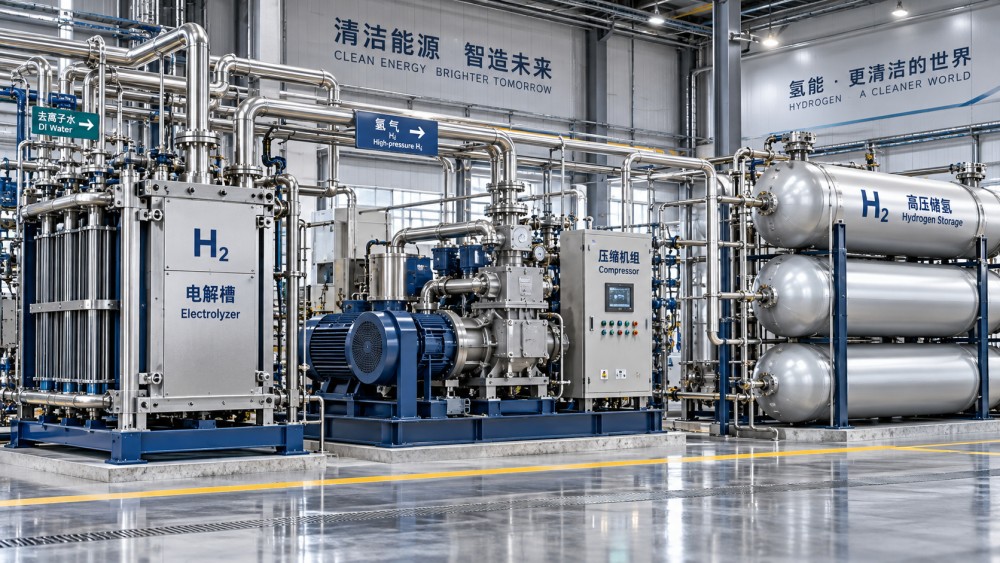
When compression belongs in the levelised cost of hydrogen
Compression belongs in the calculation whenever it is necessary to produce the hydrogen service being costed. If the stated output is hydrogen at a specified export pressure, the model must account for the equipment and energy needed to reach that pressure, unless another explicitly identified party provides the service.
Electrolyser outlet pressure matters, but it does not settle the issue. PEM and alkaline systems have different designs and operating configurations; pressure capability should be checked against the actual supplier specification rather than assumed from technology labels. A pressurised electrolyser may reduce downstream compression requirements without eliminating them.
The compressor package is more than a motor and electricity bill
A credible compression allowance considers installed capital cost, electricity consumption, cooling, maintenance, controls, and the associated civil and electrical works. Depending on the design, additional gas conditioning may be needed to preserve downstream purity. Redundant capacity may also be necessary where continuous delivery is contractually required.
The required pressure ratio, suction conditions, flow profile, and equipment efficiency determine the energy demand. A single generic electricity-per-kilogram assumption can be misleading when it is transferred between projects with different inlet and discharge pressures.
Variable operation deserves particular attention. A compressor selected for steady flow may perform differently when an electrolyser follows renewable generation. Turndown limits, cycling, standby consumption, and maintenance consequences can all affect annual cost. Evaluate the operating profile, not just the rated duty point.
For 70 MPa vehicle refuelling, a quoted production LCOH should not be confused with the cost of hydrogen dispensed into a vehicle. Station systems may require higher-pressure storage, compression, pre-cooling, and dispensing equipment to support the selected filling protocol. The vehicle’s nominal tank pressure is not a complete station design specification.
Storage is included when availability is part of the product
Hydrogen storage is sometimes treated as an optional downstream investment. That can be reasonable for a production-only study, but not when the quoted service promises a delivery pattern that production alone cannot provide.
Consider a renewable-powered electrolyser supplying an industrial user with a relatively steady demand. The electrolyser may make enough hydrogen over the year while still failing to meet demand during low-generation periods. If storage is the chosen means of bridging that mismatch, its cost belongs in the delivered-hydrogen assessment.
Different storage duties require different economics:
- Process buffering smooths short-term fluctuations and helps coordinate equipment operation.
- Delivery inventory supports loading schedules, customer demand variations, or production outages.
- Long-duration storage addresses extended supply gaps and may involve underground facilities where geology and project conditions permit.
These are not interchangeable assets. Storage duration, usable inventory, pressure range, withdrawal rate, and cycling frequency affect the design. A vessel’s total contained hydrogen is not necessarily its usable delivery inventory: minimum operating pressure and downstream requirements can leave a residual amount unavailable for the intended duty.
Costs can include storage vessels or cavern development, connections, monitoring, inspection, maintenance, and injection or withdrawal equipment. Compression associated with storage must be allocated consistently. If it is already counted in the compression package, adding it again under storage would overstate LCOH.
Storage losses affect the denominator too
Depending on the system, purging, venting, leakage, handling losses, or boil-off can reduce the hydrogen available for sale. The relevant issue is not whether every storage system has substantial losses, but whether the model recognises the losses applicable to its design.
For liquid hydrogen, liquefaction is a separate conditioning process—not simply another compression stage. A delivered-cost assessment should address liquefaction energy and equipment, cryogenic storage, transfer operations, and boil-off management. Using gross electrolyser output as the denominator while counting downstream costs can understate the cost of each kilogram actually delivered.
Use a consistent calculation—not a collection of add-ons
A simplified discounted formulation is:
LCOH = discounted lifetime costs within the selected boundary ÷ discounted lifetime net hydrogen output at that boundary.
The numerator may include initial capital expenditure, electricity and water, operating expenditure, stack and equipment replacements, compression, storage, and other included delivery activities. Financing assumptions, end-of-life costs, residual value, and any credits should be handled transparently and consistently with the chosen methodology.
The denominator should represent the hydrogen quantity relevant to the claim. For a customer-delivery calculation, that normally means net delivered hydrogen—not gross hydrogen produced before downstream losses. Equipment degradation, planned maintenance, unplanned outages, and contractual operating restrictions should inform the output forecast.
There are several legitimate modelling conventions. Some studies use discounted cash flows; others use annualised capital charges and representative annual output. The priority is to understand the convention and avoid mixing approaches. Financing costs, for example, should not be counted twice through both the discount-rate treatment and an inconsistent additional charge.
Compression electricity also needs a realistic price basis. If auxiliary equipment operates on a different schedule from the electrolyser, applying the same average electricity price to both may misrepresent cost. Shared infrastructure requires a clear allocation rule, particularly when several hydrogen users draw from one storage or pipeline system.
Why a higher production cost can still mean cheaper supply
Imagine two proposals for the same industrial buyer. Proposal A reports hydrogen at the electrolyser outlet and assumes the buyer will provide compression and buffer storage. Proposal B reports hydrogen at the buyer’s required pressure and includes sufficient buffering for the agreed delivery schedule.
Proposal A’s headline LCOH is lower. That does not establish that its supply arrangement is cheaper.
To compare them, extend Proposal A to the same delivery boundary as Proposal B. Add the required installed equipment, electricity, maintenance, losses, and any availability provisions. Then recalculate the cost using equivalent net delivered volumes. A boundary adjustment can narrow, eliminate, or reverse the apparent advantage.
The same logic applies when comparing on-site electrolysis with hydrogen transported from a central production facility. Central production may offer favourable operating economics, while transport and handling introduce costs that on-site supply avoids. Conversely, central infrastructure may achieve utilisation benefits that a smaller dedicated installation cannot.
The decision should rest on the complete service requirement—not on which proposal presents the smallest production-only number.
What to request before accepting a quoted hydrogen cost
A commercial evaluator does not need every engineering drawing to test comparability. A concise boundary statement and a traceable cost breakdown can resolve most early-stage ambiguity.
- Output specification: Request pressure, purity, temperature where relevant, and the exact measurement point.
- Included assets: Confirm whether drying, purification, compression, storage, loading, transport, and dispensing are inside the model.
- Delivery profile: Establish whether the figure represents variable production, scheduled deliveries, or firm supply with defined availability.
- Operating assumptions: Check utilisation, degradation, maintenance downtime, compressor duty, and storage cycling.
- Energy and losses: Separate electrolysis consumption from auxiliary loads and identify the treatment of downstream hydrogen losses.
- Financial basis: Compare currency, cost year, project life, discount rate, replacement assumptions, and treatment of subsidies or credits.
- Risk ownership: Identify who pays for backup supply, imbalance, equipment outages, and infrastructure outside the quoted boundary.
Ask for both an unadjusted cost and a clearly labelled policy-supported cost where incentives are material. A subsidy can improve project economics without reducing the underlying engineering resources required to produce and deliver hydrogen.
Technical compliance is part of the cost boundary
Compression and storage estimates also need an engineering reality check. Pressure equipment, hydrogen-compatible materials, safety systems, inspection access, and applicable permitting requirements can materially affect installed cost. An estimate that omits necessary compliance provisions is not equivalent to a buildable supply proposal.
Within G-HEI’s technical benchmarking approach, electrolysis, cryogenic logistics, and high-pressure refuelling are assessed as connected infrastructure rather than isolated equipment purchases. Standards such as ASME B31.12 for hydrogen piping and pipelines, the applicable parts of ISO 19880 for hydrogen fuelling stations, and SAE J2601 fuelling protocols address different scopes. They should be applied where relevant—not treated as interchangeable endorsements of an entire project.
For procurement, require suppliers to identify the applicable codes, standards, and jurisdictional requirements behind their cost estimate. This makes exclusions visible before they become change orders.
The buying decision: compare the same hydrogen service
Compression and storage are included in the levelised cost of hydrogen only when the calculation boundary includes them. They should be included when they are required to meet the stated pressure, location, and availability commitments.
Before ranking projects, write one common delivery specification and normalise every proposal against it. Keep production-only LCOH available for technology benchmarking, but use a boundary-consistent delivered cost for supply decisions. The most useful number is not the lowest one on the page; it is the one that reflects the hydrogen your operation can actually use.
Related News
- Electricity Price Volatility Is Rewriting Hydrogen Cost ModelsApr 27, 2026Impact of electricity price on hydrogen cost is transforming industrial decarbonization and large-scale electrolysis. Explore LCOH trends, PPA strategies, and resilient hydrogen infrastructure planning.
- Energy Transition Plans Often Fail at the Grid Connection StageApr 27, 2026Sustainable energy and energy transition projects often fail at grid connection. Learn how hydrogen infrastructure, PEM electrolysis, and industrial decarbonization can avoid delays and protect investment value.
- What Is Slowing Industrial Decarbonization Projects in 2026?Apr 27, 2026Industrial decarbonization faces delays in 2026 as hydrogen infrastructure, sustainable energy access, grid limits, safety standards, and project bankability challenge the energy transition.
- How PEM electrolyzers support the energy transition in EuropeNov 10, 2026Discover how PEM electrolyzers support the energy transition in Europe, from renewable hydrogen and industrial applications to project costs and infrastructure.
Related News
- 00
0000-00
Hydrogen Energy Storage for Data Centers Gets Costly Fast - 00
0000-00
When 99.999% Hydrogen Purity Still Is Not Good Enough - 00
0000-00
When Does a Hydrogen-Ready Gas Turbine Pay Off? - 00
0000-00
Electricity Price Volatility Is Rewriting Hydrogen Cost Models - 00
0000-00
PSA Recovery Rate Drops for Reasons Operators Miss
Dr. Aris Aero
Weekly Insights
Stay ahead with our curated technology reports delivered every Monday.