
Overseas Warehouse Costs and Risks: What to Evaluate Before You Expand




Overseas Warehouse Costs and Risks: What to Evaluate Before You Expand
Before committing capital to an overseas warehouse, decision-makers need to look past the usual sales pitch about faster delivery and lower freight cost. Those benefits can be real. They can also be overstated, especially in sectors tied to energy systems, industrial equipment, hydrogen infrastructure, and regulated spare parts. In practice, an overseas warehouse changes your cost structure, your compliance exposure, and your operational obligations in that market. Once inventory is on the ground, mistakes become more expensive and much harder to unwind.
If you are evaluating an overseas warehouse for technical products, critical components, or support inventory, use the checklist below the way operators do: as a pre-commit filter. Not every point will carry the same weight for every business, but skipping any of them too early usually shows up later as hidden cost, delayed customs release, non-moving stock, or contractual headaches.
Start with the real reason you need local inventory
A surprising number of overseas warehouse projects begin with a vague goal: “be closer to customers.” That is not enough. A warehouse should solve a specific problem that cannot be handled more cheaply by direct shipment, bonded storage, regional distributors, or a service-parts stocking arrangement.
Ask the hard version of the question: what exactly fails if inventory stays in the origin country? Is it bid competitiveness? Lead time on replacement parts? Penalties in maintenance contracts? Customs unpredictability? If your answer is still broad after one internal meeting, the investment case is not mature yet.
- Define whether the warehouse is for finished goods, spare parts, consumables, return handling, or project staging.
- Tie the warehouse to one measurable outcome: lower landed cost, shorter service response, higher tender eligibility, or reduced stockout risk.
- Set a time horizon. A warehouse justified only by one short project often becomes expensive dead space afterward.
Check whether your demand is actually stable enough
This is where many procurement and expansion decisions drift into optimism. Local inventory looks efficient on a spreadsheet when forecast accuracy is assumed to be good. In real operations, it often is not. For specialized equipment, hydrogen-related assemblies, safety components, or project-driven industrial goods, demand can be lumpy and tied to approval cycles, commissioning schedules, or public procurement timing.
If order volume in that market is still driven by a few large tenders or a handful of accounts, an overseas warehouse may simply convert uncertainty into carrying cost. That is not a logistics solution. It is a balance-sheet problem.
A practical test: review the last 12 to 24 months of orders by SKU family, not just total revenue. If demand concentration is high, or if your forecast depends on customer verbal commitments rather than signed framework agreements, stay conservative.
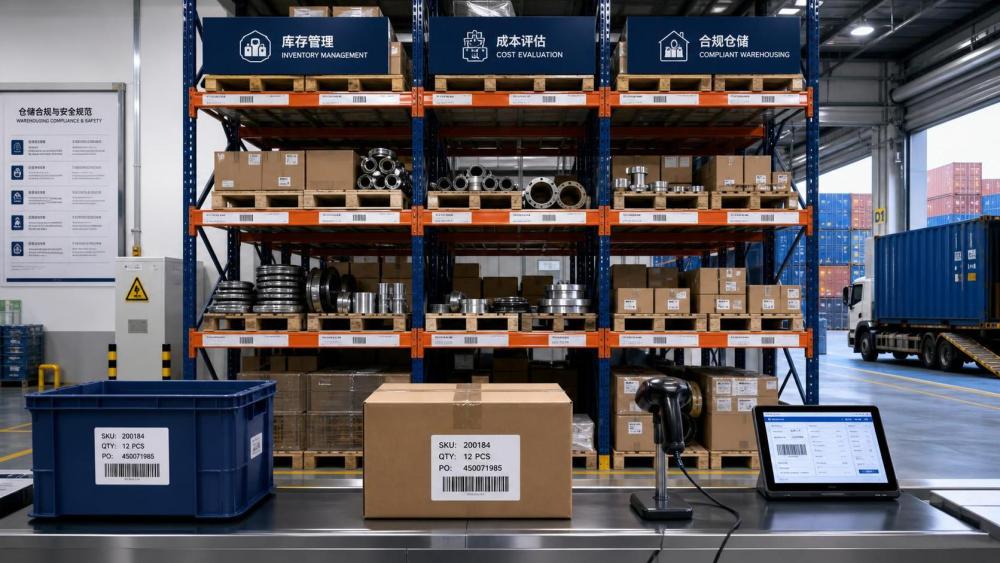
Do the full cost math, not just rent and freight
Most overseas warehouse decisions get distorted here. Teams compare warehouse rent against international shipping savings and stop too early. The actual cost stack is broader and usually less forgiving.
If you are dealing with technically sensitive components, add another line item for packaging integrity and environmental control. Some products can tolerate rough storage conditions. Others cannot. For sealed assemblies, pressure-related parts, sensors, membranes, coatings, and specialist materials, poor storage can quietly destroy value before the product ever reaches site.
Be precise about compliance responsibility
An overseas warehouse is not just a box with shelves. In many markets, it triggers a deeper local presence from a regulatory and tax perspective. Which party acts as importer of record? Who holds product liability if a component fails? Who manages local documentation, declarations, or sector-specific registration? These questions matter more in industrial and energy-adjacent procurement than in consumer goods.
For businesses involved in hydrogen systems, gas handling equipment, cryogenic logistics, fueling infrastructure, or high-pressure assemblies, the answer cannot be improvised after stock arrives. International frameworks such as ISO 19880, ASME B31.12, and SAE J2601 may shape equipment design or operating context, but they do not remove the need to verify local import, storage, transport, labeling, and workplace safety obligations in the destination country. Those local obligations must be checked jurisdiction by jurisdiction.
If your internal team cannot clearly map responsibility across legal, logistics, QA, and after-sales, pause the warehouse decision. That gap will turn into operational friction almost immediately.
Separate general warehousing from hazardous or technically controlled storage
This point gets underestimated when industrial companies use standard third-party logistics providers for products that are not truly standard. Some inventory can sit in a normal warehouse with straightforward controls. Some cannot. If your portfolio includes pressurized items, chemical consumables, batteries, temperature-sensitive materials, or components that fall under hazardous goods handling rules, the warehouse shortlist needs to be screened much more tightly.
Do not rely on broad claims like “we handle industrial goods.” Ask for specifics: segregation rules, incident procedures, ventilation provisions where relevant, traceability practices, quarantine handling, damaged-goods workflow, and insurance coverage boundaries. If the warehouse partner hesitates or answers at marketing level, treat that as a warning sign.
For hydrogen and zero-carbon infrastructure businesses, this is especially important because adjacent equipment often sits within strict safety management systems even when the warehouse is only storing subassemblies or spare units. The storage environment must not break the chain of technical assurance.
Watch the inventory risk nobody likes to own
The more specialized the item, the harder it is to recover from the wrong stock decision. That applies to custom spare parts, region-specific power modules, certified assemblies, and low-turn technical items with limited resale channels. In these cases, the overseas warehouse may reduce delivery time while increasing obsolescence exposure.
A useful discipline is to split stock into three categories before launch: must-stock, conditional stock, and do-not-preposition. The last category matters. Not every urgent-looking item belongs on the shelf overseas. Sometimes the right answer is controlled emergency air shipment from origin, especially if demand is rare and the unit value is high.
- Set a review trigger for aged stock before it becomes a write-off problem.
- Confirm whether local customers accept substitute models or only exact configuration matches.
- Check shelf-life, calibration periods, and packaging expiry where relevant.
Choose the market, not just the warehouse
An overseas warehouse is often discussed as a facility decision, but it is really a market-access decision. The best building in the wrong location still leaves you with poor delivery economics, customs drag, and weak service reach. Before comparing providers, decide what geography the warehouse is supposed to serve and whether cross-border distribution from that point is actually practical.
A hub that works for general merchandise may be a bad fit for industrial project cargo or time-sensitive replacement parts. Transit reliability, port congestion patterns, inland transport capacity, customs consistency, and access to technical service teams all matter. Some of this is dynamic and should be checked against current conditions rather than assumed from old trade-route habits.
If your buyers are ministries, utilities, EPC contractors, or regulated infrastructure operators, local presence may also influence tender perception. But that should be confirmed through actual procurement requirements or customer feedback, not guessed.
Do not outsource visibility
The warehouse operator may run the site, but you still need control over stock accuracy, serial traceability, batch records, and exception reporting. This matters even more for capital equipment support parts and safety-relevant components. If your team cannot see what is available, what is reserved, what has been damaged, and what is nearing aging thresholds, the overseas warehouse will create more uncertainty than it removes.
At minimum, confirm reporting cadence, data fields, reconciliation process, and escalation paths. Also verify whether returns can be inspected locally or only held pending head-office instructions. Small process gaps at this stage become large customer-facing delays later.
Pressure-test the exit route before you sign
This is the item experienced operators ask about early. What happens if the market slows, regulations change, a key account is lost, or your product line shifts? Can you reduce footprint quickly? Can inventory be transferred, re-exported, or liquidated without excessive tax and contract friction? Are there minimum volume commitments or termination penalties?
An overseas warehouse should be treated like an operational instrument, not a symbolic proof of international expansion. If you cannot see a realistic exit path, the entry case is weaker than it looks.
A short decision filter before you move
Green-light the overseas warehouse only when the answers are concrete: the demand signal is credible, the cost model includes carrying and compliance burden, the storage conditions fit the product, and local operational responsibility is fully mapped. If any of those still depends on assumption, the safer move is usually a lighter structure first, such as project-based stocking, bonded inventory, or a limited spare-parts pilot.
That may sound conservative. In procurement and infrastructure markets, conservative is often just accurate. A well-placed overseas warehouse can support market entry and service credibility. A poorly scoped one ties up capital, creates hidden liabilities, and leaves your team explaining why faster delivery became a more expensive problem.
Related News
- Electricity Price Volatility Is Rewriting Hydrogen Cost ModelsApr 27, 2026Impact of electricity price on hydrogen cost is transforming industrial decarbonization and large-scale electrolysis. Explore LCOH trends, PPA strategies, and resilient hydrogen infrastructure planning.
- Energy Transition Plans Often Fail at the Grid Connection StageApr 27, 2026Sustainable energy and energy transition projects often fail at grid connection. Learn how hydrogen infrastructure, PEM electrolysis, and industrial decarbonization can avoid delays and protect investment value.
- What Is Slowing Industrial Decarbonization Projects in 2026?Apr 27, 2026Industrial decarbonization faces delays in 2026 as hydrogen infrastructure, sustainable energy access, grid limits, safety standards, and project bankability challenge the energy transition.
- How PEM electrolyzers support the energy transition in EuropeNov 10, 2026Discover how PEM electrolyzers support the energy transition in Europe, from renewable hydrogen and industrial applications to project costs and infrastructure.
Related News
- 00
0000-00
Hydrogen Energy Storage for Data Centers Gets Costly Fast - 00
0000-00
When 99.999% Hydrogen Purity Still Is Not Good Enough - 00
0000-00
When Does a Hydrogen-Ready Gas Turbine Pay Off? - 00
0000-00
Electricity Price Volatility Is Rewriting Hydrogen Cost Models - 00
0000-00
PSA Recovery Rate Drops for Reasons Operators Miss
Dr. Aris Aero
Weekly Insights
Stay ahead with our curated technology reports delivered every Monday.