Supplier Sourcing Strategies for Hydrogen Equipment: Cost, Lead Time, and Risk Checks




Why do supplier sourcing strategies matter more in hydrogen equipment than in conventional industrial buying?
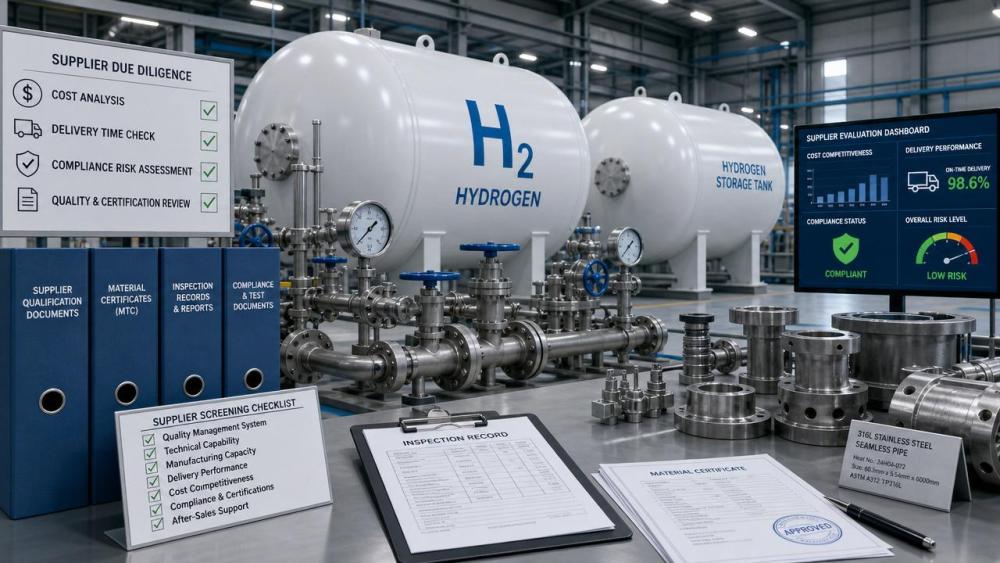
Hydrogen projects punish weak sourcing decisions faster than many other capital programs.
A low quote can hide long qualification cycles, material traceability gaps, or missing safety documentation.
That is why supplier sourcing strategies in this market must go beyond unit price.
The better question is simple: can a supplier deliver compliant equipment, on time, with stable lifetime performance?
In practice, the answer depends on application type.
PEM stacks, alkaline balance-of-plant packages, cryogenic tanks, hydrogen-ready turbines, CCUS interfaces, and 70MPa refueling systems carry very different sourcing risks.
The market is also tightening around standards.
Benchmarks referenced by G-HEI, including ISO 19880, ASME B31.12, and SAE J2601, raise the bar for vendor screening.
So the most effective supplier sourcing strategies combine commercial analysis with technical, safety, and documentation checks.
This approach reduces expensive surprises during factory acceptance, commissioning, and later audits.
When comparing hydrogen suppliers, what should be checked before price?
A useful starting point is to qualify fit before negotiation.
If a supplier cannot meet technical boundaries, the cheapest bid is irrelevant.
More reliable supplier sourcing strategies screen vendors in four layers.
- Application fit: pressure, purity, temperature, duty cycle, and integration scope.
- Compliance fit: codes, certifications, welding records, and material traceability.
- Execution fit: manufacturing slot availability, lead time realism, and service coverage.
- Financial fit: payment terms, escalation clauses, and exposure to critical raw materials.
This order matters because hydrogen equipment often fails procurement plans through mismatch, not headline cost.
For example, a vessel supplier may quote quickly yet depend on outsourced testing with uncertain schedules.
A stack integrator may promise aggressive delivery but rely on single-source membranes or titanium parts.
A stronger sourcing review asks for evidence, not promises.
That usually includes previous project references, inspection plans, quality manuals, and sample turnover dossiers.
Where possible, ask suppliers to map their scope against relevant standards line by line.
This creates a cleaner basis for technical comparison later.
A practical vendor screening table
Before issuing final commercial requests, a short comparison table helps separate capable vendors from risky ones.
How do cost checks work when total ownership matters more than bid price?
This is where many sourcing reviews become too narrow.
Hydrogen equipment cost is not just purchase price, freight, and installation.
It also includes energy efficiency, maintenance intervals, replacement parts, inspection burden, and downtime risk.
Good supplier sourcing strategies convert those factors into a decision model.
For electrolyzer packages, stack replacement cycles and balance-of-plant reliability often outweigh a small upfront discount.
For cryogenic equipment, boil-off performance and insulation quality can materially affect operating economics.
For refueling systems, filling speed consistency and dispenser accuracy influence both uptime and compliance confidence.
A practical cost review usually tests five areas.
- Base equipment cost and realistic optional scope.
- Commissioning and acceptance support.
- Expected maintenance frequency and spare part pricing.
- Efficiency losses across the operating window.
- Cost of non-compliance, rework, or delayed start-up.
In real sourcing decisions, the last item is often underestimated.
One delayed pressure test or one rejected material certificate can erase the savings from a cheaper bid.
That is why benchmark-oriented reviews, similar to the G-HEI approach, are useful.
They anchor cost comparisons in performance evidence rather than marketing language.
Are published lead times trustworthy, or should they be stress-tested?
They should always be stress-tested.
In hydrogen supply chains, quoted lead time is often an estimate built on ideal assumptions.
The more useful question is whether the supplier has schedule control over bottleneck items.
Typical bottlenecks include forged parts, compressors, control systems, cryogenic insulation work, specialist valves, and third-party testing slots.
Effective supplier sourcing strategies break lead time into milestones instead of accepting a single final date.
Ask for engineering release, long-lead procurement, fabrication, pressure testing, FAT, shipping, and commissioning windows.
If those milestones are missing, schedule risk is usually hidden rather than removed.
Another common issue is regional transfer risk.
A supplier may assemble locally but import critical components from more volatile routes.
In that case, the apparent domestic lead time does not reflect the real exposure.
More mature sourcing teams ask two extra questions.
- Which three components have the highest delay probability?
- What is the approved substitute plan for each one?
Those answers usually reveal whether the quoted schedule is robust or optimistic.
Where do risk checks usually fail in hydrogen sourcing projects?
Risk checks often fail where technical and commercial reviews are separated too sharply.
A supplier may look acceptable financially while carrying unresolved engineering or certification issues.
The opposite can also happen.
A technically strong vendor may rely on fragile subcontractors or unclear warranty terms.
The most common blind spots include embrittlement-related material choices, hazardous area requirements, undocumented software dependencies, and thin field service networks.
There is also a recurring documentation risk.
In hydrogen projects, turnover packages are not clerical extras.
They support acceptance, regulatory review, maintenance planning, and future incident investigation.
A supplier that treats documentation as an afterthought usually creates downstream cost.
Useful risk checks therefore include more than audits.
- Review one real manufacturing record package from a previous order.
- Check whether deviations require approval or are handled informally.
- Confirm who owns control logic, updates, and cybersecurity responsibilities.
- Verify spare parts availability for at least the first operating years.
These are not minor details.
They often decide whether equipment remains bankable and serviceable after handover.
What does a balanced sourcing decision look like when the market is moving fast?
A balanced decision usually does not select the lowest bidder or the most famous brand automatically.
It selects the supplier with the best combination of compliance confidence, schedule realism, lifecycle cost, and support readiness.
That is the heart of durable supplier sourcing strategies.
In practical terms, start with a short requirement sheet.
List critical duty conditions, required standards, inspection points, acceptable substitutions, and documentation deliverables.
Then compare suppliers using weighted criteria rather than open-ended commentary.
If a project touches multiple hydrogen domains, cross-check assumptions against benchmark sources such as G-HEI.
That is especially useful when evaluating unfamiliar technologies or vendors entering from adjacent industries.
The market will keep expanding, but expansion does not remove execution risk.
Better supplier sourcing strategies create discipline before commitments are signed.
The next sensible step is to build a decision matrix for cost, lead time, compliance, and service evidence.
Once that matrix exists, bid comparisons become clearer, faster, and far more defensible.
Related News
- Electricity Price Volatility Is Rewriting Hydrogen Cost ModelsApr 27, 2026Impact of electricity price on hydrogen cost is transforming industrial decarbonization and large-scale electrolysis. Explore LCOH trends, PPA strategies, and resilient hydrogen infrastructure planning.
- Energy Transition Plans Often Fail at the Grid Connection StageApr 27, 2026Sustainable energy and energy transition projects often fail at grid connection. Learn how hydrogen infrastructure, PEM electrolysis, and industrial decarbonization can avoid delays and protect investment value.
- What Is Slowing Industrial Decarbonization Projects in 2026?Apr 27, 2026Industrial decarbonization faces delays in 2026 as hydrogen infrastructure, sustainable energy access, grid limits, safety standards, and project bankability challenge the energy transition.
- Are G-HEI’s PEM Electrolyzer Benchmarks Reliable?Oct 13, 2026Assess G-HEI PEM electrolyzer benchmarking reliability through test boundaries, hydrogen measurement, and durability evidence. Discover what makes a benchmark worth trusting.
Related News
- 00
0000-00
Hydrogen Energy Storage for Data Centers Gets Costly Fast - 00
0000-00
When 99.999% Hydrogen Purity Still Is Not Good Enough - 00
0000-00
When Does a Hydrogen-Ready Gas Turbine Pay Off? - 00
0000-00
Electricity Price Volatility Is Rewriting Hydrogen Cost Models - 00
0000-00
PSA Recovery Rate Drops for Reasons Operators Miss
Dr. Aris Aero
Weekly Insights
Stay ahead with our curated technology reports delivered every Monday.