
Technology Innovation News: Which Hydrogen Breakthroughs Matter Most in 2026?




Technology Innovation News: Which Hydrogen Breakthroughs Matter Most in 2026?
In 2026, the most useful technology innovation news in hydrogen is not the announcement of another promising material or pilot unit. It is the much harder question: which breakthroughs are moving from technical possibility into bankable infrastructure. That distinction matters because hydrogen has always had a split identity. In presentations, it appears as a universal decarbonization tool. In project execution, it behaves like a demanding industrial molecule that punishes weak assumptions about purity, compression, thermal management, embrittlement, and logistics.
For decision-makers, the market is no longer sorting ideas by novelty. It is sorting them by system fit. A new electrolyzer design only matters if it can hold performance under variable renewable power, source its critical materials without destabilizing cost, and plug into downstream storage or transport without creating new constraints. A liquid hydrogen logistics concept only matters if boil-off, insulation performance, handling safety, and port integration work together in the real world. The practical winners in 2026 are the technologies that reduce friction across the value chain, not just improve one component in isolation.
That is why five areas deserve more attention than the headline cycle usually gives them: large-scale electrolysis, cryogenic hydrogen movement, hydrogen-ready gas turbines, CCUS infrastructure where pure hydrogen is not yet the only pathway, and high-pressure refueling for transport applications. Each sits at a different maturity point, and each is judged by a different standard of success.
Electrolysis is no longer a science story; it is an uptime story
The industry still talks about electrolyzers in terms of efficiency, but that is only one part of the commercial picture. In utility-scale projects, PEM and alkaline systems are now being compared less like laboratory platforms and more like long-life process assets. That shifts the conversation toward stack durability, dynamic response, water quality management, heat integration, and maintenance intervals.
PEM systems continue to attract attention because they respond well to fluctuating renewable inputs and can support compact, high-performance operation. The catch is familiar to anyone building serious capacity: catalyst materials, membrane longevity, and stack replacement economics still matter more than slide-deck efficiency claims. Alkaline systems remain relevant because they are more established and often better understood at industrial scale, but they are not automatically the lower-risk choice if a project depends on fast load-following or tight site integration.
A common misunderstanding is that electrolyzer innovation is mainly about producing cheaper hydrogen per kilogram. In reality, the more consequential advances are often hidden in balance-of-plant design, control systems, and degradation management. If a plant cannot operate reliably with variable power input, the theoretical cost curve becomes irrelevant. In 2026, the strongest technology signals are coming from architectures that treat electrolysis as part of a dispatchable energy system rather than a stand-alone machine.
This is where technical benchmarking matters. Performance claims need to be read alongside operating conditions, stack lifetime assumptions, and the quality regime required to protect downstream assets. Hydrogen purity is not an abstract specification; it affects storage compatibility, fuel cell use, turbine blending strategy, and refueling compliance.
Cryogenic logistics is becoming a strategic bottleneck
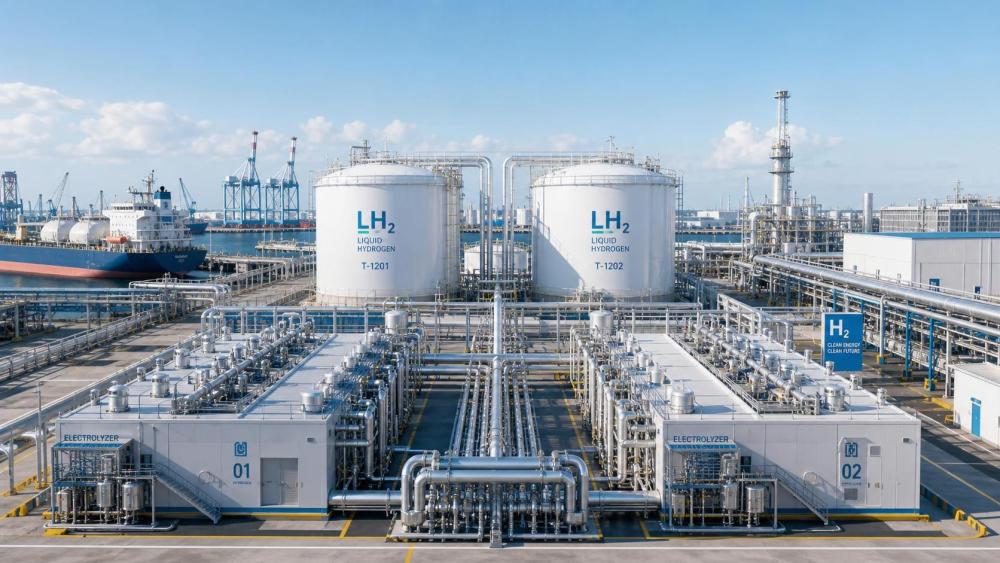
Hydrogen production gets most of the publicity, but logistics is where many projects become harder than expected. Liquid hydrogen is attractive because of volumetric density advantages over compressed gas in certain long-distance or high-throughput use cases. Yet cryogenic handling introduces a completely different engineering discipline. The issue is not just keeping hydrogen cold enough. It is maintaining insulation integrity, controlling boil-off, managing transfer losses, and ensuring vessel materials perform safely under repeated thermal cycling.
This part of the market is increasingly strategic for sovereign energy planning. Countries that expect hydrogen imports or large-scale internal distribution cannot rely on generic LNG-era assumptions. Some lessons transfer, but hydrogen’s physical behavior is different enough that infrastructure must be assessed on its own terms. Vacuum-insulated vessels, transfer systems, loading interfaces, and terminal operations all become part of the competitive equation.
What counts as a breakthrough here is not a dramatic new storage concept. More often, it is progress in loss reduction, operational consistency, and code-aligned design. That makes the technology less visible to general media, but more important to investors and public authorities. A hydrogen corridor is only credible when its logistics losses and handling risks are understood well enough to underwrite.
Hydrogen-ready turbines are being judged by fuel flexibility, not slogans
“Hydrogen-ready” has become one of the most overused phrases in energy technology. In practice, it can mean very different things. For one turbine platform, it may indicate limited blending capability under defined conditions. For another, it may refer to a roadmap toward higher hydrogen shares after future combustor modifications. Those are not equivalent positions, especially for operators making long-horizon power investment decisions.
The technical challenge is not simply whether hydrogen can burn. It is whether combustion can remain stable while controlling NOx formation, managing flame speed differences, and preserving turbine integrity across operating ranges. Retrofitting an installed fleet introduces another layer of complexity: fuel supply consistency, materials compatibility, control software updates, and outage economics all have to be accounted for.
So the meaningful breakthrough in 2026 is not a broad claim that gas power can decarbonize with hydrogen. It is credible progress in fuel-flexible turbine systems that can move across blending levels with known operating envelopes. That is a narrower claim, but a more valuable one. It gives utilities a basis for sequencing investment rather than betting on an undefined future conversion.
CCUS remains part of the hydrogen story, even where policy narratives prefer green-only language
One reason hydrogen market analysis often becomes distorted is that it collapses all production pathways into a political preference instead of an infrastructure reality. By 2026, that simplification no longer helps serious planning. Electrolytic hydrogen is central to long-term decarbonization, but CCUS-linked pathways still shape regional supply, industrial transition timing, and asset utilization in many markets.
The right question is not whether CCUS and hydrogen are rivals. In many industrial systems, they are transitional complements. Heavy industry, dispatchable power, and existing gas-linked networks do not all move at the same speed. Where carbon capture infrastructure is technically and commercially credible, it can support lower-carbon hydrogen availability while electrolysis capacity, renewable generation, and transmission expansion catch up.
This is also where due diligence becomes unforgiving. Project sponsors need to separate capture rates advertised at component level from system-level emissions performance, and they need to understand transport and storage liabilities rather than treating captured carbon as an abstract accounting line. In other words, the hydrogen breakthrough is sometimes the maturity of the adjacent carbon infrastructure that makes hydrogen deployment financeable at scale.
High-pressure refueling is moving from demonstration to operational discipline
Refueling systems above 70 MPa are one of the clearest examples of why standards matter as much as hardware. For mobility segments that depend on fast turnaround and predictable fill performance, station design cannot be treated as a commodity engineering exercise. Compression, precooling, dispenser control, storage cascade design, and vehicle interface standards all affect station throughput and user confidence.
That is why references such as ISO 19880 and SAE J2601 matter in market conversations. They are not side notes for compliance teams. They define whether a station can perform safely and consistently under real operating conditions. In practice, the market is paying closer attention to fueling accuracy, thermal management during fast fill, maintenance resilience, and integration with upstream hydrogen supply quality.
There is also a persistent misconception that refueling is only a transport niche and therefore strategically secondary. That misses the role of high-pressure infrastructure as a proving ground for compression, storage, and dispensing technologies that later influence broader industrial hydrogen handling. It is a smaller market than national pipeline conversion, but technically it is one of the places where weak engineering gets exposed fastest.
What decision-makers should actually watch
Hydrogen markets generate a lot of noise because every part of the value chain can produce impressive single-point results. The harder task is deciding which signals indicate durable market movement. Three filters help.
Those filters also explain why the center of gravity in technology innovation news is shifting. The market no longer rewards hydrogen announcements simply for proving feasibility. It rewards technologies that close the gap between demonstration and governed deployment. National energy ministries, utility CTOs, and infrastructure investors are asking more specific questions now: What is the failure mode? Which standard applies? How does this asset behave under load variation? What upstream and downstream constraints remain?
That change is healthy. It forces the hydrogen sector to mature from aspiration into industrial discipline. It also means some of the most important breakthroughs in 2026 will look less dramatic than the public expects. Better stack durability. More credible cryogenic transfer performance. Turbine systems with clearly defined hydrogen envelopes. Refueling architectures that meet demanding safety and fill consistency requirements. These are not glamorous milestones, but they are the ones that determine whether hydrogen becomes a functioning pillar of zero-carbon infrastructure or stays trapped in perpetual pilot mode.
If there is a single practical way to read the hydrogen market this year, it is this: pay less attention to technologies that sound universal, and more attention to those that survive contact with standards, materials limits, and infrastructure reality. That is where the frontier is actually being won.
Related News
- Electricity Price Volatility Is Rewriting Hydrogen Cost ModelsApr 27, 2026Impact of electricity price on hydrogen cost is transforming industrial decarbonization and large-scale electrolysis. Explore LCOH trends, PPA strategies, and resilient hydrogen infrastructure planning.
- Energy Transition Plans Often Fail at the Grid Connection StageApr 27, 2026Sustainable energy and energy transition projects often fail at grid connection. Learn how hydrogen infrastructure, PEM electrolysis, and industrial decarbonization can avoid delays and protect investment value.
- What Is Slowing Industrial Decarbonization Projects in 2026?Apr 27, 2026Industrial decarbonization faces delays in 2026 as hydrogen infrastructure, sustainable energy access, grid limits, safety standards, and project bankability challenge the energy transition.
- How PEM electrolyzers support the energy transition in EuropeNov 10, 2026Discover how PEM electrolyzers support the energy transition in Europe, from renewable hydrogen and industrial applications to project costs and infrastructure.
Related News
- 00
0000-00
Hydrogen Energy Storage for Data Centers Gets Costly Fast - 00
0000-00
When 99.999% Hydrogen Purity Still Is Not Good Enough - 00
0000-00
When Does a Hydrogen-Ready Gas Turbine Pay Off? - 00
0000-00
Electricity Price Volatility Is Rewriting Hydrogen Cost Models - 00
0000-00
PSA Recovery Rate Drops for Reasons Operators Miss
Dr. Aris Aero
Weekly Insights
Stay ahead with our curated technology reports delivered every Monday.