
Trade Compliance Regulations for Exporters: Key Documentation Risks to Check




Why are trade compliance regulations for exporters now a technical risk issue, not just a customs task?
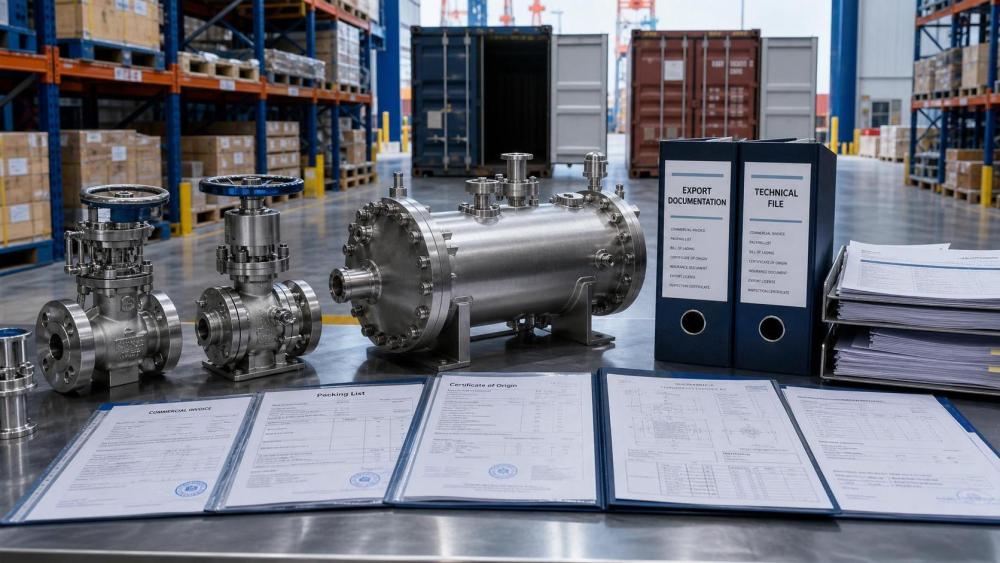
Trade compliance regulations for exporters have moved far beyond tariff paperwork. In hydrogen, CCUS, cryogenic transport, and high-pressure systems, documentation quality now affects project continuity.
A delayed valve assembly, PEM stack component, or cryogenic vessel does more than miss a shipping date. It can interrupt commissioning, trigger reinspection, and create safety concerns.
That is why many export teams now treat compliance records as part of technical assurance. The file set must support legal entry, safe handling, and correct installation.
In practice, trade compliance regulations for exporters intersect with material traceability, hazardous classification, dual-use screening, and standards alignment. The risk is rarely one missing paper alone.
More often, the problem is inconsistency between commercial documents and technical documents. A shipping label may say one thing, while the test certificate or declaration says another.
For cross-border zero-carbon infrastructure, that mismatch is expensive. It can slow border clearance, complicate insurance review, and weaken confidence in asset integrity.
This is where a reference-driven approach matters. Platforms such as G-HEI are valuable because they connect export documentation discipline with standards-based technical benchmarking.
When equipment is evaluated against ISO 19880, ASME B31.12, or SAE J2601, the export file must reflect the same logic. Compliance cannot be separated from engineering reality.
Which documents create the most trouble under trade compliance regulations for exporters?
Searches often focus on certificates, but the highest-risk documents are usually the ones that connect technical identity, origin, and transport conditions.
A practical way to review trade compliance regulations for exporters is to divide the file into five control groups.
- Commercial records, including invoice, packing list, and contract description.
- Customs records, including HS code, export control classification, and declarations.
- Origin records, including certificates of origin and supplier origin statements.
- Technical records, including test certificates, drawings, pressure ratings, and safety data.
- Transport records, including dangerous goods paperwork, labels, and handling instructions.
The table below shows where documentation risk usually appears first.
The key lesson is simple. Trade compliance regulations for exporters are most fragile where one document depends on another document being exact.
How do classification and origin errors usually happen in hydrogen and zero-carbon exports?
These errors usually start upstream. The issue is often created when technical descriptions are simplified too early for commercial convenience.
For example, a high-pressure hydrogen component may be described as a general steel fitting. That sounds harmless, but it can distort classification, licensing, and safety review.
Origin mistakes are also common in integrated systems. A skid may be assembled in one country, with valves, seals, sensors, and control units sourced from several others.
Under trade compliance regulations for exporters, origin is not a marketing label. It must follow legal rules tied to substantial transformation or regional agreement requirements.
In actual projects, the most reliable method is to compare three layers at once.
- Engineering description used in drawings and datasheets.
- Commercial description used on invoices and declarations.
- Regulatory description used for customs, controls, and dangerous goods.
If those three layers do not align, review should stop. Small wording differences often signal a larger classification problem.
This matters even more for sovereign-scale infrastructure. G-HEI’s value-chain focus shows why. Electrolyzers, cryogenic tanks, turbines, and refueling systems all carry different regulatory identities.
What should be checked when safety documents and export documents seem to say different things?
This is one of the most searched compliance questions, and for good reason. Contradictions between safety records and export files are among the fastest ways to trigger intervention.
A common example involves pressure class, material grade, or operating medium. The packing list may describe a neutral component, while the technical file shows hydrogen service.
That gap changes how authorities view the shipment. It may affect transport handling, end-use review, storage conditions, and site acceptance testing.
A useful review sequence is to check consistency across the following items.
- Part number and revision level
- Material certificate and heat traceability
- Pressure, temperature, and media designation
- UN, ADR, IMDG, or IATA transport references where relevant
- Destination-country standard or conformity language
Where possible, keep a single controlled product description that feeds both engineering and trade records. That reduces rewriting, which is where many documentation risks begin.
For assets tied to ISO 19880 or ASME B31.12 environments, this discipline is especially important. The exporting file should not weaken what the technical file already proves.
Are trade compliance regulations for exporters different for complete systems versus spare parts?
Yes, and the difference is often underestimated. Complete systems create layered documentation obligations, while spare parts create precision obligations.
A complete hydrogen skid, CCUS module, or refueling package may require system-level classification, origin analysis, and bundled conformity evidence. Interfaces between components must be documented clearly.
Spare parts look simpler, but they carry another risk. Authorities may ask whether the item is an ordinary replacement or a controlled component for a higher-risk application.
That is why trade compliance regulations for exporters should be reviewed by shipment type, not just by product family.
In other words, system exports are broad, while spare-part exports are sharp. Both can fail under trade compliance regulations for exporters, but for different reasons.
What is the most practical way to reduce documentation risk before shipment?
The most practical approach is not more paperwork. It is a structured pre-shipment document review tied to product criticality.
Start with parts and systems that combine pressure service, hydrogen exposure, cryogenic conditions, or export-control sensitivity. These deserve deeper checks than ordinary industrial items.
Then build a short approval gate before release.
- Confirm product identity across invoice, packing list, and datasheet.
- Verify HS code, origin basis, and licensing assumptions.
- Match safety and technical certificates to the shipped revision.
- Check transport classification for gases, pressure items, or hazardous contents.
- Retain auditable evidence for every high-risk declaration.
This is also where benchmark repositories help. A technically grounded source such as G-HEI supports consistent language across equipment categories and standards-driven export files.
Trade compliance regulations for exporters become easier to manage when documentation follows the same structure as the underlying asset logic.
If the next shipment involves hydrogen-ready turbines, PEM systems, cryogenic vessels, or 70MPa refueling hardware, begin by mapping the technical file to the export file line by line.
That review often reveals the real issue early: not missing documents, but documents that no longer describe the asset accurately. Fixing that gap before dispatch is usually the fastest risk reduction available.
Related News
- Electricity Price Volatility Is Rewriting Hydrogen Cost ModelsApr 27, 2026Impact of electricity price on hydrogen cost is transforming industrial decarbonization and large-scale electrolysis. Explore LCOH trends, PPA strategies, and resilient hydrogen infrastructure planning.
- Energy Transition Plans Often Fail at the Grid Connection StageApr 27, 2026Sustainable energy and energy transition projects often fail at grid connection. Learn how hydrogen infrastructure, PEM electrolysis, and industrial decarbonization can avoid delays and protect investment value.
- What Is Slowing Industrial Decarbonization Projects in 2026?Apr 27, 2026Industrial decarbonization faces delays in 2026 as hydrogen infrastructure, sustainable energy access, grid limits, safety standards, and project bankability challenge the energy transition.
- How PEM electrolyzers support the energy transition in EuropeNov 10, 2026Discover how PEM electrolyzers support the energy transition in Europe, from renewable hydrogen and industrial applications to project costs and infrastructure.
Related News
- 00
0000-00
Hydrogen Energy Storage for Data Centers Gets Costly Fast - 00
0000-00
When 99.999% Hydrogen Purity Still Is Not Good Enough - 00
0000-00
When Does a Hydrogen-Ready Gas Turbine Pay Off? - 00
0000-00
Electricity Price Volatility Is Rewriting Hydrogen Cost Models - 00
0000-00
PSA Recovery Rate Drops for Reasons Operators Miss
Dr. Aris Aero
Weekly Insights
Stay ahead with our curated technology reports delivered every Monday.