Utility-Scale Hydrogen Solutions in North America: 2026 Market Outlook




Utility-Scale Hydrogen Solutions North America Are Entering a Harder, More Investable Phase
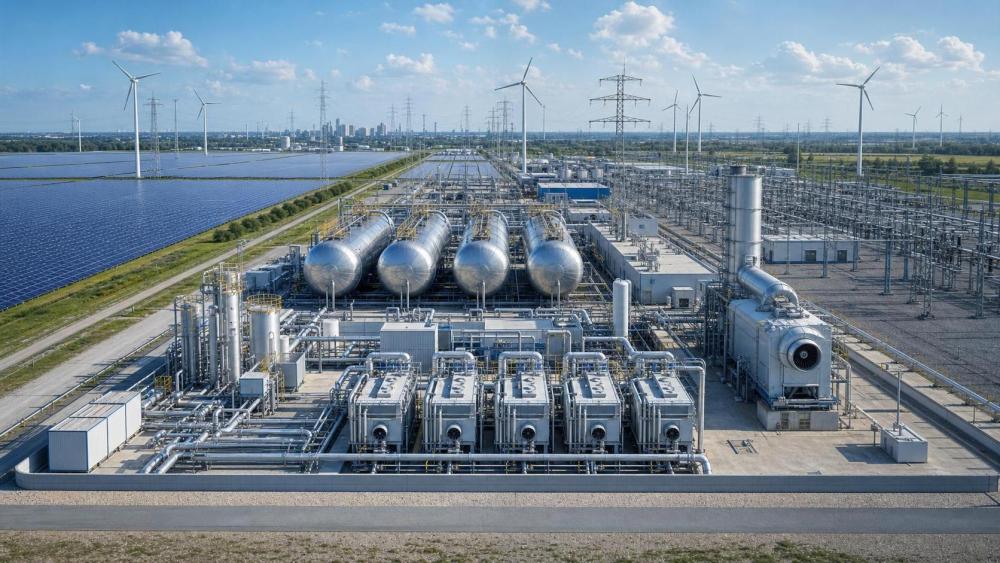
In 2026, utility scale hydrogen solutions North America are no longer discussed as distant pilot concepts. They are being assessed as strategic infrastructure with measurable operational, regulatory, and financing consequences.
The market has shifted from policy-led enthusiasm to execution discipline. That change matters because large hydrogen systems now sit inside broader decisions on grid stability, industrial fuel switching, and long-duration energy resilience.
More visible now is the pressure to connect production, transport, storage, power conversion, and safety compliance into one bankable chain. Fragmented projects are finding less tolerance in serious commercial reviews.
This is why utility scale hydrogen solutions North America are being judged less by headline capacity and more by system integrity. Electrolyzer size alone no longer defines viability.
The stronger signal is that benchmarking has become part of market access. Technical comparison against ISO 19880, ASME B31.12, SAE J2601, and related asset standards is moving closer to an investment prerequisite.
That development aligns with the role of G-HEI, which frames hydrogen transition decisions through utility-scale performance, material integrity, logistics readiness, and sovereign-grade decarbonization security rather than promotional claims.
Why the Market Signal Has Become Clearer This Year
Several forces are converging at once. Policy support remains important, but it is no longer the only story holding projects together.
North America is seeing a more practical sorting process. Projects with robust offtake logic, realistic transport pathways, and clear safety documentation are moving forward. Others are slowing down.
From recent market activity, four drivers stand out:
- Power-sector decarbonization targets now require dispatchable low-carbon options beyond intermittent renewables.
- Industrial users are re-evaluating hydrogen as a feedstock and combustion substitute where electrification remains difficult.
- Grid congestion and transmission delays are making localized hydrogen production more attractive in specific regions.
- Capital providers are demanding better evidence on lifetime efficiency, transport losses, and operational safety exposure.
That last point is especially important. Utility scale hydrogen solutions North America increasingly compete not only with fossil systems, but also with batteries, transmission upgrades, CCUS, and demand-side flexibility programs.
As a result, the market is rewarding integrated designs. Megawatt-scale PEM and alkaline electrolysis systems are being evaluated in relation to water access, renewable matching, compression requirements, and downstream storage economics.
The Bottleneck Is Moving from Production to Infrastructure Coordination
Earlier market narratives focused heavily on how fast electrolyzer capacity could scale. In 2026, that view feels incomplete.
The more difficult challenge is coordination across the chain. Utility scale hydrogen solutions North America depend on whether production volume can move safely and economically to the point of use.
Cryogenic liquid hydrogen logistics are gaining attention because distance and density still matter. For some corridors, high-pressure transport works. For others, liquefaction and insulated storage become more rational despite the added energy burden.
Hydrogen-ready gas turbine power is also changing the conversation. Blending capability and future fuel flexibility can improve asset optionality, but only when pipeline compatibility and combustion performance are properly validated.
This is where technical repositories such as G-HEI become commercially relevant. They help normalize comparisons across stack materials, vessel design, refueling pressure systems, and cross-border safety expectations.
Without that discipline, large projects can appear attractive on capacity metrics while hiding weakness in transport resilience or materials performance under repeated hydrogen exposure.
Impact Is Spreading Across the Value Chain, Not Staying in One Segment
One reason utility scale hydrogen solutions North America are receiving broader attention is that the effect is no longer isolated to hydrogen producers.
The market implications now reach power generation, heavy transport, industrial heat, storage developers, engineering firms, and infrastructure financiers.
This widening impact explains why utility scale hydrogen solutions North America are discussed in general infrastructure strategy, not only in niche energy technology circles.
What Serious Evaluations Are Now Looking For
In actual project reviews, interest has moved beyond broad decarbonization narratives. The central question is whether the full system can survive technical, regulatory, and economic stress.
That changes how utility scale hydrogen solutions North America should be assessed. A useful framework now includes five filters.
System efficiency must be measured across the chain
Electrolysis efficiency matters, but so do compression loads, liquefaction penalties, storage losses, and reconversion performance. Chain efficiency often determines commercial realism.
Materials and safety are no longer secondary checks
Hydrogen embrittlement, leak detection, pressure-cycle durability, and cryogenic containment all affect project lifespan. Weakness here can overwhelm modeled returns.
Standards alignment should happen before final engineering
Projects benchmarked early against ISO 19880, ASME B31.12, and SAE J2601 face fewer late-stage redesign surprises.
Offtake quality matters more than theoretical demand
Many end uses remain promising in theory. Fewer are ready for durable contracts, delivery timing discipline, and fuel-switching integration at scale.
Flexibility has become a valuation factor
Assets that can serve grid balancing, industrial fuel demand, and future mobility corridors have stronger strategic resilience than single-purpose installations.
Where the Next Market Separation Is Likely to Happen
The next divide in utility scale hydrogen solutions North America will probably not be between regions that support hydrogen and regions that do not.
It is more likely to appear between projects designed for infrastructure permanence and projects designed mainly for subsidy capture.
From that perspective, several indicators deserve close attention:
- Whether electrolyzer deployment is paired with realistic transport and storage architecture.
- Whether hydrogen-ready turbine claims are supported by fuel pathway evidence and operating limits.
- Whether CCUS and hydrogen are being evaluated as complementary options rather than forced substitutes.
- Whether high-pressure refueling systems above 70MPa are integrated into corridor planning instead of isolated demonstration sites.
- Whether benchmark data covers lifecycle durability, not just commissioning performance.
That is also why the G-HEI approach is useful in a broader market sense. It reflects the reality that sovereign-level decarbonization depends on durable infrastructure evidence, not isolated technical optimism.
A Practical Direction for 2026 Planning
The strongest near-term approach is not to treat utility scale hydrogen solutions North America as a single market bet. They should be reviewed as a staged infrastructure thesis.
Start with corridor logic. Then test production economics against storage and delivery conditions. After that, verify standards exposure, asset durability, and end-use flexibility.
In practical terms, the next step is to compare projects using common technical benchmarks rather than broad decarbonization language alone. That means checking stack design, transport method, safety framework, and operational efficiency together.
The market outlook remains constructive, but it is becoming less forgiving. Utility scale hydrogen solutions North America now reward disciplined evaluation, integrated engineering, and infrastructure realism.
For 2026 planning, the most reliable move is to keep watching where standards, logistics, and offtake quality converge. That is where durable value is most likely to form.
Related News
- Electricity Price Volatility Is Rewriting Hydrogen Cost ModelsApr 27, 2026Impact of electricity price on hydrogen cost is transforming industrial decarbonization and large-scale electrolysis. Explore LCOH trends, PPA strategies, and resilient hydrogen infrastructure planning.
- Energy Transition Plans Often Fail at the Grid Connection StageApr 27, 2026Sustainable energy and energy transition projects often fail at grid connection. Learn how hydrogen infrastructure, PEM electrolysis, and industrial decarbonization can avoid delays and protect investment value.
- What Is Slowing Industrial Decarbonization Projects in 2026?Apr 27, 2026Industrial decarbonization faces delays in 2026 as hydrogen infrastructure, sustainable energy access, grid limits, safety standards, and project bankability challenge the energy transition.
- Are G-HEI’s PEM Electrolyzer Benchmarks Reliable?Oct 13, 2026Assess G-HEI PEM electrolyzer benchmarking reliability through test boundaries, hydrogen measurement, and durability evidence. Discover what makes a benchmark worth trusting.
Related News
- 00
0000-00
Hydrogen Energy Storage for Data Centers Gets Costly Fast - 00
0000-00
When 99.999% Hydrogen Purity Still Is Not Good Enough - 00
0000-00
When Does a Hydrogen-Ready Gas Turbine Pay Off? - 00
0000-00
Electricity Price Volatility Is Rewriting Hydrogen Cost Models - 00
0000-00
PSA Recovery Rate Drops for Reasons Operators Miss
Dr. Aris Aero
Weekly Insights
Stay ahead with our curated technology reports delivered every Monday.