What Are the Risks of Choosing a Small PEM Electrolyzer Supplier?




What Are the Risks of Choosing a Small PEM Electrolyzer Supplier?
What are the risks of choosing a small PEM electrolyzer supplier? For a utility-scale hydrogen project, the question reaches far beyond the purchase price of a stack or containerized skid. PEM electrolysis is often selected for fast response to variable renewable power, compact footprint, and the ability to produce high-purity hydrogen at elevated pressure. Those advantages are real. But they also depend on a tightly controlled combination of stack materials, power electronics, water treatment, process safety, controls, and long-term field service.
A smaller supplier may offer genuine technical innovation, close engineering attention, or an attractive commercial proposal. Size alone is not evidence of poor quality. The risk arises when a supplier’s practical capacity has not caught up with the scale, operating profile, financing requirements, and compliance obligations of the project. For developers, utilities, industrial off-takers, and public-sector energy planners, this distinction matters: an electrolyzer is not simply purchased equipment. It becomes a long-lived operating asset embedded in an electrical, water, compression, storage, and hydrogen-handling system.
The most serious procurement failures tend to emerge after the contract is signed, when factory acceptance testing, site integration, performance verification, spare-parts support, or stack replacement becomes difficult. A disciplined supplier review should therefore test not only what is being offered today, but whether the organization can sustain the asset for years under real operating conditions.
The Scale Gap Between a Demonstrator and a Bankable Asset
Many emerging PEM suppliers can demonstrate an operating unit at pilot scale. That is an important milestone, but it does not automatically prove repeatable delivery at multi-megawatt scale. A project can fail commercially even when the core electrochemical technology works in a controlled setting. Scaling exposes weak points in procurement, quality systems, module assembly, heat management, software commissioning, and documentation control.
Manufacturing capacity deserves particular scrutiny. Buyers should distinguish between a stated annual capacity, a planned factory expansion, and verified throughput from a functioning production line. A supplier may have enough space for future assembly, yet lack secured equipment, trained labor, incoming-material controls, or qualified subcontractors. When several projects are awarded at once, delivery schedules can slip quickly if catalyst-coated membranes, porous transport layers, titanium components, rectifiers, or balance-of-plant equipment are constrained.
The same issue affects consistency. PEM stacks rely on components whose quality tolerances have direct consequences for voltage efficiency, gas crossover, pressure behavior, and degradation. A supplier that hand-builds a limited number of systems may produce excellent early units. Reproducing that performance across a fleet requires process discipline: traceability of critical materials, validated assembly procedures, inspection criteria, and a credible method for handling non-conforming parts.
Stack Durability Is a Commercial Risk, Not Just a Laboratory Metric
A PEM stack’s reported efficiency at a particular operating point can be useful, but it is only one part of the decision. Long-term value depends on how the stack behaves across the project’s expected load profile. Renewable-linked systems may see frequent ramping, partial-load operation, start-stop cycles, and periods of curtailed generation. Industrial hydrogen systems may instead prioritize stable baseload availability. Neither operating pattern should be assumed to be benign without evidence.
Smaller suppliers can be vulnerable when their durability claims rest mainly on short test campaigns or a limited installed base. This does not make the claim invalid; it means the buyer should ask what evidence supports it. Relevant questions include whether degradation has been measured under representative pressure, temperature, water-quality, and cycling conditions; whether stack test methods are consistent across production batches; and how performance loss is treated in the contractual guarantee.
A vague promise of “long stack life” is less useful than a defined framework covering initial performance, acceptable degradation, operating envelope, warranty exclusions, monitoring requirements, and replacement responsibility. The buyer should also understand whether a stack exchange requires a full system shutdown, specialist personnel, return shipment, factory refurbishment, or site-level replacement procedures. In remote locations, these details can determine downtime far more than the nominal cost of the replacement stack.
Balance-of-Plant Weaknesses Can Undermine a Good Stack
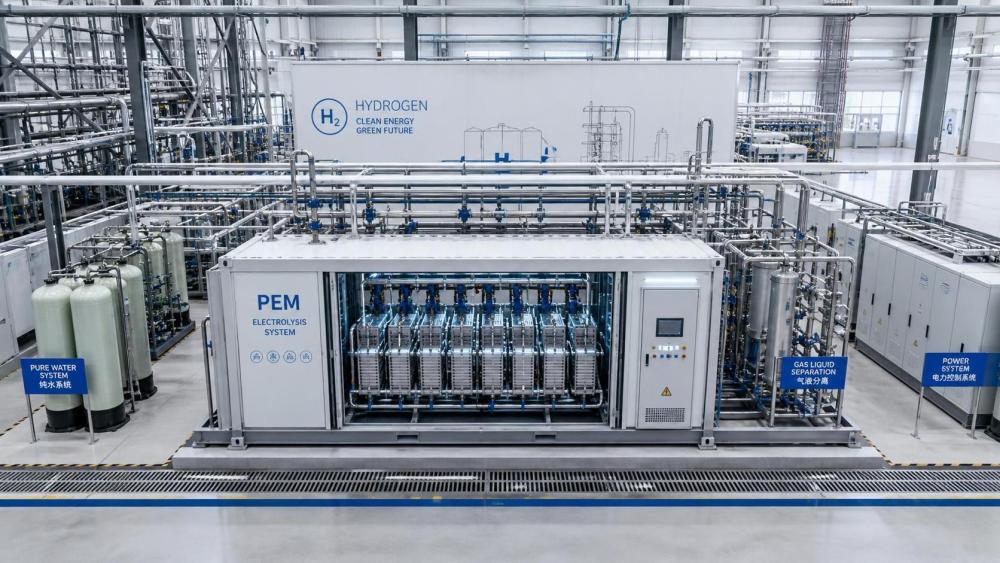
The stack attracts most of the attention, yet many operational problems occur outside it. The power supply, cooling circuit, deionized-water system, gas-liquid separation, hydrogen drying, oxygen handling, ventilation, instrumentation, and control architecture must function as one integrated process. A small supplier may have strong stack expertise but limited experience engineering the full balance of plant for a specific grid connection, climate, water source, hazardous-area classification, or downstream pressure requirement.
Interface risk becomes more serious when the electrolyzer is connected to compressors, storage, pipeline injection systems, refueling assets, ammonia production, e-fuel synthesis, or hydrogen-ready gas turbines. An electrolyzer vendor may define a hydrogen outlet condition that appears acceptable on a datasheet but does not match the impurity, pressure stability, flow-control, or availability needs of downstream equipment. Fixing the mismatch after installation can require additional purification, compression buffering, control modifications, or piping changes.
This is why a procurement review should include system boundaries. Who supplies and guarantees water treatment? Who is responsible for electrical harmonics, emergency shutdown logic, ventilation design, gas detection, pressure relief routing, cybersecurity of the control system, and integration with the plant’s distributed control system? If responsibilities are split among several vendors, the contractual interfaces must be explicit rather than left to commissioning teams to resolve on site.
Certification Support and Safety Documentation May Be Incomplete
Hydrogen projects are increasingly evaluated through the lens of asset security, public safety, and permitting readiness. A system that performs in a supplier’s workshop may still face delays when local authorities, insurers, lenders, or engineering contractors request complete technical files. Smaller companies often underestimate the workload associated with drawings, material records, hazardous-area documentation, risk assessments, operating manuals, maintenance procedures, and evidence supporting design assumptions.
Applicable requirements vary by jurisdiction and project configuration. Standards such as ISO 19880, ASME B31.12, and SAE J2601 may become relevant at different points in the wider hydrogen chain, particularly where high-pressure handling, refueling, piping, or storage is involved. They should not be treated as a generic certification checklist for every electrolyzer package. The correct approach is to map the project scope, local rules, contractual standards, and authority requirements before finalizing the equipment design.
A capable supplier should be able to explain what documentation it owns, what third-party approvals are available, what remains the responsibility of the EPC contractor, and what must be confirmed for the installation country. If answers remain broad until late in detailed engineering, the project may discover that a low initial quote excluded work that is essential for permit approval or insurer acceptance.
Financial Fragility Can Become an Operational Problem
Electrolyzer procurement usually involves long lead times, staged payments, performance obligations, and warranty exposure. A supplier with limited working capital may depend heavily on customer deposits to purchase materials and maintain production. That structure can create vulnerability if a project is delayed, a component price changes, a financing round fails, or another customer cancels an order.
For the project owner, the concern is not merely supplier insolvency. It is the continuity of intellectual property access, source code, spare parts, drawings, warranty obligations, and technical support. If the manufacturer cannot continue operating, a functioning plant may become difficult to maintain even if the physical equipment remains installed. This is especially significant for proprietary stacks and control systems that cannot easily be supported by an independent service provider.
Due diligence should therefore examine audited financial information where available, ownership structure, insurance, order backlog, payment terms, warranty security, and contingency arrangements. Depending on project scale and local practice, buyers may also consider milestone-linked payments, performance security, parent guarantees, escrow provisions for critical software, or contractual access to technical documentation. These measures do not eliminate technology risk, but they reduce the chance that a corporate event turns into a stranded asset.
Service Capacity Is Often the Decisive Test
The most underestimated risk of choosing a small PEM electrolyzer supplier is inadequate support after commissioning. Hydrogen production assets need planned maintenance, remote diagnostics, calibration, water-quality management, software updates, failure analysis, and access to trained technicians. A supplier may provide responsive support during the first installation, then struggle as its installed base expands across several regions.
A service proposal should be tested in operational terms. Where are field engineers located? Which faults can be diagnosed remotely? What spares are held regionally, and which must be manufactured to order? Who can enter the site, work on energized equipment, or conduct hydrogen-system interventions under local safety rules? Is there a documented escalation process for a recurring stack or controls issue? A generic commitment to “24/7 support” has little value without staffing, tools, spare-parts logistics, and defined response responsibilities behind it.
Availability guarantees also need careful reading. They may exclude grid events, water-quality deviations, downstream outages, operator actions, scheduled maintenance, or conditions outside a narrow design envelope. Such exclusions can be reasonable, but the owner needs to know whether the remaining guarantee reflects the way the facility will actually operate.
A Better Way to Evaluate an Emerging Supplier
An emerging supplier should not automatically be removed from consideration. In some cases, its technology, engineering flexibility, or commercial structure may fit a project well. The decision should be based on evidence rather than reputation, optimism, or a single efficiency figure. A practical review normally examines four connected areas: proven equipment performance, repeatable manufacturing, compliance readiness, and lifecycle support.
Request operating evidence that resembles the intended duty cycle, not only a best-case test point. Visit the manufacturing operation if the project is material enough to justify it. Review serial-number traceability and quality procedures for critical components. Ask for a clear list of project references that the supplier is permitted to disclose, while recognizing that confidentiality may limit detail. Most importantly, identify the contractual boundary between the electrolyzer package and the surrounding hydrogen infrastructure before issuing a final purchase order.
This systems view is central to the work of the Global Hydrogen-Economy & Zero-Carbon Infrastructure (G-HEI). The hydrogen transition is no longer only about producing molecules at the lowest apparent cost. It requires reliable links between megawatt-scale PEM and alkaline electrolysis, cryogenic logistics, hydrogen-ready power generation, CCUS infrastructure, and high-pressure refueling. Benchmarking equipment against material-integrity, process-safety, and interoperability requirements helps decision-makers see risks that a stand-alone equipment comparison can miss.
Before selecting any PEM partner, particularly a smaller one, require a project-specific answer to a simple question: if the plant must operate safely, compliantly, and predictably for its planned life, who has the technical capacity and contractual responsibility to keep it operating? The quality of that answer is usually more revealing than the lowest bid.
Related News
- Electricity Price Volatility Is Rewriting Hydrogen Cost ModelsApr 27, 2026Impact of electricity price on hydrogen cost is transforming industrial decarbonization and large-scale electrolysis. Explore LCOH trends, PPA strategies, and resilient hydrogen infrastructure planning.
- Energy Transition Plans Often Fail at the Grid Connection StageApr 27, 2026Sustainable energy and energy transition projects often fail at grid connection. Learn how hydrogen infrastructure, PEM electrolysis, and industrial decarbonization can avoid delays and protect investment value.
- What Is Slowing Industrial Decarbonization Projects in 2026?Apr 27, 2026Industrial decarbonization faces delays in 2026 as hydrogen infrastructure, sustainable energy access, grid limits, safety standards, and project bankability challenge the energy transition.
- Are G-HEI’s PEM Electrolyzer Benchmarks Reliable?Oct 13, 2026Assess G-HEI PEM electrolyzer benchmarking reliability through test boundaries, hydrogen measurement, and durability evidence. Discover what makes a benchmark worth trusting.
Related News
- 00
0000-00
Hydrogen Energy Storage for Data Centers Gets Costly Fast - 00
0000-00
When 99.999% Hydrogen Purity Still Is Not Good Enough - 00
0000-00
When Does a Hydrogen-Ready Gas Turbine Pay Off? - 00
0000-00
Electricity Price Volatility Is Rewriting Hydrogen Cost Models - 00
0000-00
PSA Recovery Rate Drops for Reasons Operators Miss
Dr. Aris Aero
Weekly Insights
Stay ahead with our curated technology reports delivered every Monday.