What drives electrolysis scaling cost in megawatt PEM projects?




A megawatt PEM electrolyzer project can look straightforward in an approval memo: more capacity should mean a lower unit cost. In practice, that assumption often breaks down once a project moves beyond a single packaged unit and into a site-specific industrial asset.
For financial approvers, electrolysis scaling cost is not simply the price per megawatt on a supplier quotation. It is the combined effect of stack architecture, critical-material exposure, power integration, water quality, civil works, commissioning, replacement planning, and the allocation of performance risk over the plant’s operating life. A lower initial equipment price can still produce a less investable project if uptime, degradation, utility interfaces, or service obligations have been treated as secondary details.
The practical question is therefore not “What does a larger PEM electrolyzer cost?” It is: Which costs genuinely fall with scale, which costs shift elsewhere in the system, and which risks remain stubbornly site-specific?
Electrolysis Scaling Cost: What Actually Changes at Megawatt Scale?
Scaling a PEM plant from pilot capacity to multi-megawatt operation introduces some real economies. Engineering effort can be spread across more production capacity. A larger order may improve procurement leverage. Centralized controls, shared water treatment, common compression facilities, and consolidated maintenance access can lower the cost per unit of hydrogen capacity.
But scale does not eliminate the physical constraints of hydrogen production. It can expose them more sharply. Electrical connections become more consequential; cooling loads require more deliberate design; hydrogen handling enters a more demanding safety category; and the site must accommodate larger flows of demineralized water, oxygen, heat, and high-pressure gas. The stack may be modular, but the project is rarely modular in the same simple way.
Financial teams should separate the budget into three layers:
- Core electrolyzer equipment: stacks, power conversion equipment, control systems, skids, and essential auxiliaries.
- Balance of plant: water treatment, cooling, gas purification, drying, compression, storage interfaces, piping, safety systems, and electrical infrastructure.
- Site and lifecycle costs: civil works, installation, permitting support, commissioning, spares, stack replacement, service labor, insurance requirements, and contingency.
Vendor comparisons often concentrate on the first layer because it is easier to quote. Yet the second and third layers can decide whether the economic case survives investment review.
The Stack Is Expensive—But It Is Not the Whole Cost Story
PEM electrolysis is valued for its compact footprint, responsive operation, and potential compatibility with variable renewable electricity. Those qualities come with a material profile that deserves close financial attention. PEM stacks typically depend on components and coatings designed to operate in a demanding electrochemical environment, including titanium-based porous transport layers or related corrosion-resistant structures, catalyst materials, membrane assemblies, bipolar plates, seals, and precision manufacturing processes.
Critical-material exposure matters because it affects more than the opening purchase order. It can influence lead times, supplier concentration, replacement pricing, warranty terms, and the availability of qualified spare stacks years after the original installation. A procurement decision based only on today’s stack price may leave the asset owner exposed to an unfavorable replacement market later.
Approvers should request clarity on what is included in the stack scope, how degradation is defined, what operating conditions the supplier assumes, and which components are expected to be replaced during the project life. A guaranteed efficiency point is useful, but it is incomplete without understanding the operating envelope behind it: load profile, inlet-water specification, ambient conditions, ramping frequency, pressure configuration, and maintenance regime.
One common mistake is to interpret a stated stack lifetime as a calendar certainty. In reality, stack condition is influenced by operating hours, transient behavior, water purity, shutdown practices, temperature management, and the quality of the electrical supply. A financial model should therefore include sensitivity cases rather than treating replacement timing as a single fixed event.
Why Balance-of-Plant Costs Can Rise Faster Than Expected
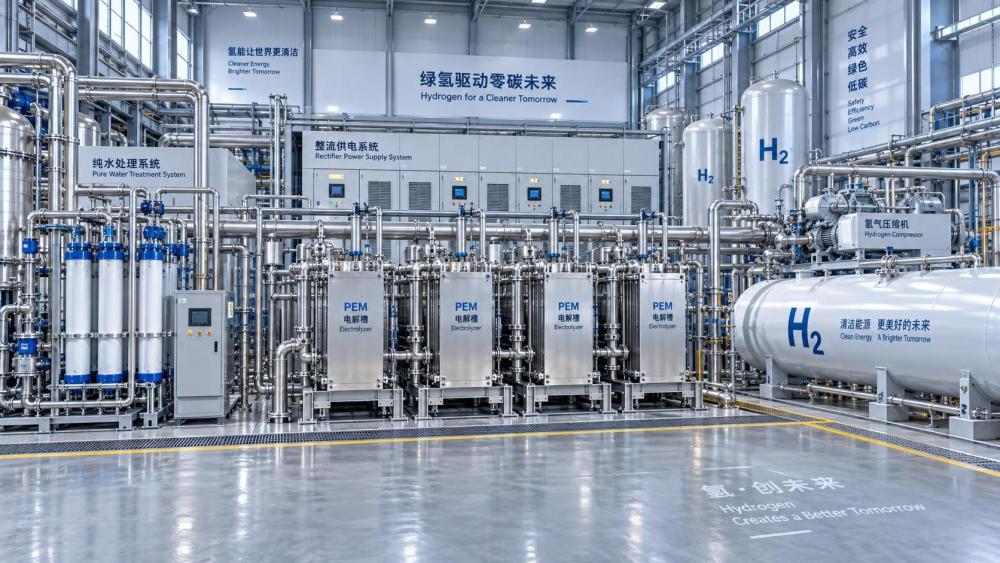
At small scale, many systems arrive as compact packages with much of the complexity hidden inside a vendor boundary. At megawatt scale, the boundaries become visible. The project must receive electricity at the required voltage and quality, convert it efficiently for the electrolyzer, manage heat, condition water, safely handle hydrogen and oxygen, and connect production to a real offtake pathway.
That is where balance-of-plant cost can become a major source of variation. Two projects with the same nominal PEM capacity can require very different capital commitments because their site conditions are different.
Consider a few examples. A plant located next to a reliable source of high-quality process water may have a relatively modest water-treatment requirement. Another may need extensive pretreatment, polishing, wastewater management, or additional resilience for seasonal water variability. A facility producing hydrogen for immediate low-pressure use has a different cost profile from one feeding high-pressure storage, tube trailers, a refueling system, or a pipeline blend point. Likewise, an installation with available substation capacity differs materially from one requiring a new grid connection, transformer upgrades, harmonics studies, or renewable generation integration.
In board-level terms, the issue is not whether these systems are “extras.” They are part of the production asset. Omitting them from an early comparison may create an attractive headline CAPEX number, only to restore the cost later through change orders and schedule delay.
Electricity Cost Is an Operating Expense, but Power Quality Is a Capital Decision
Electricity is normally the dominant operating cost in green hydrogen production. That fact is well understood. Less consistently appreciated is that the quality and availability of power affect both operating economics and the initial capital design.
PEM systems can respond quickly to changing power input, making them suitable for renewable-linked operation. However, a project designed around intermittent generation must still address the financial consequences of lower utilization, frequent ramping, curtailment, grid charges, and potentially more complex controls. High responsiveness does not automatically mean low hydrogen cost.
For the approval team, the central metric should be a transparent levelized cost of hydrogen model built around realistic annual operating hours—not only electrolyzer efficiency at rated load. Ask whether the model reflects the expected dispatch profile, loss factors in transformers and rectifiers, auxiliary consumption, compression duty, water-treatment energy, and downtime for scheduled or unplanned maintenance.
Where a project relies on a dedicated renewable portfolio, examine the boundary between generation and electrolysis. Is the plant sized for peak renewable output, average output, contracted grid import, or an optimized hybrid strategy? Oversizing the electrolyzer can improve renewable capture in some circumstances, but it may also create an underutilized capital asset. Undersizing it may leave valuable low-carbon electricity curtailed. This is an optimization problem, not a procurement line-item decision.
Installation Complexity Is Where Budgets Quietly Lose Discipline
Projects tend to become expensive at interfaces. A supplier may provide a technically sound electrolyzer package, while the owner, EPC contractor, electrical contractor, civil designer, gas specialist, and local authority each control adjacent pieces of the final system. Unless responsibilities are explicit, gaps and duplicated allowances emerge at the worst possible time.
Installation cost is shaped by access constraints, foundation requirements, hazardous-area classification, ventilation, drainage, cable routing, crane access, local labor conditions, weather protection, control-room integration, and the physical distance between the electrolyzer and its electricity or hydrogen destination. Even the arrangement of oxygen discharge and hydrogen venting can influence plot plan, permitting, and construction scope.
Financial approvers should be cautious when comparing a supplier’s “ex works” or limited-skid quotation with another offer that includes broader integration. Normalize the bids before concluding that one system is less expensive. A useful comparison identifies who bears the cost and risk for each interface: incoming power, treated water, cooling medium, gas quality, compression, storage, export connection, safety instrumentation, commissioning, and acceptance testing.
Lifecycle Economics Depend on Serviceability, Not Just Warranty Length
A warranty can provide comfort, but it is not a substitute for a lifecycle plan. The meaningful question is whether the project has a credible path to preserve output and availability over time. That includes stack replacement logistics, long-lead spare components, remote diagnostics, local service capability, planned outages, process-water monitoring, and contractual remedies when performance falls outside agreed parameters.
Some cost items are predictable: consumables, inspections, calibration, and planned maintenance. Others are more difficult: replacement stack price escalation, availability of qualified components, downtime during repairs, and changing safety obligations as the surrounding hydrogen network grows. These should be modeled as risk ranges, not ignored because they are uncertain.
For a large industrial buyer, availability can be more valuable than a modest reduction in initial CAPEX. If hydrogen supports a refinery, chemical process, steel operation, dispatchable power asset, or mobility network, an outage may create downstream losses that dwarf a small equipment saving. The appropriate procurement decision therefore weighs total cost of ownership against the operational value of reliable supply.
A Due-Diligence View for Finance and Procurement Teams
Before approving a megawatt PEM project, bring technical, commercial, and operational evidence into one decision pack. The following questions reveal whether quoted electrolysis scaling cost is robust or merely incomplete:
- What capacity basis is being quoted: DC stack input, AC plant input, or usable hydrogen output at a specified pressure and purity?
- Which balance-of-plant systems are included, excluded, or provisionally priced?
- What water quality, power quality, ambient conditions, and operating profile are assumed in the performance case?
- How are efficiency, degradation, availability, and hydrogen purity measured and verified during acceptance?
- What is the anticipated replacement strategy for stacks and critical components, including supply-chain exposure?
- Who owns integration risk at the electrical, water, cooling, gas export, and control-system interfaces?
- Does the plant design align with the applicable safety and integrity framework, including relevant hydrogen handling, piping, and refueling requirements where applicable?
- What contingencies remain outside the supplier quote, and who has authority to release them?
These are not administrative questions. They determine whether a cost estimate can be financed, insured, constructed, and operated without repeated rework.
Use Benchmarking to Avoid False Economies
For national-scale programs, utilities, and industrial portfolios, the most useful comparison is rarely a generic cost-per-megawatt benchmark. It is a normalized benchmark that accounts for system boundary, duty cycle, delivery pressure, site conditions, compliance requirements, and lifecycle obligations.
Technical repositories and multidisciplinary benchmarking resources such as G-HEI can support this process by placing electrolyzer decisions in the broader zero-carbon infrastructure context. PEM equipment must ultimately coexist with high-pressure hydrogen systems, cryogenic logistics where relevant, pipelines, turbines, storage assets, and rigorous material-integrity expectations. A narrowly optimized electrolyzer purchase can become a costly bottleneck if it does not fit the infrastructure around it.
For finance leaders, the disciplined position is simple: scale can reduce unit cost, but it does not remove complexity. The strongest investment cases make every major assumption visible—from titanium and stack replacement exposure to grid connection scope and water-treatment duty. When those assumptions are tested early, electrolysis scaling cost becomes a controllable decision variable rather than an unpleasant surprise after approval.
Related News
- Electricity Price Volatility Is Rewriting Hydrogen Cost ModelsApr 27, 2026Impact of electricity price on hydrogen cost is transforming industrial decarbonization and large-scale electrolysis. Explore LCOH trends, PPA strategies, and resilient hydrogen infrastructure planning.
- Energy Transition Plans Often Fail at the Grid Connection StageApr 27, 2026Sustainable energy and energy transition projects often fail at grid connection. Learn how hydrogen infrastructure, PEM electrolysis, and industrial decarbonization can avoid delays and protect investment value.
- What Is Slowing Industrial Decarbonization Projects in 2026?Apr 27, 2026Industrial decarbonization faces delays in 2026 as hydrogen infrastructure, sustainable energy access, grid limits, safety standards, and project bankability challenge the energy transition.
- Are G-HEI’s PEM Electrolyzer Benchmarks Reliable?Oct 13, 2026Assess G-HEI PEM electrolyzer benchmarking reliability through test boundaries, hydrogen measurement, and durability evidence. Discover what makes a benchmark worth trusting.
Related News
- 00
0000-00
Hydrogen Energy Storage for Data Centers Gets Costly Fast - 00
0000-00
When 99.999% Hydrogen Purity Still Is Not Good Enough - 00
0000-00
When Does a Hydrogen-Ready Gas Turbine Pay Off? - 00
0000-00
Electricity Price Volatility Is Rewriting Hydrogen Cost Models - 00
0000-00
PSA Recovery Rate Drops for Reasons Operators Miss
Dr. Aris Aero
Weekly Insights
Stay ahead with our curated technology reports delivered every Monday.