
What makes an electrolysis system suitable for offshore facilities?




What Makes an Electrolysis System Suitable for Offshore Facilities?
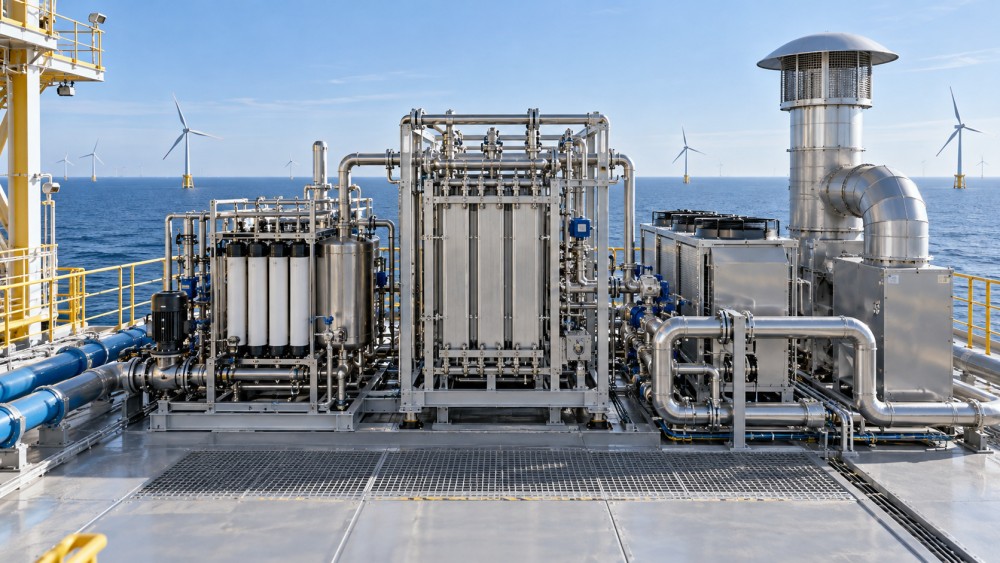
An electrolysis system for offshore facilities is not simply an onshore hydrogen plant placed on a platform or floating vessel. The stack may be the most visible component, but it is rarely the item that determines whether an offshore project succeeds. In practice, suitability is decided by the interaction between footprint, structural loading, electrical variability, water treatment, hazardous-area design, corrosion resistance, access for maintenance, and the consequences of an unplanned shutdown.
For a technical evaluator, the central question is not “Which electrolyzer produces the most hydrogen?” It is: “Which complete system can operate predictably within this offshore asset’s physical, electrical, safety, and logistics constraints?” A unit with a strong nameplate rating can still be a poor fit if it requires frequent specialist intervention, has weak tolerance for power fluctuations, or creates ventilation and gas-handling problems in a congested topside layout.
That distinction matters as offshore hydrogen concepts move beyond demonstration-scale thinking. Production may be linked to offshore wind, electrified oil and gas infrastructure, floating energy hubs, ammonia conversion, or hydrogen supply for marine and industrial networks. Each use case changes the engineering priorities. An electrolyzer feeding local power balancing has a different operating profile from one supplying compressed hydrogen, liquid-hydrogen logistics, or a downstream synthesis process.
Start with the operating envelope, not the electrolyzer brochure
The first screening step should define the real operating envelope. Offshore facilities experience limitations that are easy to understate during early concept design: restricted deck space, lifting limits, motion for floating assets, salt-laden air, limited freshwater availability, vessel or platform electrical constraints, and weather-dependent access. These conditions affect every auxiliary package around the electrolyzer, including water purification, cooling, power conversion, gas drying, compression, control cabinets, ventilation, and fire-and-gas equipment.
A useful evaluation basis separates steady-state requirements from upset conditions. Technical teams should ask what happens during rapid power reduction, loss of cooling, shutdown of seawater intake, loss of instrument air, temporary isolation of hydrogen export, or failure of a single ventilation train. The system does not need to continue producing hydrogen in every event. It does need a defined and safe response, with credible restart procedures and no hidden dependence on personnel or equipment that cannot be mobilized quickly offshore.
This is also where production targets need to become more realistic. Hydrogen output should be assessed at the expected load profile, not only at nominal load. If the power source is variable renewable generation, load-following capability, minimum stable load, ramp behaviour, and the impact of repeated cycling become part of the selection decision. A design optimized for continuous baseload operation may require a different operating philosophy from one intended to follow wind-driven power availability.
PEM or alkaline: the offshore decision is broader than efficiency
Both proton exchange membrane (PEM) and alkaline electrolysis can be considered for offshore service, but neither technology is automatically “the offshore choice.” PEM systems are often examined where compactness, rapid response, and operation alongside variable electrical input are high priorities. Their materials strategy, including the use of titanium in certain stack components, needs careful review in relation to supply chain, service procedures, and lifecycle replacement planning.
Alkaline systems have a long industrial history and can be attractive where operating conditions are relatively stable and the project can accommodate the balance-of-plant requirements. Yet the evaluator must look beyond the stack. Electrolyte handling, containment, maintenance access, and separation arrangements may influence offshore layout decisions. A technology comparison that stops at electrical consumption per kilogram of hydrogen misses the real integration burden.
The more practical question is whether the proposed configuration matches the facility’s power regime and maintenance model. If the asset has a stable electrical supply, ample utility capacity, and planned maintenance campaigns, one solution may be entirely reasonable. If it must absorb rapid renewable swings with a very lean offshore crew, another configuration may offer a more manageable risk profile. The vendor should be required to demonstrate this through operating limits, control narratives, and maintenance documentation—not just a performance curve.
Marine materials and seawater boundaries deserve early attention
Offshore corrosion is not a cosmetic issue. It can compromise enclosures, cable entries, pipe supports, fasteners, heat exchangers, ventilation systems, and instrument connections long before the electrolyzer stack itself becomes the concern. Material selection should account for chloride exposure, humidity, salt deposition, galvanic couples, washdown practices, and the accessibility of inspection points. “Marine grade” is too vague to be an acceptance criterion unless it is tied to a defined material specification, coating system, enclosure rating, and inspection approach.
Seawater is another source of confusion. A conventional electrolyzer generally requires purified water of the quality specified by its manufacturer; it is not enough to pump seawater directly into a standard PEM or alkaline unit. If seawater is proposed as the feedwater source, the project must include a robust pretreatment and purification train and identify its rejection streams, chemical consumption, redundancy philosophy, and cleaning requirements. Direct seawater electrolysis remains a separate technical proposition and should not be assumed simply because the installation is offshore.
Cooling can create similar complications. Seawater cooling may appear straightforward, but biofouling, corrosion, intake reliability, discharge conditions, and heat-exchanger maintainability all deserve examination. In many concepts, the water and thermal-management package occupies more engineering attention than expected. It should be assessed as an integral part of the hydrogen plant rather than an ancillary utility.
Hazardous-area design begins with layout and ventilation
Hydrogen has a wide flammability range, low ignition energy, and high diffusivity. Offshore facilities add confined modules, enclosed machinery spaces, congested pipe runs, and potentially limited escape routes. For that reason, hazardous-area compliance cannot be solved late in the project by selecting certified instruments. The gas release philosophy, zoning study, ventilation concept, detection coverage, electrical segregation, emergency shutdown logic, and vent routing must work together from the beginning.
A credible design considers where hydrogen could be released during normal operation, sampling, drain-down, purging, maintenance, and equipment failure. It then considers where that gas can accumulate. Hydrogen naturally rises, but roof geometry, cable trays, structural members, dead zones, and inadequate airflow can defeat simplistic assumptions. The safest arrangement is often one that keeps hydrogen-containing equipment physically separated where possible, provides direct and well-considered vent paths, and avoids forcing operators to conduct routine work inside a potential release zone.
Applicable requirements will depend on asset type, jurisdiction, classification arrangements, and host-facility rules. IEC 60079-series requirements are commonly relevant to explosive atmospheres, while offshore electrical and marine requirements may bring additional obligations. If the hydrogen will later be compressed, piped, stored, or dispensed, interface standards also become important. ASME B31.12 is relevant to hydrogen piping and pipelines in applicable project contexts; ISO 19880 and SAE J2601 may matter at refuelling interfaces, but neither should be treated as a universal design code for the entire offshore electrolyzer package.
Weight, modularity, and maintainability are often the project killers
Offshore space is costly, but weight and centre-of-gravity effects can be even more restrictive. A complete electrolysis plant may involve transformers, rectifiers, water treatment, cooling skids, gas purification, nitrogen systems, analyzers, and hydrogen handling equipment. Evaluating only the electrolyzer skid footprint gives a misleading picture. The assessment should use the installed envelope, including access corridors, lifting zones, temporary maintenance space, escape routes, drainage, cable routing, and required separation distances.
Modularization can reduce offshore construction work, but it creates its own questions. Can each module be lifted within the available crane capacity? Are transportation accelerations and offshore motions considered in equipment design? Are inter-module connections accessible after installation? Does a module contain enough isolation capability to permit work on one train without shutting down the entire plant? These are detailed matters, yet they regularly distinguish a constructible concept from an elegant drawing.
Maintainability should be tested with actual tasks. Ask how a stack is replaced, how filters and deionization media are changed, where a failed converter module is removed, and how gas analyzers are calibrated. If the answer relies on removing permanent structure, chartering specialized lifting equipment, or waiting for weather windows, the lifecycle consequences need to be visible in the decision model. Remote monitoring helps, but it does not eliminate physical maintenance.
Assess the hydrogen boundary, not just production
An offshore electrolyzer is only one link in the hydrogen chain. The outlet pressure, purity requirements, moisture limits, compression duty, buffering capacity, export piping, storage concept, and receiving system should be defined before equipment is selected. A mismatch at this boundary can produce expensive late-stage changes. For example, a system intended for pipeline export has different integration needs from one feeding a fuel-cell power package, high-pressure storage, a hydrogen-ready gas turbine, or a conversion process for ammonia or other carriers.
This systems view is particularly important when projects are benchmarked across wider zero-carbon infrastructure. The G-HEI approach places megawatt-scale PEM and alkaline electrolysis alongside cryogenic liquid hydrogen logistics, hydrogen-ready turbine power, CCUS infrastructure, and high-pressure refuelling systems. That wider frame is useful because it exposes interface risk early: materials that are acceptable at one pressure or temperature may not be suitable downstream; a purity specification may be more demanding than the electrolyzer outlet alone can guarantee; a compressed-gas solution may alter the platform’s power and heat balance.
A practical technical evaluation should force trade-offs into the open
Rather than scoring vendors only against headline efficiency and capital cost, technical teams should request a structured evidence package. It should include guaranteed operating ranges, utility consumption, heat rejection, water-quality requirements, power-quality tolerances, degradation assumptions, shutdown and restart logic, maintenance intervals, critical spare parts, control-system interfaces, hazardous-area documentation, material specifications, and the complete battery limits of supply.
The most useful review meetings tend to focus on awkward questions: What is the single-point failure that stops production? Which consumables must be stocked offshore? What happens when output cannot be exported? What is the response to hydrogen purity deviation? Which components require vendor personnel? How much deck area is temporarily needed for major maintenance? A supplier that answers these points clearly is usually easier to integrate than one offering only optimistic production figures.
A suitable electrolysis system for offshore facilities is therefore a balanced configuration, not a stack selection. It should fit the available power, tolerate the expected operating profile, protect against seawater and corrosion risks, meet the project’s hazardous-area philosophy, and remain serviceable when access is difficult. Before moving to procurement, freeze the interfaces, test the layout against real maintenance activities, and verify the applicable standards with the project’s marine, process-safety, and classification stakeholders. That discipline is usually more valuable than chasing a marginal improvement in nameplate efficiency.
Related News
- Electricity Price Volatility Is Rewriting Hydrogen Cost ModelsApr 27, 2026Impact of electricity price on hydrogen cost is transforming industrial decarbonization and large-scale electrolysis. Explore LCOH trends, PPA strategies, and resilient hydrogen infrastructure planning.
- Energy Transition Plans Often Fail at the Grid Connection StageApr 27, 2026Sustainable energy and energy transition projects often fail at grid connection. Learn how hydrogen infrastructure, PEM electrolysis, and industrial decarbonization can avoid delays and protect investment value.
- What Is Slowing Industrial Decarbonization Projects in 2026?Apr 27, 2026Industrial decarbonization faces delays in 2026 as hydrogen infrastructure, sustainable energy access, grid limits, safety standards, and project bankability challenge the energy transition.
- How PEM electrolyzers support the energy transition in EuropeNov 10, 2026Discover how PEM electrolyzers support the energy transition in Europe, from renewable hydrogen and industrial applications to project costs and infrastructure.
Related News
- 00
0000-00
Hydrogen Energy Storage for Data Centers Gets Costly Fast - 00
0000-00
When 99.999% Hydrogen Purity Still Is Not Good Enough - 00
0000-00
When Does a Hydrogen-Ready Gas Turbine Pay Off? - 00
0000-00
Electricity Price Volatility Is Rewriting Hydrogen Cost Models - 00
0000-00
PSA Recovery Rate Drops for Reasons Operators Miss
Dr. Aris Aero
Weekly Insights
Stay ahead with our curated technology reports delivered every Monday.