
When do industrial parks need megawatt-scale hydrogen production?




Industrial parks need megawatt-scale hydrogen production when hydrogen stops being an occasional fuel, test feedstock, or demonstration commodity and becomes a continuously managed utility. The decisive point is not a headline electrolyzer rating. It is whether the park has a sufficiently large, predictable, and usable hydrogen load to justify integrating electricity supply, water treatment, compression, storage, distribution, safety systems, and operating personnel into one coordinated asset.
A small pilot can tolerate intermittent deliveries, manual cylinder handling, or a single end use that operates only during selected shifts. A megawatt-class plant cannot be assessed that way. Once the project must support process operations, fleets, backup generation, or multiple tenants with defined availability commitments, the question changes from “Can hydrogen be produced on site?” to “Can the park reliably produce, condition, store, and deliver hydrogen at the required pressure, purity, and time profile?”
For industrial projects, moving to megawatt scale is justified by a combination of demand concentration, supply-risk exposure, decarbonization requirements, and the practical limits of delivered hydrogen logistics. It is not automatically justified by a net-zero target or by the availability of low-carbon power.
Start with the hydrogen load, not the electrolyzer
The most common sizing error is to begin with an electrolyzer nameplate capacity and then search for uses large enough to absorb its output. A more defensible project starts with a hydrogen balance built from actual consuming equipment: thermal processes, reduction reactions, furnaces, chemical feedstock requirements, fuel-cell vehicles, turbines, and any blending or storage application.
The balance needs to distinguish between average daily demand and the demand that the plant must meet during its hardest operating hours. A park may consume a substantial annual hydrogen volume but still be unsuitable for dedicated megawatt production if consumption is concentrated in short, irregular campaigns. Conversely, a moderately sized but steady 24-hour process can support a larger electrolyzer because high utilization improves the value of the installed asset.
As an indicative engineering reference, a 1 MW electrolyzer operating near full load may produce roughly 18–20 kg of hydrogen per hour when system electricity consumption is in the range of about 50–55 kWh per kg. Actual output depends on technology, pressure, degradation allowance, auxiliary loads, operating point, and whether the quoted energy figure covers only the stack or the complete production system. The figure is useful for an early mass balance, but it is not a substitute for vendor guarantees at the specified site conditions.
A project moves toward megawatt scale when its base-load requirement can absorb a meaningful share of this output without forcing frequent curtailment, excessive low-value venting, or an oversized storage system. The economic significance is straightforward: unused production capacity does not become valuable merely because the electrolyzer can respond to a renewable power profile.
Demand should be broken down into at least four separate streams:
- Firm process demand: hydrogen that must be available to avoid interrupting production or compromising product quality.
- Flexible demand: consumption that can be shifted to periods of low electricity cost or high renewable output.
- Mobility demand: vehicle refueling, where hourly peaks can be much higher than the average daily requirement.
- Contingency demand: backup power, emergency fuel, or future tenant demand that should not be treated as guaranteed base load until contractually secured.
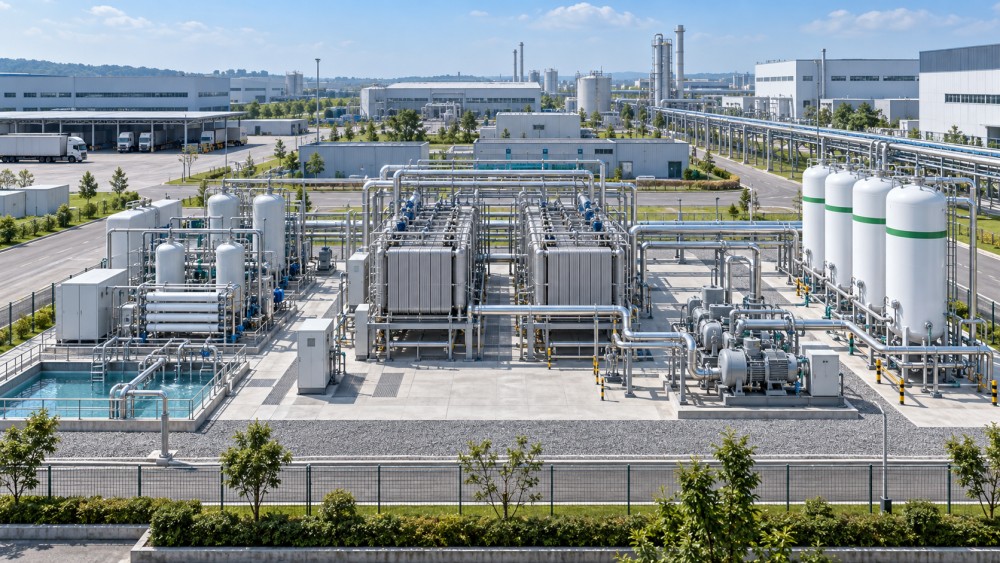
This separation matters because each stream drives a different design response. A continuous process may justify direct pipeline supply at moderate pressure. A truck fleet may require high-pressure compression and a cascade storage arrangement. A backup-power use may consume little hydrogen in normal operation but require a large inventory that materially changes the site layout and safety case.
The operational signals that make on-site megawatt production credible
Industrial parks do not need to wait for every tenant to convert before evaluating a shared hydrogen hub. They do, however, need evidence that the central asset will serve a defined operating purpose rather than a collection of unconnected aspirations.
Hydrogen for industrial projects in industrial parks is most compelling when production and consumption are geographically close. Distance inside a park is not trivial: pipe routing, road crossings, isolation sections, pressure control, hazardous-area classification, emergency access, and tenant interfaces can make an internal network a major portion of project complexity. A “central plant” should therefore be evaluated against the actual physical topology of demand, not only against aggregate annual consumption.
Process heat can create demand, but not every heat load is a hydrogen load
High-temperature heat is often cited as a reason to build on-site hydrogen capacity. That reasoning is valid only after the thermal process has been examined in detail. Hydrogen combustion can be relevant where direct electrification is technically constrained, where a flame-based process needs a gaseous fuel, or where product requirements limit other heating methods. But replacing natural gas with hydrogen can change burner configuration, flame speed, combustion control, NOx management, furnace materials, and safety controls.
The project team should not count the full thermal energy demand as future hydrogen demand until equipment compatibility and operating conditions have been assessed. A furnace that can technically burn a hydrogen blend is not necessarily ready for 100% hydrogen. Similarly, a boiler conversion may appear simple on a fuel-energy basis but require modifications to burners, controls, ventilation, detection, and permitting.
For a park with several heat users, the practical question is whether hydrogen demand will be continuous enough to anchor the electrolyzer. If users have seasonal or batch-operated loads, the production system may need flexible electricity procurement and substantial storage, or it may be better to phase capacity with confirmed conversion milestones.
Heavy-duty mobility often determines the downstream design
A logistics fleet can provide visible early demand, but it should not be modeled as a smooth hydrogen load. Refueling tends to cluster around shift changes, depot returns, and dispatch windows. A fleet may consume a moderate total quantity per day while requiring a high short-duration delivery rate at the dispenser.
This is why an electrolyzer’s hourly output should not be directly equated with station capacity. Refueling applications need compression, high-pressure storage, pre-cooling where required by the fueling protocol, dispensing equipment, and controls designed for the intended vehicle class. SAE J2601 is relevant to light-duty gaseous hydrogen vehicle fueling protocols; its use should not be assumed to define every heavy-duty or industrial refueling configuration. The applicable local regulations and vehicle-specific interface requirements remain decisive.
Where mobility is one of several park uses, it is often sensible to separate the low- or medium-pressure process hydrogen network from the high-pressure mobility train. That prevents fleet peaks from destabilizing supply to production equipment and makes maintenance isolation more manageable. The result may be a common hydrogen source with different downstream service architectures.
Power supply is the real capacity decision
A megawatt electrolyzer is also a major electrical load. The feasibility review must establish not only the nominal megawatt rating but the available connection capacity, voltage level, transformer scope, power-quality requirements, curtailment exposure, and the tariff structure across operating hours. These factors can have more influence on delivered hydrogen cost and availability than a modest difference in stack efficiency.
Projects linked to dedicated renewable generation need particular discipline. A renewable asset and an electrolyzer may both be described in megawatts, but their ratings do not demonstrate annual energy alignment. Generation variability, grid export limits, planned maintenance, and seasonal patterns determine electrolyzer utilization. If the industrial demand is firm, the design must explicitly state whether the electrolyzer will use grid electricity, stored hydrogen, contracted backup supply, or reduced customer service during low-generation periods.
PEM and alkaline electrolyzers can both be relevant at megawatt scale, but selection should follow the operating profile rather than a technology label. PEM systems are often considered where compactness and responsiveness to variable electrical input are valuable. Alkaline systems may be well suited to steady, large-scale operation. The project comparison should examine guaranteed output range, start-stop expectations, water quality requirements, stack replacement assumptions, delivery schedule, footprint, and the complete balance of plant. A stack-level efficiency claim says little about the energy consumed by water purification, cooling, gas treatment, compression, and storage.
Water, hydrogen quality, and pressure are separate design questions
Electrolysis consumes approximately 9 kg of water for each kilogram of hydrogen as a chemical minimum. The total site-water requirement will be higher once purification losses, cooling arrangements, and other auxiliary needs are included. Water availability is therefore a permitting and resilience issue, not a minor utility detail. Feedwater chemistry, discharge routes for treatment systems, and contingency arrangements during water restrictions should be resolved before the production rating is fixed.
Hydrogen leaves an electrolyzer at a condition that may not match the end use. A chemical process may require a defined purity and pressure. A metal-processing application may have moisture or contamination limits. A pipeline network needs pressure regulation and materials suitable for hydrogen service. Vehicle fueling introduces a separate high-pressure specification. Treating “hydrogen” as one uniform product leads to avoidable rework after commissioning.
The process design basis should state, for every off-taker, the required flow rate, minimum and maximum pressure, purity limits, delivery temperature, measurement method, and permitted interruption duration. This document is more valuable for equipment selection than an early decision between electrolyzer brands.
Storage is what turns production into a dependable utility
Storage is not simply a buffer added at the end of the design. It defines how the park manages mismatch between electricity availability, electrolyzer output, and customer demand. A small buffer may smooth compressor cycling. A larger inventory may cover a production outage, renewable intermittency, or a fleet refueling peak. The larger the required autonomy, the more important the cost, footprint, permitting, separation distances, and emergency planning become.
Stored hydrogen also introduces an operational choice: whether the park can accept reduced supply during maintenance or must maintain contractual availability. A single electrolyzer train with no alternative supply may be acceptable for a flexible, non-critical load. It is rarely a sufficient basis for a process that faces material losses or shutdown costs from hydrogen interruption. Modular trains, connection points for tube trailers, reserved storage capacity, or an external pipeline tie-in can each provide resilience, but they have different commercial and safety consequences.
In jurisdictions where they apply, standards such as ISO 22734 for hydrogen generators using water electrolysis, ASME B31.12 for hydrogen piping and pipelines, and ISO 19880-1 for gaseous hydrogen fueling stations provide useful technical reference points. They do not replace local building, fire, pressure-equipment, electrical, environmental, and occupational-safety requirements. The permitting strategy must identify the controlling local authority and the applicable code hierarchy early enough to affect plot planning.
The site layout can invalidate an otherwise sound capacity model
Hydrogen installations require more than an empty plot. The layout must accommodate hazardous-area zoning, ventilation, gas detection, emergency shutdown, electrical segregation, vehicle access, fire-service access, safe vent routing, separation from occupied buildings, and maintainable access to compressors and storage vessels. Existing industrial parks can be constrained by tenant boundaries and buried services long before they are constrained by land area.
Pipework selection also deserves early scrutiny. Hydrogen’s small molecule, high diffusivity, and interaction with some materials mean that piping, valves, seals, weld procedures, leak testing, and inspection philosophy must be suited to the pressure, temperature, and service duty. Routing a hydrogen line through a congested park is not equivalent to adding another utility line. The interface between the central plant and each tenant needs defined ownership, isolation responsibility, metering, pressure control, and emergency communication.
A phased hub is often more rational than an oversized first build
Megawatt-scale production does not require building every future element on day one. A credible phased project may install common civil works, electrical infrastructure, water treatment capacity, safety systems, and distribution corridors sized for expansion, while deploying electrolyzer and compression trains in increments aligned with contracted demand.
Phasing is not merely a way to defer capital expenditure. It prevents a park from locking into a pressure architecture, storage philosophy, or technology configuration before end-use conversion decisions are mature. It also allows commissioning to focus on one defined service: for example, process hydrogen at a specified pressure, followed later by a dedicated mobility compression and dispensing train.
The phase boundary must remain technically real. A first-stage installation should not rely on future equipment to meet present-day safety, operability, or availability obligations. Nor should “expandable” electrical and civil provisions be accepted without verifying that switchgear ratings, transformer capacity, pipe racks, foundations, vent systems, and permits genuinely allow the intended expansion.
The threshold is an integrated operating case
An industrial park needs megawatt-scale hydrogen production when it can demonstrate a durable load profile, a workable electricity and water supply, an achievable site layout, and a distribution system that delivers hydrogen in the form each user actually needs. The megawatt rating is a consequence of that operating case, not the starting point.
Where demand remains speculative, intermittent, or dependent on unapproved equipment conversions, a pilot or contracted external supply can preserve flexibility. Where multiple users have firm demand, trucked supply creates material operational exposure, and the park can support safe utility-scale integration, a megawatt-class hub becomes a project infrastructure decision rather than an energy experiment.
Related News
- Electricity Price Volatility Is Rewriting Hydrogen Cost ModelsApr 27, 2026Impact of electricity price on hydrogen cost is transforming industrial decarbonization and large-scale electrolysis. Explore LCOH trends, PPA strategies, and resilient hydrogen infrastructure planning.
- Energy Transition Plans Often Fail at the Grid Connection StageApr 27, 2026Sustainable energy and energy transition projects often fail at grid connection. Learn how hydrogen infrastructure, PEM electrolysis, and industrial decarbonization can avoid delays and protect investment value.
- What Is Slowing Industrial Decarbonization Projects in 2026?Apr 27, 2026Industrial decarbonization faces delays in 2026 as hydrogen infrastructure, sustainable energy access, grid limits, safety standards, and project bankability challenge the energy transition.
- How PEM electrolyzers support the energy transition in EuropeNov 10, 2026Discover how PEM electrolyzers support the energy transition in Europe, from renewable hydrogen and industrial applications to project costs and infrastructure.
Related News
- 00
0000-00
Hydrogen Energy Storage for Data Centers Gets Costly Fast - 00
0000-00
When 99.999% Hydrogen Purity Still Is Not Good Enough - 00
0000-00
When Does a Hydrogen-Ready Gas Turbine Pay Off? - 00
0000-00
Electricity Price Volatility Is Rewriting Hydrogen Cost Models - 00
0000-00
PSA Recovery Rate Drops for Reasons Operators Miss
Dr. Aris Aero
Weekly Insights
Stay ahead with our curated technology reports delivered every Monday.