When does a sovereign hydrogen infrastructure platform lower project risk




A sovereign hydrogen infrastructure platform lowers project risk when it stops being a data shelf and becomes the common technical basis for engineering, contracting, permitting, commissioning, and long-horizon maintenance. In practice, that point is reached when the platform can expose incompatibilities before equipment is ordered, reveal operating limits before process design is frozen, and connect performance assumptions across production, storage, transport, and end use. If it cannot influence those decisions early enough, it may still organize information, but it is not materially reducing risk.
The most immediate risk reduction appears at specification stage. Hydrogen systems fail commercially long before they fail mechanically if scope documents treat compressors, piping, vessels, seals, control logic, and refueling interfaces as separate purchases rather than one interacting system. A sovereign hydrogen infrastructure platform becomes valuable when it allows comparison of material grades, pressure classes, temperature envelopes, impurity tolerance, inspection methods, and maintenance intervals on the same basis. That prevents a familiar problem: a technically sound component set that cannot operate together without derating, redesign, or extra purification.
Material selection is usually where hidden exposure begins. Hydrogen embrittlement, permeation, seal degradation, and low-temperature brittleness are not abstract concerns; they shape whether a line can be safely pressurized, how often fittings need inspection, and which shutdown scenarios are credible. The platform lowers risk when it can trace each component back to its actual service condition: dry gas or wet gas, ambient or cryogenic, static pressure or cyclic pressure, blended stream or pure hydrogen, indoor skid or marine terminal environment. A stainless steel grade that is acceptable in one section may be inappropriate in another because weld condition, hardness, and pressure cycling matter as much as nominal chemistry. Without a structured way to compare those conditions, teams often approve equipment on the basis of generic hydrogen compatibility claims that are too broad to support sovereign-scale assets.
Risk Falls When Interface Assumptions Are Visible
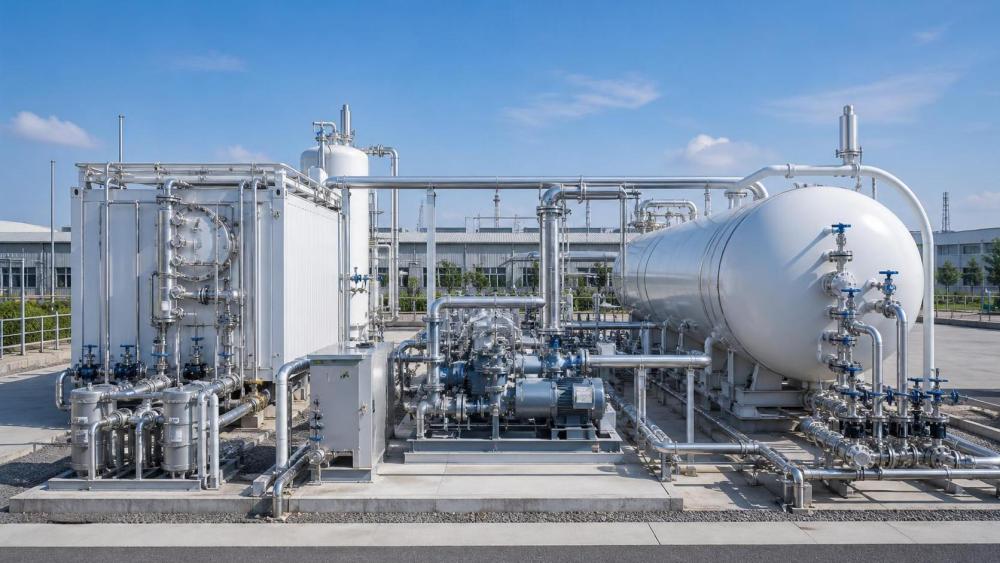
Many hydrogen projects are delayed by interfaces rather than by core technology. An electrolyzer package may meet output targets on paper, yet downstream compression may be sized for a different purity range, storage may assume a different fill profile, and tube trailer or liquid handling logistics may impose turnaround limits that were never reflected in the production model. A sovereign hydrogen infrastructure platform earns its place when these assumptions are visible across package boundaries.
That visibility matters in several places at once. Purity specifications affect catalyst life, metering accuracy, and fueling protocol stability. Pressure ramp rates influence vessel fatigue and compressor valve wear. Boil-off management changes the economics and safety case of liquid hydrogen storage. Turbine blending tolerance may depend on burner design, flame detection logic, and fuel gas conditioning upstream. If these variables sit in separate spreadsheets owned by separate contractors, project risk stays high even when each workstream appears well documented.
Cross-value-chain benchmarking also changes procurement behavior. Instead of selecting the lowest apparent cost within each equipment lot, the project can compare combinations of equipment against the same duty profile. That matters because low-cost choices often shift cost and risk to installation or operations. A valve with limited seat material data under repeated hydrogen cycling may force shorter maintenance intervals. A cryogenic vessel with acceptable static insulation performance may still create operational loss if connection points, transfer hoses, and purge procedures are poorly matched to the site layout. The platform lowers risk when it captures those second-order effects before contract award.
It Must Be Strong Enough for Permitting and Safety Review
Projects do not become lower risk merely because they contain more technical data. The information has to be organized in a way that supports hazard review, design review, and regulator-facing documentation. Hydrogen infrastructure crosses pressure safety, hazardous area classification, fire protection, vent stack design, leak detection, emergency shutdown philosophy, and in some cases cryogenic handling. A sovereign hydrogen infrastructure platform is useful when it can show the chain of reasoning from design intent to safeguard selection.
For example, leak detection is often treated as a sensor procurement issue, but risk reduction depends on detector placement, ventilation assumptions, gas dispersion paths, alarm voting logic, and shutdown consequences. The same is true for vent and purge design. Whether a vent line terminates safely is tied to release rate, elevation, ignition source control, and maintenance access, not just pipe diameter. If the platform only stores component certificates, it does little to lower risk. If it preserves the design basis for these safeguards and links them to operating scenarios, it becomes a practical control against late-stage redesign.
The same standard applies to mechanical integrity. Piping specifications, weld procedures, non-destructive examination records, torque requirements for fittings, and pressure test boundaries need to remain connected after installation. Hydrogen systems are particularly exposed to small errors that accumulate: an incorrect elastomer at one joint, a rough internal surface in a high-velocity section, an inadequately cleaned line before startup, or a field substitution that appears minor to a general contractor but alters compatibility. Risk drops when the platform can expose these deviations before startup and preserve them as searchable records afterward.
Transport and Installation Are Often Underestimated
A sovereign hydrogen infrastructure platform lowers project risk when it covers logistics and field assembly with the same rigor as process design. Large hydrogen assets are rarely installed exactly as drawn in a controlled factory setting. Modules move through ports, highways, temporary laydown yards, lifting operations, and weather exposure. Cryogenic equipment may require stricter handling controls than the civil schedule expects. High-pressure assemblies can arrive with preservation requirements that are lost once crates are opened on site. Even a clean, capped line can become a contamination risk if storage and handling discipline breaks down during installation.
This is where document control alone is not enough. The platform needs to preserve installation-critical information such as orientation limits, lifting points, purge requirements before tie-in, flange face protection, acceptable storage temperature, hold points for inspection, and post-installation cleanliness verification. If these details remain buried in vendor manuals, they are often discovered only after a field issue appears. A bent impulse line, moisture introduced during tie-in, or a wrongly sequenced pressure test can push startup back by weeks because hydrogen systems are less forgiving of contamination and leakage than many conventional gas systems.
Transport risk is even sharper for liquid hydrogen and high-pressure refueling hardware. Vacuum integrity, hose handling, connector wear, and pre-cooling procedures all affect whether the delivered system performs as intended. A platform lowers risk when it records the operational constraints of these assets in a way that survives handover from vendor to EPC contractor to site operator. Otherwise, performance drift begins almost immediately after commissioning.
Lower Risk Requires a Usable Maintenance Logic
Projects with long asset lives need more than a startup-ready design. The platform begins to reduce risk in a durable way when it supports condition monitoring, inspection planning, spares strategy, and change management. Hydrogen equipment does not age uniformly. Compressor seals, valves under high cycling, insulation vacuum systems, dispenser nozzles, analyzers, and fuel conditioning skids all degrade on different patterns. If maintenance is built around generic time intervals copied from adjacent industries, the result may be either over-maintenance or dangerous complacency.
A better threshold is whether the platform can map failure modes to inspection methods and trigger points. That includes leak trend analysis, vibration or temperature signatures on rotating equipment, inspection of threaded or compression fittings in vibration-prone sections, periodic verification of detector calibration, and review of pressure cycle accumulation on vessels and lines. In cryogenic service, vacuum loss and thermal ingress need to be treated as asset integrity issues, not simply as efficiency losses. In refueling applications, nozzle wear, communication handshake reliability, and fill protocol consistency need to stay visible because small deviations can change both customer experience and safety margin.
Spare parts governance is another dividing line. The project remains exposed if replacement seals, sensors, regulators, or fittings can enter the site without a compatibility review. A sovereign hydrogen infrastructure platform lowers risk when approved substitutions are controlled by service condition, not just by part number similarity. This matters during outages, when pressure to restore service can override the engineering basis unless the basis is easy to retrieve.
Common Misjudgments That Keep Risk High
One common error is assuming that compliance documents alone prove readiness. Certificates are necessary, but they do not resolve whether the certified item was selected for the actual duty. Another is treating hydrogen purity as a procurement clause instead of an operational variable. Moisture, oxygen, particulates, and trace contaminants can affect storage, fuel cells, turbines, and dispensers differently, so one plant-wide purity statement may hide several incompatible realities.
A third misjudgment is copying natural gas installation habits into hydrogen service with minor edits. Some practices transfer well; others do not. Leak behavior, material response, ventilation needs, and fueling dynamics create enough difference that familiar methods can become risky when applied without review. There is also a recurring tendency to separate digital control risk from mechanical risk. In hydrogen infrastructure they are connected. Purge sequence errors, slow valve response, analyzer drift, and poorly tuned shutdown logic can expose equipment to conditions that the mechanical design never intended to see.
Another weak point appears at contract packaging. When supply scopes are split too aggressively, nobody owns the technical truth across boundaries. The electrolyzer supplier protects electrolyzer performance, the storage contractor protects vessel delivery, the control integrator protects software scope, and the site contractor protects construction completion. Risk remains in the spaces between them unless a sovereign hydrogen infrastructure platform carries shared assumptions, deviations, and acceptance criteria across the full chain.
When the Platform Is Mature Enough to Matter
The practical threshold is straightforward. Risk starts to decline when the platform can answer design and operating questions faster than the project can create new ambiguity. It should be possible to trace a line from process conditions to material choice, from material choice to fabrication method, from fabrication to inspection, and from inspection to operational limits. It should also be possible to see where one package depends on another without waiting for an incident, a failed factory acceptance test, or a late-stage permit comment.
If the platform supports only static comparison, it may still be useful for early screening. If it can also preserve deviations, field changes, maintenance history, and interface constraints, it becomes part of project control. That is the point where a sovereign hydrogen infrastructure platform genuinely lowers project risk: when it narrows the gap between technical intent and installed reality, and keeps that gap narrow after the system enters service.
Related News
- Electricity Price Volatility Is Rewriting Hydrogen Cost ModelsApr 27, 2026Impact of electricity price on hydrogen cost is transforming industrial decarbonization and large-scale electrolysis. Explore LCOH trends, PPA strategies, and resilient hydrogen infrastructure planning.
- Energy Transition Plans Often Fail at the Grid Connection StageApr 27, 2026Sustainable energy and energy transition projects often fail at grid connection. Learn how hydrogen infrastructure, PEM electrolysis, and industrial decarbonization can avoid delays and protect investment value.
- What Is Slowing Industrial Decarbonization Projects in 2026?Apr 27, 2026Industrial decarbonization faces delays in 2026 as hydrogen infrastructure, sustainable energy access, grid limits, safety standards, and project bankability challenge the energy transition.
- Are G-HEI’s PEM Electrolyzer Benchmarks Reliable?Oct 13, 2026Assess G-HEI PEM electrolyzer benchmarking reliability through test boundaries, hydrogen measurement, and durability evidence. Discover what makes a benchmark worth trusting.
Related News
- 00
0000-00
Hydrogen Energy Storage for Data Centers Gets Costly Fast - 00
0000-00
When 99.999% Hydrogen Purity Still Is Not Good Enough - 00
0000-00
When Does a Hydrogen-Ready Gas Turbine Pay Off? - 00
0000-00
Electricity Price Volatility Is Rewriting Hydrogen Cost Models - 00
0000-00
PSA Recovery Rate Drops for Reasons Operators Miss
Dr. Aris Aero
Weekly Insights
Stay ahead with our curated technology reports delivered every Monday.