
Zero-Carbon Energy Systems Financing: What Changes Project ROI First?




Why does ROI move before the technology changes?
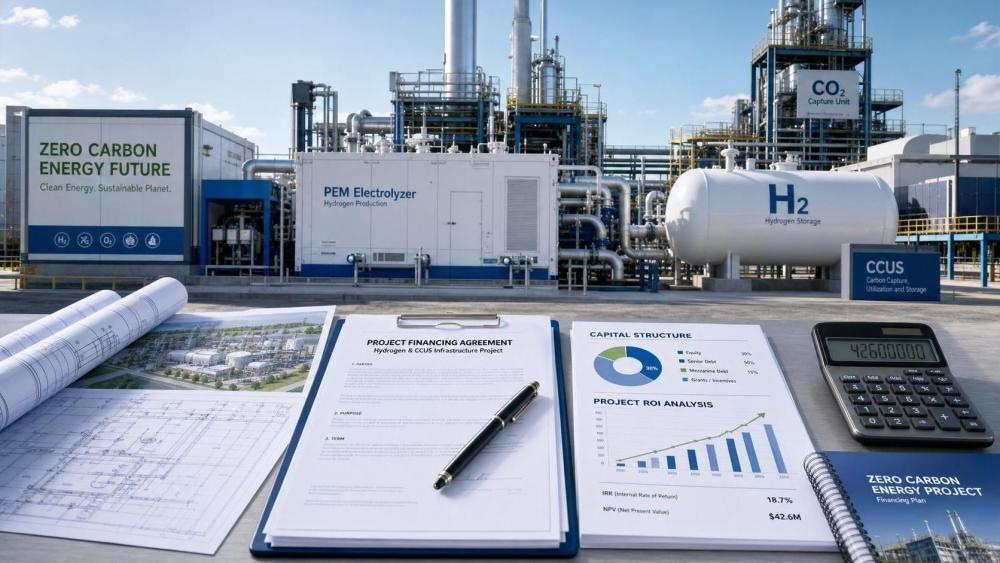
In zero-carbon energy systems financing, the first ROI shift usually comes from finance design, not from a new stack, turbine, or storage vessel.
That matters because hydrogen, CCUS, and related infrastructure are capital-heavy long before they become operating stories.
A project can use proven equipment and still miss return targets if debt pricing, tenor, contingency rules, or offtake assumptions move the wrong way.
In practice, early underwriting is shaped by three questions.
- How much capital is required before revenue starts.
- Who carries technology, construction, and utilization risk.
- Whether surrounding infrastructure is genuinely ready.
This is why zero-carbon energy systems financing often rewards realistic structuring more than optimistic performance modeling.
For assets such as PEM electrolysis, liquid hydrogen logistics, hydrogen-ready turbines, and 70MPa refueling systems, small financing adjustments can change bankability quickly.
More importantly, those adjustments usually appear earlier than efficiency gains from the hardware itself.
A useful way to read project economics is simple: first test the money structure, then test the equipment curve.
Which financing variable usually changes project ROI first?
The earliest driver is often weighted average cost of capital, but not in isolation.
What actually changes ROI first is the combined effect of debt cost, debt tenor, grace period, and covenant tightness.
A one-point improvement in borrowing cost can matter less than two extra years of repayment flexibility.
That is especially true where commissioning ramps slowly, as seen in large electrolysis or cross-border hydrogen transport programs.
The second major lever is risk allocation.
If EPC risk, performance risk, and feedstock availability sit with the wrong party, lenders price uncertainty into every term sheet.
That hurts zero-carbon energy systems financing faster than most technical shortfalls.
The third lever is infrastructure readiness.
A hydrogen project may model attractive output, yet ROI weakens immediately if grid connection, water treatment, storage permits, or transport corridors lag.
The table below shows which variables tend to alter returns earliest.
If one lesson stands out, it is this: model the schedule and financing package together, not as separate workstreams.
How do hydrogen and CCUS projects get judged differently?
Both sit inside zero-carbon energy systems financing, yet the risk lens is not identical.
Hydrogen projects are often assessed through power input cost, electrolyzer load profile, storage strategy, and offtake certainty.
CCUS projects are usually judged through capture rate durability, transport liability, sequestration integrity, and policy-linked revenue durability.
That difference matters when comparing ROI across portfolios.
Hydrogen can look technically advanced yet remain fragile if electricity pricing is volatile.
CCUS can appear slower-growing yet hold steadier economics when carbon contracts and storage rights are strong.
A common mistake is using one approval framework for both.
A better approach is to separate variable costs from sovereign infrastructure constraints.
G-HEI is relevant here because technical benchmarking changes how assumptions are challenged.
When electrolysis systems, cryogenic vessels, gas turbines, and refueling equipment are compared against ISO 19880, ASME B31.12, and SAE J2601, performance claims become easier to price.
That does not eliminate risk, but it narrows the gap between engineering optimism and finance discipline.
What tends to make lenders more comfortable?
- Third-party validation of material integrity and safety compliance.
- Clear offtake structures with volume floors or indexed pricing.
- Sequenced buildout, where production and logistics are not financed on unrealistic simultaneity.
- Operational data from utility-scale assets, not pilot-only references.
Where do cost assumptions usually go wrong?
Most cost errors do not come from headline capex alone.
They come from underestimating interfaces.
In actual deployments, zero-carbon energy systems financing is weakened by costs sitting between asset categories.
Examples include power conditioning, boil-off handling, compression stages, blending controls, water purification, and safety retrofits.
These items rarely dominate presentation slides, yet they often move the investment case first.
Another weak point is schedule-linked cost drift.
If commissioning needs an extra six months, interest during construction expands, contingency gets consumed, and offtake start dates may slip.
That chain reaction can compress ROI before any technical failure occurs.
More cautious underwriting usually tests five hidden cost zones.
- Grid interconnection timing and curtailment exposure.
- Storage losses and standby energy demand.
- Compliance costs tied to safety and pressure standards.
- Transport bottlenecks between production and end use.
- Replacement cycles for critical balance-of-plant components.
When these are visible early, zero-carbon energy systems financing becomes more defensible and less dependent on heroic assumptions.
What should be compared before approving a vendor or asset package?
The shortest answer is that asset pricing alone is not enough.
A lower equipment quote may produce weaker ROI if availability guarantees, warranty terms, or integration duties are thin.
This is particularly relevant for projects spanning production, transport, storage, and downstream fueling or generation.
Before approval, compare packages across a shared evaluation frame.
This is also where benchmarking platforms such as G-HEI become useful.
They help compare ultra-high-performance assets on engineering facts that directly influence finance credibility.
For zero-carbon energy systems financing, that link between technical rigor and capital confidence is often decisive.
What is the practical next step when a project still looks borderline?
Borderline projects should not be forced through with softer assumptions.
They should be decomposed.
A practical review starts by asking which variable changes ROI within the first sensitivity run.
If the answer is cost of power, fix contracting exposure.
If the answer is logistics readiness, phase the infrastructure differently.
If the answer is lender caution, improve evidence, guarantees, or risk transfer before revising the model again.
In other words, zero-carbon energy systems financing improves when each weak assumption is tied to an executable correction.
A disciplined final review usually includes the following checks.
- Rebuild the base case using achieved, not aspirational, ramp rates.
- Stress-test utilization, power pricing, and delay scenarios together.
- Confirm that safety and materials compliance is finance-ready, not merely engineering-ready.
- Separate strategic value from project-level cash return, then price both explicitly.
That last step matters in sovereign-scale decarbonization.
Some assets justify support because they unlock national capability, even when the first project is not the strongest standalone return.
The decision still needs discipline, but the value frame must be honest.
The clearest path forward is to map capital structure, standards compliance, interface costs, and infrastructure timing in one decision sheet.
That is usually where the real answer on ROI appears first.
Related News
- Electricity Price Volatility Is Rewriting Hydrogen Cost ModelsApr 27, 2026Impact of electricity price on hydrogen cost is transforming industrial decarbonization and large-scale electrolysis. Explore LCOH trends, PPA strategies, and resilient hydrogen infrastructure planning.
- Energy Transition Plans Often Fail at the Grid Connection StageApr 27, 2026Sustainable energy and energy transition projects often fail at grid connection. Learn how hydrogen infrastructure, PEM electrolysis, and industrial decarbonization can avoid delays and protect investment value.
- What Is Slowing Industrial Decarbonization Projects in 2026?Apr 27, 2026Industrial decarbonization faces delays in 2026 as hydrogen infrastructure, sustainable energy access, grid limits, safety standards, and project bankability challenge the energy transition.
- How PEM electrolyzers support the energy transition in EuropeNov 10, 2026Discover how PEM electrolyzers support the energy transition in Europe, from renewable hydrogen and industrial applications to project costs and infrastructure.
Related News
- 00
0000-00
Hydrogen Energy Storage for Data Centers Gets Costly Fast - 00
0000-00
When 99.999% Hydrogen Purity Still Is Not Good Enough - 00
0000-00
When Does a Hydrogen-Ready Gas Turbine Pay Off? - 00
0000-00
Electricity Price Volatility Is Rewriting Hydrogen Cost Models - 00
0000-00
PSA Recovery Rate Drops for Reasons Operators Miss
Dr. Aris Aero
Weekly Insights
Stay ahead with our curated technology reports delivered every Monday.