




How Airports Can Size Hydrogen Infrastructure for Fuel Cell Ground Fleets
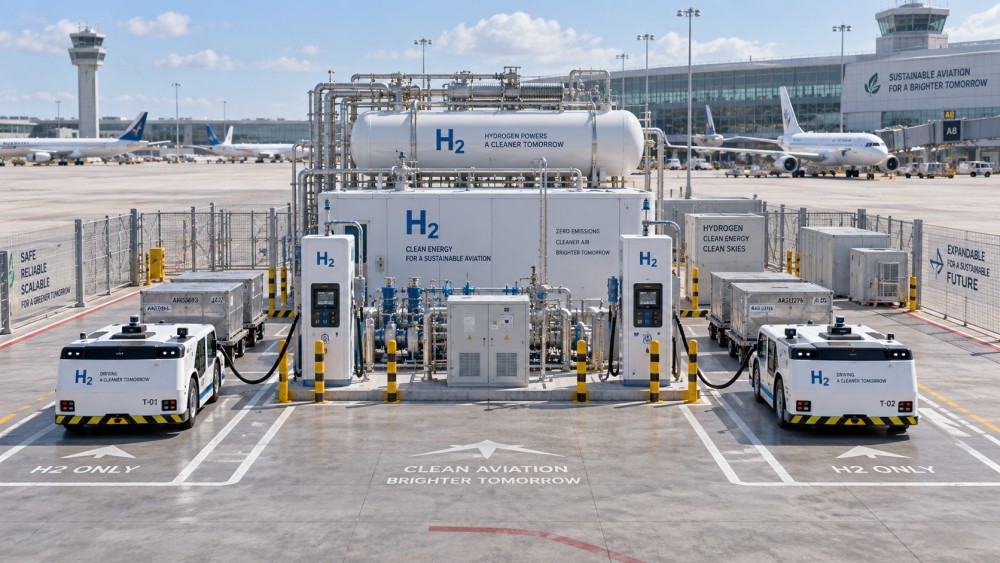
Airports planning fuel cell ground fleets need more than a refueling station. They need a scalable, safety-led energy strategy built around real operating demand.
Effective Hydrogen infrastructure solutions airports must match vehicle duty cycles, fueling peaks, storage resilience, supply choices, and regulatory obligations from the first project stage.
For project managers, the central question is not simply how much hydrogen a fleet consumes each year. It is whether the system performs reliably during operational peaks.
A correctly sized system protects airside availability, avoids excessive capital spending, accommodates fleet growth, and gives airport stakeholders a defensible basis for investment approval.
Start With the Operational Question, Not the Equipment List
The most common planning error is selecting electrolyzers, compressors, or dispensers before understanding how ground support equipment actually operates across each airport shift.
Fuel cell baggage tractors, buses, pushback tractors, cargo handlers, and utility vehicles have different energy use patterns, refill windows, route lengths, and standby requirements.
Project teams should first identify which vehicles will transition, where they operate, when they return to base, and which activities cannot tolerate fueling delays.
This fleet-first approach converts an aspirational hydrogen program into a measurable infrastructure requirement with clear assumptions that engineering, operations, and finance teams can review.
Annual hydrogen demand matters for procurement and cost forecasting. Peak daily demand matters for storage. Peak hourly demand determines compression, dispensing, and queue management capacity.
An airport can have modest annual demand but still require substantial fueling capability if several vehicles need rapid turnaround during a narrow baggage or aircraft servicing window.
Build a Fleet Demand Model Before Sizing Supply Assets
A practical demand model begins with a vehicle inventory, including asset type, fuel cell configuration, tank capacity, expected utilization, fueling pressure, and replacement schedule.
For every vehicle class, estimate daily operating hours, average kilometers or work cycles, hydrogen consumption per hour, and the expected number of refueling events.
Use measured telematics data where possible. If operations data is incomplete, create conservative scenarios based on manufacturer consumption figures and validated duty-cycle observations.
The model should separate average consumption from peak consumption. Average figures support budget planning, while peak figures prevent congestion and unavailable equipment during critical periods.
For example, twenty fuel cell baggage tractors may consume a predictable daily total, yet most may arrive for refueling within two hours after evening arrivals.
That concentration affects dispenser throughput, compressor flow rate, cascade storage volume, vehicle staging space, and the number of trained personnel needed to manage fueling safely.
Seasonality also matters. Holiday schedules, irregular operations, extreme temperatures, major events, and future terminal expansion can all alter fleet demand beyond an annual average.
Project leaders should document three cases: initial deployment, expected five-year deployment, and stressed peak operation. Equipment can then be phased without underdesigning the site.
Translate Vehicle Demand Into Daily and Peak Hydrogen Requirements
After collecting fleet assumptions, calculate daily hydrogen demand by multiplying each vehicle’s daily operating consumption by the number of active vehicles in that category.
Next, calculate the largest credible fueling window. This is usually the period when returning vehicles must be refueled before their next assigned operational task.
Divide the hydrogen required in that window by available fueling time. The result provides a preliminary estimate for required station throughput in kilograms per hour.
Do not assume every vehicle needs a full fill. Partial refueling strategies can reduce peak demand, but only when fleet dispatching and state-of-charge visibility are mature.
Fueling protocols should account for vehicle tank pressure, ambient temperature, allowable fill rates, dispenser availability, and the time needed for positioning and pre-fueling inspections.
For airport applications, a system sized only for nominal fuel transfer can create queues because vehicle movements, access control, and ramp safety procedures consume additional minutes.
Include a practical utilization factor rather than assuming dispensers operate continuously. A station designed around ideal utilization often fails to meet real-world turnaround requirements.
The output should be a transparent design basis listing kilograms per day, kilograms per peak hour, fills per shift, expected queue duration, and minimum operational reserve.
Size Storage for Resilience, Not Only for Average Consumption
Hydrogen storage is the buffer between supply variability and airside operations. Its size should reflect resilience targets, delivery schedules, production reliability, and emergency response constraints.
A delivered-hydrogen site may need sufficient inventory to cover delayed tube trailers, weather disruptions, restricted road access, or supplier interruptions affecting the airport region.
An on-site production site may require similar resilience because electrolyzer maintenance, power interruptions, water treatment issues, or compressor outages can limit output unexpectedly.
Storage design usually combines low-pressure buffer storage, high-pressure cascade storage, and sometimes mobile storage capacity. Each layer performs a different operational function.
Low-pressure storage can stabilize electrolyzer production. High-pressure storage supports rapid dispensing. Mobile supply arrangements can provide contingency capacity during commissioning or maintenance events.
Project teams should establish a defined autonomy target, such as one operational day, several peak shifts, or longer coverage for airports with constrained supply routes.
More storage can improve continuity, but it increases capital cost, land requirements, hazardous-area considerations, inspection obligations, and permitting complexity. The correct answer is site-specific.
A phased design often works well: install civil works and safety separation for future storage, while initially purchasing only the capacity required for validated fleet demand.
Choose Between Delivered Hydrogen, On-Site Electrolysis, or a Hybrid Model
Supply architecture is one of the largest decisions in Hydrogen infrastructure solutions airports because it affects cost, carbon performance, land use, operational risk, and expansion flexibility.
Delivered gaseous hydrogen can be attractive for early fleet deployments because it reduces initial process equipment, electrical upgrades, water systems, and commissioning scope.
However, delivered supply exposes the project to transport logistics, supplier availability, route restrictions, price volatility, and emissions associated with hydrogen production and distribution.
On-site electrolysis can offer greater supply control, especially where airports have reliable low-carbon electricity, adequate water treatment capability, and sufficient space for utility infrastructure.
Electrolysis is not automatically the lowest-cost solution. Its economics depend heavily on electricity tariffs, demand charges, electrolyzer utilization, renewable power contracts, and maintenance strategy.
A hybrid configuration can combine on-site production for base demand with delivered hydrogen or mobile storage for seasonal peaks, outages, and gradual fleet expansion.
When comparing options, assess delivered cost per kilogram, total installed cost, required electrical capacity, truck movements, resilience, carbon intensity, and contractual risk.
Decision-makers should also separate present economics from future optionality. A connection-sized electrical masterplan may be valuable even when electrolysis is deferred until later phases.
Do Not Underestimate Compression and Dispensing Capacity
Hydrogen production capacity does not automatically translate into fueling capacity. Compression and dispensing equipment must move hydrogen at the required pressure and speed during operational peaks.
Ground fleets may use pressure levels different from passenger fuel cell vehicles. Confirm vehicle specifications, connector standards, fueling protocols, and anticipated future fleet models early.
Compression sizing should consider inlet pressure, target storage pressure, refill frequency, heat rejection, redundancy requirements, maintenance intervals, and the compressor’s real duty cycle.
A compressor can produce sufficient hydrogen over a day while still failing to replenish high-pressure storage quickly enough between concentrated fueling periods.
Dispenser quantity is similarly operational rather than theoretical. A single high-capacity dispenser may appear efficient but can become a single point of failure for airside fleets.
Two dispensers may provide better service continuity, separate vehicle classes, reduce queue risk, and allow maintenance without stopping the airport’s hydrogen operations.
Include turnaround time from vehicle entry to exit, rather than calculating only hydrogen transfer time. Airside circulation and safe positioning affect actual dispenser productivity.
Specify metering, data capture, and remote diagnostics from the beginning. These capabilities improve fuel accounting, fleet analysis, preventive maintenance, and expansion decisions.
Plan the Airport Site Around Safety, Access, and Airside Operations
Station location determines more than construction cost. It affects vehicle routing, emergency access, separation distances, aircraft safety interfaces, utility connections, and future expansion potential.
A site near fleet depots can reduce deadheading and driver time, but it must also accommodate controlled access, ventilation, equipment clearances, and safe vehicle circulation.
Early engagement with airport operations, fire services, security, facilities teams, and aviation safety stakeholders prevents late-stage conflicts that can delay deployment significantly.
Hazardous-area classification, vent stack placement, gas detection, emergency shutdown systems, grounding, electrical design, and blast or separation considerations require specialist engineering review.
Applicable requirements may include ISO 19880, SAE J2601, local fire codes, pressure equipment rules, electrical standards, and airport-specific airside safety procedures.
Project managers should verify which authority has approval responsibility for each element. Building regulators, airport authorities, fire marshals, and environmental agencies may have different roles.
Permitting schedules should not be treated as an administrative afterthought. Concept design, hazard studies, authority consultation, and emergency planning must advance alongside procurement.
A credible project plan includes commissioning procedures, operator training, maintenance access, emergency exercises, and clear ownership for station operation after handover.
Design for Growth Without Paying for Unused Capacity Today
Airport fleet decarbonization rarely happens in one procurement cycle. Ground support equipment is replaced gradually, and infrastructure should support that transition without unnecessary early oversizing.
The strongest approach is often modular expansion. Establish the ultimate site layout, utilities corridor, control architecture, and safety envelope while deploying initial equipment in phases.
For example, initial capacity may support baggage tractors and shuttle buses, followed later by cargo equipment, maintenance vehicles, pushback tractors, and adjacent logistics fleets.
Future demand should be evaluated by vehicle segment because larger vehicles may use more hydrogen per fill, require different fueling pressures, or need longer station dwell time.
Protect physical expansion space for storage vessels, compressors, dispensers, electrical transformers, water treatment, and hydrogen unloading areas before nearby development closes those options.
Scalable controls are equally important. A supervisory system should accommodate additional dispensers, production assets, storage banks, alarms, and reporting points without complete replacement.
Phased capital deployment improves governance because each expansion decision can use actual hydrogen consumption, station uptime, fleet utilization, and energy-cost evidence from earlier phases.
This reduces the risk of committing to a large centralized asset before fleet procurement schedules and operational adoption have been proven in the field.
Use a Total Cost and Risk Framework for the Investment Decision
Capital expenditure is visible, but it should not dominate the decision. Airports should compare alternatives using total cost of ownership and operational risk over the asset life.
Relevant costs include hydrogen supply, electricity, demand charges, water, maintenance, inspections, staffing, insurance, land preparation, permitting, spare parts, and equipment replacement.
Operational value should also be measured. Faster refueling, lower vehicle downtime, reduced emissions exposure, quieter airside work, and stronger resilience may justify higher initial investment.
Develop a sensitivity analysis for fleet growth, electricity price, delivered hydrogen cost, station utilization, carbon intensity, supply disruption duration, and equipment availability.
This analysis identifies which assumptions materially affect project viability. It also helps leaders avoid false precision when market prices and fleet deployment schedules remain uncertain.
Risk allocation deserves attention in supplier contracts. Clarify performance guarantees, hydrogen quality, uptime commitments, maintenance responsibility, data ownership, and response times for critical failures.
Where possible, connect payments to measurable outcomes such as delivered kilograms, dispenser availability, fueling time, station uptime, and verified emissions performance.
A well-structured commercial model makes technical sizing more bankable because stakeholders can see how operating risk, maintenance risk, and supply risk are managed.
Create a Practical Sizing Workflow for Airport Delivery Teams
A disciplined workflow keeps the project grounded in operations while allowing technical design to mature. Begin with fleet data, duty cycles, and a realistic deployment schedule.
Then define peak-hour fueling demand, minimum resilience requirements, preferred supply routes, site constraints, applicable codes, and the desired expansion horizon for the airport.
Develop several concept options instead of one assumed solution. Compare delivered hydrogen, electrolysis, and hybrid configurations against the same performance and cost criteria.
Use preliminary process modeling to test production, storage, compression, and dispensing interactions. The model should include equipment downtime and credible peak operational scenarios.
Conduct safety and constructability reviews before selecting a preferred concept. This avoids a technically attractive option that cannot be permitted or built within airport constraints.
After concept selection, produce a basis of design that clearly distinguishes confirmed facts, engineering assumptions, supplier inputs, and decisions still requiring stakeholder approval.
This document becomes the reference for procurement, permitting, budget authorization, and change control. It also prevents scope drift as more departments join the project.
Finally, build measurement into operations. Actual consumption, fill duration, equipment uptime, and queue data should guide every later capacity expansion decision.
Conclusion: Size for Reliable Airport Operations First
Successful hydrogen infrastructure for ground fleets is not defined by the largest electrolyzer or the highest storage pressure. It is defined by dependable operational service.
Airport project leaders should begin with duty cycles and peak fueling behavior, then size storage, compression, dispensing, supply resilience, and safety systems around those realities.
The best Hydrogen infrastructure solutions airports combine an evidence-based initial design with reserved space, utilities, and controls for staged expansion as fleet adoption grows.
By treating hydrogen as a complete operational energy system rather than a standalone refueling asset, airports can reduce implementation risk and build a credible path to zero-carbon ground operations.