
What drives hydrogen compression systems cost in 70 MPa stations?




For financial decision-makers evaluating 70 MPa hydrogen stations, Hydrogen compression systems cost is often the largest and most risk-sensitive capital variable.
Beyond compressor hardware, total cost is shaped by throughput targets, cascade storage design, cooling requirements, redundancy, safety compliance, maintenance exposure, and electricity consumption.
Understanding these cost drivers is essential for building bankable refueling infrastructure that meets ISO 19880 and SAE J2601 expectations while protecting long-term asset returns.
The central investment conclusion is straightforward: a low quoted compressor price rarely represents the lowest station cost or the strongest lifecycle economics.
At 70 MPa, compression must be evaluated as an integrated dispensing system, not as an isolated package purchased on nameplate capacity alone.
Financial approval should therefore test whether the design can reliably deliver contracted fills, control downtime, preserve safety margins, and remain serviceable under actual utilization.
The most defensible business case links capital expenditure, energy cost, availability, maintenance obligations, and revenue assumptions to a defined fueling profile.
Why 70 MPa Hydrogen Compression Carries a Higher Cost Premium
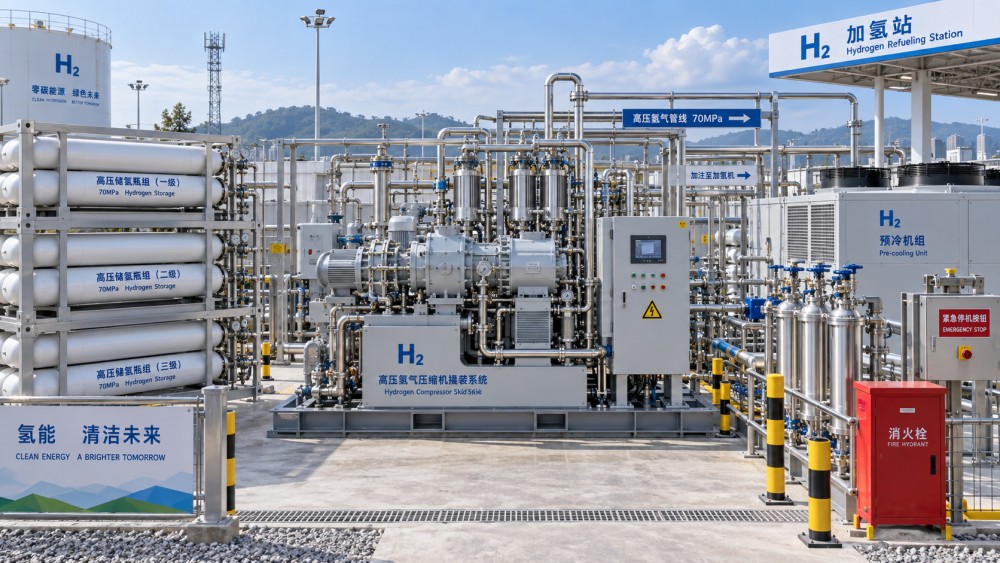
A 70 MPa station generally serves light-duty vehicles requiring hydrogen delivered at nominal 700 bar, with dispensing pressures and thermal conditions governed by SAE J2601.
Hydrogen arriving from tube trailers, pipelines, electrolyzers, or onsite storage usually enters the station at much lower pressure than final vehicle delivery requirements.
The compression system must raise pressure efficiently while managing hydrogen's small molecular size, leakage risk, heat generation, contamination sensitivity, and demanding fatigue conditions.
Higher final pressure increases the mechanical demands on compression stages, seals, valves, piping, storage vessels, instrumentation, and protective systems across the station.
That is why Hydrogen compression systems cost should be assessed alongside high-pressure storage and precooling rather than allocated only to a compressor procurement line.
For a financial approver, the relevant question is not simply whether a compressor reaches 90 MPa or above under ideal conditions.
The better question is whether the integrated system can complete the required number of compliant fills per day without excessive compression hours or unplanned interruption.
Stations designed for occasional demonstration fueling have very different economics from stations supporting fleets, highway traffic, transit hubs, or critical public-service operations.
Utilization uncertainty makes overbuilding and underbuilding equally expensive, because either condition can weaken returns through stranded capacity or lost customer revenue.
Throughput and Duty Cycle Set the Largest Capital Requirement
Daily hydrogen throughput is usually the first variable that determines compressor sizing, storage quantity, electrical infrastructure, cooling equipment, and the extent of redundancy.
A station expected to dispense 200 kilograms daily does not scale linearly from a 50-kilogram station, especially when demand is concentrated into short peak periods.
Financial models should distinguish average daily volume from peak-hour demand, because customer queues and fill failures are driven by hourly operational conditions.
A fleet depot may have predictable windows, while a retail highway station must accommodate variable arrivals, vehicle mix, ambient temperatures, and consecutive fills.
High peak demand often requires larger compression capacity or more stored high-pressure hydrogen, each producing different capital and operating cost consequences.
More compressor capacity raises equipment price, electrical connection requirements, footprint, and maintenance exposure, but may reduce storage needs and recovery time between fills.
More cascade storage can protect dispensing performance, yet high-pressure vessels, controls, safety distances, and periodic inspection requirements can materially increase installed cost.
The appropriate balance depends on demand shape, hydrogen supply pressure, delivery logistics, land constraints, electricity tariffs, and the commercial penalty associated with unavailable fueling.
Approval teams should request modeled station behavior across peak scenarios rather than relying only on maximum kilograms per day stated in vendor proposals.
Compression Technology Changes Both CAPEX and Risk Exposure
Hydrogen stations may use diaphragm, reciprocating piston, ionic, electrochemical, or other specialized compression approaches, each with different performance and ownership characteristics.
Diaphragm compressors are widely considered where gas purity and containment are important, but their economics depend heavily on pressure ratio, flow rate, and membrane service intervals.
Reciprocating systems can support larger flows, yet seal wear, lubrication strategy, vibration control, and maintenance access require careful review in hydrogen applications.
Electrochemical compressors may offer attractive purity or modularity characteristics in selected applications, although capacity, efficiency, maturity, and replacement economics must be tested carefully.
No compression technology should be selected solely because its initial equipment quotation appears lower than alternative designs with comparable nominal output.
Decision-makers should compare guaranteed flow at actual inlet pressure, discharge pressure, ambient temperature, expected duty cycle, and end-of-life component condition.
They should also examine vendor evidence for mean time between service events, major overhaul intervals, spare-part lead times, and field performance at similar stations.
A technically advanced unit without local service capability may create greater financial risk than a moderately more expensive solution supported by proven regional maintenance resources.
Technology selection becomes especially important where station availability supports public commitments, fleet operating contracts, government incentives, or hydrogen supply take-or-pay obligations.
Cascade Storage Design Can Shift Cost More Than Expected
Cascade storage allows hydrogen to move from lower to higher pressure banks during dispensing, reducing compressor work during each individual vehicle fill.
However, the number, volume, rating, arrangement, and certification requirements of storage banks can become a substantial portion of station capital expenditure.
A larger cascade may improve consecutive-fill performance and reduce customer wait times, but it also adds vessel cost, civil engineering, safety controls, and footprint demands.
For 70 MPa service, storage architecture must support appropriate pressure sequencing while preserving enough usable inventory after pressure equalization during vehicle fueling.
Financial review should focus on usable hydrogen kilograms, not simply gross water volume or the total nominal storage pressure shown in marketing documentation.
Usable inventory varies with bank pressure, vehicle tank pressure, temperature, control strategy, minimum operating pressure, and the refill time available between demand peaks.
Underestimating these interactions can lead to a station that appears adequately sized on paper but delivers fewer profitable fills during high-demand periods.
Conversely, excessive storage can consume capital that would produce better returns if allocated to compression reliability, grid upgrades, or future expansion capability.
A well-structured vendor comparison should provide equivalent cascade assumptions, fill simulations, availability assumptions, and quantified tradeoffs between vessel inventory and compressor capacity.
Prec Cooling, Electrical Systems, and Civil Works Are Not Secondary Costs
Fast filling at 70 MPa commonly requires hydrogen precooling because gas temperature rises during fueling, potentially affecting vehicle tank temperature limits and fill completion.
The precooling package includes refrigeration equipment, heat exchangers, controls, insulation, refrigerant management, electrical supply, and maintenance provisions beyond the visible chiller unit.
Cooling demand depends on fueling rate, ambient conditions, hydrogen inlet temperature, consecutive fills, and the selected fueling protocol under SAE J2601.
A lower-cost cooling system may be acceptable for low-utilization fleets, but may constrain throughput or cause failed fills during hot-weather peak operations.
Electrical infrastructure is another commonly underestimated element within Hydrogen compression systems cost, particularly where compressors, chillers, controls, and ventilation have simultaneous peak loads.
Connection upgrades, transformers, switchgear, harmonics management, backup power, and utility lead times can alter project economics long before station commissioning.
Civil works also vary significantly by site, including foundations, blast and separation distances, equipment enclosures, drainage, vehicle circulation, fencing, and hazardous-area requirements.
Financial estimates should separate equipment pricing from installed project cost, because the latter determines actual funding needs and construction schedule exposure.
Projects near constrained urban sites or existing fueling operations require particular contingency because logistics, permitting, and shutdown coordination can exceed early assumptions.
Safety Compliance Creates Value When It Reduces Approval and Downtime Risk
Compliance with ISO 19880, applicable local codes, pressure-equipment rules, electrical classifications, and fire authority requirements is a core financial consideration, not merely an engineering formality.
Design changes requested late by authorities can delay revenue generation, increase contractor claims, and require equipment rework that is far more expensive than early compliance planning.
Hydrogen detection, emergency shutdown systems, ventilation, vent-stack design, pressure relief, hazardous-area equipment, and fire-safety integration all affect final station cost.
Material selection is equally important because hydrogen service can create embrittlement, fatigue, permeation, and compatibility concerns that conventional gas infrastructure may not address.
Financial approvers should require documented materials traceability, pressure-cycle design basis, test records, and clear responsibility for code interpretation across suppliers and contractors.
The lowest bid may omit interface responsibilities between compressor skids, storage modules, dispenser systems, controls, and site safety infrastructure.
Those omissions frequently become change orders, schedule disputes, or operating constraints after installation, transferring risk back to the station owner.
A bankable scope assigns one party responsibility for integrated functional performance, while preserving transparent obligations for independent equipment vendors and civil contractors.
Maintenance Economics Often Decide the Real Lifecycle Cost
Compression equipment contains wear components exposed to high pressure, repeated cycling, vibration, contamination risk, and hydrogen-specific sealing challenges throughout station operation.
Routine maintenance may include seal replacement, diaphragm replacement, valve servicing, filtration, calibration, lubrication checks where applicable, cooling-system work, and leak testing.
Major maintenance events can be financially significant because they combine parts, specialized labor, travel, downtime, recommissioning, and potential lost fueling revenue.
When comparing vendors, buyers should request a lifecycle maintenance schedule that identifies each intervention, expected labor hours, consumables, overhaul cost, and operational impact.
Availability guarantees should define exclusions carefully, since a high headline uptime figure has limited value if common failures fall outside the supplier's responsibility.
Spare-parts strategy matters as much as service pricing, particularly in regions with limited hydrogen infrastructure and long logistics routes for specialized components.
Critical spares held onsite increase working capital, yet may be justified when station downtime threatens fleet operations, public reputation, or contractual service-level commitments.
Maintenance reserves should be modeled separately from annual operating expense averages, because irregular major overhauls can create material cash-flow pressure in early operating years.
For lenders and investment committees, a credible maintenance plan is evidence that projected availability and revenue assumptions are operationally achievable.
Electricity Consumption Must Be Measured Against Delivered Hydrogen Revenue
Compression and precooling consume substantial electricity, and their contribution to operating cost rises where grid tariffs include demand charges or time-of-use pricing.
Energy consumption should be evaluated in kilowatt-hours per kilogram delivered, using the actual station boundary and realistic inlet and outlet pressure assumptions.
A compressor's standalone efficiency cannot represent the full energy burden if storage replenishment, refrigeration, controls, drying, ventilation, and auxiliary systems are excluded.
Electricity cost also depends on when the station compresses hydrogen, creating an opportunity to refill storage during lower-cost periods where operational conditions permit.
Smart control strategies can reduce peak electricity exposure, although they must not compromise readiness for forecast demand or create unacceptable recovery time after busy periods.
For onsite electrolysis, compression should be assessed jointly with electrolyzer operating pressure, production flexibility, renewable power availability, and hydrogen buffering strategy.
Producing hydrogen at a higher pressure may reduce downstream compression duty, but it can change electrolyzer capital cost, efficiency, operating constraints, and maintenance requirements.
The correct economic comparison is therefore total delivered hydrogen cost, not a narrow comparison of compressor electricity use in isolation.
How Financial Teams Should Structure a Bankable Procurement Decision
Start with a clear demand case defining daily volume, peak-hour volume, vehicle classes, fill protocol, supply pressure, operating hours, and required availability.
Then require each bidder to provide an integrated mass-flow and thermal model demonstrating expected fills, recovery time, storage utilization, and performance under extreme conditions.
Normalize commercial proposals using the same assumptions for civil works, electrical upgrades, installation, commissioning, training, spares, warranty, and preventive maintenance.
Evaluate Hydrogen compression systems cost across capital expenditure, scheduled maintenance, unscheduled maintenance risk, electricity, replacement components, insurance, and expected downtime losses.
Scenario analysis should test slower demand ramp-up, delayed hydrogen supply, hotter weather, lower inlet pressure, component failure, grid constraints, and changes in electricity pricing.
Financial models should also identify expansion triggers, allowing capacity additions to be phased when utilization justifies investment rather than funded prematurely.
Contract terms should include performance acceptance criteria based on delivered kilograms, compliant fills, energy consumption, availability, safety functionality, and documented maintenance commitments.
A transparent lifecycle comparison can reveal that a higher initial capital investment produces superior net present value through better reliability, lower energy use, and stronger customer retention.
Conclusion: Treat Compression as the Station's Economic Core
For 70 MPa hydrogen stations, compression is not simply a mechanical subsystem; it determines capacity, availability, energy exposure, safety complexity, and the credibility of revenue forecasts.
The most important cost drivers are throughput profile, compression technology, cascade storage, precooling, electrical infrastructure, safety compliance, maintenance obligations, and service capability.
Financial decision-makers should resist simple equipment-price comparisons and instead approve designs supported by integrated performance modeling and transparent lifecycle assumptions.
When Hydrogen compression systems cost is evaluated against usable capacity, uptime, delivered-hydrogen economics, and expansion flexibility, the resulting investment decision becomes substantially more defensible.
Related News
- Can a hydrogen compression systems supplier meet 70 MPa demand?Nov 01, 2026Can a hydrogen compression systems supplier meet 70 MPa demand? Learn how to assess throughput, safety, reliability, and station-wide performance before you buy.
- How airports can size hydrogen infrastructure for fuel cell ground fleetsOct 10, 2026Hydrogen infrastructure solutions airports need to size fuel cell ground fleet systems for peak demand, storage, safety, and scalable growth. Explore a practical planning guide.
- What should an OEM guarantee for 70 MPa hydrogen station compressors?Oct 09, 2026Hydrogen fueling station equipment OEM guarantees for 70 MPa compressors: define safety, performance, testing, materials, uptime, and service commitments before you buy.
- What drives hydrogen compression systems cost in 70 MPa stations?Oct 08, 2026Hydrogen compression systems cost: discover the key CAPEX and lifecycle drivers for 70 MPa stations, from throughput and storage to energy, safety, and uptime.
Related News
- 00
0000-00
Hydrogen Energy Storage for Data Centers Gets Costly Fast - 00
0000-00
When 99.999% Hydrogen Purity Still Is Not Good Enough - 00
0000-00
When Does a Hydrogen-Ready Gas Turbine Pay Off? - 00
0000-00
Electricity Price Volatility Is Rewriting Hydrogen Cost Models - 00
0000-00
PSA Recovery Rate Drops for Reasons Operators Miss
Dr. Victor Gear
Weekly Insights
Stay ahead with our curated technology reports delivered every Monday.