What should a turnkey hydrogen refueling station include?




What Should a Turnkey Hydrogen Refueling Station Include?
A turnkey hydrogen refueling station is often described as a packaged solution: hydrogen comes in, vehicles refuel, and the operator receives a functioning asset. That description is convenient, but it is not enough for a project decision. A station can have a reputable dispenser and high-pressure storage vessels yet still be incomplete as a deployable, financeable facility if its supply interface, power connection, control logic, permitting package, civil works, commissioning plan, and maintenance responsibilities are not clearly defined.
For project managers, the real question is not whether a supplier can provide equipment. It is whether the proposed scope will operate reliably under the intended duty cycle, meet the relevant safety framework, and remain serviceable when a critical component requires attention. That distinction becomes especially important for 70 MPa passenger-vehicle applications, where fueling performance depends on the entire pressure, temperature, and communication chain—not on the dispenser alone.
When assessing Hydrogen refueling stations turnkey proposals, it helps to treat the station as a connected infrastructure system. Hydrogen quality, logistics, compression, storage, pre-cooling, dispensing, hazardous-area design, digital controls, and site integration all affect availability. Missing interfaces are where cost overruns and delayed handover usually begin.
Start with the operating model, not the equipment list
Before reviewing compressor capacity or dispenser count, define what the station is expected to do. A fleet depot with predictable return-to-base buses, trucks, or material-handling vehicles needs a different layout from a public station serving intermittent passenger traffic. Depot operations may prioritize overnight fueling windows, high daily throughput, and resilient fleet dispatch. A public-facing site may need faster transaction times, a more visible user interface, payment integration, and a different approach to queue management.
The hydrogen source is equally decisive. Delivery can arrive as compressed gaseous hydrogen, liquid hydrogen, tube-trailer supply, pipeline feed, or on-site production through electrolysis. None of these options is automatically preferable. The right decision depends on expected demand, local electricity characteristics, road access, permitted delivery schedules, available plot area, supply resilience, and the commercial boundary between fuel provider and station operator.
A common early-stage error is sizing a station against an aspirational vehicle count without examining arrival patterns. Ten vehicles spread throughout a day impose a very different thermal and storage demand than ten vehicles arriving in a 45-minute shift-change period. A credible turnkey scope should document the assumed refueling profile and state what performance is guaranteed under those conditions.
The physical process train: more than storage and a dispenser
At a minimum, a complete high-pressure station needs a defined hydrogen receiving interface, gas treatment or quality-control provisions where required, compression, buffer or cascade storage, cooling, dispensing equipment, piping, valves, instrumentation, and a safe venting arrangement. The design should also identify isolation points and the consequences of taking any major subsystem offline. If the compressor is unavailable, for example, can stored inventory support limited fueling, or does the entire station stop?
For delivered gaseous hydrogen, the unloading connection, trailer parking arrangement, breakaway protection, grounding requirements, and pressure-management sequence must be engineered rather than left as a site assumption. For liquid hydrogen supply, the scope becomes broader: cryogenic storage, transfer equipment, boil-off management, vacuum-insulated components, vent routing, and operating procedures must be considered as part of the station—not as separate logistics issues.
Compression is usually one of the most consequential decisions in the package. Buyers should ask about required inlet pressure, target outlet pressure, expected operating envelope, planned maintenance intervals, vibration and noise controls, and the availability of critical spare parts. Compressor selection is not merely about nominal flow. A machine that looks adequate on a data sheet may perform poorly in a real station if its duty cycle, suction conditions, heat rejection, or maintenance approach does not match the site.
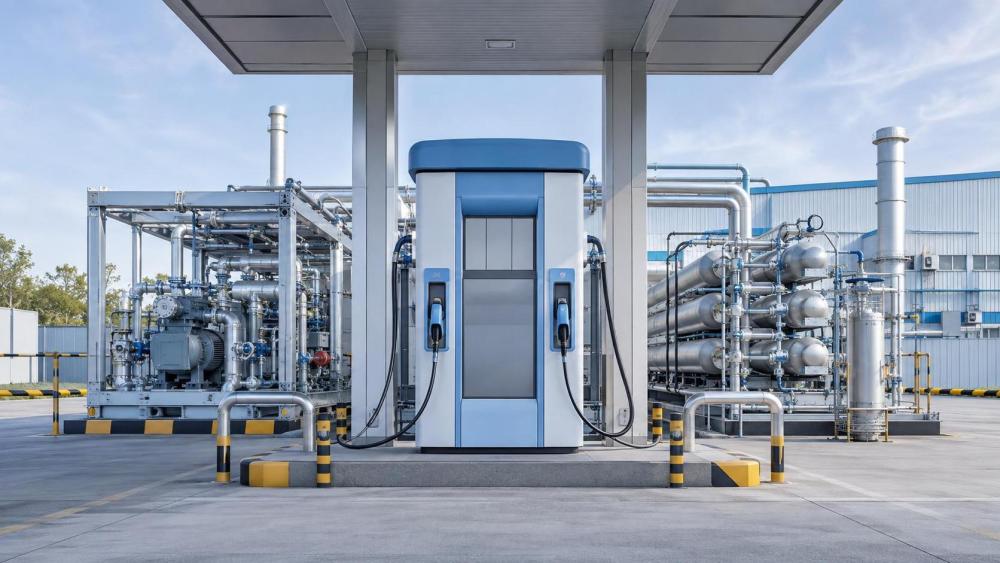
Cascade storage requires the same discipline. The number of banks, pressure levels, usable inventory, vessel arrangement, and control sequence influence both fill speed and hydrogen utilization. Storage should be evaluated together with compression and the anticipated fueling pattern. Overlooking this relationship can leave a station technically capable of reaching its stated pressure but unable to provide repeatable fills during peak demand.
Why pre-cooling and dispensing controls deserve close scrutiny
A 70 MPa fueling system is a controlled thermodynamic process. Gas temperature rises during fast filling, so the station needs an appropriately designed pre-cooling system, temperature measurement, pressure control, and a fueling algorithm compatible with the intended vehicle class. SAE J2601 is commonly referenced for hydrogen fueling protocols and should be considered alongside the vehicle interface and local approval requirements. It is not enough to state that a dispenser is “70 MPa capable.” The supplier should explain the fueling protocol, the communication method, the conditions under which a full fill is expected, and how the system responds to abnormal temperature or pressure readings.
The dispenser itself should include appropriately rated hoses, nozzles, breakaway devices, metering where required by the commercial model, clear status indication, emergency-stop access, and a practical arrangement for inspection and replacement of wear components. If both 35 MPa and 70 MPa vehicles are planned, the equipment architecture, operating logic, and capacity assumptions should show how both services will be managed without turning one into a permanent compromise.
Safety engineering must be embedded, not added at the end
Hydrogen’s low molecular weight, broad flammability range, and tendency to escape through small leakage paths demand disciplined design and operation. A turnkey station should include a documented hazardous-area assessment, hydrogen detection, ventilation where enclosure design requires it, emergency shutdown functions, pressure-relief devices, vent stacks or vent routing, electrical classification, fire detection or protection interfaces as required by the authority having jurisdiction, and clear emergency response procedures.
The relevant standards cannot be treated as names on a proposal cover page. ISO 19880 provides an important reference framework for gaseous hydrogen fueling stations. ASME B31.12 addresses hydrogen piping and pipelines. SAE J2601 is relevant to fueling protocols. Their application must be reconciled with local construction rules, fire codes, occupational safety requirements, environmental permissions, and the requirements of insurers or lenders. In some jurisdictions, the local authority may impose separation distances, inspection stages, documentation formats, or emergency-service engagement beyond what an equipment vendor normally supplies.
Material selection deserves particular attention. Hydrogen service can raise concerns around compatibility, permeation, fatigue, and embrittlement in certain conditions. Pressure-containing components, seals, tubing, fittings, weld procedures, and inspection records should be traceable to their intended hydrogen duty. This is one reason strategic benchmarking organizations such as G-HEI place material integrity alongside station efficiency and safety: high-pressure performance is only meaningful if the asset remains defensible throughout its operating life.
Civil, electrical, and utility scope is where “turnkey” often becomes ambiguous
A packaged station can arrive largely assembled, but it cannot operate without site readiness. Foundations, equipment pads, drainage, access roads, crash protection, fencing, lighting, cable routes, earthing, water supply if applicable, telecoms, and power distribution need explicit ownership. The project team should not assume these are included simply because the proposal uses the word turnkey.
Electrical demand can be material, particularly where compression and refrigeration operate concurrently. The proposed electrical load, voltage level, backup-power philosophy, harmonic considerations, transformer scope, and utility connection lead time should be assessed early. For stations coupled to on-site electrolyzers, the integration becomes more involved. The hydrogen production rate, purification, drying, buffer storage, and station demand must be coordinated; otherwise, the project may build generation capacity that does not align with actual refueling peaks.
Do not overlook vehicle movement. The trailer route, refueling lane geometry, turning radius, vehicle separation, service access to compressors and storage banks, and safe evacuation routes may determine whether a concept layout is buildable. These details are mundane compared with a 70 MPa compressor skid, but they regularly decide whether construction proceeds without redesign.
Controls, monitoring, and cybersecurity are operational equipment
A modern station should provide a supervisory control system that makes operating status understandable to both on-site staff and remote support teams. At a practical level, this includes alarms, event logs, pressure and temperature trends, dispenser transaction data where relevant, compressor status, gas detection signals, and remote diagnostics subject to the owner’s cybersecurity policy.
Project managers should ask who owns the data, who can modify control parameters, and whether remote access depends on a proprietary service platform. A station that can only be diagnosed by one vendor may be acceptable in some contracts, but the commercial and resilience implications should be explicit. Cybersecurity requirements are also becoming harder to separate from operational safety when remote access, fleet systems, utility networks, or payment platforms are connected.
Commissioning, acceptance, and lifecycle support should be contractual deliverables
A station is not truly turnkey when the vendor’s responsibility ends at mechanical completion. The scope should cover installation supervision where relevant, leak testing, pressure testing, functional testing, integrated safety testing, commissioning, operator training, documentation, and performance acceptance. The handover package should normally include process and instrumentation diagrams, electrical drawings, hazardous-area documentation, operating manuals, maintenance instructions, spare-parts lists, inspection records, software and control-system documentation, and training records.
Acceptance criteria need to be written in operational terms. They may address fuel quality responsibilities, dispensing pressure, successful fueling sequences, station availability definitions, throughput under stated assumptions, alarm and shutdown behavior, and documentation completion. The important phrase is “under stated assumptions.” A performance commitment without defined inlet conditions, ambient conditions, vehicle type, fueling sequence, and utility availability leaves too much room for dispute.
Long-term service is not an afterthought. High-pressure seals, filters, hoses, valves, sensors, refrigeration components, and compressor parts have different maintenance needs. Review recommended preventive maintenance, critical-spares strategy, response arrangements, training requirements, and the availability of qualified technicians in the project region. A lower capital offer can be less attractive if it creates a prolonged dependency on imported spares or specialist travel for routine faults.
A practical way to compare turnkey proposals
Instead of comparing quotations line by line only, create a responsibility matrix covering the full station boundary. Include hydrogen supply connection, unloading or production interface, compression, storage, dispensing, safety systems, civil works, electrical works, permits, controls, commissioning, training, warranty, and maintenance. Each item should have one accountable party, a stated interface, and an acceptance condition.
The strongest turnkey hydrogen refueling station proposal is not necessarily the one with the longest equipment schedule. It is the one that makes technical and commercial boundaries visible, links performance to real operating conditions, and treats safety, material integrity, and maintenance as design inputs from day one. For high-pressure infrastructure, those disciplines are not administrative overhead. They are what turn a collection of skids into an asset that can be permitted, operated, and expanded with confidence.
Related News
- How airports can size hydrogen infrastructure for fuel cell ground fleetsOct 10, 2026Hydrogen infrastructure solutions airports need to size fuel cell ground fleet systems for peak demand, storage, safety, and scalable growth. Explore a practical planning guide.
- What should an OEM guarantee for 70 MPa hydrogen station compressors?Oct 09, 2026Hydrogen fueling station equipment OEM guarantees for 70 MPa compressors: define safety, performance, testing, materials, uptime, and service commitments before you buy.
- What drives hydrogen compression systems cost in 70 MPa stations?Oct 08, 2026Hydrogen compression systems cost: discover the key CAPEX and lifecycle drivers for 70 MPa stations, from throughput and storage to energy, safety, and uptime.
- What drives hydrogen refueling station equipment prices?Sep 09, 2026Hydrogen refueling station equipment price: discover the key cost drivers, from compression and storage to cooling, safety, compliance, and lifecycle value.
Related News
- 00
0000-00
Hydrogen Energy Storage for Data Centers Gets Costly Fast - 00
0000-00
When 99.999% Hydrogen Purity Still Is Not Good Enough - 00
0000-00
When Does a Hydrogen-Ready Gas Turbine Pay Off? - 00
0000-00
Electricity Price Volatility Is Rewriting Hydrogen Cost Models - 00
0000-00
PSA Recovery Rate Drops for Reasons Operators Miss
Dr. Victor Gear
Weekly Insights
Stay ahead with our curated technology reports delivered every Monday.