Biodegradable Packaging for H2 Sensors: Key Trade-Offs




Biodegradable packaging becomes a real design question in hydrogen sensing
Hydrogen sensors now sit inside assets where false confidence is expensive and slow failure is dangerous.
That changes how biodegradable packaging should be judged.
In low-risk electronics, sustainable packs often compete on branding and disposal convenience.
In hydrogen infrastructure, biodegradable packaging affects contamination control, moisture exposure, traceability, and storage stability before installation.
For G-HEI-aligned projects, that distinction matters.
Whether the sensor supports PEM electrolysis, cryogenic logistics, gas turbines, CCUS interfaces, or 70MPa refueling, packaging is part of asset integrity.
The key issue is not whether biodegradable packaging is good or bad.
It is whether a biodegradable packaging format can protect calibration-sensitive components without creating hidden operational risk.
Why the same packaging choice behaves differently across hydrogen sites
Different hydrogen environments stress packaging in very different ways.
Some sensors move quickly from warehouse to installation.
Others sit for months in controlled inventory, then travel to remote sites with vibration, salt air, or freeze-thaw exposure.
A biodegradable packaging material that performs well in a dry assembly plant may soften, shed fibers, or lose barrier performance in humid transit.
That matters more for hydrogen sensors because membranes, catalytic layers, connectors, and calibration interfaces can react badly to dust, volatiles, or moisture ingress.
Another difference is compliance pressure.
Hydrogen systems are audited through broader safety and engineering frameworks, including ISO 19880, ASME B31.12, and related site protocols.
Packaging is rarely the headline item, yet poor packaging can compromise documented cleanliness, lot control, and readiness for hazardous environments.
The practical evaluation usually starts with four questions
- Does the biodegradable packaging maintain barrier performance for the actual storage period?
- Can it avoid particle shedding or chemical transfer onto sensing elements?
- Will site logistics expose it to humidity, cold shock, UV, or rough handling?
- Can the pack still support labeling, traceability, and controlled opening procedures?
Electrolyzer halls and balance-of-plant areas usually need stricter moisture discipline
In megawatt-scale PEM and alkaline installations, humidity is not just an environmental detail.
It changes how spare sensors age before commissioning.
Biodegradable packaging made from molded fiber or starch blends can fit sustainability targets.
Still, these formats need careful review when storage rooms are near wet-process zones.
A common mistake is assuming indoor storage means low exposure.
In practice, loading bays, maintenance carts, and temporary staging areas often create variable humidity cycles.
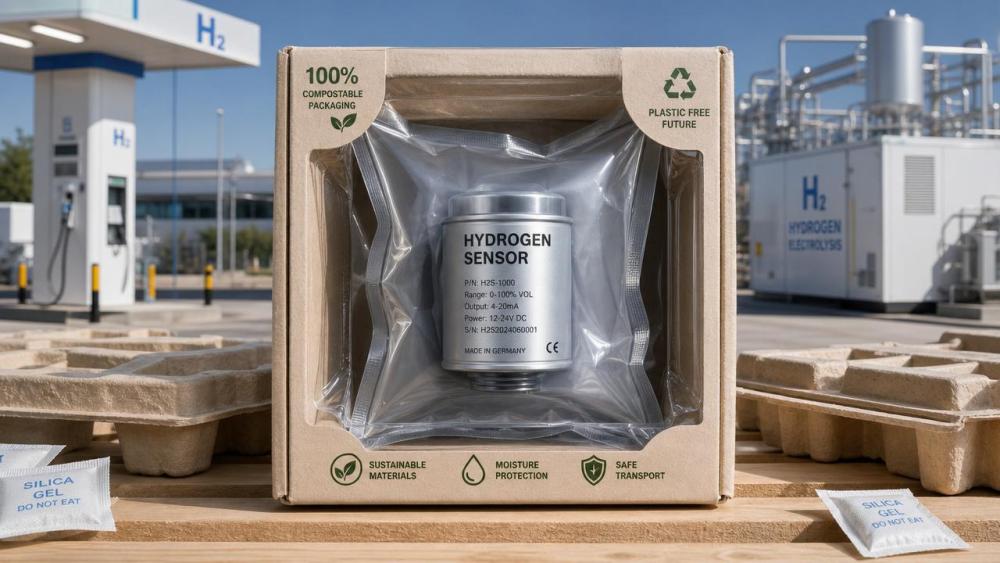
Here, biodegradable packaging works better when paired with sealed inner barriers, desiccant control, and defined maximum storage windows.
The outer pack may be compostable or fiber-based.
The sensor-facing layer should still be validated for cleanliness and vapor resistance.
Cryogenic hydrogen logistics create a different problem: transport shock and condensation cycles
Cryogenic logistics do not usually expose packaged sensors to liquid hydrogen directly.
The issue is repeated temperature transition during shipping and field handling.
A biodegradable packaging solution that becomes brittle in cold-chain support conditions may crack around corners or seals.
Once that happens, condensation can form during rewarming and shorten shelf life.
This is why transport validation matters more than brochure claims about compostability.
More robust formats often use a hybrid approach.
The biodegradable packaging handles cushioning and disposal goals, while the inner pouch controls water vapor and particulates.
That is usually easier to justify than an all-biodegradable package that cannot hold performance after thermal cycling.
At refueling stations, fast replacement and field handling often outweigh ideal lab conditions
High-pressure refueling sites create one of the clearest trade-offs for biodegradable packaging.
Sensors may be replaced under time pressure, outdoors, and by teams focused on uptime.
If packaging tears unpredictably, absorbs rain, or leaves fragments in gloves and fittings, sustainability gains disappear quickly.
In this setting, easy-open design, visible lot data, and contamination-safe unpacking matter as much as material origin.
Biodegradable packaging can still be a fit.
The better choice is usually a ruggedized format with clear opening direction, strong wet handling, and a protected inner component tray.
When judged against lifecycle cost, this reduces failed installs and repeat site visits.
Where demand differences become visible
Mixed infrastructure programs need packaging that supports traceability, not only disposal goals
Large hydrogen rollouts rarely operate as single-site projects.
Equipment moves across warehouses, integrators, testing labs, and commissioning teams.
In these programs, biodegradable packaging fails most often when label durability is ignored.
If batch codes smear, adhesive labels detach, or QR data becomes unreadable, compliance records weaken.
That is a serious issue for benchmark-driven infrastructure where every component may need documented chain-of-custody.
For G-HEI-style technical governance, biodegradable packaging should be assessed as part of the information system.
A lower-plastic package is useful only when traceability remains intact through storage, transit, opening, and replacement.
What gets misjudged most often before rollout
The first error is treating biodegradable packaging as a simple materials swap.
For hydrogen sensors, packaging performance is system-dependent.
The second error is using standard packaging tests that ignore real storage duration and field unpacking behavior.
A pack may pass compression tests and still fail during damp outdoor replacement.
Another weak point is overvaluing unit cost.
A cheaper biodegradable packaging format can become more expensive if it raises calibration drift, repeat logistics, or unusable spare rates.
There is also a standards blind spot.
Even where packaging is not directly governed, its failure can undermine documented readiness for high-integrity hydrogen service.
A better decision path before selecting biodegradable packaging
- Map each sensor type to its real storage and transport profile.
- Separate outer sustainability goals from inner protection requirements.
- Test particulate shedding, moisture ingress, and cold-to-warm transition behavior.
- Verify label readability after abrasion, humidity, and handling.
- Review disposal benefits against replacement failure costs.
The strongest fit is usually selective adoption, not universal replacement
In practice, biodegradable packaging works best when matched to packaging layers and site conditions.
Noncritical accessories may tolerate broader material substitution.
Primary hydrogen sensors usually need tighter validation.
That does not weaken the sustainability case.
It makes the case credible.
The most resilient programs define where biodegradable packaging can safely reduce plastic, where hybrid structures are justified, and where no substitution should occur yet.
Before moving forward, it helps to compare actual operating scenes, shelf-life limits, traceability demands, and contamination tolerance by asset class.
That creates a packaging standard grounded in hydrogen reality rather than sustainability symbolism alone.
Related News
- When 99.999% Hydrogen Purity Still Is Not Good EnoughApr 27, 2026Industrial decarbonization starts with more than hydrogen gas purity (99.999%). Explore hydrogen infrastructure, material integrity, safety standards, and utility-scale performance risks.
- PSA Recovery Rate Drops for Reasons Operators MissApr 27, 2026Pressure swing adsorption (PSA) recovery rate drops often stem from hidden control, valve, and adsorbent issues—not feed gas alone. Learn how to protect hydrogen purity, storage efficiency, and industrial decarbonization performance.
- Deionized Water Conductivity Limits for PEM Electrolyzers: Monitoring and ControlOct 10, 2026Deionized water conductivity for PEM electrolyzer systems: learn OEM limits, monitoring points, alarm strategies, and practical control steps to protect stack performance.
- How to complete a hydrogen certification compliance checkOct 01, 2026Hydrogen certification compliance check guide: verify standards, materials, safety systems, testing records, and field installations to close gaps and prepare assets for approval.
Related News
- 00
0000-00
Hydrogen Energy Storage for Data Centers Gets Costly Fast - 00
0000-00
When 99.999% Hydrogen Purity Still Is Not Good Enough - 00
0000-00
When Does a Hydrogen-Ready Gas Turbine Pay Off? - 00
0000-00
Electricity Price Volatility Is Rewriting Hydrogen Cost Models - 00
0000-00
PSA Recovery Rate Drops for Reasons Operators Miss
Dr. Victor Gear
Weekly Insights
Stay ahead with our curated technology reports delivered every Monday.