
What does hydrogen quality control need to detect at a fueling station?




Hydrogen quality control at a fueling station must detect whether the delivered gas remains within the composition and contamination limits required by the vehicle fuel-cell system and the station’s refueling process. The release decision cannot rely on a delivery certificate alone. Compression, storage, cascade cycling, transfer hoses, filters, valves, dryers, and sampling connections can all introduce or concentrate contaminants after hydrogen leaves the production site.
For road-vehicle applications, SAE J2719 is commonly used as the fuel-quality reference, while station design and dispensing practices may also be governed by ISO 19880-series requirements and SAE J2601 fueling protocols. These documents address different parts of the system, but they meet at the dispenser: hydrogen must be clean enough for the vehicle, dry enough for fuel-cell durability, and consistent enough for controlled high-pressure fills.
Hydrogen purity and composition
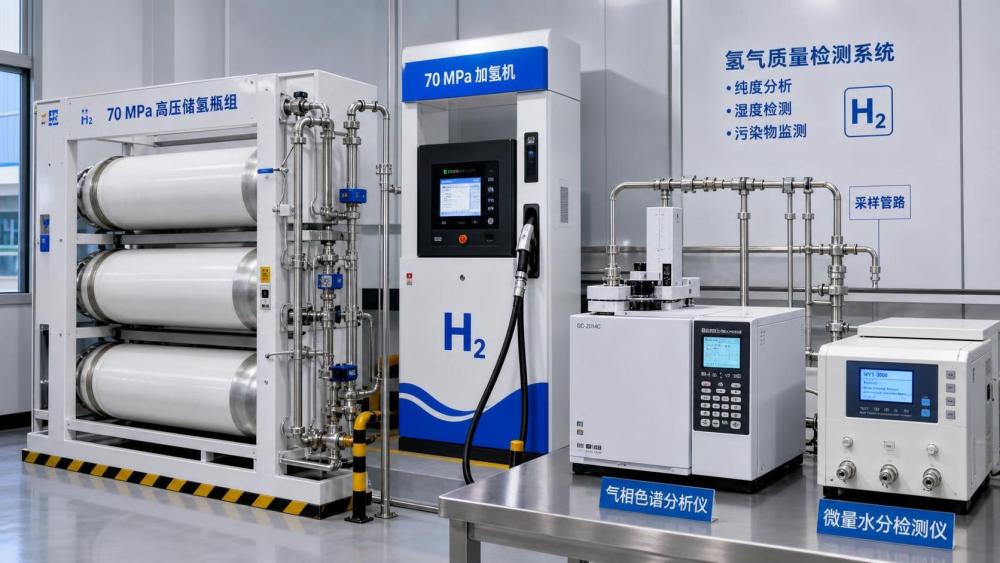
The first measurement is bulk hydrogen content. A low total hydrogen concentration may indicate dilution by air, nitrogen, methane, carbon dioxide, or another process gas. The analytical method must distinguish a true purity issue from an instrument response caused by pressure, temperature, or sample-line contamination. Gas chromatography is often used for periodic confirmation because it can separate multiple permanent gases and hydrocarbons. A process analyzer may be used for continuous or frequent screening where its range, calibration gases, and cross-sensitivity are suitable.
Composition deviations deserve investigation even when the hydrogen purity result appears close to a specified threshold. A small increase in nitrogen may point to inadequate purging after maintenance, ingress through a poorly sealed connection, or residual gas in a trailer, tube bundle, or sample cylinder. Oxygen can indicate air ingress and may also create a compatibility concern when hydrogen is present in confined equipment. Methane, argon, helium, and carbon dioxide can be associated with upstream production, purification, transport, or purge practices. Their significance depends on concentration, source, and the applicable fuel specification.
A meaningful quality program records both the measured value and the sampling location. Gas at the incoming connection is not necessarily representative of gas delivered at the nozzle. Testing at receipt, after compression, in storage, and at the dispenser creates a traceable picture of where a deviation entered the station.
Water: a small contaminant with large consequences
Moisture is one of the most sensitive and operationally relevant measurements. Water can affect polymer-electrolyte fuel-cell performance and durability, promote corrosion in unsuitable components, reduce the effectiveness of adsorption media, and freeze or condense under some pressure-reduction and temperature conditions. Water also complicates the interpretation of other contaminant measurements because it can adsorb onto tubing walls and then desorb slowly during sampling.
Detection should be expressed in a unit compatible with the governing specification and the instrument’s calibration basis. Dew-point instruments may be practical for process surveillance, but their reading must be interpreted at the correct pressure. A dew point measured under elevated pressure cannot be compared directly with a limit stated as a mole fraction without an appropriate conversion. Trace-moisture analyzers based on cavity ring-down spectroscopy, tunable diode laser absorption, electrolytic sensors, or other validated methods can offer different response times, ranges, maintenance burdens, and susceptibility to contamination.
Sample-system design often determines whether a low-level water result is credible. Stainless-steel tubing with clean, compatible fittings is generally preferred. Dead legs should be minimized; polymer tubing, lubricated quick-connects, and poorly dried regulators can release water long after installation. Before a sample is accepted, the line should be purged until the reading stabilizes in accordance with the documented method. A rapid low value immediately after connecting an analyzer may simply reflect dry residual gas inside the instrument path, while a drifting high value can come from the sample train rather than the hydrogen supply.
Contaminants that affect fuel-cell electrochemistry
Several contaminants may be present at extremely low concentrations yet remain relevant because fuel-cell catalysts and membrane assemblies are sensitive to particular chemical species. Carbon monoxide is a familiar concern because it can adsorb on platinum catalyst sites and reduce electrochemical activity. Carbon dioxide, ammonia, formaldehyde, formic acid, and other carbon- or nitrogen-containing compounds can originate from upstream processes, adsorbents, cleaning products, ambient ingress, or material degradation. The correct list and limits should be taken from the fuel-quality specification applicable to the delivered hydrogen grade.
Total hydrocarbon screening alone is rarely enough. A total hydrocarbon analyzer can reveal unusual organic contamination, but it may not identify the compound responsible or prove compliance with individual limits. When a screening result is elevated, laboratory-grade gas chromatography or mass-spectrometric analysis may be needed to identify the source. The distinction matters: methane, compressor oil vapor, solvent residue, and plasticizer emissions do not carry the same implications or require the same corrective action.
Ammonia requires particular care in stations supplied by hydrogen from ammonia-related value chains or facilities using nitrogen-bearing chemicals. Detection methods must have a verified low-range response and compatible wetted materials. Ammonia can adsorb strongly to sample surfaces, creating delayed response and apparent memory effects. A sample line that has previously seen a high concentration can affect later measurements unless it is properly conditioned or replaced.
Oil, aerosols, and particles
Hydrogen may meet gaseous impurity limits while still carrying liquid or solid material that threatens equipment and vehicle interfaces. Compressor lubricant carryover, degraded seals, desiccant fines, metallic wear debris, gasket fragments, and corrosion products can enter the high-pressure stream. These materials may foul valves, restrict filters, damage precision components, or transfer through the dispenser coupling.
Oil contamination should be assessed as both vapor and aerosol risk. A vapor-phase measurement may miss droplets or condensed material trapped upstream of the sample point. Conversely, a filter-based particle sample may capture material introduced by the sampling assembly itself. The method should specify line cleanliness, collection media, flow rate, sampled volume, blank controls, handling conditions, and the analytical technique used to characterize collected material. Gravimetric measurement, microscopy, infrared analysis, and elemental analysis answer different questions and should not be treated as interchangeable.
Differential pressure across filtration stages is useful as an asset condition indicator, but it is not a direct proof of delivered cleanliness. A low differential pressure can coexist with filter damage, bypassing, incorrect installation, or contamination downstream of the filter. High differential pressure may signal loading, moisture exposure, or flow conditions outside the original design basis. Filter replacement should preserve traceability for element grade, material compatibility, installation orientation, and service history.
Point of control matters in a 70 MPa station
A station supplying 70 MPa vehicles commonly receives hydrogen, compresses it, stores it in high-pressure banks, and dispenses through cooling and pressure-control equipment. Each transition creates a separate quality-control boundary. Incoming verification protects the station inventory. Post-compression monitoring can reveal lubricant carryover or wear. Storage monitoring can show whether purge gas, maintenance activity, or cross-contamination affected a bank. Nozzle-side sampling provides the closest representation of the gas a vehicle may receive.
Sampling directly at the dispenser must be engineered so that it does not create an unsafe release path or alter the fuel condition being measured. Pressure reduction generates cooling and can cause condensation, which changes the apparent concentration of some contaminants. Heated or temperature-controlled sample paths may be appropriate for certain analyses, provided the method establishes that the arrangement does not create new artifacts. Materials in contact with high-pressure hydrogen must also be selected for the pressure, temperature, permeation, cleanliness, and hydrogen-compatibility requirements of the installation.
Refueling control data and quality data should be reviewed together. A fill that terminates early, shows an unusual pressure-temperature profile, or repeatedly triggers dispenser faults may have mechanical or communication causes, but it can also justify a quality investigation. Quality records become more useful when they include bank identification, source lot, delivery time, compressor operating state, filter service events, analyzer status, and the exact point at which the sample was taken.
Distinguishing real contamination from bad measurement
False alarms are costly because they can immobilize inventory and prompt unnecessary maintenance. False passes carry a more serious downstream risk. The response to an out-of-specification reading therefore needs a disciplined confirmation path.
- Verify instrument status first: calibration validity, zero and span response, analyzer alarms, pressure control, and sample-flow stability.
- Inspect the sampling path for leaks, loose fittings, damaged regulators, residual cleaning fluids, incorrect tubing, or a recently changed filter element.
- Take a confirmatory sample using an independent method or a separately prepared sample path when the contaminant and limit justify it.
- Compare upstream and downstream locations rather than relying on a single result. A location-based difference can isolate whether the source is delivered hydrogen, compression equipment, storage, or dispensing hardware.
- Preserve the affected records and segregate the relevant inventory according to the station’s release procedure until the result is resolved.
Calibration gas quality is part of the measurement system. Trace-level analyzers require calibration standards with suitable uncertainty, stability, cylinder treatment, and expiration control. A calibration gas that lacks the target compound, contains an incompatible balance gas, or has changed composition during storage can create a misleadingly precise result. Functional tests should also cover alarms, automatic shutdown logic where installed, data capture, and time synchronization between analyzers and station controls.
Maintenance activities can change fuel quality
Many contamination events begin during otherwise routine work. Opening a line exposes internal surfaces to ambient moisture. Replacing a valve or regulator can introduce machining residues, thread compounds, elastomer fragments, or debris from protective caps. Using nitrogen for purging may leave residual nitrogen if the purge and displacement sequence is incomplete. Introducing oil-lubricated tools or compressed shop air near open hydrogen equipment increases the chance of avoidable contamination.
A controlled return-to-service sequence should define cleaning acceptance, approved materials, purge gas quality, purge volume or endpoint, leak testing, initial sampling, and release authority. Particular attention is needed after compressor seal work, dryer media replacement, storage-vessel intervention, relief-device work, and replacement of dispenser hoses or breakaway assemblies. These events affect different failure modes, so a generic maintenance release form can miss the relevant quality risks.
Supplier documentation remains valuable, especially for bulk deliveries and tube-trailer receipts, but it should be reconciled with station data. A certificate can describe the product at the point of certification; it does not confirm that every transfer connection, storage bank, and downstream component remained clean. Chain-of-custody records should identify source, delivery vessel, receiving connection, transfer date, and any blending or recirculation event.
Using trends instead of isolated readings
Hydrogen quality control becomes more reliable when it treats results as a time series. A water value that is technically acceptable but rising after each compression cycle may reveal dryer exhaustion before an actual limit is exceeded. Recurrent particle findings after a particular maintenance action may point to a material or cleaning issue. Short contaminant spikes during high-demand periods can indicate thermal, flow, or pressure-related behavior that a single stationary sample would miss.
Trend limits should be separated from formal specification limits. An internal investigation threshold can trigger sampling, inspection, or maintenance planning without declaring the delivered gas nonconforming. The distinction prevents operational decisions from being driven by arbitrary alarms while still providing an early warning path. Every threshold needs a documented basis, including method uncertainty and the expected variability of the measurement.
At the fueling station, the objective is to establish confidence that the hydrogen at the dispensing interface retains the intended purity through its entire handling path. That confidence comes from targeted contaminant detection, representative sampling, controlled maintenance, and records that connect each result to the actual gas route through the station.
Related News
- When 99.999% Hydrogen Purity Still Is Not Good EnoughApr 27, 2026Industrial decarbonization starts with more than hydrogen gas purity (99.999%). Explore hydrogen infrastructure, material integrity, safety standards, and utility-scale performance risks.
- PSA Recovery Rate Drops for Reasons Operators MissApr 27, 2026Pressure swing adsorption (PSA) recovery rate drops often stem from hidden control, valve, and adsorbent issues—not feed gas alone. Learn how to protect hydrogen purity, storage efficiency, and industrial decarbonization performance.
- Hydrogen Purity for PEM Fuel Cells: Which Contaminants Must Be Tested?Oct 20, 2026Hydrogen purity matters for PEM fuel cells. Discover which contaminants to test, how ISO 14687 applies, and why reliable sampling helps protect performance and verify fuel quality.
- Hydrogen Procurement Due Diligence: Verifying Supply, Purity, and Delivery TermsOct 15, 2026Hydrogen knowledge for procurement: verify supply capacity, purity, certificates, logistics, pricing, and delivery terms to secure reliable, cost-controlled hydrogen supply.
Related News
- 00
0000-00
Hydrogen Energy Storage for Data Centers Gets Costly Fast - 00
0000-00
When 99.999% Hydrogen Purity Still Is Not Good Enough - 00
0000-00
When Does a Hydrogen-Ready Gas Turbine Pay Off? - 00
0000-00
Electricity Price Volatility Is Rewriting Hydrogen Cost Models - 00
0000-00
PSA Recovery Rate Drops for Reasons Operators Miss
Dr. Victor Gear
Weekly Insights
Stay ahead with our curated technology reports delivered every Monday.