
How ISO 19880 shapes safety requirements for hydrogen refueling systems




ISO 19880 shapes hydrogen refueling safety by treating a station as an integrated pressure-management system rather than a collection of approved components. A dispenser, storage bank, compressor, piping run, breakaway coupling, vent stack, and control logic can each meet an individual specification while the assembled station still contains unsafe pressure paths, trapped gas volumes, incompatible materials, or inadequate separation from ignition sources. The standard directs attention to those interfaces.
For high-pressure vehicle fueling, the most consequential hazards arise from hydrogen's low ignition energy, broad flammability range, rapid release behavior, and ability to permeate or degrade certain metallic materials under particular stress and environmental conditions. ISO 19880 addresses these hazards through requirements and engineering principles covering station layout, equipment selection, pressure containment, hazardous-area control, emergency response functions, inspection, and verification. Its value lies in converting a broad safety objective into design and operational decisions that can be traced, reviewed, and tested.
Safety begins with the defined operating envelope
A refueling system cannot be assessed solely by its nominal pressure rating. The intended service envelope needs to state the hydrogen supply condition, maximum allowable pressure, temperature range, flow behavior, filling protocol, storage arrangement, expected duty cycle, and external conditions. A station designed around compressed gaseous hydrogen has different containment and venting considerations from one receiving liquid hydrogen and vaporizing it on site. Likewise, a 70 MPa dispensing arrangement introduces different thermal and pressure-transient demands than lower-pressure dispensing.
ISO 19880 drives this definition early because later decisions depend on it. Pipe wall thickness, valve selection, pressure-relief settings, temperature instrumentation, nozzle performance, and control-system interlocks cannot be judged independently of the actual operating envelope. A component data sheet stating a pressure capability is insufficient when its rating excludes cyclic service, low-temperature exposure, rapid pressurization, or hydrogen service.
Pressure is also frequently misunderstood as a static value. During compression, cascade switching, pre-cooling, and vehicle filling, local conditions may change quickly. Dead legs and isolated cavities can retain gas that expands when temperature rises. A downstream section can remain pressurized after a command to stop flow if isolation logic and venting paths are not considered together. ISO 19880 therefore supports a system view in which normal, transient, maintenance, and fault conditions are defined before safeguards are credited.
Layout, separation, and controlled release paths
Physical arrangement is a primary safety control, not a final civil-design exercise. Equipment handling high-pressure hydrogen must be located so a foreseeable leak or pressure-relief discharge does not create an uncontrolled accumulation near electrical equipment, buildings, vehicle circulation routes, air intakes, enclosed pits, or routine access points. Clear routing for relief discharge is especially important because a relief device protects the pressure boundary only when its discharge destination is safe.
A vent line that appears acceptable on a drawing can become problematic after installation. Horizontal runs, low points, restrictive fittings, unsupported sections, or shared discharge headers may affect backpressure, condensate management, mechanical stability, and the direction of a release. The discharge point also needs to remain effective after adjacent structures, signs, canopies, or later site modifications are added. Venting arrangements should be reviewed as three-dimensional flow paths rather than as symbols on a piping diagram.
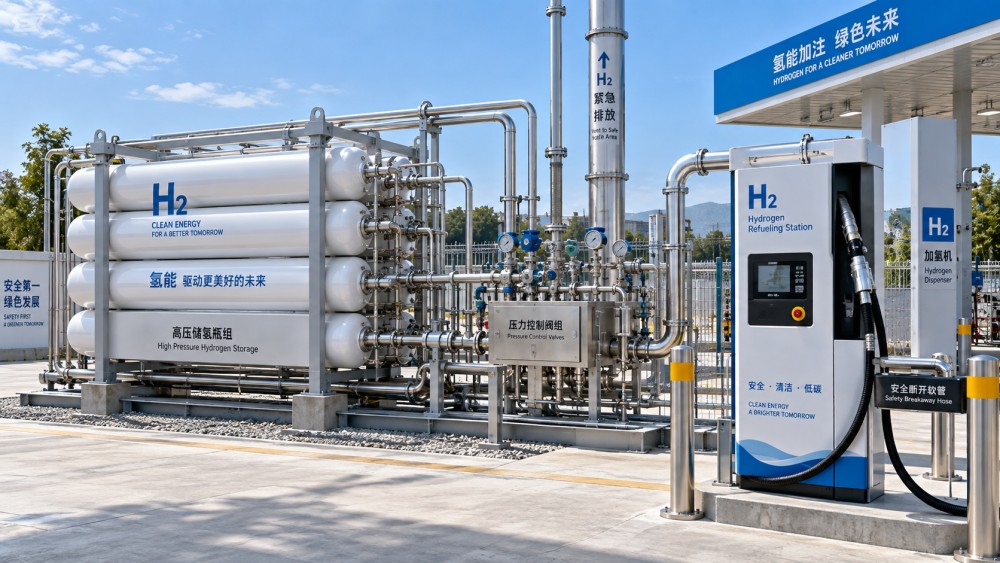
Enclosures require particular scrutiny. Hydrogen that leaks outdoors often disperses upward, but a roof cavity, cabinet top, canopy feature, or poorly ventilated compartment can interrupt that behavior. Natural ventilation assumptions must match the actual geometry, openings, and obstruction pattern. Where forced ventilation or gas detection supports the safety concept, loss of power, sensor fault, maintenance bypass, and alarm response need defined treatment. A detector alone does not control a release; its location, alarm setpoint, voting logic, shutdown action, and proof-testing arrangement determine whether it contributes meaningful risk reduction.
Pressure containment is a materials and fabrication question
ISO 19880 influences component integrity by requiring pressure-containing equipment to be appropriate for hydrogen service and the loads it will experience. This extends beyond vessel and pipe pressure ratings. Material selection must consider hydrogen-assisted cracking or embrittlement susceptibility, tensile strength, hardness, microstructure, residual stress, cyclic loading, environmental exposure, and manufacturing route. A material suitable for another compressed gas is not automatically suitable for high-pressure hydrogen.
The practical distinction matters most at local stress raisers. Threads, sharp geometry changes, damaged sealing faces, weld toes, transitions between dissimilar sections, and poorly supported small-bore tubing may carry much higher local stress than a simplified line-pressure calculation suggests. Surface condition and fabrication quality can change the significance of those locations. Cold work introduced during bending, inappropriate heat treatment, uncontrolled grinding, or unqualified repair work can alter the integrity basis even if the part's original material certificate was acceptable.
Joining methods deserve the same level of review as base materials. Welded connections, cone-and-thread fittings, compression fittings, flanges, and proprietary high-pressure joints have different failure modes and inspection needs. A fitting that seals reliably during a brief hydrostatic test can develop leakage during repeated pressure cycles if assembly torque, tube preparation, alignment, or vibration restraint is uncontrolled. The relevant evidence includes installation instructions, assembler competence, inspection records, torque or make-up controls where applicable, and traceability of the actual components installed.
Hydrostatic testing and leak testing answer different questions. A strength-oriented pressure test demonstrates that a pressure boundary tolerates a specified test condition; it does not establish that every hydrogen sealing interface will remain tight in service. Leak testing must use an appropriate method, sensitivity, pressure condition, stabilization period, and acceptance criterion for the part of the system being examined. Test medium selection, drying, purge arrangements, and isolation of sensitive instruments also require planning. Residual moisture, trapped liquid, or contamination left after testing can create later reliability concerns.
Dispensing performance is linked to thermal control
Safe vehicle fueling depends on the relationship between hydrogen temperature, mass flow, pressure rise, vehicle tank response, and the selected fueling protocol. Rapid filling produces temperature effects that cannot be managed by a pressure limit alone. The dispenser control system must receive valid signals, apply the intended control logic, and stop or modify fueling when temperature, pressure, communication status, or abnormal-flow conditions fall outside the permitted range.
Pre-cooling is often described too simply as a way to make filling faster. Its safety function is to manage the thermal state of gas entering the vehicle system so the fill remains within the applicable fueling limits. The required performance is affected by ambient temperature, inlet gas temperature, refrigeration availability, flow demand, thermal soak, and the condition of the cooling circuit. A station can show acceptable behavior during a short commissioning sequence yet lose margin after repeated fills when cooling capacity has not recovered.
Temperature sensors need more than a calibration certificate. Their placement must represent the controlled process, their response time must suit the control action, and failed or implausible readings must lead to a defined state. A sensor mounted where it sees a chilled pipe wall rather than representative flowing gas can create false confidence. The same concern applies to pressure transmitters placed across filters, check valves, or restrictions: the indicated value may not be the pressure relevant to the protected equipment or vehicle interface.
Isolation, emergency shutdown, and depressurization
ISO 19880 places emphasis on bringing the system to a defined safe condition during abnormal events. That condition is not always identical across the station. An emergency shutdown may need to stop compression, close source isolation valves, prevent further dispensing, de-energize selected equipment, and preserve functions needed for detection, communication, or controlled venting. The shutdown philosophy should identify which valves fail closed, which remain powered, how stored energy is handled, and what occurs after loss and restoration of electrical power.
Emergency isolation valves are often credited without examining their installed environment. A valve's response time, flow direction, actuator supply, fire exposure, accessibility, and position feedback can affect the outcome. A closed isolation valve can also leave a confined section between two valves at elevated pressure. Controlled depressurization may be needed for defined segments, but venting every section automatically can create a larger release than necessary. The design basis should distinguish between isolating the source, relieving overpressure, and intentionally depressurizing equipment for maintenance or fault response.
Breakaway devices at the dispenser illustrate the need for functional testing. Their purpose is not merely to separate under excessive hose load. After activation, they need to limit release from both relevant sides as intended, avoid creating projectile hazards, and support clear restoration controls. Replacement with a visually similar part that lacks the correct pressure, flow, material, or certification basis can invalidate the original design assumptions.
Risk assessment must follow actual flow paths
A useful assessment traces credible releases from each pressure segment through the physical station. It asks where hydrogen can go after a failed seal, ruptured tube, open relief device, damaged hose, or unintended valve position. It then evaluates ignition sources, confinement, occupancy, detection, isolation, ventilation, and emergency access along that path. Generic hazard-register language is inadequate when it does not identify the valves, circuits, elevations, enclosures, and response actions that make the station unique.
Changes deserve the same discipline as initial design. Replacing a regulator with a different internal volume, extending a vent pipe, moving a detector, modifying a compressor control panel, or adding a protective enclosure can alter the safety case. Such changes should trigger review of drawings, hazardous-area classification, cause-and-effect logic, relief calculations, inspection requirements, and training materials where relevant. Minor-looking modifications are a common source of mismatch between approved documents and the installed station.
Verification continues after commissioning
Conformity with ISO 19880 is sustained through evidence, not a one-time acceptance event. Commissioning should confirm that piping is correctly identified, pressure boundaries match drawings, valves move to their intended positions, alarms initiate the specified response, vent paths are unobstructed, and dispenser behavior remains within its approved control envelope. Functional tests need recorded preconditions and pass criteria; a statement that an emergency stop was “tested” has limited value without identifying what was observed.
Inspection intervals should reflect degradation mechanisms rather than calendar habit alone. High-cycle valves, hoses, couplings, filters, seals, sensor lines, and compressor-adjacent tubing may require closer attention because vibration, pressure cycling, contamination, or thermal movement concentrates there. Leak investigation should distinguish between a recurring fitting assembly issue, a seal-material compatibility problem, a pressure transient, and damage from external loading. Re-tightening a connection without determining why it leaked can conceal the mechanism until the next cycle.
ISO 19880 ultimately sets a disciplined expectation: the station must remain understandable as built, as operated, and as changed. When design intent, component evidence, control logic, and field configuration remain aligned, high-pressure hydrogen hazards are managed through verifiable barriers rather than assumptions.
Related News
- UK Hydrogen Refuelling Developer Element 2 Enters Administration, Business Put Up for SaleNov 09, 2026Element 2 enters administration, putting its UK hydrogen refuelling business up for sale. Explore potential risks for suppliers, buyers and infrastructure projects.
- What does ISO 19880-2 require for hydrogen refueling dispensers?Oct 22, 2026Hydrogen refueling stations ISO 19880: explore ISO 19880-2 dispenser safety, pressure integrity, and verification evidence to assess supplier claims and make confident buying decisions.
- Hydrogen Dispenser Certifications: Which Standards Apply to 70 MPa Retail Stations?Oct 09, 2026Hydrogen dispenser certifications for 70 MPa retail stations: explore ISO 19880, SAE J2601, pressure equipment, hazardous-area and metering requirements.
- What certification is required before an H2 dispenser enters service?Oct 18, 2026H2 dispenser certification: discover the approvals, safety tests, commissioning evidence, and metrology checks needed before a hydrogen dispenser enters service.
Related News
- 00
0000-00
Hydrogen Energy Storage for Data Centers Gets Costly Fast - 00
0000-00
When 99.999% Hydrogen Purity Still Is Not Good Enough - 00
0000-00
When Does a Hydrogen-Ready Gas Turbine Pay Off? - 00
0000-00
Electricity Price Volatility Is Rewriting Hydrogen Cost Models - 00
0000-00
PSA Recovery Rate Drops for Reasons Operators Miss
Dr. Victor Gear
Weekly Insights
Stay ahead with our curated technology reports delivered every Monday.