Hydrogen Dispenser Certifications: Which Standards Apply to 70 MPa Retail Stations?




At a 70 MPa retail hydrogen station, dispenser certification is not established by a single document or a single pressure rating. The dispenser sits at the intersection of station safety requirements, fueling-protocol requirements, pressure-equipment law, electrical installation rules, metering obligations, and component approvals. A unit can contain individually certified valves, hoses, breakaways, fittings, and electrical equipment yet still fail acceptance if the assembled dispenser, its controls, or its installation do not meet the applicable station-level requirements.
The practical starting point is to separate standards that define the fueling system from rules that create a legal route to place equipment into service. ISO 19880 series documents are central references for gaseous hydrogen fueling stations. SAE J2601 governs the fueling protocol used to fill hydrogen storage systems, particularly the relationship among pressure, temperature, state of charge, and permissible fueling conditions. National or regional law then determines how pressure equipment, hazardous-area electrical equipment, weighing or metering devices, and the completed installation must be approved or inspected.
What a 70 MPa dispenser must demonstrate
A nominal 70 MPa vehicle fill is commonly described as “700 bar,” but that label is insufficient for certification review. The dispenser’s high-pressure path must be evaluated against its maximum allowable working pressure, expected pressure excursions, design temperature range, hydrogen compatibility, and the conditions imposed by the fueling sequence. Components downstream of compression and storage can experience rapid pressurization, repeated cycling, low gas temperatures during expansion, and elevated temperatures associated with fast filling. These conditions are different from a static vessel holding hydrogen at one stable pressure.
ISO 19880-1 provides a system-level framework for gaseous hydrogen fueling stations. It addresses topics such as system layout, safety functions, venting, separation, emergency shutdown, pressure protection, materials, inspection, and commissioning. It does not function as a universal product certificate for every dispenser sold in every jurisdiction. Instead, it supplies the engineering basis against which the station and its dispenser interface can be specified, assessed, and verified.
For a dispenser assembly, the evidence package normally has to establish several connected facts:
- The pressure-containing components are rated for the highest pressure and temperature envelope expected at their actual location, rather than merely for the advertised vehicle nominal pressure.
- Hydrogen-wetted materials, seals, tubing, connectors, and valve internals are suitable for high-pressure gaseous hydrogen and for the anticipated pressure-cycle duty.
- The dispenser’s control logic supports the selected fueling protocol, including communication behavior, temperature input handling, pressure measurement, and termination conditions.
- Electrical parts are appropriate for the hazardous-area classification assigned to the physical installation, with enclosure, cable-entry, grounding, and maintenance conditions preserved.
- The installed dispenser can safely isolate, depressurize where required, detect abnormal conditions, and transition to a defined safe state after loss of power or a fault.
These points cannot be treated as independent procurement boxes. A hose certification, for example, does not prove that a hose routing radius, coupling arrangement, breakaway interface, or protective sleeve is acceptable in the finished dispenser. Similarly, an approved transmitter does not validate its installation if impulse lines, fittings, electrical segregation, or software scaling introduce a failure path.
ISO 19880 and the boundary of the dispenser
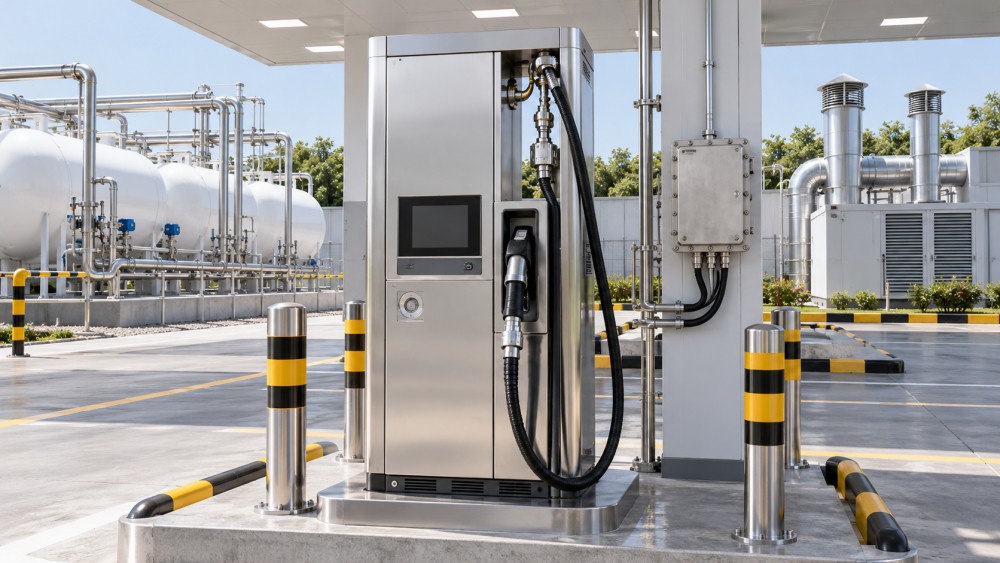
ISO 19880 is often cited as though it applies only to the upstream station. That interpretation is too narrow. The dispenser is part of the hydrogen delivery system and participates in safety functions that affect the station as a whole. Its physical boundary should be defined clearly in the design dossier: high-pressure inlet isolation, filters, piping, valves, pressure-control elements, metering section, hose, breakaway, nozzle, vent or purge routing, control enclosure, and emergency interfaces.
Boundary definition matters because responsibilities can otherwise disappear between packaged equipment suppliers. The station package may identify an emergency shutdown function, while the dispenser drawing assumes the dispenser controller will close a local valve. If the control-cable interface, fail position, power-loss behavior, or response-time requirement is not documented, the function exists on paper but is not demonstrably complete.
ISO 19880-aligned review should also examine the vent path created by normal and abnormal events. Relief discharge, bleed-down discharge, trapped-volume depressurization, nozzle disconnection behavior, and enclosure leakage require different analysis. Routing every release to a common line is not automatically acceptable; flow capacity, backpressure, discharge location, ice formation, condensate, and the possibility of a blocked outlet all affect the result. A vent designed for a small controlled purge may be unsuitable for the credible discharge flow associated with a relief device.
The standard framework also places importance on component accessibility and protective arrangements. High-pressure joints located behind panels are not harmless simply because they are concealed. Service clearances, leak-test access, protection from vehicle impact, hose handling, drainage, and the ability to inspect fittings after a drive-off or breakaway event all influence whether the installation remains maintainable and verifiable.
SAE J2601 is a fueling requirement, not a pressure-equipment certificate
SAE J2601 addresses protocol-controlled hydrogen fueling. For a 70 MPa retail dispenser, its relevance lies in whether the dispenser and station controls can execute the applicable fill sequence within defined limits. The protocol relies on measured or communicated conditions, commonly including vehicle information, hydrogen gas temperature, pressure, and fueling state. A dispenser cannot claim protocol conformity merely because it has a 70 MPa-rated nozzle and a high-pressure hose.
Protocol compliance depends on the integrity of the full measurement-and-control chain. Pressure transmitters need an appropriate range, accuracy, response behavior, calibration method, and traceability. Gas-temperature sensors must be installed where their readings represent the gas condition used by the control algorithm; a sensor mounted in a thermally lagging pocket or influenced by ambient enclosure heat can cause systematic error. Flow measurement, where used for transaction or control purposes, must be evaluated for the intended hydrogen properties and operating range.
Communication deserves equal scrutiny. A failed or degraded vehicle-dispenser communication session should produce a defined outcome under the selected protocol, not an improvised manual workaround. Software versions, configurable fueling tables, alarm thresholds, and cybersecurity-controlled access to parameter changes belong in the certification record because an otherwise compliant physical dispenser can be altered materially by a configuration change.
There is also a distinction between protocol capability and site capability. A dispenser controller may support a 70 MPa fueling protocol, while the station’s precooling capacity, cascade-storage arrangement, compressor recovery behavior, or inlet gas temperature cannot sustain the assumed fueling envelope during repeated transactions. Acceptance testing should therefore use representative station conditions rather than a single favorable demonstration fill.
Regional regulation determines the approval route
International standards provide technical alignment, but local law establishes whether pressure equipment requires third-party conformity assessment, registration, inspection before service, periodic examination, or documentation in a prescribed language and format. The legal classification may differ between a pressure vessel, piping assembly, safety accessory, hose assembly, and dispenser enclosure. A dispenser is often a mixed assembly rather than one homogeneous regulated item.
In regions applying pressure-equipment legislation, the assessment must address the pressure-bearing parts according to their classification rules and applicable conformity route. In other jurisdictions, approval may be tied to recognized codes, an authority having jurisdiction, a fire-safety review, or site-specific inspection. The correct question is not “Is the dispenser certified?” but “Which elements require approval here, under which scope, and what evidence is accepted at commissioning?”
Component certificates need context
Hydrogen dispenser certifications frequently fail at the document-review stage because certificates are collected without comparing their conditions of use to the final bill of materials and piping diagram. A certificate should be reviewed for the exact model, revision, material, sealing compound, pressure class, temperature rating, connection type, electrical category, and permitted environment. A product family certificate may exclude a variant selected for a particular enclosure or hose arrangement.
Material verification requires more than confirming stainless steel on a purchase order. Hydrogen service can be sensitive to alloy grade, strength level, cold work, heat treatment, weld condition, surface condition, and cyclic loading. A tube or fitting that is technically compatible with hydrogen in a general material listing may still require a more specific fatigue or fracture-mechanics basis at the applied stress level. Substitution of a higher-strength fastener, a different elastomer, or an alternative cleaning process should not be treated as a minor commercial change.
Cleanliness is another underappreciated certification boundary. Particles left after tube cutting, machining, or assembly can damage valve seats and regulators, interfere with sealing, or migrate into sensitive metering and nozzle components. Documentation should connect fabrication cleanliness requirements to flushing, inspection, filter strategy, and final assembly controls. Pressure testing alone cannot show that the high-pressure circuit is free of contamination or that seals have remained undamaged after repeated assembly.
Installation can invalidate an otherwise compliant package
Factory acceptance evidence is valuable, but retail-site installation introduces conditions that a factory test may not reproduce. Foundations and vehicle barriers can alter access or impact protection. Field-made tubing runs may introduce bends, unsupported mass, vibration points, or fitting orientation that differs from the qualified design. A vent line may be extended to suit the site and thereby exceed the backpressure assumptions of a relief device. Electrical bonding can be interrupted by paint, nonconductive gaskets, or later panel replacement.
Commissioning should therefore reconcile the as-built condition with the approved design. The record should include current piping and instrumentation drawings, electrical drawings, hazardous-area classification drawings, relief-device data, material traceability where required, torque or assembly records for critical joints, leak-test results, functional tests, and software configuration identification. Photographic evidence is useful for concealed tubing, cable glands, grounding points, and vent routing before panels are closed.
Leak testing needs a defined method and acceptance basis. A broad test of the completed circuit can reveal gross leakage, but it does not necessarily isolate the source of a small leak at a valve stem, fitting, nozzle seal, or enclosure penetration. Test pressure, stabilization time, temperature correction where relevant, instrument resolution, and isolation boundaries should be recorded. A pressure loss caused by thermal settling is not equivalent to a leak, while dismissing all pressure change as temperature effect can hide a genuine defect.
Maintaining the certified condition
Certification is tied to a configuration, not merely to the dispenser serial number. Replacing a breakaway, hose, nozzle, valve cartridge, controller, temperature probe, display, or cable gland can affect the evidence basis. The replacement part should match the approved specification, and any deviation should trigger engineering review before return to service. This is particularly important when obsolete components are replaced by later revisions whose interfaces appear identical.
Periodic inspection should focus on degradation mechanisms that are realistic for high-pressure dispensing: hose abrasion and twist, nozzle latch wear, damaged sealing surfaces, fitting fretting from vibration, corrosion beneath clamps, filter loading, enclosure ingress, relief-path obstruction, and drift in pressure or temperature measurement. Test intervals must follow the applicable regulatory and equipment requirements; a generic interval copied from another station may overlook a different duty cycle, climate exposure, or component approval condition.
A defensible certification file links each claim to evidence: the governing standard or regulation, the defined equipment boundary, the approved configuration, test records, and the as-built installation. That linkage turns “70 MPa certified” from an ambiguous sales description into a technically meaningful statement about a retail dispenser that can be inspected, maintained, and operated within its demonstrated limits.
Related News
- UK Hydrogen Refuelling Developer Element 2 Enters Administration, Business Put Up for SaleNov 09, 2026Element 2 enters administration, putting its UK hydrogen refuelling business up for sale. Explore potential risks for suppliers, buyers and infrastructure projects.
- What does ISO 19880-2 require for hydrogen refueling dispensers?Oct 22, 2026Hydrogen refueling stations ISO 19880: explore ISO 19880-2 dispenser safety, pressure integrity, and verification evidence to assess supplier claims and make confident buying decisions.
- Hydrogen Dispenser Certifications: Which Standards Apply to 70 MPa Retail Stations?Oct 09, 2026Hydrogen dispenser certifications for 70 MPa retail stations: explore ISO 19880, SAE J2601, pressure equipment, hazardous-area and metering requirements.
- What certification is required before an H2 dispenser enters service?Oct 18, 2026H2 dispenser certification: discover the approvals, safety tests, commissioning evidence, and metrology checks needed before a hydrogen dispenser enters service.
Related News
- 00
0000-00
Hydrogen Energy Storage for Data Centers Gets Costly Fast - 00
0000-00
When 99.999% Hydrogen Purity Still Is Not Good Enough - 00
0000-00
When Does a Hydrogen-Ready Gas Turbine Pay Off? - 00
0000-00
Electricity Price Volatility Is Rewriting Hydrogen Cost Models - 00
0000-00
PSA Recovery Rate Drops for Reasons Operators Miss
Dr. Victor Gear
Weekly Insights
Stay ahead with our curated technology reports delivered every Monday.