What does ISO 19880-2 require for hydrogen refueling dispensers?




For quality and safety teams researching “Hydrogen refueling stations ISO 19880,” one question deserves particular attention: what must the dispenser itself deliver? ISO 19880-2 is the dispenser-focused reference within the gaseous hydrogen refueling standards family. Its relevance extends beyond the cabinet to the equipment, controls, and interfaces responsible for delivering hydrogen safely to a vehicle.
The practical answer is that a dispenser needs a defined operating envelope, suitable hydrogen-service components, effective protective functions, and verification evidence for the supplied configuration. However, the applicable document’s publication status, edition, and scope must be confirmed before turning those expectations into contractual requirements. Dispenser conformity is not the same thing as whole-station approval or fueling-protocol validation.
Start with the document, not the supplier’s compliance claim
A specification stating only “compliant with ISO 19880-2” leaves too much unresolved. Obtain the full document designation, publication year or draft identifier, and the supplier’s declared scope of conformity. Confirm its status through the ISO catalogue or the relevant national standards body. A committee draft, DIS, or FDIS should not be represented as an issued International Standard.
This matters when equipment development and standardization move at different speeds. A manufacturer may have designed against an earlier draft, while the purchaser expects a later document. Neither a brochure nor a generic declaration establishes which requirements were evaluated. Request a clause-by-clause compliance matrix identifying supporting drawings, calculations, test reports, and any exclusions.
The technical topics below provide a practical review framework. They are not a substitute for the normative text, and they should not be treated as a claim that every listed check is explicitly mandated by every version of ISO 19880-2.
Where dispenser requirements stop—and station requirements continue
The dispenser operates at a crowded interface: upstream hydrogen supply, station controls, the customer-facing hose assembly, and the vehicle receptacle. Before reviewing individual components, establish where the supplier’s responsibility begins and ends. A cabinet-only supply package can have very different verification boundaries from a complete dispensing system.
A frequent integration risk is an unassigned protective function. The dispenser supplier assumes the station controller will isolate the supply; the station integrator assumes the dispenser already does so. An interface drawing and a cause-and-effect schedule are more useful here than another general statement of compliance.
Pressure integrity means more than a pressure rating
For a high-pressure hydrogen dispenser, start by distinguishing vehicle nominal working pressure from equipment design limits. An H70 application does not mean every component can simply be selected against a 70 MPa label. The actual pressure and temperature envelope must account for the fueling process, upstream supply conditions, and credible abnormal conditions.
Review the pressure boundary as an assembly: tubing, fittings, valves, filters, meters, sensors, and connections. Material suitability depends on hydrogen exposure, stress, temperature, and cycling—not just the material’s trade name. Stainless steel alone is not a sufficient specification, and a component’s suitability for another compressed gas does not establish suitability for hydrogen service.
Ask how the supplier supports its material selection and joining methods. Useful evidence includes traceable component specifications, pressure-rating documentation, assembly procedures, and relevant qualification records. Where hydrogen compatibility or fatigue performance is supported by testing, check that the tested conditions represent the proposed service.
Strength verification and leak-tightness verification answer different questions. A pressure-containing assembly may withstand a proof test yet leak at a fitting or seal. The inspection plan should distinguish these checks and identify test media, acceptance criteria, instrumentation, and any precautions needed before introducing hydrogen.
Protective functions must work across the dispenser boundary
The central safety question is not whether an emergency-stop button is fitted. It is whether the system reaches a defined safe state when something goes wrong. Review the response to excessive pressure, unacceptable temperature, loss of electrical power, invalid sensor signals, and communication faults where communications form part of the fueling strategy.
“Safe state” needs engineering detail. Which valves close? Does upstream isolation also occur? Which sections remain pressurized? Can a stopped transaction restart automatically? How is trapped gas handled during maintenance? The answers should be consistent across the control narrative, piping and instrumentation diagram, electrical design, and operating instructions.
Leak detection, ventilation, and hazardous-area electrical protection also require coordinated review. Do not assume that placing a detector somewhere inside the cabinet is sufficient. Detector location, ventilation paths, potential release points, and the intended enclosure arrangement need to make sense together.
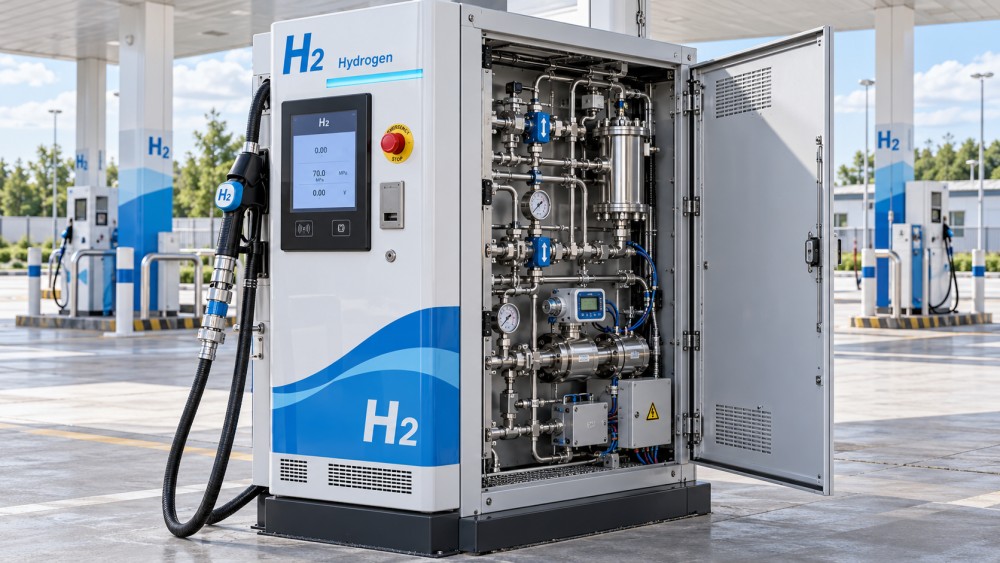
A useful engineering illustration at this point is a dispenser interface schematic showing the supply isolation, metering section, hose, breakaway, nozzle, vent connections, and control links. Its value is in exposing responsibility gaps—not merely showing where components sit.
The hose and vehicle connection deserve separate attention
The hose assembly is repeatedly handled, bent, exposed to weather, and connected by users with varying experience. Review its pressure and temperature suitability, installation geometry, inspection criteria, and replacement instructions. A qualified hose can still be poorly integrated if it rubs against the cabinet or is forced below its permitted bend radius.
The nozzle, receptacle interface, and breakaway arrangement require their own applicable evidence. ISO 17268 addresses gaseous hydrogen land-vehicle refueling connection devices; ISO 19880-5 addresses dispenser hoses and hose assemblies. Verify applicable editions and component coverage rather than assuming the dispenser declaration automatically covers everything attached to it.
Separate fueling performance from hardware conformity
A dispenser can contain suitable pressure components and still deliver an unacceptable fueling sequence. Pressure ramp control, delivered hydrogen temperature, measurement response, and vehicle communication can affect performance. These need evaluation against the intended vehicle category and applicable fueling protocol, not a generic claim of “fast filling.”
Consider a commissioning situation in which the dispenser passes its factory checks, but the installed precooling system cannot maintain the specified delivery conditions during repeated fills. That is an integration problem, not necessarily evidence of a defective dispenser. Acceptance criteria should therefore distinguish dispenser capability from station-supplied conditions.
Likewise, a calibrated mass flow meter does not by itself establish legal authorization to sell hydrogen by mass. Commercial measurement requirements depend on the jurisdiction. Keep metrology approval, measurement accuracy, and dispenser safety conformity as separate entries in the project’s compliance register.
What evidence should quality teams actually accept?
A useful verification package connects each requirement to the equipment being delivered. A report for a similar model may be relevant, but only if the supplier explains why differences in valves, hoses, firmware, pressure rating, or enclosure design do not invalidate the results.
- Configuration baseline: approved drawings, bill of materials, control-software identification, and declared operating limits.
- Design evidence: applicable calculations, risk assessment, component qualifications, and documented interface assumptions.
- Verification records: relevant design/type tests and production checks, with methods, acceptance criteria, results, and equipment identification.
- Functional testing: demonstrated shutdown responses and interlocks, including selected fault conditions rather than normal operation alone.
- Site acceptance evidence: confirmation that installation interfaces, control signals, vent arrangements, and supplied utilities match the approved design.
- Lifecycle documentation: inspection intervals, maintenance procedures, replacement restrictions, and change-control requirements.
Factory acceptance testing should not be stretched into a claim of complete installed-system validation. Some interactions can only be checked after installation. Conversely, site testing should not become an excuse to omit design qualification that ought to have been resolved before shipment.
Turn the standard into an enforceable acceptance basis
For infrastructure benchmarking, G-HEI’s cross-value-chain perspective is useful here: dispensing equipment must be assessed as part of a connected hydrogen system, not as an isolated cabinet. Production quality, storage pressure, cooling capacity, and station controls all influence the conditions under which the dispenser operates. That does not merge their compliance obligations; it makes their interfaces more important.
Before accepting an ISO 19880-2 claim, resolve four points: the exact reference document, the supplied equipment boundary, the evidence supporting conformity, and the checks reserved for site integration. Record deviations explicitly, with an accountable decision-maker and a documented technical basis.
The strongest procurement question is therefore not “Is this dispenser certified?” It is “Which requirements apply to this configuration, how were they verified, and what remains to be demonstrated after installation?” If the supplier cannot answer that clearly, the compliance statement is not yet an adequate acceptance basis.
Related News
- UK Hydrogen Refuelling Developer Element 2 Enters Administration, Business Put Up for SaleNov 09, 2026Element 2 enters administration, putting its UK hydrogen refuelling business up for sale. Explore potential risks for suppliers, buyers and infrastructure projects.
- What does ISO 19880-2 require for hydrogen refueling dispensers?Oct 22, 2026Hydrogen refueling stations ISO 19880: explore ISO 19880-2 dispenser safety, pressure integrity, and verification evidence to assess supplier claims and make confident buying decisions.
- Hydrogen Dispenser Certifications: Which Standards Apply to 70 MPa Retail Stations?Oct 09, 2026Hydrogen dispenser certifications for 70 MPa retail stations: explore ISO 19880, SAE J2601, pressure equipment, hazardous-area and metering requirements.
- What certification is required before an H2 dispenser enters service?Oct 18, 2026H2 dispenser certification: discover the approvals, safety tests, commissioning evidence, and metrology checks needed before a hydrogen dispenser enters service.
Related News
- 00
0000-00
Hydrogen Energy Storage for Data Centers Gets Costly Fast - 00
0000-00
When 99.999% Hydrogen Purity Still Is Not Good Enough - 00
0000-00
When Does a Hydrogen-Ready Gas Turbine Pay Off? - 00
0000-00
Electricity Price Volatility Is Rewriting Hydrogen Cost Models - 00
0000-00
PSA Recovery Rate Drops for Reasons Operators Miss
Dr. Victor Gear
Weekly Insights
Stay ahead with our curated technology reports delivered every Monday.